
Blog
Home / Blog

Lightspeed Payments Review
- 21st Jan, 2026
- | By Linda Mae
- | Reviews
Lightspeed Payments is the in-house payment processing solution developed to work directly within the broader Lightspeed POS ecosystem. Rather than functioning as a standalone merchant processor, it is designed to be an embedded layer that connects transactions, reporting, and settlement closely with the point-of-sale software itself. This approach reflects a wider industry shift toward unified commerce platforms where software and payments are managed under one system rather than through multiple vendors. Lets read more about Lightspeed Payments Review.
In the case of already-existing Lightspeed POS businesses, the payments solution is marketed as a convenience functionality that lessens the need for third-party integrations. The payments are channeled through a single dashboard system where payment information is linked with inventory management tools, sales insights, and accounting functions. Even though the functionality provides a convenient operation solution for businesses, it provides flexibility and price transparency that is of importance for merchants who are price-sensitive.
Lightspeed Payments is usually preferred for use in retail, restaurant, and hospitality-related businesses that focus on the aspects of speed, reliability, and convenience of payment transactions. Lightspeed Payments does not promote itself as a payment solution service that has the capability of catering to the demands of a variety of merchants, including different types of businesses. Here, the importance of an early comprehension of the difference has to be considered, as the use of Lightspeed Payments gets optimal with the broader structure of a payment solution service when used independently.
Table of Contents
ToggleCompany Background and Market Position | Lightspeed Payments Review
Lightspeed started out by developing software that is primarily used by retail and hospitality establishments who wish to manage inventory, consumer, or sales data. However, over time, it began providing payment processing options as an in-house solution, instead of partnering exclusively with a payment processor. Such an approach can be generalized in the sense that there are POS system providers who wish to control the entire payment process, from entry to payoffs.
Market wise, Lightspeed competes in the market as a competitor in the integrated POS market, where it competes with other providers of integrated POS solutions comprising payment systems. However, the brand awareness of Lightspeed is higher in the medium-scale retail chains as well as hospitality establishments than in the micro-merchants or large-scale merchants. Additionally, the payment solution of Lightspeed is generally preferred by merchants who utilize Lightspeed’s POS solutions than by merchants seeking payment solutions beforehand.
From a positioning standpoint, Lightspeed Payments sits between simplicity and structure. It offers fewer customisations than independent merchant accounts but more cohesion than loosely integrated third-party processors. This makes it appealing to operators who value predictable workflows over granular cost optimisation. However, it also means the product may feel restrictive to merchants who are accustomed to negotiating processing rates independently or switching providers frequently. Lightspeed’s market strength lies in offering a controlled, integrated environment rather than maximum flexibility.
How Lightspeed Payments Works
Lightspeed Payments is essentially an integrated payment layer that is a part of Lightspeed POS. After signing up for a merchant service, Lightspeed Payments enables merchants to handle their entire payment transactions with Lightspeed POS, be it at a physical point of sale terminal or via any supported sales method. There is no need for a merchant to handle a payments dashboard.
Onboarding entails business validation, bank account setup, and hardware installation, where necessary. However, because the payment solution is an integral part of the POS, most of this process takes place within the same management interface that merchants are familiar with regarding inventory, employee access, and reporting. While this eases training requirements, it integrates payment experience strongly with Lightspeed’s system design processes.
Once live, transactions appear in real time within the Lightspeed backend, allowing merchants to track sales, refunds, and payment statuses in one place. Settlements are generally batched automatically, with funds deposited into the merchant’s bank account based on predefined payout schedules. While this simplifies daily reconciliation, it also means merchants must rely on Lightspeed’s reporting formats rather than importing data from an external processor. Overall, the system prioritises operational cohesion over modularity.
Supported Businesses and Industry Fit
Lightspeed Payments is usually implemented by retail and hospitality merchants who are already utilizing Lightspeed POS on a day-to-day basis. This encompasses retail operations, restaurants, cafes, and hospitality groups operating multiple locations, taking advantage of uniform systems to manage their operations. The payment system is not industry-agnostic and functions better in a situation wherein the POS functionality by Lightspeed is already optimized to suit their requirements.
Small businesses may benefit from simplicity in having all their POS and payments streamlined with one company, especially if they do not already have accounting or IT support in-house. These businesses will see a benefit in having all payments streamlined in one interface, with reduced concerns for management to focus on from different vendors. Medium-sized businesses will benefit from having all payments visible from different locations in one interface.
However, businesses with highly specialised payment requirements, such as custom billing logic, advanced subscription billing, or niche compliance needs, may find Lightspeed Payments limiting. Similarly, merchants that operate in industries not well supported by Lightspeed POS may struggle to justify adopting the payments product. In practice, Lightspeed Payments is best viewed as an extension of a retail- and hospitality-focused POS system rather than a universal payments platform.
Payment Methods and Supported Transactions
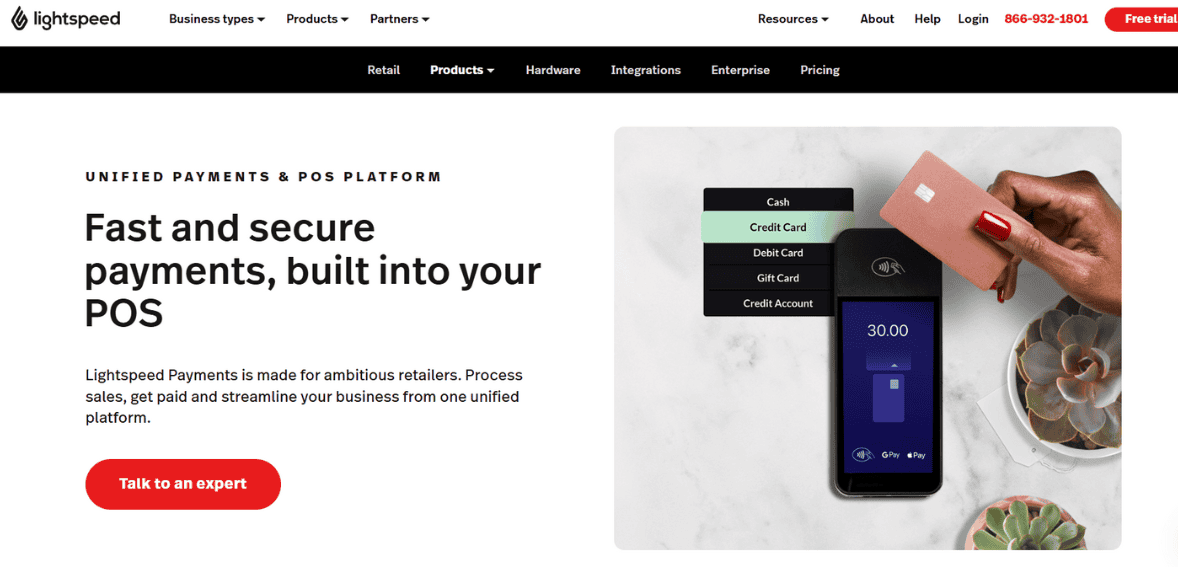
Lightspeed Payments accepts a number of popular payment types that are well-suited to a current retail or hospitality setting. These will generally include the most popular credit and debit card types, contact payments, and mobile payments. The aim is for quick card-present payments, but additional types may become available depending on the Lightspeed plan.
Card payments in-store represent the primary functionality, where the transactions are processed directly from compatible terminals connected to the point of sales. The process is seamless and efficient with the least interruptions at the point of sales. For establishments providing mixed models in the serving of clients, the solution accommodates flexible transaction processes without the need for additional payment solutions.
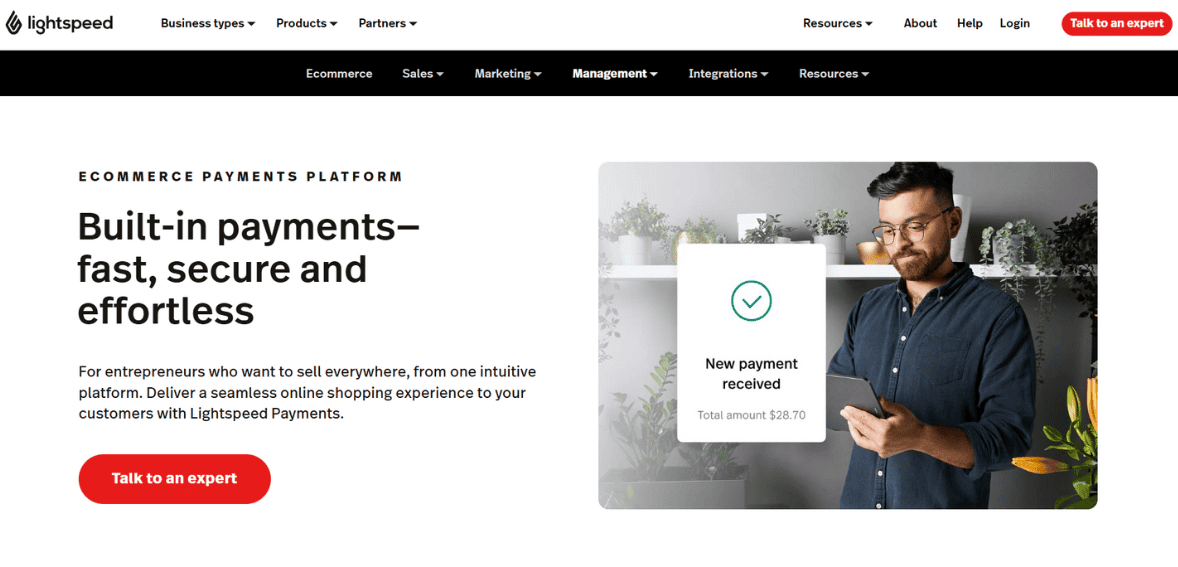
Though Lightspeed Payments is competent when it comes to handling day-to-day payment requirements, it is not marketed as a dedicated omnichannel/e-commerce payment solution by itself. When it comes to handling complicated e-commerce operations, it might be necessary to evaluate payment integration competency across various channels in the Lightspeed environment. When it comes to payment options, it is not an area where there is some novel payment experimentation under way.
Hardware Compatibility and POS Integration
Hardware compatibility is tightly linked to the Lightspeed ecosystem. Payment terminals and card readers supported by Lightspeed Payments are selected to work seamlessly with the POS software, ensuring stable communication and consistent transaction flows. This integration reduces setup issues and technical troubleshooting for merchants but does limit hardware choice.
Because payments and POS are designed as a unified system, transaction details such as totals, tips, and refunds remain synchronised without manual intervention. This is particularly useful in high-volume environments where accuracy and speed are critical. Staff typically interact with a single screen rather than juggling separate payment devices and systems.
The downside of this tightly integrated approach is reduced flexibility. Merchants cannot freely mix and match third-party terminals without losing native integration benefits. For businesses that already own payment hardware or prefer vendor neutrality, this can be a consideration. Lightspeed’s hardware model prioritises reliability and simplicity over open compatibility.
Pricing Structure and Processing Fees
Lightspeed Payments pricing is typically structured around transaction fees rather than publicly listed flat rates. Merchants are often quoted rates based on business type, transaction volume, and region. This approach aligns with many integrated payment systems but can make upfront cost comparisons more difficult.
Processing fees usually cover card transactions and include both interchange and processing margins. Additional costs may apply depending on hardware, plan tiers, or optional features within the Lightspeed ecosystem. While this pricing model offers convenience, it may not always deliver the lowest possible rates for high-volume merchants who actively negotiate payment contracts.
Transparency varies, and businesses considering Lightspeed Payments should review contract terms carefully. The main advantage is predictability and integration rather than aggressive cost optimisation. For merchants who value simplicity over line-item cost control, the pricing structure may feel reasonable. Cost-focused operators may want to evaluate alternatives carefully.
Payout Speed and Fund Settlement
Payout speed is a critical factor for cash flow management, and Lightspeed Payments generally follows standard settlement timelines. Transactions are batched and deposited according to the provider’s payout schedule, often within a few business days depending on region and banking arrangements.
Merchants can monitor payout status directly within the Lightspeed dashboard, which provides visibility into pending and completed settlements. This integrated reporting simplifies reconciliation and reduces the need to cross-check external processor statements. While settlements are reliable, weekend or holiday delays can still occur, as with most payment processors. Businesses that rely on daily cash flow access should factor this into planning. Lightspeed Payments focuses more on consistency than ultra-fast payouts, making it suitable for businesses with predictable revenue cycles.
Reporting, Analytics, and Payment Insights
One of the main strengths of Lightspeed Payments lies in its integration with Lightspeed’s reporting and analytics tools. Payment data flows directly into sales reports, inventory analytics, and performance dashboards, allowing merchants to view financial performance in context rather than isolation.
This unified reporting can be particularly valuable for multi-location businesses tracking trends across stores. Managers can analyse payment volumes, average transaction values, and refund patterns without exporting data between systems. For operational oversight, this level of integration improves clarity. However, merchants accustomed to the advanced analytics offered by standalone processors may find some limitations in customisation. Reports are designed to align with POS workflows rather than provide deep payment-only analysis. The trade-off is ease of use versus analytical depth.
Chargebacks, Refunds, and Dispute Management
Lightspeed Payments handles refunds and chargebacks directly within its platform, allowing merchants to manage disputes without involving external systems. Refunds can be processed from the POS interface, maintaining transaction history consistency across records.
Chargeback notifications and responses are typically managed through the Lightspeed backend, with guidance provided on submission timelines and documentation requirements. While this centralisation simplifies the process, merchants still bear responsibility for responding promptly and accurately. The system provides basic visibility into dispute status, but it does not eliminate the operational effort required to manage chargebacks. As with most processors, prevention through clear policies and accurate transactions remains essential. Lightspeed Payments offers tools rather than guarantees in dispute management.
Security, Compliance, and Fraud Prevention
Security and compliance are foundational to any payment processor, and Lightspeed Payments follows industry-standard practices. This includes PCI compliance, encrypted transactions, and secure handling of cardholder data. By embedding payments within its POS, Lightspeed reduces the risk of data fragmentation across systems.
Fraud monitoring tools are present but generally focused on standard retail risk patterns rather than advanced custom rules. For most small to mid-sized merchants, this level of protection is sufficient. Businesses operating in higher-risk segments may require additional safeguards. Lightspeed’s approach prioritises compliance and baseline security rather than complex fraud customisation. This keeps the system approachable for typical retail operators while meeting regulatory requirements.
Ease of Use and Merchant Experience
Ease of use is one of the most noticeable benefits of Lightspeed Payments. Merchants interact with a single interface for sales, payments, and reporting, reducing training time and daily friction. Staff can process transactions quickly without navigating separate payment terminals or systems. The dashboard layout is designed around operational workflows rather than technical configuration. This makes it accessible for non-technical users but may frustrate advanced users seeking deeper control. Overall usability reflects Lightspeed’s focus on practical business operations. For growing teams, consistency across locations helps standardise processes. The trade-off is reduced flexibility, which some merchants may find limiting over time.
Customer Support and Account Management
Customer support for Lightspeed Payments is typically provided alongside POS support, creating a single point of contact for technical and billing issues. This unified support structure can be helpful when payments and POS functionality overlap. Response quality and speed vary based on region and support plan. Merchants with complex payment issues may find resolution times depend on internal escalation processes rather than immediate fixes. Account management tends to be structured rather than personalised. This works well for standardised operations but may feel impersonal to businesses seeking tailored advice. Support is functional but not heavily consultative.
Pros and Cons of Lightspeed Payments
Lightspeed Payments offers strong integration, unified reporting, and operational simplicity. It reduces vendor complexity and aligns payments tightly with POS workflows, which suits many retail and hospitality businesses. On the downside, limited hardware flexibility, pricing opacity, and constrained customisation may deter more cost-sensitive or technically advanced merchants. The system prioritises cohesion over freedom. Understanding these trade-offs is key to assessing suitability.
Who Should Consider and Who Should Avoid Lightspeed Payments
Businesses already using Lightspeed POS and valuing simplicity are the strongest candidates. Retailers and hospitality operators with stable transaction volumes and predictable workflows often benefit most. Merchants seeking rate negotiation flexibility, advanced payment customisation, or standalone processing independence may prefer alternatives. Lightspeed Payments is best when used as intended, not adapted beyond its design.
Final Verdict
Lightspeed Payments is a practical, integrated solution rather than a highly competitive standalone processor. Its strengths lie in simplicity, consistency, and system cohesion. For businesses aligned with the Lightspeed ecosystem, it can reduce operational friction. For others, its limitations may outweigh its convenience.
FAQs
Is Lightspeed Payments mandatory with Lightspeed POS?
Lightspeed Payments is often encouraged but not always mandatory. Availability of third-party processors varies by plan and region.
How quickly are funds deposited?
Payouts typically occur within a few business days, depending on banking schedules and region.
Is Lightspeed Payments suitable for multi-location businesses?
Yes, particularly for businesses that value unified reporting and standardised workflows across locations.