
Blog
Home / Blog

Velocity Merchant Services Review
- 30th Jun, 2026
- | By Linda Mae
- | Reviews
Velocity Merchant Services, operating variously as VMS and Velocity LLC, is a merchant account provider and payment processor founded in Downers Grove, Illinois. The company was established in approximately 1997 to 1999 by Dema Barakat, who had previously worked as an employee of EVO Merchant Services before registering her independent sales organization and launching Velocity. The company is operated as a husband-and-wife partnership, with Dema Barakat serving as founder and president and Danoush Khairkhah as CEO. Velocity operates as a registered ISO and MSP of Deutsche Bank AG, New York, and functions as a reseller of First Data, now Fiserv, and EVO Payments International processing services. Lets read more about Velocity Merchant Services Review.
Before proceeding, it is necessary to note a naming confusion that affects online research for this company. A separate entity called Velocity Processing operates in the payment processing space and has received strongly positive reviews from its own customers. Velocity Processing and Velocity Merchant Services are different companies with different ownership, different geographic bases, and entirely different reputations in the market. Any merchant conducting due diligence should confirm specifically which entity they are evaluating, since the two names appear in close proximity across payment processing review websites and the quality differential between them is significant.
Table of Contents
ToggleCompany Background and Market Position | Velocity Merchant Services Review
Velocity Merchant Services was founded in the late 1990s in the Chicago metropolitan area, growing out of Dema Barakat’s experience within the EVO Payments International organization before she established her own ISO. The company describes itself as a smaller-sized supplier with a merchant portfolio numbering in the thousands, which accurately positions it as a regional or niche ISO rather than a nationally dominant processor.
The company operates from 3051 Oak Grove Road, 2nd Floor, in Downers Grove, Illinois, and employs approximately 50 individuals across its operations. Revenue has been reported at approximately 22.8 million dollars, reflecting the modest scale appropriate to a company serving several thousand merchants rather than hundreds of thousands. The business model follows the standard ISO structure: VMS manages the merchant relationship, sales, and account management layer, while the actual processing infrastructure is provided by First Data via Fiserv and EVO Payments International.
Dema Barakat’s background within EVO Payments before founding VMS reflects the common career path in the ISO industry, where experienced payment professionals leverage their institutional knowledge and industry relationships to establish independent sales organizations serving regional merchant bases. The personal involvement of the founder in customer complaint resolution, noted in independent reviews where Barakat is described as sometimes getting directly involved with customers regarding complaints and pricing, reflects the owner-operated character of the business and can be a genuine differentiator for merchants who value accountability and personal engagement.
The company serves merchants across groceries, restaurants, retail shops, salons and spas, automotive businesses, and other professional services, with specific EBT processing capability for grocery and convenience store clients distinguishing VMS from processors that focus exclusively on standard card acceptance.
Core Payment Processing Capabilities
Velocity Merchant Services offers a range of services tailored to various business needs including credit and debit card processing, ACH and check payments, mobile and virtual terminals, and POS solutions. This breadth of payment type coverage addresses the standard requirements of the small and medium-sized business customer base that VMS targets.
All major credit and debit card networks are accommodated, including Visa, Mastercard, Discover, and American Express for in-person, online, and card-not-present transaction contexts. EBT and SNAP card processing is a particular type of service that separates VMS, catering to the unique needs of grocery and convenience stores working with government assistance program participants as clients. The current company website highlights the availability of hardware for SNAP terminals, including options such as dual screen SNAP terminals and small chip-EBT certified terminal devices.
Contactless payment acceptance covers NFC-enabled payments made via contactless cards and mobile wallets, such as Apple Pay. The platform addresses the current payment preferences of consumers as well as the increasingly expected ability to complete payment by simply tapping a card on the terminal device. EMV chip card processing allows for the safety of in-person chip-authenticated transactions provided by this option.
ACH and check processing are other services included in payment type processing, extending the list of payments processed through the platform to include direct bank transfer payments and paper check management.
Clover POS Systems and Hardware
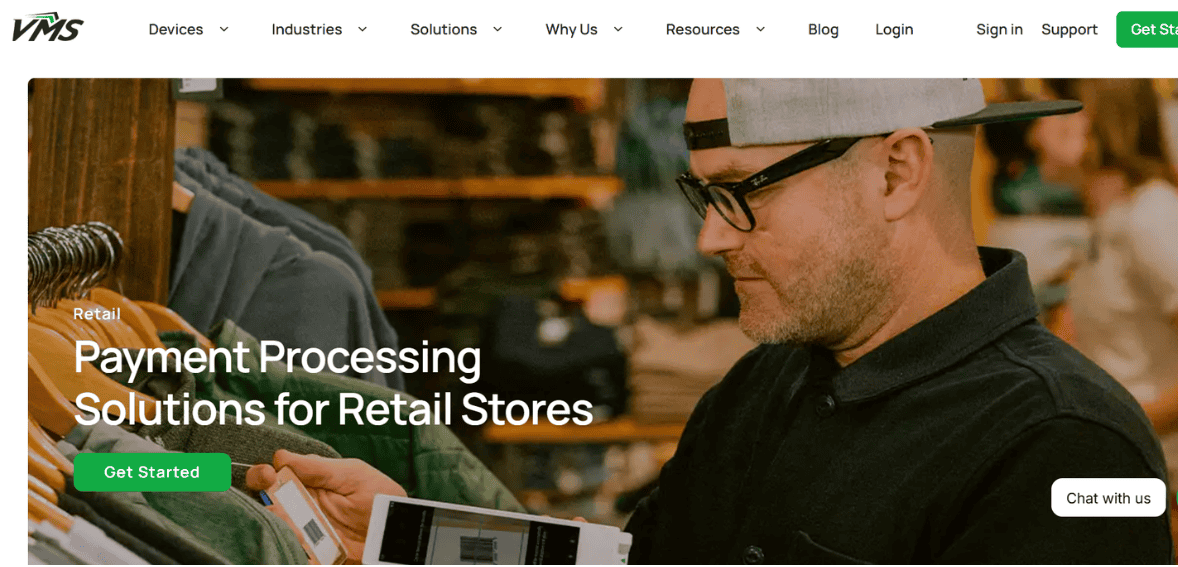
Velocity Merchant offers POS systems through Clover, providing businesses with an integrated solution for managing transactions. The Clover ecosystem is one of the more recognized POS platforms in the US small business market, offering a range of hardware options from compact card readers to full countertop station configurations, supported by an app marketplace that extends functionality into inventory management, staff scheduling, and customer engagement tools.
The hardware lineup through VMS includes Clover Go and iCharge for mobile payment processing. Clover Go can accept both EMV chip and swipe card payments while iCharge only accepts swipe card payments, but both offer reporting, addition of tips, and the ability to email or text receipts. Clover Mobile is also available as a full POS system that can be carried, accepting EMV, contactless, and swiped card payments, which gives field-based merchants a complete POS capability rather than a basic card reader.
The equipment rental history of VMS contains an important and documented concern that merchants should understand before agreeing to any hardware arrangement. Independent reviews note that vendors who signed Velocity equipment rental contracts before October 2014 were generally unaware that they were entering a separate deal with Northern Leasing, which caused considerable confusion. The company subsequently moved equipment leasing to First Data Global Leasing, which has its own documented complaint history around long-term non-cancellable lease agreements. Any merchant being offered a hardware lease rather than a purchase arrangement should request the complete lease terms, calculate the total cost over the full lease period, compare that to the outright purchase price of equivalent hardware, and understand explicitly that a lease agreement is a separate contractual obligation that persists independently of the processing relationship.
Virtual Terminal and eCommerce Capabilities
Virtual terminals from Velocity enable businesses to process payments remotely, ideal for companies that handle orders over the phone or by mail, allowing for secure payment acceptance without the need for physical card readers. The cloud-based virtual terminal and gateway allows merchants to accept payments online through an eCommerce website or by entering card information directly into a payment form.
Recurring billing functionality supports subscription businesses and any merchant that bills customers on a regular schedule, automating the charge process and eliminating the need to manually initiate each billing cycle. VMS syncs with QuickBooks for easy order management, which reduces the manual data entry required to connect payment records with accounting software for merchants who manage their bookkeeping in QuickBooks.
Website design services represent an unusual addition to the VMS offering relative to most payment processors. The company provides complimentary website design and setup services for eCommerce merchants, offering templates and an in-house design capability that helps new online sellers establish their digital presence alongside their payment acceptance capability. The websites are described as formatted for any device and offering multiple features, which addresses the growing importance of mobile-optimized eCommerce for businesses whose customers increasingly shop through smartphones.
The ProPak custom-designed POS system combines payment acceptance with sales reporting and inventory management tools, positioning it as a more complete business management solution than a bare-bones payment terminal. The system is described as enhancing efficiency, lowering operating costs, and supporting business development through sales data capture and analysis.
Zero Fee Processing
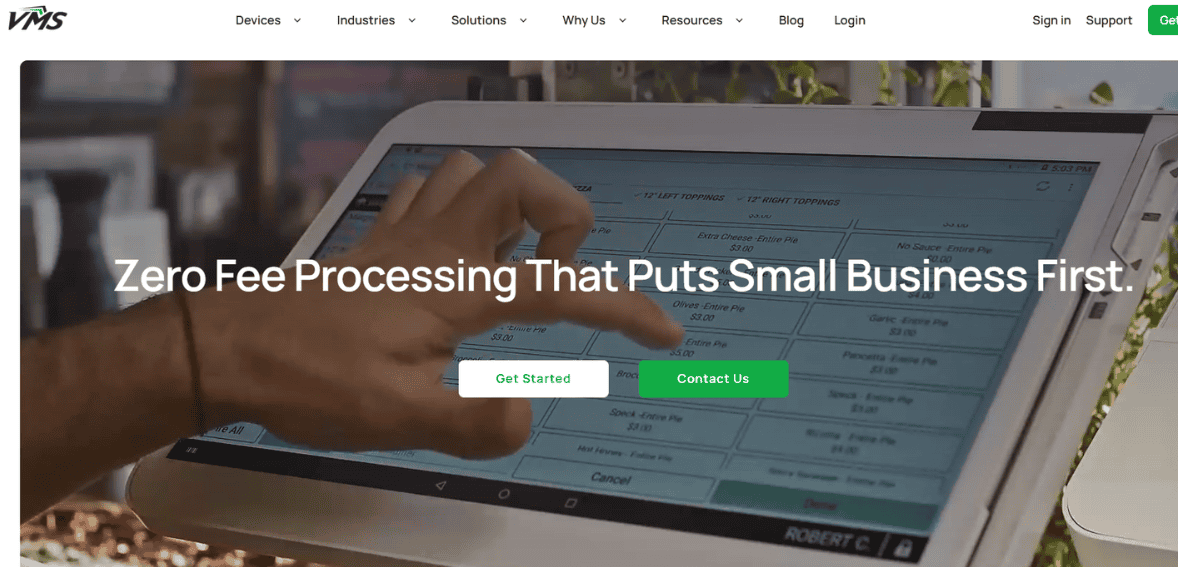
Zero Fee Processing eliminates credit card processing fees for your business, so you keep more of every sale while keeping checkout simple for your customers. This surcharge passthrough model, under which credit card processing fees are passed to the customer rather than absorbed by the merchant, has become a mainstream offering across the merchant services industry following regulatory and card network rule changes that made merchant surcharging legally permissible in most US states.
It is simple in practice; when the client makes payment using a credit card, a small charge amounting to the processing cost is placed on the payment total. The merchant gets the total from the sale transaction without any deduction for the processing cost. The use of debit cards is exempted from this surcharge, and the customer is made aware of the surcharge at the point of transaction.
It offers a commercial advantage to small businesses with tight margins in that the credit card processing cost burden is avoided. There is the need to ensure, however, that the merchant is legally permitted to place the surcharge, which only applies in a few states; this also requires an assessment of how the merchant’s customer base will react to the surcharge in their specific market environment.
Merchant Cash Advance and Business Funding
Velocity Payment Systems offers merchant cash advances, which can help when cash runs short, providing up to 275,000 dollars in 72 hours according to its website. The availability of working capital through the same company that provides payment processing follows a common industry pattern, positioning VMS as a more comprehensive small business financial services provider rather than a narrow payment processing utility.
As with any merchant cash advance product, the effective cost of capital should be carefully evaluated before accepting a cash advance, since the convenience of fast funding and no formal credit check comes at a cost that is typically significantly higher than conventional business financing when expressed as an annualized rate. The repayment mechanism, where a percentage of daily card sales is automatically applied toward the advance balance, means that repayment accelerates during busy periods and slows during slow periods, which can be commercially appropriate for seasonal businesses but makes the total repayment timeline difficult to predict precisely.
Merchants considering a VMS cash advance should request the specific factor rate applicable to their advance, calculate the total cost of capital over the expected repayment period, and compare that against alternative financing options including business lines of credit, equipment financing, and SBA loan programs before treating the convenience of 72-hour funding as a sufficient reason to accept the advance.
Pricing Structure and Transparency Issues
Velocity Merchant Services does not publish its rates or fees on its website. VMS claims to have the lowest fees in the industry and that it provides transparent pricing with no unexpected processing fees, and follows an interchange-plus pricing model. The claim of transparent pricing is worth examining carefully in the context of the documented complaint record, which suggests a significant gap between this stated commitment and the experience of multiple merchants who felt they were not fully informed about the fee structure at the time of signup.
As per documented information from independent sources, the standard contract terms of VMS include a three-year agreement with a one-year automatic renewal, an early termination fee of 395 dollars, and an annual PCI compliance fee of 120 dollars. Transaction rates vary between 1% and 4.99% depending on whether the transaction was done by swiping, keying in, or virtual terminal transactions; it is quite a broad spectrum because of the variability brought about by the reseller discretion pricing model that is common among ISOs. The monthly minimum fee also applies to some accounts.
VMS will not allow you to cancel your services without paying a fee of between 495 and 1,500 dollars. The company does not tell you anything about this when you sign up for the application. You learn it when you attempt to terminate their services. As per the documented merchant experience, the fact that the cancellation fee varies from 495 to 1,500 dollars and yet is way more than the ETF of 395 dollars indicates that liquidated damages clauses in contracts can result in exit costs that are higher than the stated ETF.
Contract Terms and the Liquidated Damages Concern
The contract terms at Velocity Merchant Services contain a provision that has generated specific and repeated merchant complaints: the liquidated damages clause that can impose exit costs well above the nominal early termination fee. This payment processor offers a three-year contract with one-year auto-renewal through EVO Payments. A 395 dollar early termination fee applies. In addition, the contract may require liquidated damages, which require repayment of the company’s losses in the event of early cancellation.
The practical implication of a liquidated damages provision is that the actual cost of exiting the contract early is not capped at the stated 395 dollar ETF but can be calculated as a function of the company’s claimed financial losses from the premature termination, which can result in substantially higher charges. The documented merchant feedback citing cancellation fees in the 495 to 1,500 dollar range is consistent with this liquidated damages calculation producing exit costs above the nominal ETF figure.
The three-year initial term with one-year automatic renewal means that merchants who miss the cancellation window are committed to an additional year of service, and the combination of the renewal trap with the liquidated damages exit cost creates a financial environment where remaining in the relationship even when dissatisfied is economically preferable to exiting. This structural dynamic reduces the accountability incentive for the company to resolve service quality issues proactively.
Merchants considering VMS should request the complete written agreement before signing, specifically ask whether the contract contains a liquidated damages provision and how that provision is calculated, confirm the exact early termination fee amount, identify the cancellation notice requirement and the specific method by which notice must be submitted, and calendar the cancellation deadline before signing rather than discovering it when they want to leave.
Customer Support Patterns
The customer support picture at Velocity Merchant Services presents a significant contrast between the experiences of satisfied and dissatisfied merchants. Positive reviews, including those attributed to personal outreach from the CEO and founder, describe responsive, helpful representatives and effective issue resolution. There are 13 positive reviews that argue Velocity Merchant Services has been extremely helpful with resolving issues and has excellent customer service.
The negative feedback is more detailed and more recent. Poor customer service: sold us on a new credit card and EBT reader, unable to use it for the past two weeks, lost much of our business; they don’t return our calls, don’t fix our problems. A second review in early 2026 also mentioned poor customer service, saying that the service was rude and terrible, mentioning one of the representatives by name. A merchant said that he was told by the customer service that there would be just a 35-dollar fee to cancel his account before he found out that he had actually been charged 500 dollars.
Persistent cold calling is another problem that concerns not only the merchants who signed up with VMS, but all merchants. Based on 26 Google reviews, the main problem reported is the cold calling: the VMS employees continued calling them even though they made it clear that they didn’t want their services. Unsolicited and persistent sales calls after having explicitly requested to stop calling are part of the sales practices that have attracted regulatory attention in the industry.
Strengths, Limitations, and Who It Is Best For
Velocity Merchant Services offers genuine product breadth for a small regional ISO, including EBT and SNAP processing for grocery and convenience stores, Clover POS integration, mobile payment solutions through Clover Go and iCharge, recurring billing, QuickBooks integration, complimentary website design services for eCommerce merchants, Zero Fee Processing surcharge capability, and working capital through merchant cash advances. The personal involvement of the founder in customer issue resolution and the owner-operated character of the business can provide a degree of accountability and responsiveness that larger, more impersonal processors cannot match for the right merchant relationship.
The limitations are significant and consistently documented. The contract structure, featuring a three-year term, liquidated damages provisions that can produce exit costs well above the nominal ETF, four-year equipment lease terms through First Data Global Leasing, and automatic annual renewal, creates substantial financial risk for merchants who sign without fully understanding the exit implications. The documented complaint patterns around deceptive sales practices, undisclosed cancellation fees, post-cancellation billing disputes, rude customer service, and persistent unsolicited calling reflect systemic concerns rather than isolated incidents. The pricing opacity and the wide rate range of 1% to 4.99% require careful independent verification before accepting any quoted rate as final and complete.
The merchants best positioned to consider Velocity Merchant Services are small businesses in the Chicago metropolitan area that specifically need EBT and SNAP processing alongside standard card acceptance, those who value a local owner-operated relationship with a small ISO, and merchants who conduct thorough contract review and negotiate explicitly on cancellation terms before signing. Merchants who prioritize pricing transparency, contract flexibility, and straightforward exit terms are better served by providers with more favorable standard contract structures.
FAQs
Q1. Is Velocity Merchant Services the same as Velocity Processing, and how can I tell the difference?
No, these are completely separate companies with no relationship to each other. Velocity Merchant Services, also operating as Velocity LLC, is based in Downers Grove, Illinois, was founded by Dema Barakat, operates as a registered ISO and MSP of Deutsche Bank AG, and resells First Data and EVO Payments International processing services. It has accumulated a documented pattern of complaints around deceptive sales practices and contract terms.
Velocity Processing is a different company entirely, operating from a different location with different ownership and management, and has received strongly positive reviews from its customers for competitive pricing and professional service. When researching either company, verify the headquarters location, the founder and leadership, the ISO registration details, and the specific website domain to confirm you are evaluating the correct entity. The payment processing review websites that cover both companies in close proximity can make this confusion easy to fall into if you are reading quickly rather than verifying the company details for each specific review.
Q2. What is the true cost of exiting a Velocity Merchant Services contract, and why do some merchants report paying far more than the stated 395 dollar ETF?
The 395 dollar early termination fee listed in available contract documentation is the nominal ETF, but the contract also contains a liquidated damages provision that can produce exit costs substantially above this figure. Liquidated damages clauses require the departing merchant to repay the company’s calculated financial losses from the premature contract termination, which is a different and potentially much larger figure than a flat cancellation fee.
The merchant feedback citing cancellation costs in the 495 to 1,500 dollar range is consistent with liquidated damages calculations producing higher charges than the stated ETF in certain circumstances. In addition, equipment rental agreements with First Data Global Leasing are separate four-year contracts that continue independently of the processing relationship, meaning a merchant who exits the processing agreement early still owes the remaining lease payments on rented equipment.
The combination of the ETF, potential liquidated damages, and remaining lease obligations can create total exit costs that merchants did not anticipate when signing. Before signing any VMS agreement, request explicit written confirmation of the maximum possible exit cost under all applicable provisions, including both the ETF and the liquidated damages calculation methodology, so that you enter the relationship with a clear and complete understanding of the financial consequences of early termination.
Q3. Does Velocity Merchant Services genuinely offer interchange-plus pricing, and how should merchants verify they are actually receiving it?
Velocity Merchant Services claims to follow an interchange-plus pricing model, which is the more transparent and generally merchant-favorable pricing structure compared to tiered or bundled pricing. However, the documented complaint pattern of merchants discovering fees significantly higher than what was described during the sales process suggests that the pricing structure applied to actual accounts does not always reflect the interchange-plus model in a straightforward or easily verifiable way. To verify that you are genuinely receiving interchange-plus pricing, request a written statement template that shows how each transaction will be reflected on your monthly bill, specifically looking for line items that show the actual interchange cost as a separate figure from the processor’s fixed markup.
On a genuine interchange-plus statement, you should see the actual card network interchange rate applied to each transaction plus a consistent fixed markup, rather than broad tier categories that obscure the underlying interchange cost. Compare your first three months of actual statements against this template and raise any discrepancies in writing immediately. If the statement does not clearly itemize interchange costs separately from the processor markup, or if the effective rates across your actual processing volume are significantly above what interchange-plus benchmarks for your card mix would suggest, you may not be receiving the pricing model that was represented to you during the sales process.