
Blog
Home / Blog

Mollie Review
- 03rd Jul, 2026
- | By Linda Mae
- | Reviews
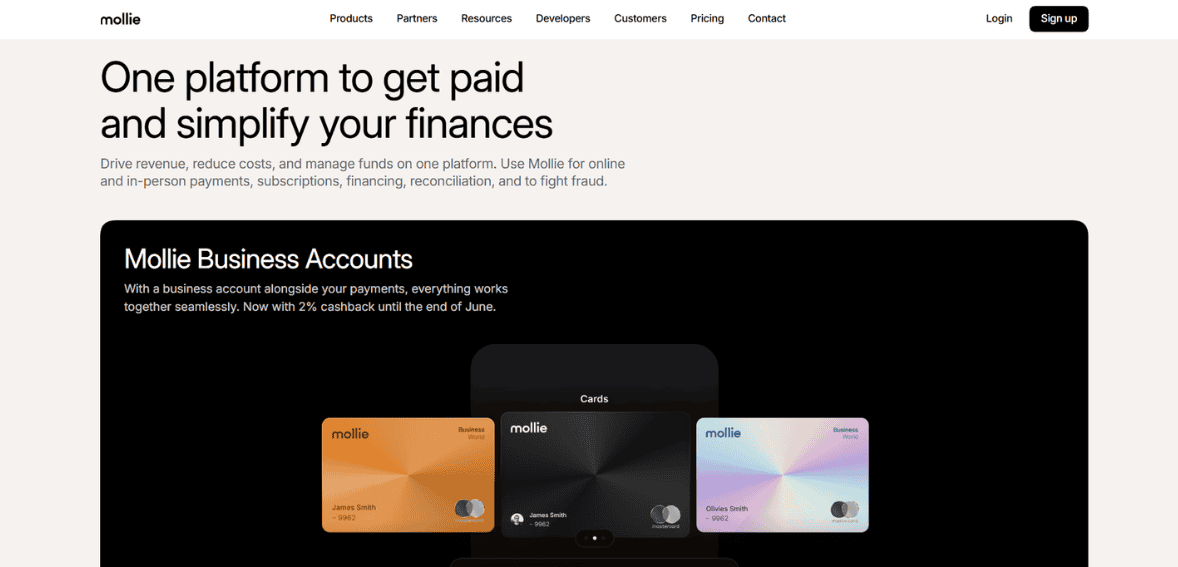
Mollie is a Dutch payment service provider that has grown from a focused iDEAL integration tool into one of Europe’s most valuable fintech companies, serving over 250,000 businesses across the continent with a platform that deliberately prioritizes simplicity, transparency, and European payment method depth over global breadth or enterprise complexity. Founded in 2004 in Amsterdam by Adriaan Mol, Mollie has grown to serve over 200,000 businesses across Europe, processing billions of euros annually. The company has raised over 800 million dollars in funding and was valued at 6.5 billion dollars, making it one of Europe’s most valuable fintech companies.
The company’s positioning is unusually clear and honest for a payments provider. Mollie is not trying to compete with Stripe on global coverage or with Adyen on enterprise complexity. Its stated focus is making European payments simple, transparent, and reliable for small and medium-sized businesses, and the platform’s design choices consistently reflect that priority. No monthly fees, no setup costs, no minimum volume commitments, next-business-day payouts as standard, and a published per-transaction rate for every supported payment method are the commercial commitments that have driven adoption across the Benelux, DACH, French, Italian, Spanish, and British markets.
Mollie differentiates through SMB accessibility rather than enterprise scale or developer sophistication. Where Stripe targets technical teams and Adyen serves enterprise merchants, Mollie positions as the middle ground: professional payment infrastructure without enterprise complexity. This positioning is both commercially sensible and genuinely useful for the 94% of Mollie reviewers who are small businesses, a figure that confirms the platform has found and retained its intended audience.
Table of Contents
ToggleCompany Background and Market Position
Adriaan Mol founded Mollie in Amsterdam in 2004, initially as a focused tool for Dutch merchants to accept iDEAL payments, which were and remain the dominant online payment method in the Netherlands, accounting for over 70% of Dutch online transactions. The decision to start with a single, deeply important local payment method rather than attempting broad coverage from day one reflected a deliberate product philosophy that has characterized Mollie throughout its history.
From that focused beginning, Mollie expanded to cover every significant European local payment method, all accessible through a single, clean API. Today Mollie serves over 200,000 businesses across Europe. The expansion from iDEAL specialist to pan-European payment platform was achieved without the foreign acquisitions or complex corporate restructuring that have characterized many competitors, reflecting organic product development rather than portfolio assembly through M&A.
Mollie is regulated by De Nederlandsche Bank as a payment institution with continuous regulatory oversight, capital requirements, and operational standards. As a Dutch firm based in Amsterdam, it falls fully under the purview of EU regulations. Regulatory underpinning as a part of the European regulatory framework, not as a foreign company trying to gain entry into the European market, gives a sense of structure in terms of data handling, regulatory compliance, and applicability of EU consumer regulations to Mollie.
The unique combination of high growth rates and profitability makes Mollie stand out against many other fintech companies focused primarily on growth and not profitability. The involvement of Blackstone Growth at the forefront gives an indication that the business model has been institutionalized. High growth rate combined with profitability indicates sustainable unit economics and not growth driven by marketing expenditures, which makes the business less risky for investors/customers who need to evaluate whether the company is a viable long-term partner. For a firm considering a payment platform partner from a sustainability perspective, Mollie’s profitability in addition to its high growth rate is a unique advantage over loss-making competitors who depend on investment money to continue their operations.
Core Payment Processing Capabilities
Mollie processes credit and debit card transactions across all major networks including Visa, Mastercard, American Express, and Cartes Bancaires, the French card network with significant domestic penetration in France. Digital wallet acceptance covers Apple Pay and Google Pay at the same rate as card processing. The core infrastructure provides API integration for custom implementations alongside mobile-optimized checkout flows.
The transaction pricing model is genuinely transparent and publicly published, which is a meaningful differentiator from processors that require sales engagement to obtain even basic rate information. Card payments start from 0.25 euros plus 1.8% per transaction for European cards. Non-European card transactions carry a higher rate of 2.8% to reflect the higher interchange costs associated with non-EEA issued cards. This explicit distinction between European and non-European card pricing is honest and practically useful for merchants evaluating their cost exposure based on their customer geography.
Mollie offers next business day payouts as standard. If a customer pays on Monday, the funds are typically in the merchant’s bank account on Tuesday. This is faster than many competitors that operate on a T+2 or T+7 schedule. Weekly or monthly payout schedules can also be configured. The speed and predictability of settlement timing matters considerably for small business cash flow management, and next-business-day standard settlement without a premium tier requirement is a genuine operational advantage.
Strong Customer Authentication under PSD2 is handled by Mollie’s infrastructure, with dynamic 3D Secure applied where required by regulation without imposing friction on transactions that do not require strong authentication. The automatic risk-based application of SCA, rather than applying it universally, improves checkout conversion by avoiding unnecessary authentication steps for low-risk transactions while maintaining regulatory compliance for those that require it.
European Local Payment Methods: The Core Differentiator
The breadth and depth of European local payment method support is Mollie’s clearest competitive advantage over global processors for European merchants, and it deserves detailed examination because the conversion implications of offering locally preferred payment methods versus defaulting to international card acceptance are commercially significant.
iDEAL, the most popular payment method in the Netherlands, costs a flat 0.29 euros per transaction with no percentage fee. For a Dutch merchant processing a 50-euro transaction, the Mollie iDEAL cost of 0.29 euros compares favorably to the card processing cost of approximately 1.15 euros at the standard European card rate. At scale, this cost differential across a high-iDEAL transaction mix is financially material. More importantly, offering iDEAL rather than defaulting to card-only checkout prevents checkout abandonment from Dutch customers who prefer bank transfer payment.
With Bancontact, which is the most used card and bank payment method in Belgium, merchants get charged 0.39 euros per transaction through Mollie. On the other hand, Stripe charges 1.4% + 0.25 euros for the Bancontact payment method. With Bancontact usage being very high for Belgian merchants, this results in a substantial cost saving. SEPA Direct Debit allows for bank debit from eurozone member states at the cost of 0.25 euros + 0.4%-0.9%, depending on the transaction type, and is ideal for recurring payments for subscription or membership businesses that operate in the EU market.
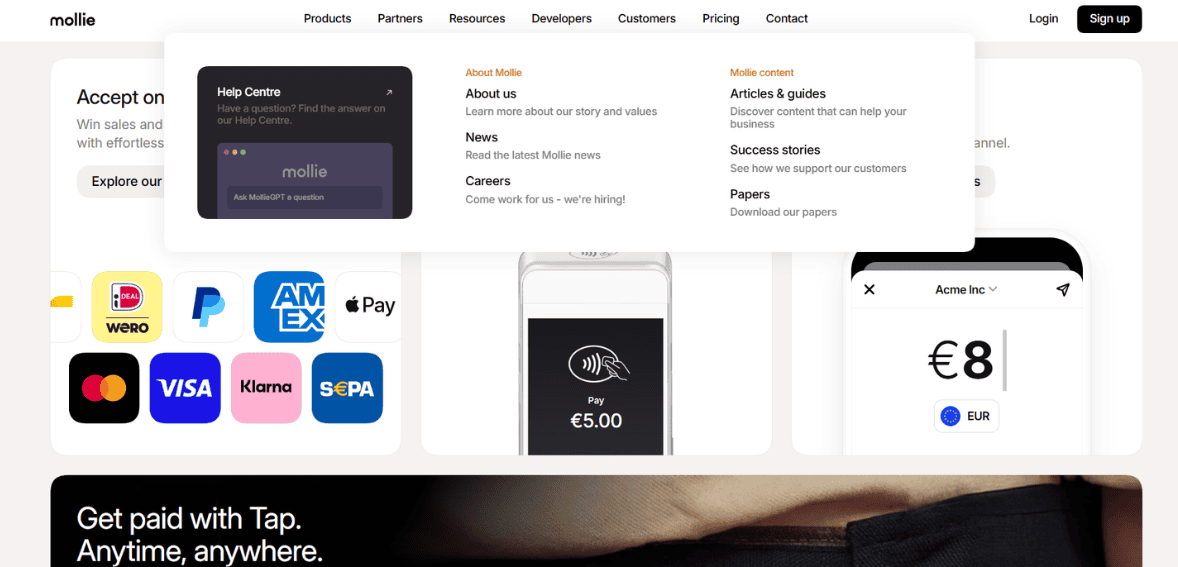
Other European payment methods that Mollie provides support for include SOFORT in Germany and Austria, Klarna (Buy Now Pay Later) in several countries in Europe, Twint in Switzerland, Przelewy24 in Poland, EPS in Austria, and Giropay in Germany, among many others for different national markets. Altogether, there are more than 35 payment methods on the Mollie platform.
Pricing Structure and Transparency
Mollie charges per transaction with no monthly fees. All pricing is publicly listed. This publishing of rates is genuinely distinctive in the payment processing industry, where opacity around pricing is the norm and merchants are typically required to engage in sales conversations to obtain even approximate cost information.
The absence of monthly fees means the total cost of ownership is often lower for businesses with variable or seasonal transaction volumes. Mollie’s effective rate for a typical European debit card transaction is around 0.25 euros plus 0.2%, which is significantly cheaper than flat-rate processors like Stripe which charges 1.5% plus 0.25 euros for European cards. This cost advantage reflects EU interchange fee regulation, which caps consumer debit card interchange at 0.2% and consumer credit card interchange at 0.3%, meaning that processors passing through actual interchange costs at these regulated rates are structurally more cost-effective than flat-rate processors that bundle higher margins into a simplified rate.
A Pro plan at 20 euros per month offers lower transaction rates alongside one hardware terminal license for merchants whose transaction volume makes the monthly fee worthwhile relative to the per-transaction savings. The pay-as-you-go free tier with no monthly commitment suits businesses with lower or variable volumes who want professional payment infrastructure without fixed costs during periods of reduced activity.
Mollie also provides an enterprise pricing option for high-transaction volume merchants that comes with a separate account management and priority customer support services. The need for this enterprise pricing option arises from the fact that although the transparent pricing provided by the service might be highly competitive, it does not fully maximize the interests of the biggest merchants which could benefit more from customized rate negotiation.
It has been noted in some reviews on Capterra that the pricing is sometimes confusing in particular market conditions where one needs to know the difference between domestic and non-domestic card categories. The pricing model in Italy seemed to be a little confusing and even expensive because of the confusion about domestic cards and various other categories of fees.
Mollie Connect: Marketplace and Platform Payments
Mollie Connect is a marketplace and platform payment solution that allows onboarding of sub-merchants, processing payments on their behalf, and splitting funds between multiple parties. It is comparable to Stripe Connect and is suitable for European marketplaces, SaaS platforms, and crowdfunding sites that need to facilitate payments between buyers and sellers.
The OAuth-based onboarding flow within Mollie Connect allows marketplace operators to bring sellers onto the platform while ensuring KYC verification is completed for each seller as part of the onboarding process, which satisfies the regulatory requirements for marketplace payment flows under European financial services law. The split payment capability automatically distributes transaction funds between the seller, the marketplace commission, and any other designated parties at the point of settlement, eliminating the manual fund distribution step that marketplace operators would otherwise need to manage.
For European marketplace businesses specifically, the value of Mollie Connect operating entirely within the EU regulatory framework, rather than requiring reliance on a foreign-regulated payment infrastructure, provides both compliance simplicity and the full coverage of European local payment methods for marketplace buyers and sellers across the continent.
The depth of Mollie Connect’s features is more limited than Stripe Connect for complex marketplace architectures, and platform businesses with sophisticated routing requirements, multi-currency sub-merchant settlement, or highly customized commission structures may find that the feature set requires supplementation or that the enterprise tier is necessary to access the depth they need.
Mollie Terminal: In-Person Payments
Mollie Terminal extends the platform’s payment acceptance to physical environments, providing card terminals that connect to the same Mollie dashboard used for online payments. Transactions from both channels appear in a unified overview, simplifying reconciliation for businesses that operate both online and offline.
One of the operational benefits of using Mollie as a payment solution for the combination of online and in-person transactions is a unified dashboard. Since there is no need to reconcile transactions from different payment systems for different transaction types, merchants who have both channels get a real operational benefit from this payment system. Nowadays, unification of in-person and online transactions data becomes a requirement for the payment platforms; however, the level of their unity changes among providers, and integration by Mollie is praised for its practical simplicity.
With the Pro plan, which costs 20 euros per month, one terminal license is included, with additional terminals charged at the same price per month per terminal. In cases when the business is mostly conducted online and only occasionally requires in-person payments, having an opportunity to use a terminal via the same service becomes very useful. All of the latest in-person payment options, such as contactless tap-to-pay, chip cards, and QR codes, are available through the terminal.
Developer Tools and Integration Ecosystem
Mollie delivers payment acceptance across multiple channels through a unified platform supporting over 35 payment methods, including digital wallets, credit cards, and European local payment options. The core infrastructure provides API integration for custom implementations alongside mobile-optimized checkout flows.
The Mollie API is well-documented for a payment provider of its size and profile, with integration guides, sample code, and a test environment that allows developers to validate their implementation before going live with real transactions. The test environment specifically receives positive mentions from users, with one Capterra reviewer noting that the setup was fairly easy and the test environment worked well.
Ecommerce platform integrations cover the major platforms relevant to European merchants, with pre-built integrations for WooCommerce, Magento, Shopify, PrestaShop, BigCommerce, and others reducing the development effort of connecting an existing online store to the Mollie payment infrastructure. For merchants running on these platforms, the integration path involves installing a Mollie plugin rather than building a custom API integration from scratch.
The API and developer documentation, while functional, are not as comprehensive or polished as Stripe’s. Fewer SDKs, fewer code examples, and a smaller developer community mean more self-reliance is needed. This honest assessment from independent reviewers positions Mollie appropriately for developers evaluating it: capable and accessible for standard integration requirements, but less supported by the ecosystem of community resources, third-party libraries, and documented edge case solutions that Stripe’s much larger developer community has built over years.
Recurring Payments and Subscription Billing
Recurring Payments automates subscription billing across multiple payment methods for SaaS and membership businesses. The subscription billing capability covers both card-based recurring charges and SEPA Direct Debit mandates, giving European subscription businesses the choice between card-stored subscription billing and the bank account debit approach that many European B2B and utility customers prefer.
SEPA Direct Debit subscriptions are particularly relevant for European SaaS businesses and membership organizations whose customers are more comfortable with bank account debit for recurring services than with stored card billing. The SEPA mandate framework, which provides customers with clear authorization and dispute rights under EU banking regulation, is the appropriate mechanism for recurring payments in many European business contexts and Mollie’s support for it within the subscription billing flow addresses a genuinely European business requirement.
The subscription billing functionality within standard Mollie payment links is noted as being limited to one-time transactions, with recurring billing requiring either the Subscriptions API or a third-party billing layer on top. Plain Mollie payment links are one-time only. For recurring, use the API or a billing platform like PayRequest’s Subscriptions feature. Merchants who want recurring billing should verify the specific implementation approach required for their use case before assuming that payment link functionality will cover recurring collection automatically.
Customer Support and Onboarding Experience
Mollie’s five-minute onboarding process is one of the platform’s most frequently cited practical advantages, and the speed of account activation is consistent with the no-monthly-fee, no-minimum-commitment positioning. Businesses can create an account, complete verification, and begin accepting payments in a short timeframe without the extended underwriting process that characterizes some payment providers.
User feedback on customer support is mixed and consistent across multiple review platforms. Positive experiences describe clear guidance, good follow-up, and helpful responses. Negative experiences describe slow response times, customer support that is not the best, with slow responses to questions regarding payments, and occasional frustration during onboarding or account issue resolution.
Some users report good contact with customer service while others describe poor communication during onboarding or account issues. This variability in support quality is a recurring theme across Mollie reviews on both Capterra and Software Advice, suggesting that the support experience is inconsistent enough to be a legitimate consideration rather than a minor edge case.
For straightforward integration and operational questions, the knowledge base, documentation, and community resources provide reasonable self-service capability. For issues requiring account-level intervention, the support response quality and speed vary in ways that merchants dependent on timely issue resolution should factor into their evaluation.
Strengths, Limitations, and Who It Is Best For
Mollie is a genuinely excellent payment platform for its intended audience: European small and medium-sized businesses that want simple, transparent, professionally capable payment infrastructure with deep local payment method support and no monthly fee commitment. For European SMBs, Mollie typically offers better value and a simpler integration experience than Stripe, particularly for businesses with a high proportion of European local payment method transactions where Mollie’s per-method flat rates are significantly lower than Stripe’s percentage-based rates for the same methods. The profitability alongside growth, the EU regulatory grounding, the published pricing, next-business-day settlement, and the five-minute onboarding all reflect a platform that has optimized for accessibility and operational simplicity rather than feature maximalism.
The limitations are equally real and deserve honest acknowledgment. Mollie requires a European business entity to open an account. The platform is designed for merchants operating in European markets. Businesses outside Europe should consider Stripe, Adyen, or Checkout.com instead. The geographic constraint is not a flaw in the context of the platform’s deliberate positioning, but it is a hard eligibility requirement that non-European businesses need to understand upfront. Currency support at approximately 20 currencies is more limited than global alternatives. Enterprise-grade features including advanced analytics, custom routing, and sophisticated marketplace architectures are less developed than what Checkout.com or Adyen offer at that tier. Developer documentation and community resources, while functional, fall short of Stripe’s ecosystem depth. Customer support quality varies.
The businesses best positioned to benefit from Mollie are European eCommerce retailers who want to maximize conversion through local payment method availability in their target markets, subscription and SaaS businesses operating in European markets that need SEPA Direct Debit alongside card billing for their recurring payment flows, marketplace and platform businesses operating within the EU regulatory framework that need sub-merchant onboarding and split payment capability, hospitality and food service businesses in Europe that want unified online and in-person payment management through a single dashboard, and any European SMB that wants professional payment infrastructure with transparent per-transaction pricing and no monthly commitment.
FAQs
Q1. Can a non-European business use Mollie for payment processing?
No. Mollie requires a European business entity to open an account and is designed for merchants operating in European markets. This is a hard eligibility requirement rather than a preference. Businesses incorporated and operating outside Europe cannot open Mollie accounts. The platform’s acquiring relationships, regulatory framework, and operational infrastructure are built around the European payment landscape, and its payment method coverage reflects European consumer preferences rather than global breadth.
Non-European businesses seeking payment processing should evaluate Stripe, Adyen, Checkout.com, or other providers with global merchant eligibility. European businesses with significant non-European customer bases can use Mollie for their European payment method coverage while evaluating whether to supplement with a global provider for non-European card acceptance, which independent reviewers have noted is a practical approach for businesses with mixed European and global customer geographies.
Q2. How does Mollie’s pricing compare to Stripe for a European business with a mix of card and local payment method transactions?
For businesses with a significant proportion of European local payment method transactions, Mollie is typically meaningfully less expensive than Stripe on a per-transaction basis. Bancontact through Mollie costs 0.39 euros flat compared to Stripe’s 1.4% plus 0.25 euros for the same method. On a 50-euro Bancontact transaction, Mollie charges 0.39 euros while Stripe charges approximately 0.95 euros, a differential of approximately 0.56 euros per transaction that compounds at scale for Belgian merchants with high Bancontact volume.
For iDEAL, Mollie’s flat 0.29 euros per transaction compares favorably to Stripe’s iDEAL pricing. For standard European card transactions, Mollie’s 0.25 euros plus 1.8% compares to Stripe’s 1.5% plus 0.25 euros for European cards, with the comparison depending on transaction size. The break-even point where Mollie and Stripe cost the same for a European card transaction is approximately 14 euros, with Mollie being cheaper above that amount. For businesses processing a mix of high-value card transactions and local payment methods, the all-in cost comparison almost universally favors Mollie for European-focused merchant volumes.
Q3. What should businesses know about Mollie’s customer support before committing to it as their payment infrastructure?
User feedback on Mollie’s customer support is mixed, with some users describing clear guidance and good follow-up while others report slow responses and poor communication during onboarding or account issues. The variability in support experience is consistent enough across multiple independent review platforms to represent a genuine operational consideration rather than a minority complaint. For businesses whose payment operations are mission-critical and who need reliable, fast support when issues arise, this inconsistency is worth factoring into the evaluation.
Practical steps to manage support risk include thoroughly testing the integration in the sandbox environment before going live to minimize post-launch issues, building familiarity with the documentation and knowledge base so that common questions can be self-resolved, and considering the Pro plan if its enterprise pricing tier access provides dedicated account management for your volume. Businesses that have evaluated Mollie and prioritize support depth alongside European local payment method coverage may also want to compare TouchBizPay, Checkout.com, and other European providers that offer stronger enterprise support structures.