
Blog
Home / Blog

Airwallex Review
- 22nd Jul, 2026
- | By Linda Mae
- | Reviews
Airwallex is a global financial infrastructure platform founded in Melbourne, Australia in 2015 by Jack Zhang, Lucy Liu, Max Li, and Ki-Lok Wong, a group of founders with backgrounds spanning financial technology, engineering, and international business. Now headquartered in Singapore and San Francisco with significant operations in Hong Kong, the UK, and major Asia-Pacific markets, Airwallex has grown into one of the most funded fintech companies of its generation, raising over 900 million dollars in total funding and achieving a valuation in the range of 5.6 billion dollars at its last major funding round, backed by investors including Tencent, Sequoia Capital China, DST Global, and Lone Pine Capital. Lets read more about Airwallex Review.
The basic premise behind the platform was simple but commercially astute: international money transfer was too expensive, slow, and difficult for corporations, all due to the fact that international payment was conducted via correspondent bank relationships, an old-fashioned structure which only worked well in the past, when international business dealings were carried out not by digital companies but large businesses. Airwallex sought to solve the problem by developing its own connections to domestic payment rails in key markets and avoiding the use of SWIFT for the vast majority of international payments settlements.
By 2026, Airwallex is processing many international payments per year and provides its service to businesses from early stage start-ups paying their contractors abroad for the first time to medium-sized companies handling complex multi-currency treasury transactions. The platform is known for its superior foreign exchange rates, the quality of the multi-currency account structure, and its developing suite of embedded financial services.
Table of Contents
ToggleCompany Background and Market Position | Airwallex Review
Airwallex has moved its official headquarters from Melbourne to Singapore, though it maintains major offices in Melbourne, Hong Kong, London, San Francisco, Shanghai, Shenzhen, and Beijing. The Chinese market and Chinese-origin merchant base have been particularly important to Airwallex’s growth, and the company is described as one of the most popular cross-border payment tools for Chinese merchants going global and for foreign trade companies managing payments between China and overseas markets.
The investor base reflects this dual East-West positioning. Tencent, one of China’s largest technology conglomerates, is a significant backer. Sequoia Capital China, DST Global, and other Asia-Pacific-focused funds join Western institutional investors including Lone Pine Capital in the cap table. This investor geography is both a strength, providing deep network access and distribution in Asian markets, and a consideration for businesses whose suppliers, customers, or regulators have sensitivities around Chinese technology investment in payment infrastructure.
Airwallex has a range of financial services licenses across many jurisdictions, such as Singapore, Australia, the UK, Hong Kong, the US, Canada, and others, which allows it to function as a licensed payment institution in key jurisdictions without using just one jurisdictional license to gain passporting to other jurisdictions. This approach is an important risk management step that makes Airwallex different from the platforms which have just one license and passport through that license to other markets or via partnerships with local players.
Airwallex is a platform designed for small businesses that work with cross-border payments, and 73% of its reviewers are from small businesses and 27% from enterprises expanding global finance operations, according to Capterra. Such reviewer distribution proves that Airwallex has indeed become accessible to small business users who are able to work with it even without the presence of the separate finance department in an organization.
Multi-Currency Global Accounts
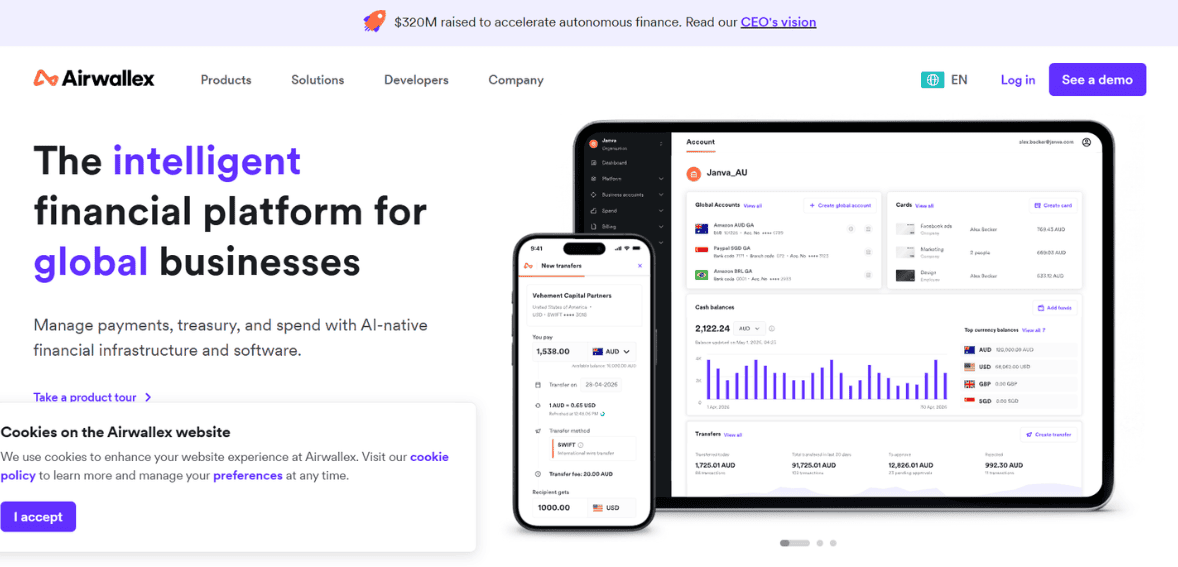
The Global Account is Airwallex’s foundational product and the starting point for most merchant relationships. It functions as a multi-currency business account that allows businesses to hold balances in over 20 currencies, receive payments in local currency from customers or marketplaces without forced conversion, and send payments through local rails rather than costly international wire transfers.
The local account details that Airwallex provides for major markets are one of the most practically valuable aspects of the Global Account. Businesses receive account numbers and routing details that allow counterparties in Australia, the UK, the EU, the US, Hong Kong, Singapore, and other markets to send money as if they were making a domestic transfer, rather than an international wire. For a business receiving payments from customers or marketplaces across multiple countries, the ability to collect those funds in the local currency of each market without requiring the payer to send an international wire is a meaningful friction reduction that improves both collection rates and the experience for the business’s counterparties.
Multi-currency holding allows businesses to park revenue in the currency it was received in, converting to the base currency only when needed or when the exchange rate is favorable rather than being forced to convert immediately at whatever rate is available at the time of receipt. This flexibility gives businesses with meaningful FX exposure a practical tool for managing currency risk without requiring sophisticated treasury instruments or relationships with specialized FX brokers.
The multi-currency account structure particularly benefits eCommerce businesses selling through major platforms like Amazon, eBay, Lazada, or SHOPLINE, which pay out in the local currency of each marketplace. Rather than converting these payouts to a single currency immediately and incurring marketplace conversion fees or unfavorable rates, businesses can receive each payout in the relevant local currency, hold it in Airwallex, and deploy it for relevant local expenses or convert strategically.
Foreign Exchange and Cross-Border Transfer Capabilities
The foreign exchange capability is widely cited as Airwallex’s most immediately tangible value proposition for businesses switching from traditional banking or platforms like PayPal. Unlike traditional banks or platforms like PayPal, Airwallex charges a fee of 0.5% to 1.0% depending on the currency, and is known for providing FX rates significantly better than traditional banks, often near mid-market pricing.
The specific FX pricing varies by currency pair, account tier, and volume. The rate from 0.2% above interbank is competitive for the Hong Kong market as reviewed in mid-2026, with the spread from mid-market narrowing for major currency pairs like USD, EUR, GBP, and AUD where liquidity is deepest and pricing competition is strongest. Less liquid currency pairs carry wider spreads, which is standard across the FX industry but worth understanding for businesses with material exposure to emerging market currencies.
There is also the 0.3% inbound receiving fee in Airwallex Hong Kong account dashboard which has been observed to be not available on its pricing page and may be charged to certain account types alone. This type of fee that can only be observed through the account itself demonstrates the lack of transparency in pricing that businesses must consider when they do not have access to the right information concerning pricing beyond the main page. This fee comes to 600 Hong Kong dollars at 200,000 Hong Kong dollars receiving per month and constitutes a material figure when compared to the monthly subscription fees for the smaller plan tiers.
The transfer speed to over 150 countries using both local and international transfer networks involves the use of rails such as the ACH rail in the US, the SEPA rail in the eurozone countries, the BACS and the faster payment rails in the UK and the APAC region. Majority of the transfers done using the local rails are completed on the same day and even within a few hours while those involving SWIFT rails normally take between one to three days and are associated with correspondent bank fees that affect the receipt.
Corporate Cards and Expense Management
Airwallex issues unlimited virtual or physical cards for teams, spending, and operations, with the corporate card offering functioning as both a payment tool and an expense management layer that eliminates many of the friction points associated with traditional corporate credit card programs.
Virtual cards can be issued instantly through the Airwallex dashboard, making them immediately available for online spending without waiting for physical card production and delivery. The instant issuance is practically useful for businesses that need to create project-specific or vendor-specific cards on short notice, or that want to issue cards to new team members as soon as they join rather than waiting through a traditional card application and delivery cycle.
Physical Visa debit cards are available for team members who need a card for in-person expenses or physical card acceptance scenarios. The Visa network acceptance means these cards work wherever Visa is accepted globally, which covers the vast majority of business spending scenarios.
Card-level spending controls allow companies to control spending limits, merchant category restrictions, and individual cardholder permissions without having to engage IT and go through an approval process. Card-level spending controls are especially useful when dealing with distributed teams, where there is no possibility for finance to control purchases on an individual level in real time but there is a need to have some controls against non-compliant spending.
It is important to consider the number of cardholders while calculating costs. Fee scheme for Hong Kong bank accounts involves an allowance of a certain number of cardholders before extra per-card fees come into play, and it becomes clear from our cost analysis that the optimal configuration for large distributed teams involves understanding the exact cardholder allowance for each plan before considering the subscription cost as the total cost of the card program.
Since Airwallex cards work together with a multi-currency account, it is possible for employees to spend money in foreign currencies without automatic conversion but by drawing from the relevant currency balances kept in the Airwallex account.
Embedded Finance and Platform Products
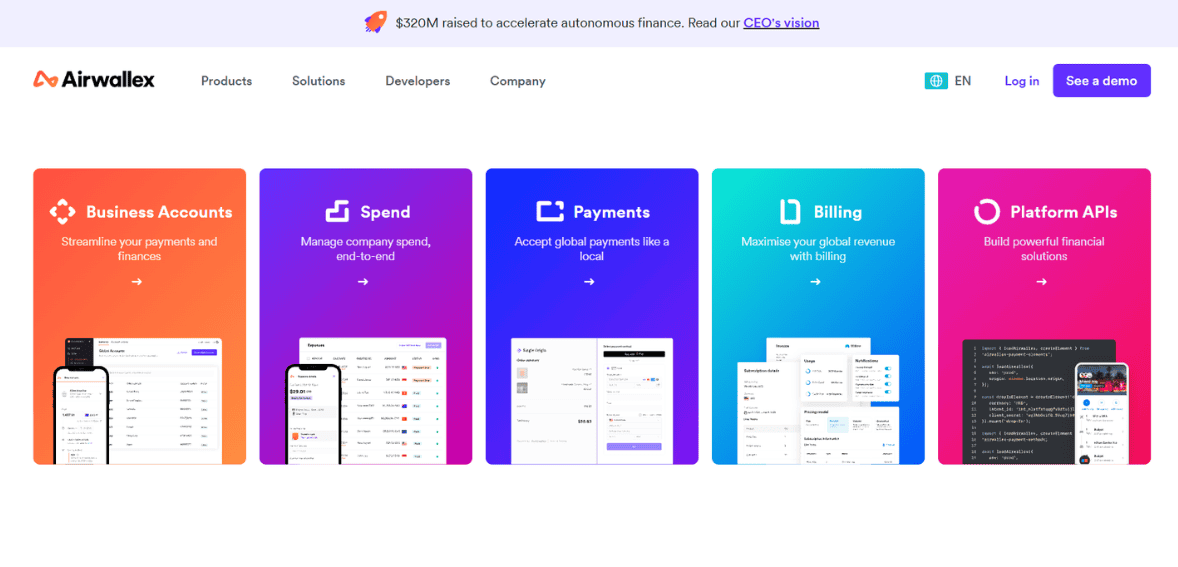
Beyond the direct-to-business products, Airwallex offers embedded finance capabilities for platforms and marketplaces that want to offer financial services to their own customers without becoming regulated financial institutions themselves. This product category, positioned similarly to Stripe’s platform and Rapyd’s fintech-as-a-service offering, enables software companies to embed multi-currency accounts, payments, and cards directly into their own product experience with Airwallex handling the underlying licensing and infrastructure.
The Embedded Finance product is described as enabling platforms to generate new lines of revenue by offering their own financial products. This revenue model, where the platform earns a share of the economic value generated by embedded financial services, follows the pattern that has driven significant commercial value in the fintech-as-a-service space. For software companies building tools for internationally distributed businesses, the ability to offer embedded payment and FX functionality alongside their core product creates a stickier product and a higher-value customer relationship.
API-first design makes the Embedded Finance product genuinely usable by development teams building custom financial workflows. The unified API surface that covers payment collection, cross-border transfers, FX, and card issuance allows platform builders to create customized financial experiences without managing separate integrations for each underlying capability, reducing the development effort and maintaining consistent data flows across the embedded finance product.
Customization options for payment workflows are limited, which may not suit complex transaction needs. This documented limitation is relevant for platform builders with highly specific workflow requirements that fall outside Airwallex’s standard API capabilities, and should be assessed during the technical evaluation phase rather than assumed to be accommodated.
Integrations and Accounting Connectivity
Airwallex integrates with ten third-party tools and platforms according to Capterra, covering accounting and operations apps including Xero, QuickBooks Online, NetSuite, and Odoo, plus eCommerce platforms such as Shopify, WooCommerce, SHOPLINE, Shoplazza, and Lazada.
The accounting integrations are described as sync rather than replacement, which is an important distinction that prevents a common implementation mistake. Airwallex is the payment and FX layer, not bookkeeping software. It pairs with Xero or QuickBooks rather than replacing them, and the value of the integration is that transactions processed through Airwallex flow automatically into the accounting system rather than requiring manual entry or CSV export. Businesses should set up the accounting integration from day one to prevent the reconciliation backlog that accumulates when Airwallex transactions and accounting records are managed separately.
The e-commerce platform integrations include plug-and-play plug-ins for Shopify and WooCommerce, offering online retailers an easy integration between their online store and Airwallex’s payments and currencies infrastructure. As far as US-based merchants are concerned, Airwallex offers them no-code plug-ins that allow localizing the checkout process, i.e., displaying currency options and payment methods based on the customer’s location.
Limited availability of integration with some accounting or ERP systems is the known limitation of Airwallex, which may become an issue for companies using non-standard accounting software or ERP systems, not included in the list of supported integrations. If your company uses SAP, Microsoft Dynamics, or any other ERP system, make sure you have proper integration with Airwallex first.
Security and Regulatory Compliance
The infrastructure meets the highest international standards, including PCI DSS, SOC1, and SOC2 compliance, reflecting the security investment appropriate for a regulated financial institution handling significant payment volumes across multiple jurisdictions.
The multi-jurisdiction licensing framework, with financial services licences in Singapore, Australia, the UK, Hong Kong, the US, Canada, and others, means that Airwallex operates under local regulatory oversight in each of its primary markets rather than relying on a single home-country licence with passporting arrangements. This regulatory structure provides local accountability in each market and ensures that customer funds in each jurisdiction are managed according to that jurisdiction’s specific safeguarding and compliance requirements.
Anti-money laundering and know-your-customer standards are enforced across multiple jurisdictions as part of the regulatory compliance framework, and transaction monitoring for fraud detection is applied to payment flows as standard operational procedure. Two-factor authentication is required for account access, providing baseline protection against unauthorized account access that is a standard expectation for any regulated financial institution.
Business verification is required during the account opening process, typically taking one to three business days for straightforward corporate structures. More complex ownership structures or higher-risk jurisdictions may extend this timeline, and businesses should initiate the verification process before they have an urgent payment to make rather than expecting same-day account activation.
Pricing Structure and Transparency
Airwallex uses a tiered subscription model with the specific tier structure varying by market. In Hong Kong, the three-tier structure covers Explore at no monthly fee, Grow at HKD 499 per month, and Accelerate starting at HKD 2,499 per month. Equivalent tier structures exist for Australian, UK, US, and Singapore customers with market-appropriate pricing.
The free Explore tier provides access to the core functionality including multi-currency accounts, transfers, and basic card capability, making it accessible for businesses wanting to test the platform before committing to a paid plan. The paid tiers unlock additional cards, higher transfer limits, enhanced support, and reduced FX spreads, with the economics of upgrading dependent on transaction volume and the value of the included feature expansions.
The 0.3% inbound receiving fee identified in account dashboard review rather than public pricing pages is the most important transparency gap merchants should investigate. At any meaningful monthly collection volume, this fee can materially change the all-in cost calculation relative to the headline subscription price. Businesses should contact Airwallex directly and request explicit written confirmation of all fees applicable to their specific account type and use case, including any receiving fees, before treating the published plan pricing as comprehensive.
Common complaints on Trustpilot focus on payment holds, slow issue resolution, and pricing changes that some users felt were not clearly communicated. The 3.3 out of 5 rating on Trustpilot across a larger sample sits below some fintech competitors in the same space, while G2’s smaller sample of 50 business users skews more positive, particularly on ease of use and integrations. This divergence suggests that the support and pricing communication experiences generate material dissatisfaction among a portion of users, even as the product’s core functionality and FX capabilities are broadly valued.
Customer Support
Airwallex offers customer support through email and live chat, with detailed guides and FAQs on the website to resolve common issues. While support is generally responsive, some users feel that more personalized assistance could enhance the experience. This characterization reflects the consistent pattern in independent reviews: the self-service documentation and knowledge base are well-developed, while complex issue resolution, particularly around payment holds, account verification issues, and pricing disputes, can involve longer resolution timelines than users expect.
Dedicated account managers appear to be available only to enterprise or large-scale clients, meaning smaller businesses may receive limited personalized support. This tiered support model is standard for fintech platforms at Airwallex’s scale but creates a service quality gap between enterprise clients who have named account contacts and smaller businesses navigating support through general channels.
Payment holds are documented as one of the more common friction points, with users describing holds on incoming transfers pending additional verification. This is a standard risk management mechanism for regulated financial institutions, but the communication around why a hold has been applied and how quickly it will be resolved affects how disruptive the experience is for the business affected. Improving the proactive communication around payment holds is one of the most consistent areas of improvement feedback in the independent review record.
Strengths, Limitations, and Who It Is Best For
Airwallex delivers genuine and well-documented value for its target audience: businesses with meaningful international payment flows who are paying too much for FX and waiting too long for cross-border transfers through traditional banking channels. The near mid-market FX rates, the multi-currency account infrastructure with local collection details in major markets, the instant virtual card issuance, the accounting integrations with Xero and QuickBooks, and the embedded finance capabilities for platform builders collectively represent a coherent and commercially valuable product for internationally operating businesses.
The limitations are equally real. The inbound receiving fee that appears in account dashboards but not consistently in public pricing documentation is a meaningful transparency gap. Payment holds without proactive communication create operational friction. Support quality for smaller accounts is limited to general channels rather than dedicated account management. Integration depth with some ERP and accounting systems beyond the specifically listed platforms requires additional development work. The Tencent investment and Chinese-market orientation, while commercially rational for Airwallex, is a consideration for businesses whose counterparties or regulators have sensitivities around Chinese technology investment in financial infrastructure.
The businesses best positioned to benefit from Airwallex are growth-stage and mid-market businesses with regular international payment flows in major currencies who are paying 2 to 4 percent in bank FX markups and want to reduce that to 0.5 to 1 percent, eCommerce businesses collecting revenue from multiple international marketplaces who need multi-currency holding accounts to manage collection without forced conversion, technology companies and SaaS businesses paying international contractors or employees who want to eliminate expensive wire fees, platforms and marketplaces building embedded finance features who need a regulated infrastructure partner without obtaining their own licences, and businesses expanding internationally who need local account details in multiple markets to collect payments domestically in each geography.
FAQs
Q1. Is Airwallex a bank, and are funds held in an Airwallex account protected by deposit insurance?
Airwallex is not a bank. It is a regulated payment institution holding financial services licences in the markets where it operates, including Singapore, Australia, the UK, Hong Kong, the US, and Canada. As a payment institution rather than a deposit-taking institution, Airwallex is not covered by the same deposit insurance schemes that protect funds held in bank accounts.
In most jurisdictions, payment institutions are required to safeguard customer funds by holding them in segregated accounts at licensed banks, separate from Airwallex’s own operational funds, which provides a level of protection in the event of Airwallex’s insolvency. However, this safeguarding arrangement does not provide the same guarantee as deposit insurance schemes like the FDIC in the US or the FSCS in the UK, which protect specified amounts per customer per institution.
Businesses holding significant balances in Airwallex should understand the specific safeguarding arrangements applicable to their account’s jurisdiction and factor the absence of deposit insurance into their assessment of how much operational cash to hold in the platform versus in a bank account with deposit protection.
Q2. What is the actual all-in cost of using Airwallex, and are there fees beyond the published subscription price?
The published subscription pricing for Airwallex’s plan tiers covers the monthly account fee, which ranges from zero on the free Explore tier to several hundred or thousand local currency units on paid tiers depending on the market. However, additional fees beyond the subscription apply to specific activities and may not be fully visible in the public pricing documentation.
Documented fee categories include the FX spread on currency conversions, which ranges from 0.5% to 1.0% above the interbank rate depending on currency and volume tier, SWIFT transfer fees for payments that cannot be routed through local rails, and a 0.3% inbound receiving fee that has been identified in account dashboards for at least some Hong Kong account types and that is not consistently reflected in public pricing pages.
The practical implication is that businesses should request a complete written fee schedule from Airwallex that covers all applicable charges for their specific use case and account type before treating the plan pricing as the total cost. Businesses should pay particular attention to the receiving fee if they collect significant inbound payment volumes, as this fee can materially change the cost calculation relative to the headline pricing.
Q3. How does Airwallex compare to Wise Business for international payments, and which is better for a small business?
Airwallex and Wise Business serve overlapping use cases with different product depth and pricing approaches. Wise Business is generally considered simpler to set up and better suited for small businesses with straightforward international transfer needs, with a transparent per-transfer fee model and a strong reputation for clear pricing.
Airwallex offers more comprehensive features including multi-currency accounts with local collection details, corporate cards with expense management, embedded finance capabilities, and deeper eCommerce platform integrations, making it more appropriate for businesses with complex multi-currency operations or platform-building ambitions. For a small business primarily sending occasional international transfers or paying a few overseas contractors, Wise Business offers a simpler, more predictable, and potentially lower-cost experience for that specific use case.
For a business collecting revenue from multiple international marketplaces, paying a distributed team in multiple currencies, and wanting integrated expense management alongside cross-border payments, Airwallex’s broader feature set justifies the additional complexity and the importance of understanding the full fee structure before committing.