
Blog
Home / Blog

Nium Review
- 12th Aug, 2026
- | By Linda Mae
- | Reviews
Nium is a Singapore-headquartered global payments infrastructure company that has undergone a genuinely significant strategic transformation since its founding. After starting off as consumer remittance platform Instarem in 2014, Nium Pte Ltd rebranded itself two years later when it launched its B2B payments business. That has since become the main company while Instarem is a subsidiary, accounting for 10% of the overall business. The enterprise payments platform is now capable of processing payments to the tune of USD 50 billion annually. Lets read more about Nium Review.
The pivot from consumer remittance to enterprise B2B infrastructure is not merely a marketing repositioning. It reflects a deliberate product and commercial strategy: the consumer remittance market that Instarem served is intensely competitive and margin-compressed, while the B2B cross-border payment infrastructure market is larger, stickier, and carries higher value per customer. The technology and banking relationships built during the Instarem years gave Nium a working cross-border payment network as its starting point, which it then extended and deepened specifically for enterprise and platform use cases.
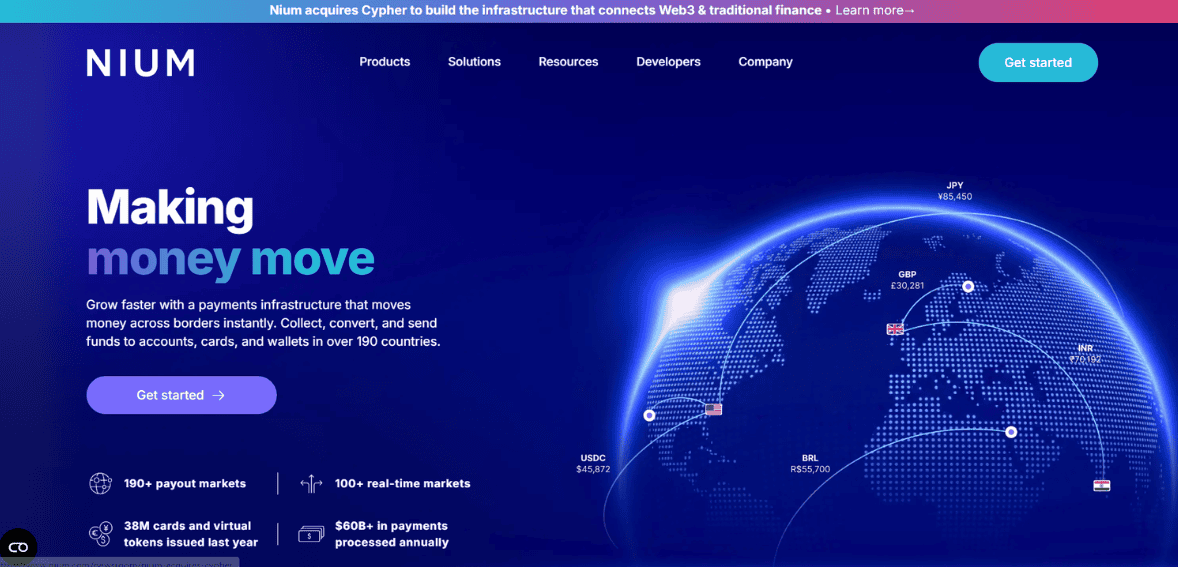
Nium provides global corporations with the ability to move money around. It allows making payments in over 190 countries, collecting in over 35 countries, and issuing cards in over 30 countries, using just one API. Using direct banking connections, local licenses, and compliance, Nium eliminates barriers to cross-border payments. Companies leverage Nium’s technology to make instant payments to gig economy workers, real-time settlements with suppliers, and integration of financial services into their applications.
The company has already raised over 300 million dollars in various financing rounds, reaching a valuation of approximately 1.4 billion dollars. Its investors include Visa, Temasek, Vertex Ventures, Rocket Capital, and other institutional investors. The investment by Visa is especially relevant in light of the strategy of Visa to invest in cross-border payment infrastructure companies instead of competing with them.
Table of Contents
ToggleCompany Background and Market Position | Nium Review
Nium Pte Ltd is headquartered in Singapore, where it holds a Major Payment Institution licence from the Monetary Authority of Singapore, allowing it to issue bank accounts and facilitate domestic and international money transfers. Apart from Singapore, it is regulated in the US, EU, Australia, Canada, Hong Kong, Indonesia, Japan, Malaysia, and India.
The depth and breadth of this licensing portfolio is one of Nium’s most significant competitive assets and one of the hardest to replicate quickly. Obtaining payment institution licences across multiple major Asian, European, and North American markets requires years of regulatory engagement, capital investment in each jurisdiction, and ongoing compliance maintenance. A fintech company beginning today to build a comparable licensing network would face a five-to-seven-year timeline before reaching anything approaching Nium’s current regulatory footprint.
Nium is a front runner both geographically and in payment services offered, being a holder of licenses in the biggest and fastest-growing markets around the globe. Geographical presence of Nium is determined by the company’s Asia-Pacific roots and its understanding that corridors that need the most attention when it comes to cross-border payments are those between Asia, Africa, and Latin America and not the corridors connecting the US and Europe that have been properly serviced already.
The list of customers includes banks, fintech companies, payroll services, travel management companies, and marketplaces, proving that Nium’s API-first infrastructure can support many enterprise and platform use cases. Fintech companies can provide improved global payment solutions and faster settlement choices. E-commerce platforms, B2B suppliers, and logistics marketplaces can rely on Nium for efficient supplier payouts, commissions, and refunding customers.
Core Payment Infrastructure and Network
With direct bank connections, local licenses, and compliance built in, Nium removes friction from cross-border payments. The direct bank connection model is the architectural foundation that differentiates Nium from payment orchestration layers that route through external acquirers or correspondent banks. By establishing direct connections to domestic banking infrastructure in each market, Nium enables transactions to enter and settle through local rails rather than the correspondent banking chains that SWIFT transactions traverse.
It facilitates cross-border payments in 70 supported currencies across 190 countries, with 80% of payments settled in real time. The 80% real-time settlement rate reflects the coverage of domestic real-time payment infrastructure in Nium’s most active corridors, including Faster Payments in the UK, SEPA Instant in Europe, UPI in India, PayNow in Singapore, and equivalent real-time rails in other major markets. The remaining 20% of transactions settle through standard clearing cycles in markets where real-time infrastructure is not yet available or where the specific payment method requires batch processing.
This global infrastructure helps businesses avoid the delays and fees associated with SWIFT-based systems. Nium meets high standards for security and compliance. Funds are held in safeguarded accounts where required, and Nium is regularly audited by global regulatory bodies.
The network architecture enables domestic payment experiences for cross-border transactions: when a business in the UK pays a supplier in India through Nium, the supplier receives the payment through domestic Indian banking rails at the speed and cost of a local transfer rather than a cross-border wire. This domestic settlement experience is the core value proposition that Nium offers relative to traditional international wire transfer infrastructure.
Collections: Receiving International Payments
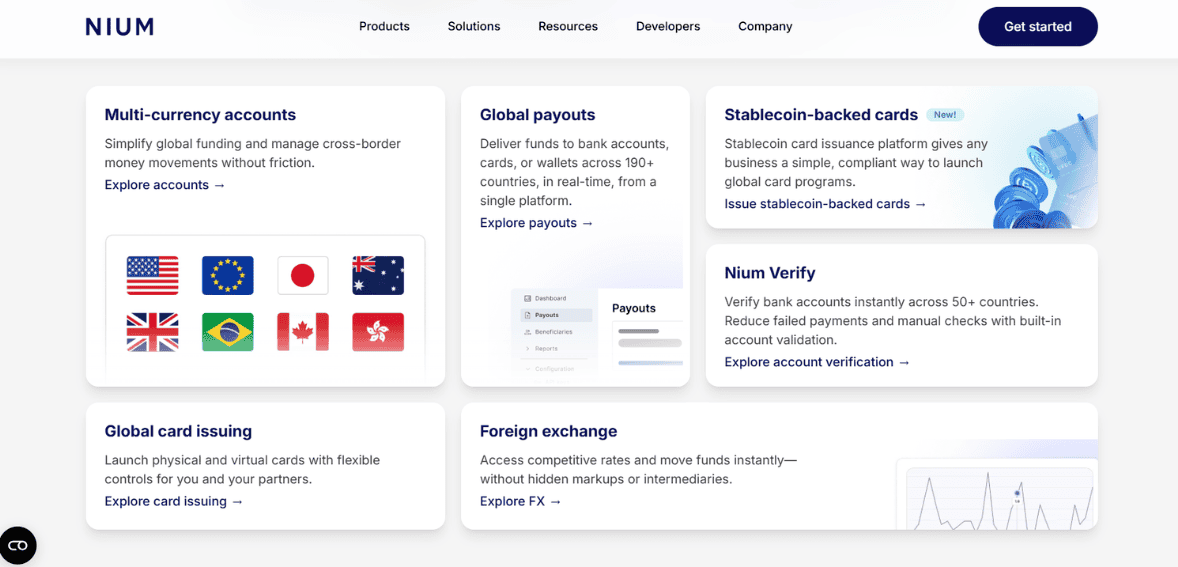
Funds can be received in 35 markets, including Southeast Asia, UK, Hong Kong, Singapore, Australia, India, and the US. The collections capability allows Nium’s enterprise clients to receive payments from customers or counterparties in each of the supported markets as domestic bank transfers, providing local account details for each market without requiring the payer to initiate an international wire.
For organizations which bill their customers or collect payments from them in several geographies, being able to provide bank account details in each of those markets significantly enhances their ability to collect payments successfully. For instance, when a customer from the UK pays the Singapore-based marketplace using the local Faster Payments service, the process becomes much easier and more familiar compared to making an international SWIFT payment; at the same time, the marketplace gets its money settled much faster than would be possible with a cross-border wire.
The ability to collect payments from 35 countries is particularly useful for Nium’s APAC businesses which form a considerable portion of Nium’s customers, while also covering the most important Western markets where cross-border collections occur on a regular basis. Geographical scope of collection services is smaller than that of payouts due to the fact that setting up bank accounts for receiving collections is more complicated than sending out payouts via local payment networks.
The ability to have named virtual accounts in the collection-supported countries allows for automatically reconciling received payments by using the virtual account name as a way to identify the payment source.
Card Issuance Infrastructure
Card issuance in 30-plus countries through a single API gives Nium’s enterprise clients the ability to issue virtual and physical cards to their users, employees, or customers within the same infrastructure relationship that handles their cross-border payment and collection needs. The card issuance capability operates through Nium’s direct relationships with Visa and Mastercard as a certified issuer program manager in supported markets.
Corporate and virtual card issuance supports use cases including employee expense management, contractor payment cards, customer prepaid instruments, and platform-issued spending cards for marketplace sellers or gig workers. The programmatic card issuance through API allows Nium’s clients to create and manage cards at scale without manual provisioning, which is essential for platforms issuing cards to large numbers of users simultaneously.
Spending controls at the card level, including merchant category restrictions, transaction amount limits, and geographic constraints, give platform operators and enterprise finance teams granular authority over how issued cards are used without requiring card-by-card manual management. These controls are particularly important for corporate card programs where policy compliance cannot depend on individual cardholder discretion.
Real-time visibility into card transaction data allows Nium’s clients to monitor spending activity as it occurs rather than relying on end-of-day statement downloads, which improves the responsiveness of expense management workflows and enables faster identification of anomalous spending patterns.
Foreign Exchange and Rate Management
Nium deploys real-time, market-aligned FX rates that can be locked for up to 24 hours. The real-time FX rate feeds reflect current interbank market pricing rather than indicative rates that may have moved materially between quotation and execution. For businesses making FX decisions that affect contract pricing or supplier payment amounts, the accuracy of the quoted rate at the time of decision matters significantly.
A 24-hour rate lock feature provides businesses with a set period of time during which they can conduct their planned FX transaction at a pre-agreed rate without being subject to any daily volatility in FX rates. This feature is helpful when making a run payment where the FX rate must be agreed on before sending the instruction but the actual transaction will take place either on the same day or the next morning.
Competitive real-time FX rates with rate locking facility and real-time fees without any hidden costs, mainly absent of intermediary fees show Nium’s focus on FX transparency. Mentioning no hidden costs and lack of intermediary mark-ups is the way how the company addresses the issue that is often raised by the clients of the traditional cross-border payment infrastructure, which involves correspondent banks and each intermediary can take its fee without informing the client.
FX cost transparency is essential for the travel management and hospitality industry customers, which comprise a significant part of Nium’s enterprise customer base, as the margins in the bookings made by these customers are often quite tight.
Gig Economy and Workforce Payment Solutions
Businesses use Nium to pay gig workers instantly, settle suppliers in real time, and embed financial services into their platforms. The gig economy use case is one of Nium’s most actively developed enterprise segments, reflecting the commercial reality that globally distributed gig workforces represent one of the largest and fastest-growing cross-border payment flow categories in the current economy.
For gig platforms paying workers across multiple countries, the alternative to a Nium-style infrastructure is managing multiple bilateral payment relationships with local payment providers in each worker geography, or routing all payments through SWIFT wires that arrive days after the work is completed. Both alternatives create worker satisfaction problems at a time when platform choice and worker retention depend significantly on how reliably and quickly workers receive their earnings.
Real-time settlement to local payment methods in each worker’s home market, whether a bank account, mobile wallet, or prepaid card depending on what is available and preferred in that market, is the operational standard that gig workers in competitive labor markets increasingly expect. Platforms that cannot meet this expectation face worker attrition to competing platforms that can.
The embedded financial services capability allows gig platforms to go beyond simple payouts and offer their workers access to tools including expense cards, earned wage access, and savings products within the same platform experience. This embedded finance layer increases the value of the platform relationship to the worker and creates additional revenue opportunities for the platform operator.
Travel Industry Specialization
Travel is one of Nium’s most developed vertical use cases and reflects the specific payment complexity of the travel industry, where payment flows involve multiple currencies, multiple counterparties, and timing mismatches between when payments are collected from travelers and when payments are due to airlines, hotels, and other travel suppliers.
Travel management companies, online travel agencies, and corporate travel platforms use Nium to settle bookings with suppliers across currencies and markets without maintaining separate currency accounts or banking relationships for each settlement currency. The ability to pay suppliers in their preferred local currency, settled through domestic rails, reduces the FX and settlement friction that characterizes traditional travel payment workflows.
The Nium Travel product line, specifically tailored for this sector, includes supplier payment capabilities, virtual card issuance for travel bookings, and reporting tools designed around the reconciliation requirements of travel accounting. The vertical-specific product investment reflects Nium’s recognition that travel has specific operational requirements that a generic B2B payment platform does not address as effectively as a purpose-built solution.
The Embedded Finance Layer
Nium business account holders may also access the fintech’s other embedded finance products, including corporate cards, expense management tools, and API integrations. The embedded finance architecture allows Nium’s clients to offer financial services to their own customers without holding payment institution licences themselves, using Nium’s regulatory infrastructure and balance sheet as the underlying foundation.
This model is similar to what Currencycloud, reviewed earlier in this series, provides for banks and fintechs wanting to offer multi-currency services without building the underlying currency infrastructure. Nium’s version of this offering is particularly relevant for Asian and emerging market platforms that want to extend financial services to their users in markets where the local banking infrastructure creates barriers to direct banking relationships.
The API-first design of the embedded finance layer means that platform builders can create custom financial experiences for their users without being constrained by Nium’s own product interfaces. The underlying payment rails, compliance infrastructure, and banking relationships are accessible through the API and can be wrapped in whatever user experience the platform operator wants to build on top.
Pricing and Account Structure
Customers must pay a one-time account opening fee and a monthly maintenance fee. This fee structure reflects Nium’s positioning as an enterprise platform rather than a self-service product available without any fixed cost commitment. The one-time account opening fee and ongoing monthly maintenance fee create a baseline commercial relationship that is appropriate for enterprise clients but represents a barrier to entry for smaller businesses or developers wanting to evaluate the platform before committing.
Nium does not publish a standard rate card, and pricing for transaction fees, FX spreads, and card issuance is negotiated based on volume, the specific services engaged, and the commercial relationship. This is standard practice for enterprise B2B infrastructure providers but requires direct commercial engagement to obtain pricing information, which is a friction point for businesses in the early evaluation phase.
Real-time fees with no hidden charges, mostly free of intermediary charges, reflects the pricing philosophy of transparent per-transaction cost without the correspondent bank deductions that reduce the received amount in traditional wire transfers. The actual FX spread and transaction fees reflect the specific corridors and payment methods used, and businesses should request corridor-specific pricing for their most important payment routes during commercial discussions.
Security, Compliance, and Regulatory Standing
Nium meets high standards for security and compliance. Funds are held in safeguarded accounts where required, and Nium is regularly audited by global regulatory bodies. The safeguarding requirement, where customer funds are held in accounts separate from Nium’s own operational funds, is a regulatory condition imposed by financial services regulators in most of Nium’s licensed markets, providing a meaningful level of protection for clients’ funds in the event of Nium’s insolvency.
PCI DSS compliance covers the payment data security requirements for cardholder information handled through the card issuance programs. Anti-money laundering and know-your-customer verification are applied to the businesses and, through their own KYC programs, to the end users transacting through Nium-powered platforms. The regulatory auditing across Nium’s 40-plus licensed markets means that compliance practices are not self-certified but independently verified.
The Zero Hash partnership announced in October 2022 extended Nium’s payment infrastructure to include crypto-related experiences, adding stablecoin and digital asset payment capabilities alongside the fiat currency network. This reflects the growing convergence of traditional payment infrastructure and digital asset settlement rails.
Developer Tools and API Quality
The single API model that covers payments to 190 countries, collections in 35 markets, and card issuance in 30 countries is the architectural design decision that most directly serves the developer teams building on Nium’s infrastructure. Rather than integrating separate APIs for each payment direction, each currency zone, and each financial product, a single Nium API integration provides programmatic access to the full network capability.
API documentation quality and developer support are important evaluation criteria for platform builders who will spend weeks or months integrating Nium’s infrastructure before their product goes live. The investment in developer tooling, including sandbox environments, sample code, and technical integration support, directly affects the ease and speed of integration and the likelihood of implementation errors that create post-launch operational issues.
The enterprise-grade nature of the platform means that pre-sales technical engagement typically involves Nium’s solutions engineering team rather than a self-service evaluation path, which provides personalized integration guidance but requires more initial time investment than a platform with full self-service documentation.
Strengths, Limitations, and Who It Is Best For
Nium is a genuinely capable global payments infrastructure company with particular strength in Asia-Pacific payment corridors, real-time settlement across 80% of transactions, a licensing portfolio covering 40-plus markets that represents years of regulatory investment, and the embedded finance capability that allows platform businesses to offer financial services under their own brand without becoming regulated financial institutions. The 50 billion dollar annual processing volume validates the infrastructure at genuine enterprise scale. The Visa investor relationship provides network access and strategic alignment with the world’s largest card network. The vertical specialization in travel and gig economy reflects meaningful product investment beyond generic B2B infrastructure.
The limitations are primarily those of any enterprise-focused B2B infrastructure provider. The account opening fee and monthly maintenance fee create a baseline cost commitment that is appropriate for enterprise clients but creates friction for smaller businesses. Pricing requires commercial engagement and is not available for self-service evaluation. The single API marketing claim covers a broad range of capabilities, and the depth of specific features within each capability area should be verified for the specific use case rather than assumed based on headline coverage numbers. Collection markets at 35 are significantly fewer than payout markets at 190, which means the inbound payment reach is considerably more limited than the outbound reach.
Nium is best suited for enterprise businesses with significant cross-border payment flows who need real-time settlement across multiple markets through a single API, travel management companies and online travel agencies that need supplier settlement in multiple currencies without correspondent banking costs, gig economy platforms paying globally distributed workforces who need real-time local settlement in each worker’s home market, fintech companies and banks wanting to add multi-currency payment and card issuance capabilities to their own products through Nium’s licensed infrastructure, and Asia-Pacific businesses with significant payment flows across the region who benefit from Nium’s depth of local market coverage and banking relationships in that geography.
FAQs
Q1. What is the difference between Nium and Instarem, and are they the same company?
After starting off as consumer remittance platform Instarem in 2014, Nium Pte Ltd rebranded itself two years later when it launched its B2B payments business. That has since become the main company while Instarem is a subsidiary, accounting for 10% of the overall business. Instarem and Nium are part of the same corporate group under Nium Pte Ltd. Instarem is the consumer-facing remittance brand that allows individuals to send money internationally, while Nium is the B2B enterprise infrastructure brand serving banks, fintechs, payroll providers, and marketplaces.
The two operate as distinct products serving different customer segments, but they share the same underlying payment infrastructure, banking relationships, and regulatory licences across the markets where Nium Pte Ltd operates. Businesses evaluating Nium for enterprise payment infrastructure and individuals evaluating Instarem for personal international money transfers are engaging with different commercial products of the same corporate entity, with the Nium enterprise platform representing the larger and strategically primary business.
Q2. How does Nium’s real-time settlement claim work in practice, and what percentage of payments actually settle in real time?
Nium facilitates cross-border payments in 70 supported currencies across 190 countries, with 80% of payments settled in real time. The 80% real-time rate reflects the coverage of real-time payment infrastructure in Nium’s most active corridors. When a payment is routed to a market where real-time clearing infrastructure exists and Nium has a direct connection to it, such as Faster Payments in the UK, SEPA Instant in Europe, UPI in India, or PayNow in Singapore, the settlement occurs within seconds of the payment being initiated. The remaining 20% of payments route through markets or payment methods where real-time clearing is not available, settling through standard batch clearing cycles that may take hours or the following business day.
The specific real-time settlement rate for any individual business depends on their payment mix by market and payment method, meaning businesses with payment flows concentrated in markets with strong real-time infrastructure may see rates above 80%, while those with significant flows to markets without real-time clearing may see lower rates. Businesses should ask Nium specifically about the real-time settlement rate applicable to their priority corridors during the commercial evaluation rather than treating the 80% platform-wide figure as applicable uniformly across all their payment routes.
Q3. Is Nium suitable for small and medium-sized businesses, or is it primarily an enterprise platform?
Nium is primarily designed and positioned for enterprise and mid-market businesses rather than small businesses with simple payment needs. The one-time account opening fee and monthly maintenance fee create baseline costs that are appropriate for enterprise clients generating sufficient transaction volume to justify them, but may not be economical for smaller businesses with lower payment volumes. The enterprise-grade commercial engagement model, where pricing and account terms are negotiated through a sales process rather than available through self-service onboarding, is similarly oriented toward buyers who are making considered technology infrastructure decisions rather than small businesses wanting to start accepting payments immediately.
Small and medium-sized businesses that need multi-currency accounts and cross-border payment capabilities are likely better served by direct-to-business platforms like Airwallex or Wise Business, which offer accessible self-service onboarding, transparent published pricing, and fee structures that are appropriate for lower volumes. Nium becomes the more compelling choice when a business has grown to the point where it needs API integration for programmatic payment operations, where its transaction volumes justify negotiated enterprise pricing, or where it wants to embed payment capabilities into its own platform rather than simply using payment services for its own operations.