
Blog
Home / Blog
Thunes Review
- 26th Jul, 2026
- | By Linda Mae
- | Reviews
Thunes is a Singapore-headquartered B2B payments infrastructure company that operates what it calls its Direct Global Network, a proprietary interoperability layer connecting otherwise fragmented payment systems across the world into a unified reach platform. The company does not compete with Stripe for eCommerce checkout or with Airwallex for multi-currency treasury management. It competes in a more specific and technically demanding space: providing the payout disbursement infrastructure through which other financial companies, platforms, and enterprises send money at scale to recipients across 140 countries through bank accounts, mobile wallets, cards, and stablecoin wallets through a single API connection. Lets read more about Thunes Review.
Thunes was founded in 2016 as the payments infrastructure spinout of TransferTo, a mobile payments platform that had been building remittance corridors since 2005. When TransferTo split, DT One retained the mobile top-up business and Thunes became a standalone B2B cross-border payments network, carrying forward the deep emerging market corridors and local payment method relationships that TransferTo had assembled over a decade. CEO Peter De Caluwe has led the company through a 150 million dollar Series D that pushed total funding to 362 million dollars at a valuation of approximately 900 million dollars.
The clients list of the company clearly shows that it is positioned in the enterprise end of the global payments value chain. The gig economy companies such as Uber and Deliveroo have partnered with Thunes for cross-border worker payouts. The super-apps such as Grab and WeChat from Southeast Asia have access to the network. The international fintech firms such as PayPal and Remitly leverage the infrastructure of Thunes for particular payout corridors.
The money transfer operators, banks, and payment service providers across the globe are part of the Thunes Direct Global Network. It is a B2B infrastructure company that is finally judged by how many end-users of its client companies get their payments via its rails rather than by how many merchants it processes cards for.
At the MPE Awards 2026, Thunes was awarded the Best Cross-Border Payment Solution award, and in June 2026, it launched its real-time US payout services using a direct link with a Tier 1 US financial institution.
Table of Contents
ToggleCompany Background and Market Position | Thunes Review
The TransferTo heritage gave Thunes something that most fintech companies attempting to build cross-border infrastructure from scratch lack: a decade of operational experience managing real-time corridors to emerging markets before the company existed under its current name. Building a remittance corridor to the Philippines, Kenya, or Pakistan is not a software engineering problem. It requires local regulatory licensing, banking relationships with domestic financial institutions, operational understanding of how local payment rails behave under various conditions, and established trust with local financial partners who control the final mile of each transaction. Thunes inherited this infrastructure rather than building it from scratch after the 2016 spinoff.
The acquisition of a controlling stake in Tookitaki in April 2022 added sophisticated AML and compliance platform capabilities that are now embedded in the Fortress Compliance Platform, Thunes’ proprietary compliance infrastructure. Tookitaki’s machine learning-based AML transaction monitoring was specifically designed for the multi-currency, high-volume, emerging market transaction patterns that standard AML tools handle poorly, which made it a strategically important addition for a network processing transactions across hundreds of currency corridors with diverse risk profiles.
Thunes has licenses in 50 markets and 50 Money Transmission Licenses in the United States and its territories, which form the regulatory basis for the legal operation of the network in each market. This extensive licensing framework forms one of the major competitive moats that Thunes has built up, as the acquisition and maintenance of money transmission licenses in 50 US states as well as the required regulatory permissions in other markets involve continuous investment that is hard to replicate within a short period of time.
The 14 Thunes offices located in Atlanta, Barcelona, Beijing, Dubai, Hong Kong, Johannesburg, London, Manila, Nairobi, Paris, Riyadh, San Francisco, and Shanghai represent the geographic presence of the firm in the markets it serves, rather than a mere formality.
The Direct Global Network Architecture
The Direct Global Network is the foundational concept that defines how Thunes differs from both traditional correspondent banking networks and standard payment gateways. Rather than routing cross-border payments through the sequence of correspondent banks that SWIFT transactions traverse, each adding processing time, fees, and opacity to the transaction, Thunes connects directly to local payment infrastructure in each market, enabling transactions to enter and exit the network through domestic rails at domestic speeds and costs.
The network currently reaches 12 billion bank accounts, mobile wallets, and stablecoin wallets across 140 countries, with 90 currencies supported for settlement. The scale of these numbers reflects the cumulative depth of the local banking and wallet partnerships that underpin the network rather than any single technical achievement: each endpoint type in each country requires specific banking or payment service relationships to enable.
The 99% real-time delivery rate for mobile wallet transactions, cited in independent network assessments, reflects one of the most practically important capabilities of the Thunes infrastructure for markets where mobile wallets have become the dominant financial access mechanism. In markets like Kenya where M-Pesa accounts are more prevalent than bank accounts, in the Philippines where GCash has achieved massive adoption, and in China where Alipay and WeChat Pay dominate consumer digital payments, reaching these wallet endpoints reliably and instantly is what makes a payout network genuinely useful for the recipient population rather than theoretically reachable but practically inaccessible.
Connected to over 60 real-time banking systems globally, Thunes routes transactions through domestic clearing networks in each market where these are available, bypassing SWIFT and correspondent banking chains for the majority of transactions where direct domestic connectivity is feasible. The SmartX Treasury System manages liquidity optimization across the network’s 90 currencies, reducing the pre-funding requirements that would otherwise make operating a multi-currency payout network prohibitively capital-intensive.
Core Disbursement Capabilities
Thunes is a disbursement-first infrastructure provider. The primary transaction direction is outbound, from the Thunes network member’s account to an end recipient’s bank account, mobile wallet, card, or stablecoin wallet. This disbursement orientation is distinct from the collect-and-disburse model of platforms like MANGOPAY or Airwallex, and it is an important context for businesses evaluating Thunes for use cases that involve both collection and disbursement.
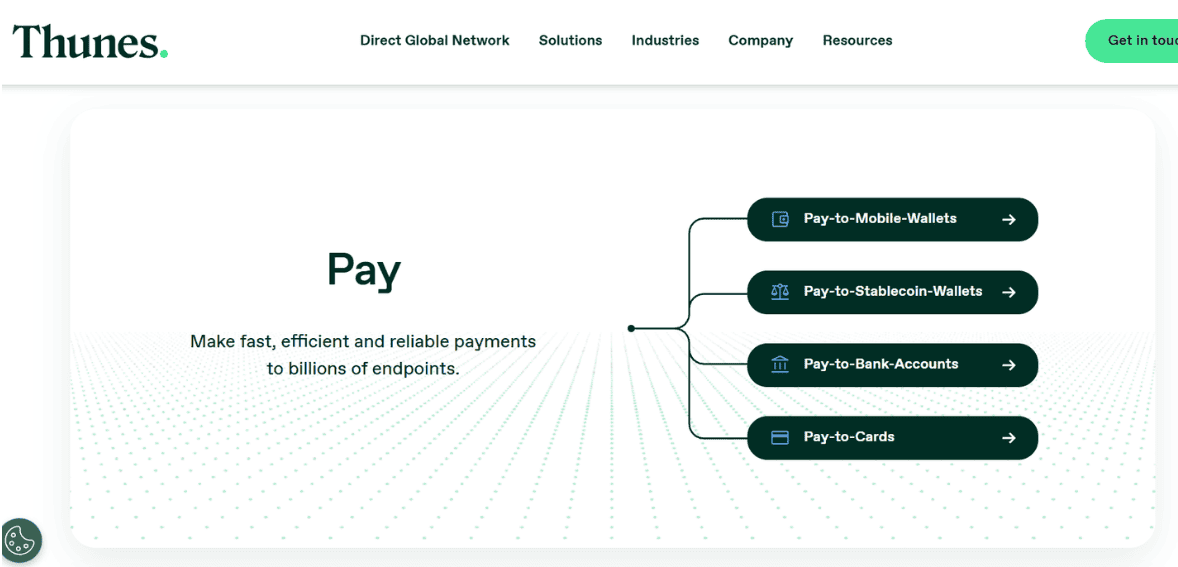
Bank account payouts reach over eight billion bank accounts across the global network, supporting transfers through domestic clearing in markets where Thunes has direct banking relationships and SWIFT in markets where correspondent banking is still the most practical route. The June 2026 launch of real-time US payout services through ACH, Same-Day ACH, and real-time payment rails, built on a direct connection to a Tier 1 US financial institution, specifically addresses one of the most significant gaps in Thunes’ network for businesses sending money into the United States from overseas.
Mobile wallet payouts represent one of Thunes’ most distinctive capabilities relative to bank-focused competitors. The network connects to over 3 billion digital wallets including M-Pesa in East Africa, Alipay and WeChat Pay in China, GCash in the Philippines, and 120-plus others globally. For gig platforms, remittance services, and NGOs disbursing funds to recipients in markets where bank account penetration is limited but smartphone ownership enables mobile wallet access, this wallet reach is the difference between a network that works for their actual recipient population and one that technically functions but cannot practically deliver funds to the people who need them.
Card payouts to 15 billion cards across Mastercard, Visa, and UnionPay networks enable instant-access disbursements through the card rails that recipients already have in their wallets, providing an alternative to bank transfer that often settles faster and requires no separate registration. For earned wage access, insurance claim disbursements, and marketplace seller payouts, card-push capability provides a fast and familiar receipt mechanism for the recipient.
Stablecoin wallet payouts, added more recently, connect to stablecoin wallets across the network, providing an additional disbursement option for recipients who prefer to receive funds in digital assets rather than fiat currency. The Circle partnership enables this stablecoin capability, and it reflects the growing practical importance of stablecoin settlement for cross-border payouts, particularly in markets where currency volatility makes fiat payout receipts less predictable in value.
The SWIFT Pay-to-Wallets Bridge
One of Thunes’ most technically significant product offerings is the SWIFT Pay-to-Wallets bridge, which allows traditional financial institutions to route payments into mobile wallets globally without building custom API integrations for each wallet provider. Banks send transaction instructions through their existing SWIFT messaging infrastructure, which is familiar to every correspondent banking team, and the Thunes Direct Global Network handles the translation and settlement to the appropriate mobile wallet endpoint.
The bridge solves the challenge of an existing gap within the global payment system where banks are able to communicate via SWIFT while mobile wallets lack the capability of doing the same. Linking the two parties together usually means one of two things; either an integration between the two must be developed from scratch, or there is an intermediary who links the two. The SWIFT bridge makes Thunes intermediary so that banks can communicate to the 3+ billion mobile wallet users around the world using the systems they understand instead of having to develop new capabilities.
For those financial institutions looking to extend their cross-border payment capabilities, Thunes’ bridge provides a solution to get access to mobile wallets without having to develop new engineering capabilities required to link directly into each wallet’s APIs, which vary in complexity.
The Fortress Compliance Platform
Compliance is a structural differentiator for Thunes rather than an operational overhead, and the Fortress Compliance Platform reflects an investment in compliance infrastructure proportional to the complexity of the markets the network operates in. Automated KYC, AML, and sanctions screening embedded in every transaction that flows through the network provides the compliance coverage required for a network operating across 140 countries, each with its own regulatory framework and risk environment.
The Tookitaki AML platform acquisition brought machine learning-based transaction monitoring specifically designed for the multi-currency, multi-corridor transaction patterns that standard rule-based AML tools handle poorly. In emerging markets where transaction patterns differ significantly from developed market norms, and where the typologies of legitimate transactions overlap more closely with suspicious activity patterns than in better-documented markets, the quality of the underlying AML model matters more than in standard compliance environments.
Regulation in 50 markets provides the legal operating authority to process payments across the network’s geographic footprint. This licensing breadth is not a theoretical capability but an active operational requirement: a payment network that lacks the regulatory authorisation to process transactions in a specific market cannot legally serve that corridor, regardless of its technical capability to route there. Thunes’ investment in obtaining and maintaining 50 market licences alongside the 50 US state money transmitter licences represents years of regulatory engagement and ongoing compliance management.
Gig Economy, Payroll, and Remote Workforce Payouts
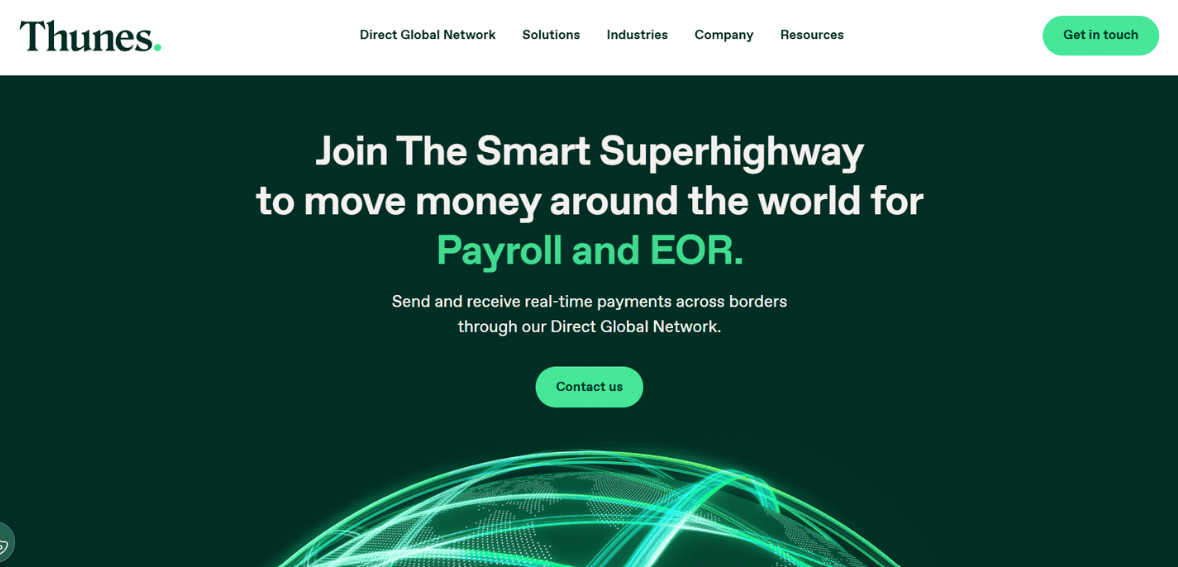
The launch of a direct-to-workforce cross-border payout solution in March 2026 marked Thunes’ formal entry into the rapidly growing global gig economy and remote workforce payment market. The solution allows businesses to pay remote overseas teams, freelancers, and gig workers instantly into bank accounts, mobile wallets, and stablecoin wallets across 140 countries, 24 hours a day, seven days a week, through a single API integration.
The commercial rationale is clear from documented research: 90% of gig workers prioritize quick access to their funds when choosing payout systems. Platforms that cannot pay instantly, or that route payouts through slow correspondent banking chains, are at a commercial disadvantage in attracting and retaining gig workers who have multiple platform options. Thunes’ real-time payout capability directly addresses this preference, providing the instant access that gig workers prioritize through whatever payment method is most accessible in their specific market.
Clients conducting overseas payroll, managing international gig working platforms, making fast eCommerce refunds, processing insurance claims, and NGOs operating in hard-to-access payout markets are specifically cited as use cases where the workforce payout solution is already generating impact. This breadth of use cases reflects the versatility of the underlying payout infrastructure rather than a narrow specialist product, since the same API capability that pays a gig worker in Kenya through M-Pesa can pay an insurance claimant in the Philippines through GCash or an NGO beneficiary in Nairobi through a bank transfer.
Pricing and Transparency
Thunes uses quote-based enterprise pricing, so there is no public rate card to compare. That model is reasonable for a network sale as long as the scoping process is specific. This characterization from an independent cross-border payment analysis accurately describes the pricing approach for a B2B infrastructure provider whose costs vary significantly by corridor, payment method, volume, and the specific capabilities engaged.
The commitment to pricing transparency within the platform is meaningful even without public rate cards: Thunes explicitly offers full visibility on transaction prices, currency conversions, and FX fees for payouts so businesses can easily understand the amount they will pay in the designated local currency. This transaction-level transparency, while not equating to pre-engagement rate publication, provides the operational cost visibility that finance teams managing high-volume payout operations need for reconciliation and cost management.
Before beginning technical integration, businesses should map their priority corridors and payout methods with Thunes’ commercial team, aligning the pricing discussion to the specific footprint they plan to use. This scoping process produces a pricing structure specific to the actual use case rather than a generic enterprise rate that may not reflect the economics of the specific corridors and payment methods the business actually needs. Businesses with heavy LATAM wallet payout needs will have a different cost structure than those primarily routing European bank transfers, and the pricing conversation should reflect those specifics.
Developer API and Integration Experience
Connect via API or Swift to make global money movement as simple as a local payment. The dual connectivity model, direct API for fintech-native organizations and SWIFT messaging for traditional financial institutions, reflects the breadth of Thunes’ intended client base from startups building new payment products to established banks extending their payout capabilities.
The single API connection that gives access to the full network reach across 140 countries, 90 currencies, and all supported endpoint types is the technical architecture that makes Thunes’ network model commercially compelling for businesses that want to add payout destinations as their geographic footprint grows without adding proportional integration complexity. Building separate bilateral integrations for each market and payment method would require a team of payment engineers and years of integration work to replicate what a single Thunes API connection makes available from day one.
Transaction duplication issues in payment processing and confirmation messages are noted in G2 reviews as a specific technical concern. The observation that payments confirmation sometimes shows duplicate entries that can lead to errors and confusion is a documented operational friction point that development teams should build error handling around rather than assuming clean single-occurrence transaction confirmations in all cases. This is a specific and practical integration consideration rather than a systemic reliability concern, but it warrants explicit attention in integration design.
Time zone-related support delays are also noted, reflecting that Thunes’ office base in Asia means that support response for queries from European or Americas-based clients may involve wait times that cross day boundaries. Businesses in these time zones should plan around this support timing characteristic.
Real-Time US Payout Launch and Network Expansion
The June 2026 launch of real-time US payout services is one of the most commercially significant recent developments in Thunes’ network expansion. The service is built on a direct connection to a Tier 1 US financial institution, enabling payouts in US dollars via ACH, Same-Day ACH, and real-time payment rails, available through the single Thunes API for businesses and payment providers outside the US sending funds into the country.
The US coverage is supported by the 50 Money Transmission Licences across states and territories that allow Thunes to connect directly to local clearing systems rather than routing through multiple third-party intermediaries. Each additional intermediary in a cross-border payment chain adds time, cost, and failure risk, and Thunes’ direct institutional connection addresses these frictions for what the company describes as a multi-trillion-dollar market gap in USD payments into the US.
The product design addresses the economic diversity of use cases by offering choice of settlement methods: lower-cost batch processing through ACH for businesses where processing cost matters more than settlement speed, and same-day or real-time rails for businesses where instant recipient access to funds is the priority. This optionality allows businesses to optimize their cost and speed trade-off rather than accepting a single settlement approach.
Strengths, Limitations, and Who It Is Best For
Thunes is a genuinely specialized and deeply capable B2B payout infrastructure platform whose strengths are most clearly realized in specific and well-defined use cases. The Direct Global Network’s reach across 140 countries, 12 billion endpoint connections across bank accounts, mobile wallets, and stablecoin wallets, the Fortress Compliance Platform embedded across all transactions, the SWIFT Pay-to-Wallets bridge, and the 50-market licensing infrastructure represent a coherent and substantial competitive position in the cross-border disbursement market. The enterprise client roster including Uber, Deliveroo, Grab, PayPal, and Remitly validates the network at genuine scale. The MPE Awards Best Cross-Border Payment Solution 2026 recognition reflects peer validation from practitioners rather than self-assessment.
The limitations are explicit and important. Thunes is a disbursement highway, not a full financial operating system. It does not provide multi-currency collection accounts, corporate card issuing, expense management, or treasury management tools alongside its payout capabilities. Businesses that need to both collect international payments and disburse funds need a complementary collection solution alongside Thunes, or a different provider that covers both directions.
Setup complexity and enterprise-only commercial engagement mean this is not an accessible starting point for small businesses or early-stage platforms evaluating their first cross-border payment infrastructure. Pricing requires sales engagement with corridor-specific scoping. Transaction duplication in confirmation messages is a documented technical concern that requires careful integration handling. Support timing across time zones can create response delays for businesses in Europe or the Americas.
Thunes is best positioned for PSPs and money transfer operators building or extending their payout network reach in corridors where mobile wallet delivery is essential, gig economy platforms needing real-time cross-border worker payments to diverse endpoints across emerging markets, global marketplaces disbursing seller payouts across dozens of countries through whatever payment method each seller prefers, enterprise payroll and employer-of-record providers managing cross-border compensation for globally distributed workforces, banks and financial institutions wanting to extend their payout capabilities into mobile wallet endpoints without building direct API integrations for each wallet provider, and NGOs and international organizations disbursing funds to beneficiaries in hard-to-reach markets where mobile wallet or local payment method coverage is the only practical delivery mechanism.
FAQs
Q1. Is Thunes suitable for a business that needs both to collect international payments and to disburse funds, or does it only handle outbound payouts?
Thunes is primarily a disbursement-first infrastructure provider. Its Direct Global Network is optimized for outbound payouts from the network member’s account to end recipients across 140 countries through bank accounts, mobile wallets, cards, and stablecoin wallets. The platform does not natively provide multi-currency collection accounts, local account details for receiving payments in different markets, or the treasury and expense management tools that businesses need to manage their inbound payment flows alongside outbound disbursements.
Businesses that need to both collect international payments from customers or marketplace platforms and disburse funds to recipients will need either a complementary collection solution alongside Thunes, or a different provider whose platform covers both directions. Platforms like Airwallex, Nuvei, or MANGOPAY cover different combinations of collection and disbursement capabilities, and the right architecture depends on the specific balance of collection and disbursement volume, the geographies involved, and the payment methods required for each direction.
Q2. How does Thunes handle compliance across 140 countries, and what does the Fortress Compliance Platform actually do?
The Fortress Compliance Platform is Thunes’ embedded compliance infrastructure that applies automated KYC, AML, and sanctions screening to transactions flowing through the Direct Global Network across all 140 countries in the network’s reach. Rather than applying a single global compliance ruleset to all transactions, the Fortress platform incorporates local regulatory requirements specific to each market, reflecting that AML transaction monitoring requirements, sanctions screening standards, and KYC obligations differ across jurisdictions in ways that a generic compliance layer cannot adequately address.
The Tookitaki AML platform acquisition in April 2022 added machine learning-based transaction monitoring specifically designed for the multi-currency, multi-corridor transaction patterns of an emerging market-focused payment network, where standard rule-based AML systems generate high false positive rates because legitimate transaction patterns in emerging markets resemble suspicious activity patterns calibrated for developed market norms. Thunes is licensed in 50 markets and holds 50 US state Money Transmission Licences, providing the legal operating authority alongside the technical compliance infrastructure to process transactions legally across the network’s geographic footprint.
Q3. What is the realistic timeline and process for a business to integrate with Thunes and begin live payouts?
Thunes is designed for enterprise and B2B platform clients rather than self-service individual business users, and the integration process reflects this positioning. The commercial engagement begins with a corridor mapping conversation in which the business identifies its priority payout countries, payment methods, and volume expectations, and Thunes’ commercial team scopes the relevant network capabilities and pricing. Following commercial agreement, technical integration uses Thunes’ API documentation to build connections to the desired endpoint types, with sandbox testing available for pre-production validation.
The timeline from initial conversation to live production payouts typically spans several weeks to a few months, depending on the technical complexity of the integration, the number of corridors being activated, and the compliance documentation requirements for the specific business type and operating jurisdictions.
Businesses evaluating Thunes should allocate meaningful engineering resources to the integration and compliance documentation process rather than expecting a quick plug-and-play deployment, and should verify that the specific corridors and payment methods most important to their use case are available and performant within the network before committing to a full integration. Testing the priority corridors in the sandbox environment before going live is an important step that the documented duplicate confirmation message concern in G2 reviews makes even more important than it would otherwise be.