
Blog
Home / Blog

Rapyd Review
- 15th Jul, 2026
- | By Linda Mae
- | Reviews
Rapyd is a London-headquartered, Tel Aviv-rooted fintech-as-a-service platform that has positioned itself with considerable ambition as the AWS of fintech: a modular, API-first infrastructure layer through which businesses can embed payment acceptance, fund disbursement, digital wallets, card issuing, and compliance capabilities into their own products across more than 100 countries. Founded in 2016 by Arik Shtilman, Arkady Karpman, and Omer Priel, the company began as a digital wallet called CashDash before pivoting decisively toward enterprise B2B fintech infrastructure. Lets read more about Rapyd Review.
The scale of the business Rapyd has constructed is real. Rapyd has secured over 1.275 billion dollars in funding overall, and that includes an important 610 million dollar acquisition of PayU’s Global Payments Organization in 2023, increasing its presence in Eastern Europe, Central Europe, Colombia, and Africa significantly. The Valitor acquisition in 2022 for 100 million dollars resulted in Iceland becoming the hub of Rapyd in Europe and gave Rapyd acquiring abilities in the UK and EEA. By 2023, Rapyd had more than 250,000 merchant clients in 41 regulated countries, enterprise clients being Adidas, Google, Rappi, Uber, and Netflix which accounted for about 75% of the revenue.
Nonetheless, prior to conducting a conventional product review, one important development in 2026 must be mentioned directly. A Trustpilot reviewer reported in early 2026 that Rapyd informed customers through email that it cannot process any payments whether they are incoming or outgoing from the end of January 2026.
Table of Contents
ToggleCompany Background and Market Position | Rapyd Review
Rapyd’s founding story reflects a deliberate pivot from consumer payments toward the B2B infrastructure market that has driven the company’s most significant growth. The original CashDash eWallet that allowed ATM withdrawals without a physical card was an interesting consumer innovation, but the market opportunity Shtilman identified in cross-border business payments was substantially larger. The company’s repositioning toward businesses struggling with international payments, local regulatory compliance, and local payment method access gave Rapyd a focus area with genuine commercial urgency for its target customers.
The company’s valuation trajectory reflects both the genuine quality of its platform and the volatility of fintech valuations in the post-2021 environment. A 15 billion dollar peak valuation in early 2022 fell to approximately 8.7 billion dollars in July 2023 and to approximately 3.5 to 4.5 billion dollars by early 2025. This valuation compression, while significant, does not inherently indicate operational distress, as broader fintech valuations experienced similar corrections across the industry during this period. However, the combination of valuation decline and the January 2026 payment processing disruption referenced above warrants careful evaluation by businesses considering Rapyd as a long-term infrastructure partner.
Rapyd is a Top 20 Visa Acquirer with higher authorization rates and fewer lost sales, and holds licenses as a Visa and Mastercard acquirer in Europe, the UK, Israel, and Singapore. These direct acquiring licenses are meaningful infrastructure assets that distinguish Rapyd from pure payment orchestration layers that route to external acquirers for all transaction processing.
The company has stated ambitions for an IPO by 2026, though no confirmed IPO had occurred as of the time of this review’s research. The 2023 projection of 2 billion dollars in revenue and 400 million dollars in EBITDA by 2026, stated by Shtilman in August 2023, represented an aggressive growth target whose achievement status will be relevant for any business evaluating Rapyd’s financial stability.
Core Payment Infrastructure: Rapyd Collect
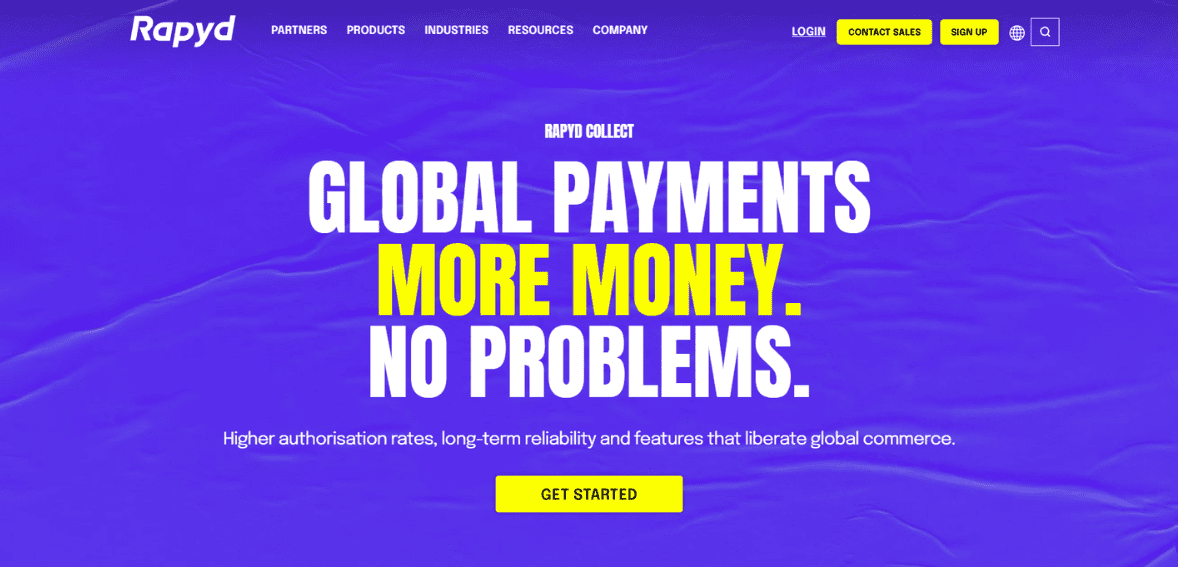
Rapyd Collect is the company’s payment acceptance product, enabling businesses to accept local payments globally across more than 900 payment methods in more than 190 countries. The breadth of local payment method coverage is genuinely one of Rapyd’s most distinctive competitive advantages and the primary reason enterprise businesses in fragmented international markets choose the platform over more limited alternatives.
The 900-plus payment methods span the full range of how consumers around the world prefer to pay: domestic credit and debit cards across Visa and Mastercard as well as local card networks, bank transfers through SEPA, ACH, PIX in Brazil, UPI in India, and equivalents across dozens of other markets, eWallets including GrabPay in Southeast Asia, M-Pesa in East Africa, and hundreds of others, and cash voucher options for markets where a significant portion of the population transacts primarily in cash.
For businesses that are trying to expand to markets such as Southeast Asia, Latin America, Africa, and the Middle East, which are different from Western markets, wherein there is one payment solution that reigns supreme, such as Visa and Mastercard, offering locally preferred payment solutions via a single API integration compared to multiple integration options per market that prefers a certain payment solution would be truly revolutionary infrastructure wise. SEA Gamer Mall utilizes Rapyd’s platform to accept payments in a manner that suits each Southeast Asian market, and other cases in gaming, eCommerce, education, and travel show that there is real commercial value in having such breadth.
The transactions process in over 150 currencies with Interchange++ pricing that involves the transparent fee structure that includes interchange fee, scheme fee, and acquirer fee for all card transactions. Interchange++ is more transparent than flat fee or bundled pricing models, but it is important to note that the actual rates need to be negotiated by the sales team at Rapyd directly.
Rapyd Disburse: Cross-Border Payouts
Rapyd Disburse sends funds quickly through bank transfers, mobile wallets, or cash pickup, and is described as ideal for gig platforms, B2B marketplaces, and remittance services. For businesses that not only collect payments from customers but also need to pay out funds to distributed recipients including sellers, contractors, gig workers, or suppliers, the combination of Collect and Disburse within a single platform reduces the complexity of managing separate collection and disbursement infrastructure.
Cross-border payouts are specifically highlighted as a strength, with the platform designed to move funds across borders through local payment rails rather than exclusively through international wire transfers, which are slower, more expensive, and less accessible in some markets. Kadmos, which pays seafarers securely across borders, represents the kind of use case where cross-border payout capability in local currencies and through locally accessible disbursement channels is operationally essential rather than a convenience.
Cash pickup disbursements are especially useful in regions where there are not many bank accounts in circulation but where there are many cash agent networks, including large chunks of Africa, South and Southeast Asia, and some parts of Latin America. Providing a way for cash disbursement using the same platform infrastructure used for card and bank transfer payments allows organizations to utilize these methods without having a separate cash disbursement solution.
Some delay in payments has been observed in customer feedback, considering that cross-border payments made across different regional rail infrastructures have varying settlement times for each country and payment mode. Companies utilizing the Rapyd Disburse platform should be aware of the settlement times for their respective markets and payment types.
Rapyd Wallet: Digital Wallet Infrastructure
Rapyd Wallet allows businesses to create branded digital wallets with KYC, multi-currency support, and balance management, with user-specific controls configurable to suit different business models. The wallet infrastructure is the foundational layer that connects the Collect and Disburse products, enabling funds received through Collect to be held within wallets before disbursement through Disburse or applied to other financial operations within the platform.
Multi-currency wallet capability allows businesses and their users to hold balances in different currencies within the same wallet infrastructure, which is relevant for platforms that collect in one currency and disburse in another, or that serve users who transact across multiple currency zones. The FX capabilities built into the wallet layer allow currency conversion at defined points in the payment flow, with the ability to lock in FX rates for brief periods to reduce exchange rate uncertainty during high-volatility periods.
Balance management and user-specific controls give platforms granular authority over what wallet holders can do with their balances, including spending limits, transfer permissions, and restrictions on how funds can be moved or withdrawn. This control layer is essential for platforms where the wallet serves a specific functional purpose rather than being a general-purpose consumer financial account.
Businesses building neobank or embedded finance products on Rapyd’s wallet infrastructure benefit from the underlying licensing and compliance infrastructure that Rapyd has assembled across its operating markets, avoiding the need to obtain separate e-money or payment institution licences in each market they serve.

Rapyd Issuing: Card Issuing Infrastructure
Rapyd Issuing provides virtual and physical card issuance with end-to-end card management including design, production, delivery, and reissuing. Virtual and physical Visa debit cards are available to eligible UK customers, with remote and direct authorization models for transaction control and configurable spending limits, ATM withdrawal controls, and merchant restrictions.
The card issuing capabilities enable businesses to issue spending instruments directly tied to their Rapyd wallet balances, thus completing the cycle between the money deposited into Rapyd-driven platforms and the ability of the users to spend the money via the standard card processing systems.
In the case of expense cards for corporate customers, the management capabilities offered by Rapyd Issuing, which include merchant category controls, spending caps, and ATM withdrawals management, constitute the management component needed for corporate card programs. In the case of payment cards issued to consumers within an embedded finance solution, the card management infrastructure makes it unnecessary for a separate card issuing agreement to be established.
The card design and manufacturing services provided by Rapyd are related to the full card program management scenario, including white label card programs, when the issuing platform’s branding is applied to the card rather than Rapyd’s.
Compliance as a Service
Rapyd handles KYC, AML, licensing, and PSD2 compliance, positioning the compliance infrastructure as a service delivered alongside the payment and financial infrastructure rather than a separate obligation the platform operator must manage independently.
Built-in KYC and KYB verification covers individuals and businesses across 170-plus countries, including document verification, liveness detection, and database screening against global watchlists and sanctions lists. For businesses that would otherwise need to source a separate identity verification provider alongside their payment infrastructure, the inclusion of KYC within the Rapyd platform eliminates a vendor relationship and reduces the integration complexity of connecting identity verification outcomes to payment permission decisions.
AML monitoring covers transaction screening and suspicious activity detection, providing the ongoing transaction monitoring required for payment businesses operating under financial services regulation in their various markets. PSD2 compliance for European operations, including Strong Customer Authentication implementation, is handled within the platform infrastructure rather than requiring separate technical integration for the SCA layer.
The licensing coverage that Rapyd has assembled across its operating markets is a meaningful operational asset for businesses that want to serve customers in regulated financial services markets without obtaining their own licences. Operating under Rapyd’s existing licences, rather than spending years and millions of dollars obtaining independent authorisation in each market, is one of the core value propositions of the fintech-as-a-service model.
Developer API and Integration Architecture
Rapyd is API-first and includes SDKs, hosted options, and sandbox access for rapid deployment. The unified API surface that covers Collect, Disburse, Wallet, Issuing, and Compliance within a single integration is the technical architecture that makes Rapyd’s all-in-one positioning credible rather than just a marketing claim.
Documentation quality is described as quite comprehensive, which makes the work much easier for developers, and the sandbox environment allows development teams to test integrations thoroughly before going live. The availability of hosted payment forms alongside the API integration path gives businesses without extensive technical teams an integration option that does not require building custom payment UI from scratch.
The platform is developer-heavy and less turnkey than purpose-built alternatives, which is an accurate characterization that aligns with Rapyd’s positioning as enterprise and mid-market infrastructure rather than a simple plug-and-play solution. Pricing can also scale quickly as transaction volumes grow, reflecting the usage-based commercial model that rewards growth but requires careful cost modeling as volume increases.
The platform’s breadth can be a double-edged sword: the platform is extensive, but start-ups looking for a pure white label PSP infrastructure may find it more developer-heavy and less turnkey than purpose-built alternatives. This observation is honest and accurate: Rapyd’s value is most clearly realized by organizations that will use a substantial portion of its capability rather than those needing only a subset of its features.
The January 2026 Payment Processing Disruption
A Trustpilot reviewer posting in early 2026 describes receiving email notification from Rapyd that the company cannot process any payments, incoming or outgoing, from the end of January 2026 onward, and urges customers to withdraw their money immediately. This is a serious operational signal that any business evaluating Rapyd as infrastructure must investigate directly before proceeding.
The specific scope and cause of this notification are not fully documented in publicly available information at the time of this review’s research. It is possible that this notification was specific to a particular product, market, or customer segment rather than a global operational shutdown. However, the language describing a notification sent to all customers via email about inability to process any payments, incoming or outgoing, is severe if accurate and broad in scope.
A second Trustpilot review describes Rapyd as not supporting merchants based in the Republic of Georgia at all, with this limitation not mentioned publicly, and presents this as a transparency concern around geographic limitations for a platform marketing itself as globally accessible. This is a separate but related concern about the gap between global marketing claims and actual service availability in specific markets.
Any business evaluating Rapyd for payment infrastructure should contact the company directly to understand the current operational status across their specific geographic markets and product requirements, and should request explicit written confirmation that the services they need are fully operational and available for their specific use case before beginning integration.
Pricing and Transparency
Because quotes are tailored, prospective clients must speak with Rapyd’s sales team. This opaque pricing model is standard for enterprise fintech infrastructure providers but creates friction for businesses that want to benchmark costs without entering a sales conversation.
Rapyd uses Interchange++ pricing for card transactions, a transparent fee structure consisting of three components: the interchange fee, the scheme fee, and the acquirer fee. This model is more transparent than flat-rate or bundled pricing because it explicitly separates the card network costs from the acquirer markup, allowing businesses to understand what portion of their transaction cost reflects card network pricing versus Rapyd’s own charge. The specific acquirer markup is negotiated based on volume and business profile.
High fees and slower settlements compared to local providers have been cited in independent reviews, which reflects the cost of accessing global infrastructure relative to a specialized local provider in any single market. For businesses that need coverage across many markets through a single integration, the all-in cost of Rapyd may still be lower than the aggregate cost of multiple local provider relationships despite higher per-transaction fees in individual markets.
The pricing can scale quickly as transaction volumes grow, reflecting a usage-based model that makes Rapyd expensive at scale relative to negotiated enterprise arrangements with direct acquirers. Businesses should model their expected annual transaction volume across each market and payment method before finalizing pricing to understand the cost trajectory as they grow.
Strengths, Limitations, and Who It Is Best For
Rapyd’s genuine strengths are substantial for the right customer profile. The breadth of 900-plus payment methods across 190-plus countries is among the most extensive in the market and addresses a real and specific problem for businesses expanding into markets where fragmented local payment preferences cannot be served by card-centric solutions. The unified API covering collection, disbursement, wallets, card issuing, and compliance reduces the vendor relationship complexity that global fintech businesses otherwise manage.
The Top 20 Visa Acquirer status and direct acquiring licences in Europe, the UK, Israel, and Singapore provide genuine processing infrastructure rather than pure orchestration. The acquisition of PayU’s GPO expanded geographic coverage into Eastern Europe and emerging markets in ways that non-acquisition-driven growth could not have matched quickly.
The limitations require honest acknowledgment. The January 2026 payment processing disruption reported on Trustpilot is a significant concern that must be investigated before any platform commitment. Pricing opacity requires sales engagement. Settlement delays in certain markets and payment methods affect cash flow predictability. Geographic claims of global coverage include markets where service is either limited or unavailable, creating transparency gaps between marketing and actual availability. The platform is developer-intensive and not appropriate for businesses with simple payment needs or limited technical resources. Valuation decline from 15 billion dollars to 3.5 to 4.5 billion dollars, while reflecting broader fintech market dynamics, adds context to the financial trajectory any long-term infrastructure partner evaluation should consider.
Rapyd is best positioned for global marketplaces that need local payment method coverage across multiple fragmented markets simultaneously, fintech companies building embedded finance products that need payment, wallet, and card infrastructure without obtaining their own licences, enterprise gig platforms managing cross-border contractor payouts across diverse geographies, travel and gaming platforms operating across Southeast Asia, Latin America, and other regions where local payment method acceptance is essential for conversion, and B2B platforms managing multi-currency treasury operations alongside transaction collection and disbursement.
FAQs
Q1. What happened with Rapyd’s payment processing in January 2026, and is the platform currently fully operational?
A Trustpilot reviewer in early 2026 described receiving an email from Rapyd stating that the company could not process any payments, incoming or outgoing, from the end of January 2026, and urging customers to withdraw funds immediately. The specific scope of this notification, whether it affected all customers globally, a specific product, a specific market, or a specific customer segment, is not definitively documented in publicly available information as of this review’s research.
Any business evaluating Rapyd as payment infrastructure must contact the company directly to obtain explicit written confirmation of the current operational status of all services relevant to their specific use case and markets before beginning integration work. Relying solely on marketing materials or general website descriptions to assess operational status is insufficient given this documented concern. The January 2026 notification, if broadly scoped, would represent a serious operational disruption that materially affects the risk assessment of Rapyd as a long-term payment infrastructure partner.
Q2. How does Rapyd compare to Stripe or Adyen for a business that primarily needs to accept payments in Western markets?
For businesses operating primarily in Western markets where Visa and Mastercard dominate consumer payment behavior, Stripe and Adyen are typically stronger choices than Rapyd. Both offer more mature developer ecosystems, more established pricing transparency, more consistent settlement reliability, and a longer track record of enterprise-grade reliability in Western European, US, Canadian, and Australian markets. Rapyd’s comparative advantage is most clearly realized in markets where local payment method coverage matters significantly, specifically in Southeast Asia, Latin America, Africa, India, and Eastern Europe, where 900-plus local payment methods provide conversion advantages that card-centric platforms cannot match.
For a SaaS company serving US and Western European customers, Stripe or Adyen will typically provide a simpler, more cost-effective, and more predictable payment infrastructure than Rapyd’s global-first architecture. For that same company expanding into Vietnam, Colombia, or Nigeria, Rapyd’s local payment method depth becomes a genuine operational differentiator that justifies the additional integration and cost complexity.
Q3. Does Rapyd support businesses based in all countries, and how should merchants verify their specific geographic eligibility?
Rapyd markets itself as a global payment platform operating across 100-plus countries, but specific geographic availability for merchants based in particular countries varies and is not fully disclosed in public marketing materials. At least one documented review describes a merchant based in the Republic of Georgia being informed after a lengthy onboarding process that Rapyd does not support merchants based in that country, with the limitation not mentioned publicly anywhere prior to that engagement.
This transparency gap between global marketing claims and actual merchant eligibility creates operational risk for businesses that invest time in the evaluation and documentation preparation process before discovering they are ineligible. Any business based outside major established markets, specifically the US, UK, EU member states, and select other markets, should contact Rapyd directly at the earliest stage of evaluation to confirm explicitly whether merchants incorporated and operating in their specific country are eligible for merchant accounts, rather than assuming global marketing language implies eligibility.