
Author Archives: Linda Mae

EVO Payments Review

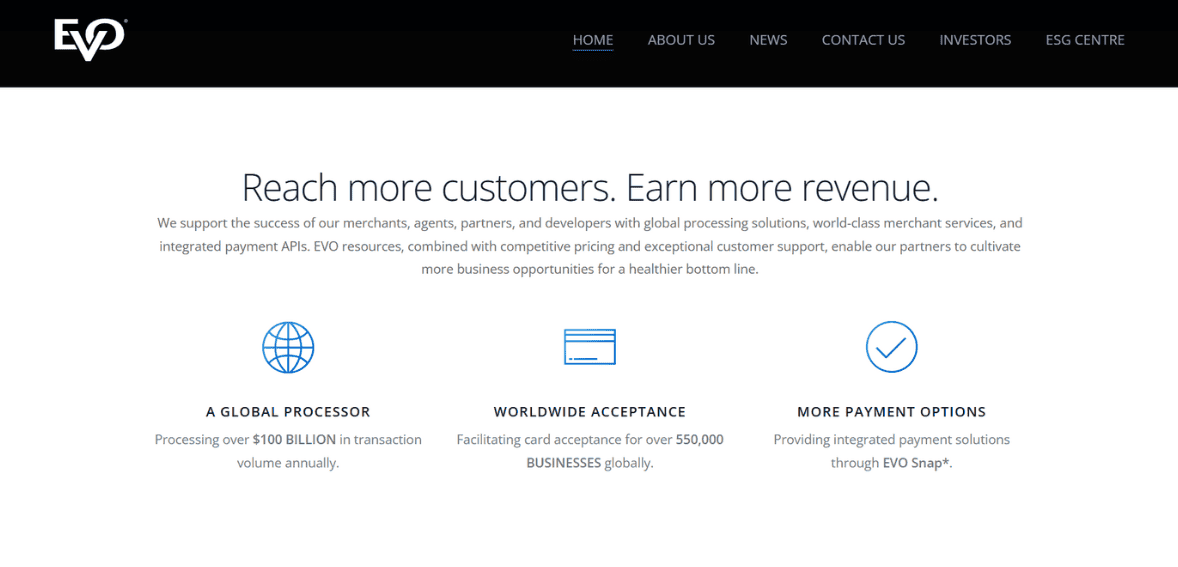
EVO Payments is a global provider of payment technology and service solutions, serving more than 550,000 merchants in retail, hospitality, eCommerce, healthcare, and professional services. It was founded with a simple philosophy-eloquently making digital payments easier in an increasingly complex environment. This organization has gradually expanded into more than 50 markets, empowering businesses to accept in-store, online, mobile, and international transactions. EVO is recognized for its ability to support everything from tiny, one-person operations to giant, multi-continent enterprises, with a broad choice of toolsets designed to ease and expand the acceptance of payments, enhance operation efficiency, and open new avenues for revenue growth. Of course, as a payments company, it has its strengths and limitations, and this review tries to highlight those in detail. Lets read more about EVO Payments Review.

The expectations of security, digital transformation, and omnichannel integrations have grown in the evolving payments industry. EVO, too, operates in such a competitive environment wherein solutions mirror a blend between traditional merchant services and modern digital tools. This review details the assessment of EVO from a number of perspectives, such as features, usability, security, pricing transparency, customer support, and ideal business fits. By evaluating each of these areas independently and objectively, the aim is to assist merchants in concluding whether EVO Payments delivers what they need or if it would be best to find alternative options.

Core Payment Processing Capabilities | EVO Payments Review

EVO Payments has its foundation in its core payment processing engine, which allows businesses to accept payments via major debit and credit cards, contactless payments, chip and pin, and mobile wallets. The payment infrastructure of EVO Payments is capable and reliable for handling large volumes of payments with relatively fast times for authorization and settlement. For most businesses, the functionality offered by EVO Payments works as it should without any issues. It supports card-present and card-not-present business setups.

EVO also supports recurrent billing capabilities, stored card profiles, and various payment options that assist merchants in catering to customer demands. These capabilities make it an apt solution for service sectors, subscription businesses, and industries with regular customers. The organization also provides ACH and electronic check acceptance services, thereby expanding payment capabilities.

However, it should be noted that, while EVO’s core processing functionality remains stable and working well, it doesn’t necessarily have a dramatically different profile compared with other competitors within its industry. Several functionalities overlap with what most mature processors have offered. EVO varies itself slightly within the scope of its global presence and scalable infrastructure, which helps businesses expand with minimal technical hassles.

Nonetheless, EVO’s basic processing tools are stable and fully developed, but it remains essential for merchants to review contract agreements and costs, as well as any additional rates that might be applicable. The system is very efficient, but it still depends on which package an organization decides to subscribe to.

Omnichannel Payment Solutions

EVO Payments offers omnichannel capabilities designed to help businesses unify payment acceptance across physical stores, online platforms, and mobile or unattended environments. This approach is increasingly important for merchants operating in hybrid models, where customers expect consistent payment experiences regardless of where a transaction begins or ends. EVO aims to bridge these environments through integrated systems that communicate with each other, allowing merchants to manage data, reporting, and reconciliation from a single ecosystem.

For brick-and-mortar operations, EVO supports traditional terminals and POS setups, while for online businesses, it offers gateways, hosted payment pages, and API-driven checkout solutions. Mobile payment support is also available through dedicated mobile apps or lightweight readers that connect to smartphones or tablets. This flexibility is helpful for on-the-go businesses or field service operations that need portable payment tools.

EVO’s omnichannel structure allows merchants to offer features like curbside payment, order-ahead transactions, and seamless customer journeys between online browsing and in-store pickup. The system is functional, though not as advanced or deeply integrated as some leading omnichannel-first competitors. EVO’s strength lies more in its broad coverage rather than in cutting-edge innovation within any one channel.

Merchants looking for an all-in-one provider across multiple environments may find EVO’s omnichannel approach convenient. However, businesses that require advanced loyalty tools, personalized customer journeys, or sophisticated retail automation may need to assess integrations or third-party partnerships to fill those gaps.

EVO Payments Review

EVO’s eCommerce and Gateway Tools

EVO Payments provides various tools for online merchants and developers who need flexible, secure, and customizable eCommerce solutions. Its payment gateway supports major shopping cart systems, popular eCommerce platforms, and custom website integrations through APIs. Merchants can enable credit card payments, digital wallets, alternative payment methods, and recurring billing without significant technical barriers.

The gateway includes features like hosted payment pages, fraud management settings, real-time reporting, and the ability to configure payment flows. Developers can use EVO’s API documentation to create more tailored checkout experiences or embed payment capabilities into SaaS platforms and custom applications. While EVO’s development tools are practical and reliable, they may not be as modern or feature-rich as some newer gateways that focus heavily on developer experience.

EVO’s eCommerce tools emphasize security, providing tokenization, encryption, and PCI-friendly checkout environments. These protections help reduce compliance burdens for merchants and minimize exposure to customer data. However, the level of fraud prevention varies based on region and plan, so merchants should verify what is included.

Overall, EVO’s online payment capabilities are competent and suitable for most small to mid-sized businesses looking for steady eCommerce support. Companies requiring ultra-fast integration, advanced analytics, or sophisticated checkout personalization may need additional layers or third-party plugins. EVO excels in reliability and breadth rather than cutting-edge digital commerce innovation.

POS and Terminal Solutions

EVO Payments offers a range of POS terminals and hardware options designed for physical businesses. These include traditional countertop terminals, PIN pads, wireless devices, and smart terminals with touchscreen interfaces. EVO works with multiple device manufacturers, so hardware options vary by region and merchant type. Many devices support EMV chip transactions, NFC contactless payments, and digital wallet acceptance, making them suitable for modern retail environments.

EVO also partners with POS software providers across retail, restaurant, hospitality, and service industries. These integrations allow merchants to bundle payment acceptance with inventory tools, scheduling features, reporting modules, and customer management systems. This network of POS partners offers flexibility, although merchants may need to confirm compatibility with their preferred system.

The usability of EVO’s terminals is generally straightforward. Most devices support quick updates, easy troubleshooting steps, and clear display interfaces. However, some merchants report that certain models may require manual configuration during setup or replacement. This is not unusual in the payments industry but worth noting for businesses with limited technical support.

While EVO’s POS offerings provide solid functionality, they do not always deliver the most modern or feature-rich experience compared to providers that build proprietary hardware ecosystems. EVO’s value lies in its wide selection and compatibility rather than a tightly integrated hardware-software suite.

Global Payment Acceptance and Multi-Currency Support

One of EVO Payments’ stronger capabilities is its global payment acceptance framework, which enables merchants to operate across borders more easily. EVO supports multi-currency processing, allowing businesses to accept payments from international customers while settling in their preferred currency. This is especially useful for hospitality businesses, eCommerce brands with international customers, and companies with overseas branches.

EVO offers Dynamic Currency Conversion in certain markets, giving customers the option to pay in their home currency. The company also provides cross-border settlement options and partnerships with acquiring banks in multiple countries. These features make EVO appealing for businesses with international sales channels or expansion plans. Compared to some domestic-focused processors, EVO stands out in its ability to handle European, North American, and Latin American markets with reasonable consistency. This global infrastructure is a defining part of EVO’s identity and is built on years of international merchant acquiring experience.

However, merchants should be aware that cross-border fees, foreign exchange surcharges, and regional pricing differences may apply. Additionally, certain advanced multi-currency features are only available in specific regions. Businesses expecting heavy international traffic should clarify all associated costs and ensure that EVO’s coverage includes their target markets. Overall, EVO performs well for merchants requiring steady international payment processing, though the value depends on fee structures and the merchant’s transaction volume.

Security, Compliance, and Fraud Prevention

EVO Payments incorporates industry-standard security measures to protect payment data and reduce risk for merchants. The company uses encryption, tokenization, and PCI DSS-aligned systems to ensure that sensitive card information is never stored or transmitted in an unprotected form. These features help merchants remain compliant and reduce potential liability in the event of a breach.

Fraud detection tools vary depending on the region and the specific gateway or POS solution in use. EVO offers features such as address verification, CVV checks, velocity controls, and rule-based screening to limit fraudulent transactions. While these tools are adequate for most small and medium businesses, enterprises with more complex fraud patterns may require additional layers or specialized third-party fraud systems.

EVO also provides resources to help merchants maintain PCI compliance, including guidance on completing self-assessment questionnaires and understanding best practices. This support is practical, though not as hands-on as some premium compliance programs offered by other providers.

It is important to note that EVO’s fraud and risk tools may feel more traditional compared to competitors that heavily invest in machine learning or advanced behavioral analysis. EVO’s focus is on reliability and standard protections rather than next-generation, AI-driven fraud prevention. Overall, EVO’s security framework is solid, industry-compliant, and sufficient for most use cases, but businesses facing high fraud exposure should assess whether additional safeguards or integrations are necessary.

Reporting, Analytics, and Merchant Dashboard Tools

EVO Payments offers reporting and analytics tools that allow merchants to monitor transactions, settlements, refunds, chargebacks, and daily batch totals. The merchant portal provides an organized dashboard where users can view transaction histories, filter data, generate statements, and download reconciliation files. For most small to mid-sized businesses, these tools offer enough detail to manage day-to-day financial tracking.

The reporting interface is functional but not the most modern or visually advanced compared to platforms built with real-time analytics and customizable dashboards. EVO tends to focus on accuracy and completeness rather than visual sophistication or predictive insights. For businesses that need straightforward reconciliation and transaction monitoring, EVO’s reporting is more than adequate. Merchants with more complex needs, such as multi-location enterprises or data-heavy operations, may find the system’s customization options somewhat limited. Integration with accounting software or ERP systems may require API connections or partner platforms, depending on the business model.

Although EVO’s reporting tools serve their purpose well, the experience varies depending on which platform or gateway a merchant is assigned. Some portals are more updated, while legacy systems may feel dated. Businesses should ask which interface they will receive before signing a contract. Overall, EVO’s reporting tools offer solid reliability and are suitable for regular financial management, but businesses accustomed to real-time analytics or advanced dashboards may need supplementary tools.

Integrations and Partner Ecosystem

EVO Payments maintains a broad partner ecosystem that includes software companies, ISVs, value-added resellers, and system integrators. This ecosystem allows merchants to connect EVO’s payment processing with various business management systems, such as POS software, ERP solutions, retail platforms, hospitality systems, and niche industry applications.

Through its APIs and developer tools, EVO enables software partners to embed payment acceptance into their platforms. This is beneficial for SaaS companies looking to streamline checkout experiences or offer integrated payments as part of their service. EVO’s integration capabilities support industries ranging from restaurants and retail to healthcare, property management, and professional services.

However, while EVO’s integration network is extensive, the quality of the experience can vary depending on the specific partner. Some integrations are seamless and well-supported, while others may require manual configuration or additional fees. Merchants should also note that EVO’s development tools may feel more traditional when compared with highly modern, developer-first payment companies. The partner ecosystem remains one of EVO’s strengths because it provides flexibility rather than locking merchants into a single proprietary system. Still, businesses should confirm compatibility with their preferred software and test integrations where possible before committing.

Contract Terms, Pricing Structure, and Fees

EVO Payments uses various pricing structures depending on region, reseller, and merchant profile. Pricing may include interchange-plus, tiered, or blended models, with fees for processing, terminals, compliance, refunds, and chargebacks. Some merchants may encounter early termination fees or long-term contractual commitments unless negotiating alternative terms.

One of the criticisms often associated with EVO is the lack of standardized pricing transparency. Because EVO works through a network of sales agents, ISOs, and partners, pricing can differ significantly from one merchant to another. This is common in the payments industry, but it means businesses should carefully review their contract, request a complete fee breakdown, and clarify any monthly, annual, or incidental charges.

EVO markets itself as providing cost-effective solutions, and in some cases, merchants do receive competitive rates. However, others report unexpected fees or difficulties understanding contract terms. The final value ultimately depends on the specific agreement and the merchant’s transaction volume and risk profile. Businesses considering EVO should ensure they receive a clear written quote, ask about PCI fees, statement fees, equipment leases, cancellation policies, and any optional service costs. Thorough due diligence is essential to avoid surprises.
EVO Payments Review

Customer Support and Service Experience

Customer support is a significant factor when evaluating any payments provider, and EVO’s reputation in this area is mixed. The company offers phone, email, and ticket-based support channels, with availability varying by region. Some merchants report timely assistance and helpful troubleshooting, while others mention long wait times or difficulty resolving issues.

Onboarding support is generally sufficient for most businesses, especially those using standard hardware or common POS integrations. EVO provides documentation and guides for basic setup, though more complex integrations may require additional steps or partner involvement. Chargeback assistance and dispute management tools are available, but the effectiveness depends on how proactive the support team is in each case. Some merchants appreciate the structured dispute process, while others feel responses could be more detailed or faster.

Customer experience with EVO varies widely, which may be due in part to the company’s large network of resellers and third-party agents. Businesses working directly with EVO tend to receive more consistent support, whereas those contracted through intermediaries may face communication gaps. Overall, EVO’s customer support is functional but not exceptional. Merchants should clarify their support channel, response expectations, and escalation options before signing.

Merchant Experience: Usability, Reliability, and Performance

From a day-to-day operational perspective, EVO Payments tends to deliver stable performance, reliable processing, and steady uptime. Merchants generally find that transactions run smoothly, terminals operate as intended, and online gateways process payments without major interruptions. Usability across EVO’s platforms is straightforward, though certain dashboards or legacy systems may feel outdated. Merchants who use EVO across physical and online channels appreciate the consistency of payment acceptance. The experience is dependable, even if not particularly innovative or feature-rich. For many small and medium businesses, this level of functionality is entirely sufficient.

However, some merchants note that occasional delays in settlement or reporting access may occur, particularly during gateway maintenance or peak processing periods. Additionally, the user interface of certain portals varies depending on the merchant’s assigned system, leading to inconsistencies in ease of use. Businesses with technical teams or IT staff generally navigate EVO’s systems with ease, while smaller merchants may require additional support during setup or troubleshooting. Despite these variations, EVO remains operationally reliable across most environments.

Pros and Cons of EVO Payments

Pros

Global presence and multi-currency acceptance suitable for international merchants

Wide range of payment methods and omnichannel support

Large partner ecosystem with many integrations

Stable processing infrastructure and reliable uptime

Flexible hardware and software options across industries

Cons

Pricing transparency can vary depending on reseller

Some interfaces and dashboards feel outdated

Mixed customer service experiences

Fraud tools are adequate but not advanced compared to AI-driven competitors

Certain features vary significantly by region

Overall, EVO offers a practical set of merchant services with strong global capabilities, but its value depends heavily on contract details and merchant expectations.

Ideal Business Types for EVO Payments

EVO Payments tends to work well for businesses that operate across multiple channels or require international payment acceptance. Retail stores, restaurants, hospitality providers, service businesses, and mid-sized eCommerce operations can benefit from EVO’s broad toolset. Companies expanding into new markets or serving global customers may find EVO’s cross-border strengths compelling.

Small businesses can also use EVO effectively, though they should pay careful attention to pricing transparency and contract terms. For larger enterprises, EVO’s integrations and partner network may provide flexibility, but organizations requiring advanced analytics or custom-built payment infrastructure might need supplementary tools.

Businesses looking for cutting-edge technology, highly modern interfaces, or next-level fraud prevention may find other providers better suited to those needs. EVO is strongest where breadth, stability, and international reach are more important than innovation or tightly integrated ecosystems. Overall, EVO fits merchants who want dependable payment processing with reasonable flexibility but do not require premium or specialized payment experiences.

Final Verdict

EVO Payments is a well-established processor offering a wide range of payment options, international capabilities, and a flexible partner ecosystem. The company delivers reliable technology and a broad set of tools suitable for many business types. However, it also has areas where merchants should proceed carefully; particularly around pricing transparency, contract details, and customer support consistency. For businesses that value global payment acceptance, stable processing, and diverse integration possibilities, EVO remains a practical option. For those needing highly modern UIs, predictive analytics, or advanced fraud prevention, EVO may feel more traditional than desired. The overall verdict is that EVO Payments provides solid functionality and dependable performance, but merchants must evaluate their contract terms closely and align the platform’s strengths with their specific operational needs. EVO is not a one-size-fits-all solution, but when matched with the right business environment, it can serve as a capable and reliable payment partner.

FAQs

Is EVO Payments suitable for small businesses?

Yes, small businesses can use EVO effectively, though they should review pricing and contract details carefully to avoid unexpected fees.

Does EVO Payments support international merchants and multi-currency payments?

Yes, EVO is strong in global acquiring and supports multi-currency processing across several regions.

How transparent is EVO’s pricing model compared to competitors?

Pricing varies depending on the reseller or contract. Merchants should request a full fee breakdown before signing.

Ecommpay Review

Ecommpay Review

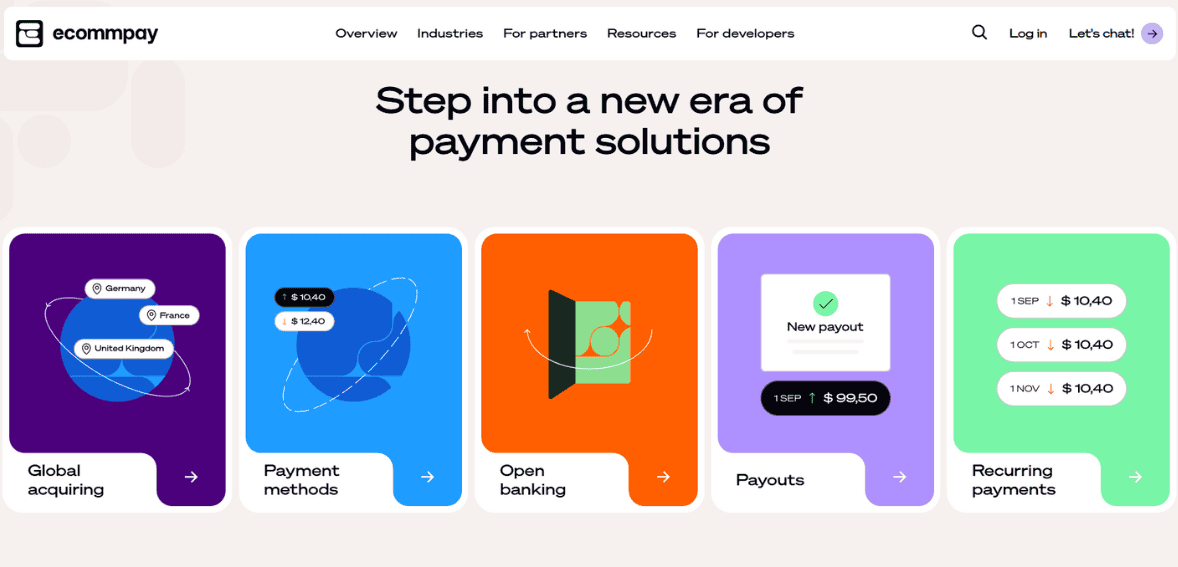
Ecommpay is a global payment service provider known for offering a wide range of payment solutions to businesses looking to accept, process, and manage online payments. With a focus on technological flexibility and international reach, the company has positioned itself as a versatile partner for merchants across e-commerce, travel, logistics, digital services, and subscription-based industries. The platform is built around the idea of providing tailored payment flows that adapt to the specific needs of each business rather than forcing clients into a rigid structure. This approach has helped Ecommpay appeal to companies wanting more control over how they accept payments and manage customer transactions. Lets read more about Ecommpay Review.

Its gateway is designed to handle both common and alternative payment methods, giving merchants access to a large global network. The company supports multiple currencies and provides a unified system for managing transactions, which can make operations smoother for businesses serving international customers. Ecommpay also emphasizes security, compliance, and risk management, which are essential components of modern digital payments. By integrating fraud prevention tools directly into its system, the platform aims to reduce chargebacks and maintain transaction integrity.

Overall, Ecommpay presents itself as a solution for businesses that require both scale and customization. It delivers the features expected from a modern payment provider while also offering the flexibility needed for companies with unique or complex operational models. This detailed evaluation is designed to help businesses decide if the platform is the right fit for them.

Company Background and Market Position | Ecommpay Review

Ecommpay‍‌‍‍‌‍‌‍‍‌ came into existence with the idea of providing merchants with more control over the payment methods they accept and how they manage payments. The company has spread across several regions, mainly in Europe and the United Kingdom, over the years and is now known as a leading payment solution provider to the digitally-driven industries. Its market strategy has been primarily geared towards assisting businesses to work globally and at the same time making compliance and payment routing easy. With such a stance, Ecommpay has been able to go head to head with not only the traditional acquirers but also with the modern fintech companies. 

The company provides the payment processes that are scalable, secure, and customizable to the industries arising from online retail, travel, transportation, digital platforms, and subscription-based services. These industries often have to deal with high transaction volumes, changing regulatory requirements, and the customer’s desire for a seamless checkout experience. Ecommpay’s development has been in line with the trend of digital commerce and cross-border payments, thus, this has enabled the company to be the go-to solution for businesses looking to expand internationally.

Facing tough competition from all sides, Ecommpay manages to set itself apart from rivals by a mix of technology and service. It delivers comprehensive APIs, local acquiring, and alternative payment methods that are up to the mark with the requirements of international merchants. Concomitantly, it provides account management and consulting services to facilitate clients in the most efficient use of their payment flows. Despite being in the same market as the big global payment providers, Ecommpay has managed to establish itself as a flexibility, security, and solutions-tailored company. This has been instrumental in helping it retain a healthy reputation among the firms that are keen on both innovation and ‍‌‍‍‌‍‌‍‍‌support.

Core Payment Gateway Capabilities

Ecommpay’s‍‌‍‍‌‍‌‍‍‌ payment gateway is built with the main goal of managing large transactional volumes rapidly and efficiently while at the same time maintaining the system’s stability. The main operation of the payment gateway is to support, authorize, organize, and settle payments through different payment instruments. To provide seller transactions, the application allows buyers to use card payments, alternative methods, or bank transfers thus, in the case of customers donating in different countries, businesses can make transactions in both of them.

Consequently, the gateway is a perfect fit for companies serving customers who have different payment habits because they can pay in any way they want. Part of the operations involves putting into practice the constant availability of the system as well as the fast data handling speed which are two very important features from the users’ point of view during checkout. 

At the same time, Ecommpay uses intelligent routing logic; thus, the transactions can be automatically sent to the bank or payment method that is most likely to get a successful authorization to the customer. There is a consequent reduction in declines and an improvement in conversion rates especially for customers in regions with banking or payment preferences. There is the opportunity to change payment flows by the use of the gateway on the list of the other not so little advantages of the gateway.

Companies may adjust the transaction flow to harmonize it with their internal operations, experience goals for customers, or even just to follow the directions given by the region they come from. It is also that payment logic, which includes managing retries and enabling one-click or recurring transactions, can be adjusted, and partial payments can be dealt with. 

Thus as a result, features like these are instrumental for subscription services or companies with intricate billing models. At the heart of the payment gateway, the two ideas that seem to be most significant are stability and adaptability. While the majority of payment providers have in their arsenal just standard processing functions, Ecommpay, as an exception, gives merchants the option of granular control over how transactions are handled. Hence, for companies that need a more strategic approach to payment management this is a considerable ‍‌‍‍‌‍‌‍‍‌benefit.

Global Payment Coverage and Local Payment Methods

One of the strengths of Ecommpay is its coverage across multiple regions and its support for a broad range of payment methods. Businesses can accept payments in many major currencies, making the platform suitable for companies with international customers. This coverage includes the UK, Europe, select Asian markets, and emerging digital economies, giving businesses access to diverse customer bases.

Ecommpay enables merchants to accept not only major card brands but also localized payment methods, which often have higher adoption in specific regions. These include digital wallets, online banking-based payments, local card schemes, and other alternative payment options. For merchants targeting customers in countries where card usage is not dominant, this flexibility can significantly improve conversion rates.

Local acquiring is another important element of the platform. When businesses process transactions through regional acquiring banks, they often experience fewer declines and lower processing costs. Ecommpay’s ability to route transactions through suitable local channels helps optimize performance and makes payment acceptance more efficient.

Cross-border commerce continues to grow, and businesses increasingly need payment platforms that adapt to regional preferences. By offering access to both global and market-specific payment methods, Ecommpay allows companies to offer checkout experiences that feel native to customers in each region. This capability can help reduce abandonment rates and build trust with international shoppers. The platform’s global coverage makes it appealing for merchants expanding into new markets, though businesses should still evaluate specific country availability and method support for their regions of interest.

Ecommpay Review

Security Framework and Compliance Standards

Security is central to any payment platform, and Ecommpay places strong emphasis on maintaining compliance with industry standards while offering tools to reduce risk. The company is PCI DSS Level 1 certified, which is the highest level of compliance required for managing cardholder data. This ensures that all card transactions are processed within a secure environment that meets global requirements.

In addition to compliance, Ecommpay integrates advanced fraud prevention tools that help merchants detect suspicious activity, prevent unauthorized transactions, and reduce chargebacks. The platform employs risk scoring, behavioral analysis, and machine learning models to evaluate transaction risk in real time. These tools can be customized to match the merchant’s risk appetite, business model, or regional regulatory constraints.

Strong customer authentication is another key aspect of the security framework. With regulations such as PSD2 in Europe requiring multi-factor authentication, Ecommpay supports the necessary tools to ensure compliant and secure transactions. This includes 3D Secure authentication, which helps validate cardholder identity and reduce fraud.

The company also offers chargeback management features that enable businesses to track disputes, collect evidence, and respond within regulatory timelines. This reduces operational burden and increases the chances of successful dispute resolution. Overall, the platform aims to provide a secure and compliant environment without compromising on customer convenience. Its layered approach to fraud prevention and compliance aligns with industry expectations and helps businesses maintain trust with customers while protecting revenue.

Ecommpay’s Payment Page and User Experience

Ecommpay offers a customizable payment page designed to create a smooth, user-friendly checkout experience. Businesses can tailor the design to match their brand identity, ensuring consistency across the customer journey. This level of customization is especially important for companies that prioritize branding and conversion optimization. A seamless checkout can significantly reduce drop-offs and encourage customers to complete their purchases.

The payment page supports responsive design, making it suitable for mobile users. With a large percentage of online transactions occurring on mobile devices, having a checkout flow that adapts seamlessly to different screen sizes is essential. Ecommpay aims to provide a layout that loads quickly, is easy to navigate, and supports various input types.

Another advantage is the ability to customize the customer journey depending on payment method, location, or transaction type. Businesses may choose to highlight specific payment options based on customer preference or optimize the sequence of input fields to minimize friction. The platform’s payment page also supports multilingual options, helping merchants serve customers from different regions more effectively.

From a user experience perspective, the goal is simplicity and clarity. Ecommpay’s interface is designed to minimize confusion and reduce unnecessary steps. While the platform offers flexibility, businesses must still ensure their design choices align with best practices to maintain conversion rates. Overall, the payment page offers a strong balance between customization and usability. It allows companies to define how their checkout experience should look and feel, while still benefiting from a solid technical foundation and built-in UX best practices.

API, Integrations, and Developer Tools

Ecommpay places significant emphasis on developer support and integration flexibility. Its API is designed to be comprehensive, allowing businesses to integrate various payment functions into their websites, apps, or internal platforms. The documentation is detailed and structured to help developers navigate different endpoints and parameters with clarity. This is important for companies building complex payment workflows that require precise control over transaction handling.

The platform also provides SDKs and plugins for popular e-commerce platforms and development environments. This reduces development time for businesses that prefer ready-made integration tools rather than building from scratch. The availability of libraries for multiple programming languages further enhances accessibility for diverse technical teams.

Ecommpay’s API supports real-time reporting, transaction updates, and payment status notifications through webhooks. These features allow businesses to maintain accurate records, automate reconciliation, and track customer activity without relying heavily on manual processes. The ability to manage refunds, partial payments, recurring billing, and payout operations through the API adds further operational efficiency.

Developers can also customize error handling, data presentation, and interactive elements of the payment flow. This level of customization is valuable for companies with unique billing models or region-specific requirements. Overall, the developer tools offered by Ecommpay reflect the company’s focus on flexibility and control. While implementation may require technical expertise, the platform provides the necessary resources to build reliable, scalable, and tailored payment integrations suitable for diverse business needs.

Ecommpay for High-Risk or Complex Business Models

Ecommpay is frequently chosen by businesses operating in sectors that require non-standard payment flows or higher levels of monitoring. Industries such as travel, transportation, subscription services, marketplaces, and digital platforms often face challenges like fluctuating volumes, long fulfilment cycles, or elevated fraud risk. Ecommpay structures its platform to support these operational realities by offering flexible checkout flows, additional authentication layers, and risk scoring options that can be customized per business model.

For subscription-based companies, recurring billing and tokenization features simplify future transactions. The system securely stores payment credentials, allowing customers to make repeat purchases or subscription renewals without re-entering information. Marketplaces benefit from the ability to manage multi-party transactions, which may involve splitting payments, delaying settlements, or releasing funds upon fulfilment. These capabilities help platforms operate more efficiently while maintaining clear financial records. Travel and transportation businesses often struggle with high refund rates or chargeback risks due to cancellations and dynamic pricing structures. Ecommpay’s fraud protection tools and authentication mechanisms help mitigate some of these risks while providing detailed insight into customer behaviour.

While the platform does not openly advertise itself as a high-risk merchant provider, its support for complex models makes it suitable for industries that require tailored workflows. Businesses still need to undergo risk evaluation, and acceptance may vary depending on regulatory requirements and operational history. Even so, Ecommpay’s flexibility positions it as a strong option for companies with non-traditional or multi-layered payment needs.

Payout and Mass Payments Capabilities

Ecommpay offers payout solutions designed for businesses that need to send funds to customers, suppliers, partners, or internal teams efficiently. The system supports both individual payouts and mass payment operations, which is essential for platforms such as gig marketplaces, affiliate programs, online gaming, and global service networks. Automated payout workflows reduce manual reconciliation and ensure faster disbursement, adding convenience for both merchants and recipients.

The platform supports multiple payout methods, including bank transfers and card-based withdrawals, depending on regional availability. These options make it easier for recipients to access funds in the way that suits them best. Ecommpay also integrates tracking tools that help businesses monitor payout status in real time, reducing delays and administrative errors.

For larger organizations, mass payouts can be scheduled or triggered automatically through API integration. This is particularly useful for industries where payouts occur frequently or at scale. The system is built to handle high volumes while maintaining accuracy and compliance with local regulations. Security is a core component of the payout infrastructure. Each transaction undergoes risk assessment, and the platform supports authentication methods to verify recipients. This helps prevent unauthorized payouts or fraudulent requests, which can be costly for online businesses.

Overall, Ecommpay’s payout capabilities are robust and well-suited for companies that require reliable and efficient fund disbursement. Whether a business is managing a global supplier network or operating a large-scale marketplace, the platform provides the features necessary to keep financial operations running smoothly.

Advanced Features and Value-Added Tools

Beyond its core payment processing capabilities, Ecommpay offers a range of advanced tools designed to help businesses optimize performance and reduce operational burden. One of its key features is intelligent payment routing, which evaluates each transaction and directs it to the most suitable acquiring bank or payment method. This improves authorization rates and ensures transactions follow the most cost-effective path.

The analytics dashboard provides merchants with detailed insights into transaction patterns, customer behaviour, and performance metrics. This helps businesses identify trends, pinpoint decline reasons, optimize checkout flows, and make informed decisions rooted in real-time data. For companies operating internationally, the insights gained from these analytics can significantly influence expansion strategies.

Recurring payments and tokenization tools allow businesses to store payment credentials securely, enabling frictionless repeat purchases and subscription renewals. Smart retry logic automatically attempts failed payments in intervals that increase the likelihood of success, reducing involuntary churn. Fraud prevention features, such as customizable rules, risk scoring, and machine learning algorithms, further enhance transaction security. Businesses can adjust fraud filters based on their own risk thresholds or regional demands.

These value-added features collectively create a more mature and capable payment environment. While many providers offer similar functionalities, Ecommpay’s focus on granular control and adaptability makes its toolset appealing to merchants who want deeper oversight and optimization opportunities. The platform empowers businesses to improve operational efficiency while enhancing the overall customer payment experience.

Pricing Structure and Transparency

Ecommpay does not publicly publish a detailed pricing list, which is common among enterprise-focused payment providers. Instead, pricing is customized based on business size, transaction volume, risk level, and industry. This approach allows companies to negotiate terms that best fit their operational needs but may make early cost comparisons more difficult for smaller businesses evaluating providers.

Typically, pricing considerations include transaction fees, acquiring costs, payout fees, chargeback handling, and the use of advanced features such as fraud management or routing logic. Companies with higher volumes may secure competitive rates, while businesses in high-risk categories might face more stringent requirements or increased costs. The lack of upfront published rates does mean that businesses must engage in direct consultation with Ecommpay to understand total expenses. While this ensures tailored pricing, some merchants may prefer providers with transparent, fixed pricing models.

However, enterprise-focused businesses often expect customized agreements, and Ecommpay’s willingness to structure pricing around specific workflows can be a benefit. The platform’s value depends on the combination of features, international reach, and optimization tools, all of which can justify flexible pricing for companies operating at scale. Ultimately, businesses should evaluate long-term value rather than solely cost. Ecommpay’s pricing may not be ideal for very small merchants with low volume, but for companies needing flexibility, control, and international capabilities, the investment can be worthwhile. Understanding all associated costs during onboarding is essential for accurate financial planning.

Ecommpay Review

Customer Support and Account Management

Customer support is a crucial element of any payment service, and Ecommpay places notable emphasis on providing dedicated account management. Merchants can access assistance through various channels, including email, phone, and technical support lines. For businesses with complex payment setups, the availability of a knowledgeable support team can significantly reduce friction during integration or daily operations.

Account managers play a key role in guiding clients through optimization strategies, compliance requirements, and payment flow design. Their expertise helps businesses adjust routing logic, configure fraud settings, or troubleshoot issues that arise during transactions. This hands-on support distinguishes Ecommpay from some providers that rely primarily on automated or ticket-based systems. Technical support is also available for developers integrating the payment gateway. Access to clear documentation and responsive engineering teams can make implementation smoother, especially for companies building custom workflows.

However, the level of support may vary depending on contract terms and business size. Larger merchants with higher volumes often receive more personalized attention, while smaller companies may experience standard-level assistance. Overall, Ecommpay’s support model aligns with its positioning as a flexible and enterprise-friendly provider. Businesses that value collaborative, ongoing support will likely appreciate the service. Those seeking simple, self-service systems should consider how much interaction they expect and evaluate whether this model matches their preferences.

Pros of Using Ecommpay

Ecommpay offers several advantages that make it attractive for businesses requiring advanced payment capabilities. One of the key strengths is its ability to customize payment flows, giving merchants far more control than many standard payment processors. This customization can improve conversion rates, streamline operations, and support unique industry needs.

Its global reach and support for multiple payment methods allow businesses to enter international markets more confidently. Local acquiring and alternative payment options help improve authorization rates and customer satisfaction. For merchants expanding across regions, this level of coverage can be a major benefit. Security and fraud prevention tools are another highlight. The company’s emphasis on PCI compliance, risk scoring, authentication, and machine learning ensures that transactions remain secure without overly restricting legitimate customers.

The availability of advanced routing logic, analytics, and tokenization further enhances the value of the platform. Businesses operating subscription models, marketplaces, or large-scale operations can benefit from these capabilities. Finally, Ecommpay’s customer support model stands out, particularly for enterprise-level merchants. Dedicated account management provides added confidence when navigating complex payment challenges. Overall, Ecommpay’s strengths lie in flexibility, global accessibility, and robust technology infrastructure. These qualities make it suitable for companies with diverse or evolving payment needs.

Cons or Limitations of Ecommpay

While Ecommpay offers strong capabilities, it also has certain limitations that businesses should consider before committing. One of the primary drawbacks is that the platform may be more complex than necessary for small businesses with simple payment needs. The emphasis on customization and flexibility often appeals to larger merchants but may feel overwhelming for companies that want basic plug-and-play solutions. The lack of transparent pricing can also be a challenge. Without publicly listed rates, businesses must undergo consultation before receiving cost estimates.

This can make early-stage comparisons difficult for merchants evaluating multiple providers. Additionally, while Ecommpay supports many payment methods, availability varies by region. Businesses expanding into less common markets should confirm method support before relying on it as part of their strategy.

Ecommpay’s platform may also require technical expertise to fully utilize its advanced features. Companies without in-house developers might find integration or customization less straightforward compared to simpler payment tools. Finally, some businesses may prefer providers with broader name recognition among consumers or with larger global footprints. Although Ecommpay is well-established, it competes in a market dominated by high-visibility brands. Overall, the limitations do not diminish the value of the platform but highlight the importance of aligning Ecommpay’s capabilities with business size, technical capacity, and operational complexity.

Who Is Ecommpay Best Suited For?

Ecommpay is well-suited for businesses that require more than basic payment processing. Companies operating internationally or dealing with complex billing models will find its flexibility and customization particularly valuable. Industries such as travel, e-commerce, digital services, education, transportation, and subscription-based platforms benefit from its ability to manage high volumes, recurring billing, and multi-party transactions.

Enterprises looking for a payment provider that can adapt to their internal workflows also stand to gain. Ecommpay’s routing logic, fraud management, and analytic tools give merchants control over transaction behaviour, which is essential for optimizing acceptance rates and revenue. Marketplaces and digital platforms needing payout management, automated settlements, or multi-currency capabilities will find the system capable of supporting their operational dynamics.

However, Ecommpay may not be the ideal choice for small businesses with minimal transaction needs or those seeking budget-friendly, plug-and-play payment systems. The platform’s strength lies in customization, scalability, and control rather than simplicity. Overall, Ecommpay is best suited for businesses with global ambitions, complex workflows, or high-volume operations that benefit from advanced payment infrastructure and tailored support.

Final Verdict

Ecommpay is a powerful and flexible payment platform built to support the needs of modern digital businesses. It offers strong global coverage, extensive customization options, and a secure infrastructure designed to handle complex transaction environments. Key features include intelligent payment routing, in-depth analytics, and adaptable checkout experiences, making it especially suitable for companies operating across multiple markets or managing complex business structures. While the platform may not be the most beginner-friendly and lacks full pricing transparency, its enterprise-level tools provide significant value for businesses focused on scalability, performance, and control.

Additional strengths include a reliable payouts system, comprehensive developer tools, advanced fraud prevention, and responsive customer support. Although smaller businesses may find the platform more than they require, growing or specialized companies benefit from its flexibility and technical depth. Overall, Ecommpay is an excellent choice for businesses that need a scalable, globally capable, and performance-driven payment solution.

FAQs

1. Is Ecommpay suitable for small businesses?

Ecommpay can support small businesses, but it is generally better suited for companies with higher volumes or complex payment needs. The platform’s advanced features and customized pricing structure may exceed what smaller merchants require.

2. Does Ecommpay support global payments and multi-currency processing?

Yes. Ecommpay supports a wide range of currencies and payment methods, including local options and digital wallets. This makes it suitable for merchants serving international markets.

3. How long does Ecommpay take to integrate?

Integration time varies depending on technical requirements and customization needs. Businesses with development resources can integrate quickly using Ecommpay’s API and SDKs. More complex setups may require additional configuration and testing.

Ecentric Payment Systems Review

Ecentric Payment Systems Review

Ecentric Payment Systems is a South African payments infrastructure provider that focuses on enterprise-scale transaction processing, settlement, and switching. Unlike popular payment providers that primarily compete in the small business, POS, or simple checkout segments, Ecentric sits in the technical backend of the payments ecosystem. Its solutions are designed more for enterprise-grade use cases and complex payment operations rather than traditional merchant onboarding. Lets read more about Ecentric Payment Systems Review.

Today businesses expect payment systems that integrate across online and in-store. Large retailers, fuel stations and chain stores need more than just a terminal or gateway. They need automated settlement, routing logic, redundancy, reconciliation processes and support for new payment rails. Ecentric sits in this space by providing tools that centralise and orchestrate transaction processing.

The company has become a relevant player in the South African payments market given the region’s strong financial infrastructure and multi-acquirer model. More businesses are looking for a single payment provider who can streamline routing and settlement and handle the complexity behind card network authorisation. Ecentric is not a competitor to payment providers for micro businesses but rather the enterprise side of the payments spectrum where reliability and back office automation matters more than just merchant acquisition.

With digital payments growing in importance Ecentric’s environment is becoming more and more important in the broader payments ecosystem. The platform is being adopted across high volume retail environments because it’s infrastructure driven payment processing not consumer focused POS solutions.

Company Background and Market Position | Ecentric Payment Systems Review

Ecentric Payment Systems is part of the Shoprite Group. This gives it credibility and access to retail transaction data, so it can reach further into enterprise payment flows. The company started out to address transaction switching and routing for organisations that couldn’t rely on traditional banking infrastructure alone. Over time it expanded into reconciliation and omni-channel payment support.

Ecentric is well known in South Africa and other African markets for serving large retailers and chain stores. Its core competitive advantage is the infrastructure for payment routing, including the ability to choose multiple acquirers, increase uptime and control processing logic. Many global payment providers focus on front-end tools like terminals, mobile readers or e-commerce checkout platforms. Ecentric has identified an opportunity on the back-end of retail payments where enterprises need redundancy, stability and visibility into every transaction.

The company operates in a niche segment of enterprise payment platforms where the priorities are different: uptime promises, batch settlement, reporting accuracy and corporate wide connectivity. This makes Ecentric more like back-end switches, settlement engines and reconciliation platforms rather than standard merchant services providers.

Given the omni-channel environment in Africa and the growth of digital commerce Ecentric seems well positioned. The enterprise payments space is competitive and being part of the Shoprite ecosystem strengthens its brand. But since Ecentric is focused on enterprise it’s not suited for very small businesses or early stage merchants which is a limitation for companies looking for high flexibility and quick onboarding.

Core Payment Solutions Overview

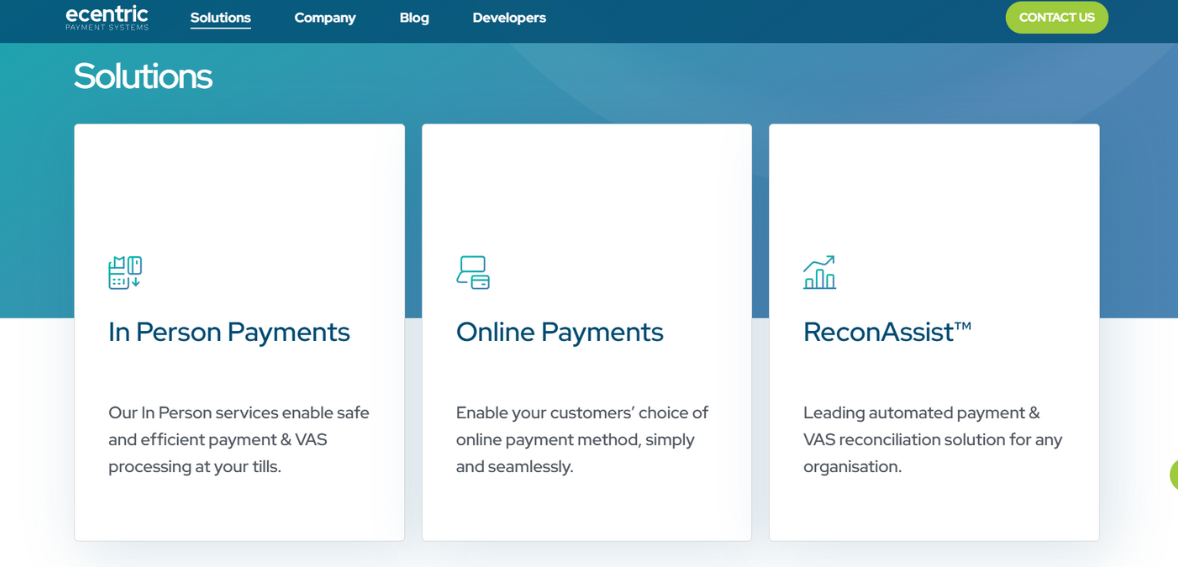
Ecentric bundles several core services that support enterprise-grade transaction flows. These include switching, routing, settlement, reconciliation, fraud controls, and payment reporting. Unlike payment gateways that offer lightweight merchant tools, Ecentric provides a technical infrastructure layer that connects retailers, banks, and networks.

Its core services include:

Payment Switching: Ecentric routes transactions to financial institutions, enabling multi-bank and multi-acquirer environments.

Reconciliation: Large volumes of transactions go through automated reconciliation workflows to avoid manual matching.

Settlement: The system manages daily financial settlement across banks, branches, and retail locations.

Omni-channel Payments: Ecentric supports both online and physical store payments.

Fraud Controls and Compliance: The company includes security and compliance systems to manage transaction risk.

A key differentiator is the focus on payment visibility, allowing businesses to track every transaction. The platform seems built for high-scale transaction flows where processing speed and error reduction are crucial. Settlement and reconciliation solutions are especially important for enterprise and multi-location environments that require automated financial workflows rather than manual adjustments.

Overall, Ecentric’s product suite aligns more with core payment infrastructure than traditional merchant services. It addresses the operational layers that businesses require after the transaction has been captured, such as routing, settlement, and reporting. This framing positions the company as a technical partner in the enterprise payments space rather than a simple POS or gateway provider.

In-Store Payment Processing Capabilities

One of Ecentric’s strengths is in-store retail payments. Retailers need a highly available system that processes large numbers of transactions throughout the day. Card payments, PIN authentication, inventory systems, and POS software all need synchronous communication. Ecentric offers switching capabilities that route transactions without relying on a single acquirer. The ability to integrate multiple banks gives businesses redundancy and potential cost efficiencies.

Reliability is a crucial benefit here. A few seconds of downtime can become costly for a business processing thousands of transactions per hour. Ecentric emphasizes stability and performance as critical areas of focus. The switching engine is designed to maintain uptime and consistent latency, two of the most important requirements in brick-and-mortar retail.

The company also offers multi-channel routing that connects terminals and POS integrations into the core platform. This functionality gives large retailers or fuel chains greater centralized control. Instead of each location independently connecting to a gateway or acquirer, the switching layer synchronizes and routes transactions across their network.

Ecentric supports a variety of card payments, POS environments, and retail use cases. Its enterprise orientation makes it less relevant for small merchants who simply require a standalone POS terminal. Businesses with multi-branch infrastructure benefit more from the system’s payment processing logic and routing control.

Online and Omni-Channel Payments

The move toward omni-channel payments has increased the demand for payment systems that connect online checkouts, in-store purchases, loyalty solutions, and alternative payment methods. Ecentric supports e-commerce transactions and digital payments through its unified platform. The goal is to create a single view of the customer transaction, regardless of channel.

For retailers, using separate solutions for online and in-store creates challenges during reconciliation and reporting. With omni-channel buying models such as buy-online-pickup-in-store becoming more common, payment providers must support consistent routing and settlement across environments. Ecentric enables retailers to connect online networks and card processors and route transactions consistently.

While Ecentric includes online processing capabilities, it is not positioned as a dedicated e-commerce gateway like global SaaS-oriented platforms. Instead, its focus remains on enterprise grade online payments, where integration with settlement and back-office systems matters most. The strength lies in unified payment operations instead of checkout customization.

This reflects a structural choice in Ecentric’s positioning: rather than offering developer-friendly merchant onboarding experiences, it focuses on scalable routing for enterprises already processing large transaction volumes. The omni-channel tools are an extension of this strategy.

Payment Switching and Transaction Routing

Ecentric’s switching engine is one of its most important strengths. The ability to route transactions across acquirers and networks allows retailers to optimize authorizations and reduce potential declines.

Many enterprise retailers prefer not to rely on a single acquiring bank because it introduces risk. Switching enables:

Redundancy

Better Performance

Cost Efficiencies

Reliability

By routing transactions across multiple banks, retailers can also reduce downtime. The routing logic can include fallback scenarios, performance monitoring, and control of routing rules. This infrastructure allows businesses to dictate where and how transactions should be processed rather than relying on default banking infrastructure.

For large businesses, routing flexibility is a compelling advantage. It allows them to negotiate fees, diversify acquirer partnerships, and improve authorization rates. Switching is also valuable from a risk and performance standpoint. However, this setup requires more technical integration and may not be suitable for small or early-stage businesses.

Overall, Ecentric’s switching engine is a defining feature that differentiates it from many payment processors. It underlines the company’s focus on high-availability and enterprise infrastructure rather than small business merchant services.

Ecentric Payment Systems Review

Security, Compliance, and Fraud Prevention

Security is a central requirement in payments, and Ecentric includes several features aligned with PCI compliance, tokenization, and encryption. The company is focused on enterprise-level risk prevention rather than personal identity verification or lightweight fraud filters.

Fraud controls are designed to assist large transaction flows, particularly where the volume of traffic increases risk. Compliance ranges from PCI standards to regulatory requirements for transaction processing. Tokenization and encryption ensure secure card handling and help retailers avoid storing sensitive cardholder details.

Because Ecentric operates inside the enterprise financial systems of major retailers, its role in maintaining secure routing and risk prevention is significant. It serves as a gateway between financial networks and merchant systems, which requires rigorous compliance.

The security tools are effective for enterprises but may be over-engineered for small merchants or startups. Businesses looking for full-stack fraud solutions for e-commerce may find alternatives more suitable. However, for retailers who already have internal fraud controls and require security across switching and settlement engines, the company provides strong compliance and risk management workflows.

Settlement, Reporting, and Reconciliation Tools

Reconciliation and settlement are key enterprise pain points. Large organizations that operate multiple locations, merchant IDs, or acquirers need automated matching between transactions and settlement records. Ecentric offers reconciliation and reporting tools that automate financial workflows. Settlement services help centralize transaction reporting and ensure retailers receive accurate settlement files. Reconciliation workflows remove the need for manual financial matching and reduce accounting risk. Merchants can track settlement timing, identify discrepancies, and generate batch reports.

These systems work well for enterprises with complex financial operations but require technical onboarding and integration. Reporting tools are designed for high-visibility financial control, which is where Ecentric is strongest. Businesses with multi-bank transaction volumes benefit from central reporting dashboards and batch processing. The advantage here is clear: automation reduces human errors and operational overhead for large companies. On the downside, the platform may not be low maintenance for smaller businesses, requiring setup time and integration work.

Integration and Developer Capabilities

Ecentric supports integration into enterprise systems, including POS platforms, banking institutions, and e-commerce platforms. APIs, SDKs, and documentation allow businesses to connect with the processing engine. However, the focus is less on frictionless merchant onboarding and more on infrastructure deployment. Technical teams within enterprises can customize routing flows, settlement files, and reconciliation formats. This flexibility is useful for retailers with internal IT teams who want more control over payments infrastructure.

Compared to developer-focused platforms designed for startups, Ecentric is concentrated on enterprise-grade integrations rather than universal developer simplicity. This profile suits retailers and large corporations but may be a hurdle for businesses without engineering resources. The key takeaway is that Ecentric delivers strong connectivity for enterprise systems but is not a plug-and-play solution for basic merchant onboarding. It is designed for organizations that want infrastructure control rather than quick setup.

Ecentric Payment Systems Review

Industry-Specific Solutions

Ecentric focuses on several enterprise verticals:

Retail

Fuel and convenience

E-commerce

Large enterprises

Corporate payment processing

The platform is most commonly used in retail environments, especially where there are multiple branches and high transaction volume. Fuel stations are another major market where uptime and routing are critical. Multi-branch enterprises also use the system because it supports routing across locations and banking networks. The company is not targeted at micro-merchants, hospitality startups, or single-location businesses. Instead, its focus is on multi-site infrastructure, payment routing, and settlement. Its vertical strength reinforces its enterprise specialization and differentiates it from universal payment processors.

Ease of Use and Platform Reliability

Ecentric is built for reliability and uptime rather than simplified onboarding. Enterprise retailers require stable systems to support large transaction streams daily. The platform includes redundancy, routing rules, and performance monitoring tools that ensure uptime. The usability profile is more suitable for businesses with technical capacity to manage payment infrastructure. It is not a lightweight platform but rather an engineering-driven solution. The company prioritizes processing stability, enterprise monitoring, and settlement control.

Because of this, the learning curve may be higher for teams familiar with traditional payment processors. The advantage is better visibility and control but with more operational management compared to small business-oriented solutions. The reliability is one of the major strengths. Retailers and enterprises benefit from routing control and settlement tools that minimize operational issues. The need for specialization is a potential trade-off.

Customer Support and Service Quality

Customer support for enterprise platforms often involves dedicated account management, specialized integration teams, and SLAs. Ecentric appears to follow this model. Support focuses more on onboarding, routing configuration, system monitoring, and troubleshooting. This is well-aligned with enterprise needs where downtimes are costly.

Large organizations expect support that covers integration, settlement operations, and technical performance. The platform’s customer support is therefore oriented towards engineering communication and financial workflows. Small merchants expecting help with POS setup or simple checkout issues may find enterprise service models excessive. The support ecosystem seems appropriate for enterprises but may not fit businesses in need of basic onboarding support.

Pricing and Fee Transparency

Pricing is not publicly available, which is typical in enterprise payments. Businesses must request custom pricing based on acquirer, routing logic, transaction volume, and settlement requirements. While this model offers flexibility, it also makes comparison difficult. Some merchants may prefer fixed pricing plans. Hidden fees are unlikely given enterprise transparency models, but the lack of public pricing does create uncertainty. Multi-acquirer routing can reduce processing costs, but hardware and integration expenses may apply. Pricing is complex and varies based on the infrastructure required, so small businesses may find it expensive.

Pros and Cons of Ecentric Payment Systems

Pros

Built for enterprise scale

Excellent switching and routing capabilities

Strong reconciliation and settlement tools

High reliability and uptime

Suitable for retailers and multi-location enterprises

Cons

Not designed for small merchants

Integration may require technical resources

Pricing transparency could be improved

Focus on back-office systems, not consumer POS

Conclusion

Ecentric Payment Systems occupies a clear niche in the payments industry. It is not a traditional POS or gateway business. Instead, it provides infrastructure for enterprise transaction processing, routing, and settlement. Its strongest capabilities lie in switching, reconciliation, and enterprise payment routing. For retailers and large organizations that need to operate multiple acquirers or manage high-volume payments, Ecentric is well-positioned. However, businesses without complex enterprise requirements or those needing lightweight onboarding may find simpler merchant solutions more practical. Ecentric excels where payment routing and settlement centralization matter most. As the payments ecosystem continues evolving towards omni-channel commerce, Ecentric remains a meaningful player in the enterprise retail market.

FAQs

Q1. Is Ecentric suitable for small businesses?

Ecentric is primarily designed for enterprise-level and multi-location retailers. Smaller merchants may find the platform too complex or costly, and simpler POS systems may be better suited.

Q2. Does Ecentric support both in-store and online payments?

Yes, the platform supports both channels, with a focus on unified payment routing and reconciliation across environments.

Q3. What makes Ecentric different from typical payment processors?

Its biggest differentiator is enterprise routing and switching, which allows retailers to use multiple acquirers, maintain uptime, and centralize settlement workflows.

Datacap Systems Review

Datacap Systems Review

Datacap Systems is a technology company that offers payment integration solutions that help businesses connect their point of sale (POS) environment with payment processors, terminals, and online commerce platforms. It positions itself as a middleware provider that simplifies the complexity of processing payments across different channels. Instead of acting like a merchant services or processor that sells payment accounts directly, Datacap focuses on the software layer that connects businesses to the processors and hardware they already want to use. It has built its solutions for industries such as retail, hospitality, eCommerce, and enterprise environments. Lets read more about Datacap Systems Review.

The company is best known for allowing merchants and software vendors to pick the technology stack that fits their needs instead of forcing a single proprietary system. This approach is increasingly important in payments because businesses want flexibility in choosing processors and devices without rewriting their existing POS software.

Over time, Datacap has developed a reputation for supporting advanced payment acceptance methods such as EMV, contactless payments, and multi processor routing. Its core value is reducing the need for custom coding or integration for each processor or terminal. Businesses and POS developers do not need to spend time building and maintaining multiple payment connections because Datacap centralizes it. This reduces the integration burden while offering greater control over setup. The platform is designed for long term reliability, processor choice, and hardware independence, and this makes it appealing for companies that want flexibility in their payment infrastructure.

Understanding the Datacap Systems Platform

At its core, the Datacap platform is built to connect the POS or business management system to payment processors, terminals, and online payment environments. It acts as a middleware layer that standardizes these connections, so businesses do not need to build separate integrations for each processor or device. The company offers a family of products including middleware software, remote management tools, terminal control utilities, and online transaction routing features.

These solutions work across brick and mortar POS setups, eCommerce stores, unattended devices, and mobile payment environments. The platform also focuses on creating a processor agnostic environment. This means a business is not limited to one processor or vendor. Instead, it can change its processor or terminal brand without replacing the POS software.

Datacap systems are built around the idea that payments should function consistently across different channels. Whether a customer buys online, in store, or on a kiosk, Datacap solutions help unify the payment experience while preserving flexibility. The platform supports multiple device types and operating systems, including mobile, stationary, and cloud POS setups. The broad compatibility is one of the key differentiators of this system.

Datacap does not force businesses into a specific way of deploying payments but instead adapts to the existing environment. Overall, Datacap Systems is designed to handle complexity in payments in a way that does not overwhelm developers or businesses, and the flexibility is one of the primary reasons it continues to be chosen by software vendors and independent retailers.

Key Features and Capabilities | Datacap Systems Review

Datacap Systems offers several capabilities that make it a strong middleware and payment integration solution. One of the key advantages is device and processor independence. Instead of requiring proprietary hardware or a single payment processor, the platform allows businesses to switch technologies without a major migration. Another important feature is omnichannel payment support. The company offers unified control for card-present and card-not-present transactions, which supports retail, online orders, and remote payment links. This simplifies overall payment management because data flows through a consistent architecture.

Datacap also supports modern payment requirements such as tokenization, encryption, and contactless acceptance. These are no longer niche capabilities. They are considered baseline standards for modern payments, and Datacap includes them as part of the core platform. It also supports remote terminal management, processor routing, configurable device connections, and compatibility across different POS applications. The platform also features developer-friendly tools, documentation, and APIs. This aligns with Datacap’s core philosophy of being integration friendly rather than a closed system.

Other notable features include automated updates, built-in redundancy mechanisms, and tools for scaling multi location environments. It offers terminals for retail counters, mobile payment terminals, kiosks, and unattended payment devices. These capabilities make the platform suitable for businesses that want one consistent setup for multiple environments rather than maintaining different systems for each location or channel.

POS and Software Integration Options

Datacap focuses heavily on POS integration because it is designed to work behind the scenes of payment processing. Unlike merchant account providers that offer proprietary POS systems, Datacap provides a flexible integration layer that works with independent POS developers and hardware manufacturers. It supports a wide range of POS systems commonly used in stores and restaurants. This is especially useful for environments where technology stacks vary across multiple locations. For example, a business using a Windows POS in one location and a mobile POS in another may want a unified payment setup. Datacap solutions are designed to accommodate that flexibility by offering APIs and tools that reduce integration friction.

The platform integrates with processors and merchant service providers through standard communication protocols. It enables one payment interface for multiple processors, which means a company can switch providers without reengineering its POS setup. This is particularly valuable in industries where payment processors are frequently changed for cost or service reasons. Datacap also supports payment gateways used for online commerce, so the business does not need separate systems or integrations for card-not-present processing. The integration process is designed to minimize custom code, so POS developers can shorten deployment times and reduce long-term maintenance. The integration experience is one of the strengths of Datacap Systems because it focuses on interoperability and a consistent architecture.

Datacap Systems Review

eCommerce and Online Payment Support

Datacap Systems is not limited to in-person payment environments. It also supports eCommerce and card-not-present transactions through online integration tools. This includes support for checkout forms, online payment gateways, payment links, and hosted checkout pages. These tools are important because they allow businesses to accept payments online without implementing separate platforms. Datacap also supports tokenization for recurring billing and repeat customer transactions. This means sensitive card data is not stored by the merchant, which reduces risk and compliance requirements.

For businesses with both online and offline operations, the platform simplifies omnichannel commerce. Payments can be processed through a unified infrastructure so that reporting, processor routing, and device management do not become fragmented across separate platforms. The platform supports multiple payment types including debit, credit, contactless, mobile wallet, and various digital payment methods. Another advantage of Datacap’s online support is compatibility with a variety of shopping carts, gateways, and order management systems. It does not restrict the business to a single provider or technology ecosystem.

Businesses that rely heavily on unified commerce systems will appreciate the cross channel capabilities offered by Datacap. While there are dedicated eCommerce platforms with more advanced marketing and checkout tools, Datacap’s strength is enabling payments that work consistently across all environments. It is best positioned for businesses that want simplicity, processor flexibility, and unified payment management rather than extensive eCommerce customization tools.

Multi Processor Compatibility and Flexibility

Datacap’s processor agnostic model is one of its biggest value propositions. Traditional payment providers often require merchants to stay within a single network or proprietary hardware environment. Datacap removes that limitation by supporting multiple processors through a standardized integration layer. This allows businesses to change processors without disrupting their POS setup or device infrastructure. It is highly beneficial for merchants that want more negotiating power with processors or want to avoid being locked into a single contract.

The flexibility extends to transaction routing and processor switching. Businesses that expand into new regions may want different processing partners, and Datacap offers the architecture to support this. Multi processor compatibility also benefits software vendors because it allows one integration to serve multiple merchant types. This reduces development costs and increases deployment speed.

From a technical perspective, the system is built to work with multiple terminal types and device manufacturers. This is a major advantage for retailers and restaurants that do not want to replace their hardware when switching processors. The flexibility is excellent for long term scalability, but businesses that prefer a fully packaged solution may find the architecture more technical than a closed platform. Datacap offers a practical balance by remaining integration focused while maintaining compatibility across different payment environments.

Hardware and Terminal Support

Datacap supports a broad range of terminal and device options from leading hardware vendors. This is appealing for businesses that want freedom of choice in their payment equipment. The platform works with traditional countertop terminals, wireless payment devices, mobile payment tools, and unattended payment hardware for kiosks or vending environments. It also supports contactless and EMV devices, which are becoming standard for most merchants.

The hardware flexibility is useful for businesses that need a consistent system across multiple locations or device types. Instead of building separate integrations for different terminals, the merchant connects everything through Datacap. Remote terminal management is another important capability. Businesses can deploy and update terminals without manually configuring each device. This is especially useful for multi location retailers, franchise operators, or enterprises that want centralized management.

The hardware independence aligns with Datacap’s core approach of reducing proprietary technology dependencies. Businesses that already have investment in specific terminals or devices can continue using them without replacement. While some processors and merchant services providers offer similar flexibility, Datacap focuses entirely on being a universal connection layer. This makes the platform a strong fit for businesses that prioritize long term flexibility and avoid hardware lock in.

Security and Compliance

Security is one of the most important requirements in the payment industry, and Datacap includes multiple features designed for secure payment acceptance. The platform supports EMV chip technology, device encryption, and tokenization. These reduce the risk of card data theft and help businesses manage compliance. Tokenization is particularly beneficial because it replaces sensitive card numbers with unique tokens. This allows merchants to process repeat transactions without storing cardholder data.

Datacap also supports secure integration and remote device configuration through standardized communication methods. It is designed to help businesses comply with PCI requirements by ensuring card data does not pass through the POS software unprotected. Security also applies to online transactions. The platform supports tools that protect data in transit and limit fraud exposure. Although security is a shared responsibility between the merchant, processor, and middleware provider, Datacap’s system is designed with security as a core principle rather than an optional feature.

For businesses that want reassurance about compliance, Datacap provides documentation and technical guidelines to ensure proper setup. It does not take a minimalist approach to security but includes encryption and tokenization across its architecture. Overall, the platform provides strong support for modern payment security standards while still maintaining flexibility and multi channel integration.

Datacap Systems Review

EMV, Contactless, and Modern Payments

Datacap Systems supports a wide range of payment methods that have become standard in both retail and eCommerce environments. This includes EMV chip card transactions, contactless payments, mobile wallets, and QR based payments. Contactless acceptance is particularly important as consumer behavior continues to shift toward tap and mobile wallet transactions. Datacap integrates with terminals that support tap-to-pay and other forms of touchless checkout.

The platform also handles secure EMV payments, which are required in most retail environments to reduce fraud. EMV is no longer optional for most merchants, and Datacap incorporates it into the standard architecture. For mobile payment acceptance, the system supports integration with terminals that accept Apple Pay, Google Pay, and similar wallet systems. This enables merchants to offer a modern checkout experience.

Another modern payment trend supported by Datacap is omnichannel checkout. This allows customers to start transactions online and complete them in store or vice versa. The platform is built to handle these scenarios without requiring separate systems. Businesses that want to adopt modern payment methods will find Datacap suitable because it does not restrict them to legacy processing systems. The support for EMV and contactless payments may not be unique compared to competitors, but it is implemented in a flexible and scalable way that fits with the rest of the platform.

Pricing Model and Cost Considerations

Datacap Systems does not follow a traditional merchant services pricing model because it does not operate as a payment processor. Instead, the pricing structure typically involves software licensing, integration, and device deployment costs. The exact pricing can vary based on the POS provider, processor partner, and deployment requirements. Some merchants will work through an integration partner who bundles Datacap with other payment services. This means pricing may not always be directly published, and costs can differ depending on the reseller or deployment environment.

One advantage is that Datacap is often more cost predictable compared to platforms that take payment residuals. Businesses do not pay based on the number of transactions or volume but instead on licenses and software installation. This can be cost effective for merchants with consistent transaction flows across multiple channels. However, costs can increase if businesses add multiple terminals or require advanced deployments.

Datacap also offers value by reducing switching costs when migrating between processors. This can save money in the long term because businesses do not need to rebuild their payment infrastructure. While some platforms offer all-in-one pricing, Datacap maintains a modular model that suits businesses that want control over the processor and merchant account costs.

User Experience and Deployment

The user experience of Datacap Systems is highly dependent on how it is deployed because it operates behind the scenes. Many merchants will interact more with their POS system than with Datacap’s tools. However, the deployment is generally designed to be straightforward for developers and merchants using supported devices. The integration process is guided by documentation and standard APIs. Setup can be faster compared to building proprietary integrations.

From an operational perspective, Datacap focuses on reliability and consistency across different environments. It reduces complexity by offering one integration for multiple processors and devices. Remote device configuration simplifies multi location rollout and ongoing updates. While some businesses might prefer a fully packaged merchant services solution, Datacap is more suitable for companies that prioritize flexibility. It requires a more technical approach compared to platforms that handle everything for the merchant. This is not necessarily a disadvantage because the flexibility delivers long term value.

Overall, the user experience is positive for merchants and developers who want a system that fits into their existing infrastructure rather than replacing it. The learning curve is lower for businesses already familiar with POS integrations and payment processing technologies.

Customer Support and Developer Resources

Datacap Systems provides technical documentation, developer tools, and integration support resources to assist businesses during deployment. Because the platform is designed to serve POS developers, VARs, and processors, the support model includes more technical detail compared to payment processors that focus on merchant support. Developer resources include integration guidelines, configuration instructions, and troubleshooting tools. This is valuable for businesses deploying the platform across multiple systems because it minimizes custom coding and reduces setup complexity.

Datacap offers customer support channels for integration issues and long term system maintenance. The company focuses on helping organizations configure hardware, set up multi processor routing, and manage device deployments. While support experiences can vary based on the reseller or integration partner, Datacap itself has a strong history of supporting complex deployments through standardized tools. The company provides updates, remote management features, and software enhancements that maintain compatibility with evolving payment security standards.

Businesses that prefer highly packaged support might find integration focused platforms more technical, however the documentation and ecosystem approach of Datacap is one of its strengths. The platform is built to support collaboration among POS developers, processors, and merchants rather than functioning as a single vendor ecosystem.

Strengths and Advantages

Datacap Systems offers several advantages for businesses that want flexibility in payment technology. One of the biggest strengths is processor independence. Merchants are not locked into a single processor or proprietary terminal environment. This supports long term scalability and cost control. The platform also supports omnichannel payments, which is becoming more important as customers shop across multiple environments.

The hardware independence is another strength. Merchants can keep using their existing payment devices or select new ones without changing their POS. The platform’s security capabilities include tokenization and encryption, both of which are essential for modern payments. The integration friendly design also benefits POS developers. It reduces the need for custom code and shortens deployment cycles.

Datacap is suitable for businesses that want more control over their payment architecture. It does not restrict processor choice or force a particular hardware system. The breadth of device and software compatibility makes it suitable for multi-location retailers, enterprises, and software companies that want to scale. Overall, Datacap’s value lies in reducing complexity and increasing flexibility when managing payments across different systems.

Limitations and Areas for Improvement

While Datacap Systems offers flexibility and broad compatibility, it is not a one-size-fits-all platform. The first potential limitation is that it is more technical than all-in-one merchant service providers. Businesses that want a fully packaged system might find the middleware model more complex. Another area to consider is pricing transparency. Because Datacap is often sold through partners, the cost structure may not be as straightforward or published as widely as processor pricing plans.

Datacap also relies on the POS ecosystem for some elements of user experience. This means the merchant experience can vary depending on the provider or reseller. Another consideration is that Datacap does not offer extensive marketing or eCommerce tools found in dedicated online platforms. Its focus is payment integration rather than business management features.

Although the platform is strong on flexibility, it may require more involvement from technical teams or integration partners. This is not necessarily a disadvantage, but businesses should understand that Datacap is a middleware system rather than a standalone payment solution. Overall, Datacap Systems is best suited for companies that want control, choice, and customization rather than a bundled solution.

FAQs

  1. Is Datacap Systems suitable for small businesses?

Yes, Datacap can work for small businesses, particularly those that want flexibility in choosing hardware and processors. However, small businesses that prefer a packaged solution might choose a fully bundled POS and processing system instead.

2. Does Datacap support multiple payment processors?

Yes. Multi processor compatibility is one of the platform’s core strengths. It supports switching or routing transactions without rewriting the POS or device configuration.

3. Which industries commonly use Datacap Systems?

Datacap is used across retail, hospitality, restaurants, convenience stores, eCommerce setups, and software vendors that need flexible payment acceptance tools. It is especially useful for multi location businesses and POS developers.

Curbstone Corporation Review

Curbstone Corporation is an enterprise-focused payment technology provider known for its secure, compliant, and performance-oriented solutions tailored to mid-market and large businesses. Its platform is designed specifically for organizations that need high-volume processing, robust security controls, and tight integration with existing systems. Unlike all-in-one merchant service providers that target small or general-purpose merchants, it focuses on secure infrastructure rather than acquiring services, allowing businesses to retain their own processors while upgrading payment architecture. This specialization helps companies reduce PCI scope, modernize legacy environments, and streamline operational workflows without restructuring their merchant relationships. Lets read more about Curbstone Corporation Review.

In today’s environment where compliance expectations, fraud risks, and customer demand for seamless transactions continue to rise, solutions like Curbstone play a role in helping businesses maintain reliability across both card-present and card-not-present transactions. Curbstone’s positioning appeals to organizations that rely on stability and control, such as manufacturers, distributors, retail chains, and enterprises operating within complex IT landscapes. Its platform emphasizes consistency, predictable throughput, and tight security boundaries, making it attractive to businesses facing intricate operational or integration challenges.

This review provides a detailed assessment of Curbstone’s core ecosystem, architecture, security philosophy, usability, pricing considerations, and fit for different types of organizations. With a balanced lens, the following sections break down how Curbstone functions, where it performs best, and where certain businesses may find limitations. The goal is to help readers understand the platform without leaning toward promotional tone or marketing assumptions, focusing instead on clarity and fair insight into Curbstone’s capabilities and practical value.

Company Background and Core Philosophy | Curbstone Corporation Review

Curbstone Corporation was built with a clear focus on secure enterprise payments, especially for environments where data control, infrastructure stability, and compliance minimization are top priorities. Unlike many modern payment platforms that prioritize rapid onboarding or plug-and-play simplicity, it takes a more infrastructure-centric approach. It focuses heavily on reducing risk, improving system integrity, and creating an environment where sensitive cardholder data does not enter a merchant’s local environment. This philosophy is reflected in its technical framework, which centers on remote tokenization and data redirection rather than local processing.

The company has a long history of working with organizations running on IBM i (AS/400) systems, a segment with unique architectural requirements. Over time, Curbstone has broadened its offerings for hybrid environments, but it has maintained its foundational alignment with enterprises that rely on custom systems, on-premise deployments, and performance-sensitive operations. This background shapes the platform’s functionality and makes it distinct from cloud-native providers that cater mainly to modern SaaS ecosystems.

Curbstone’s mission revolves around enabling businesses to manage payments securely without sacrificing speed or customization ability. Its emphasis on deterministic performance, stable throughput, and long-term operational consistency reflects an enterprise mindset rather than a startup-oriented approach. The company prioritizes transparency around security processes and aims to give merchants greater control instead of bundling payment services behind opaque layers.

Overall, Curbstone’s background and philosophy appeal to businesses seeking reliable, deeply integrated, and compliance-friendly payment infrastructure rather than flexible, front-end driven commerce tools. It is a niche but important profile for enterprises with specific requirements.

Overview of Curbstone’s Payment Processing Ecosystem

Curbstone offers a structured payment ecosystem designed to streamline how enterprises process transactions across different channels. Its solutions encompass card-present, card-not-present, e-commerce, and integrated workflows where payments must fit tightly into operational systems. The architecture offloads sensitive data handling away from merchant systems, layering secure gateways, tokenization, and API-driven processes to minimize PCI exposure. This design means merchants retain control over their business logic while relying on Curbstone for secure transmission and authorization.

The ecosystem includes middleware and communication layers that allow merchants to interface with acquiring banks and processors. Curbstone is processor-agnostic, giving businesses the flexibility to continue existing relationships or negotiate new ones without platform constraints. This separation between technology and acquiring services is a defining characteristic of the Curbstone model. It enables enterprises to enhance security and efficiency without changing processors or disrupting financial workflows.

Curbstone’s system supports traditional retail payment flows, order-entry environments, batch processing, and even large-scale EDI-driven settlements. Its ability to work with on-premise infrastructure, legacy applications, and hybrid architectures distinguishes it from cloud-centric payment solutions. By supporting enterprise-grade connectivity, distributed environments, and multi-system orchestration, it positions itself as a backend infrastructure enhancer rather than a standalone payment tool.

Overall, Curbstone’s ecosystem is built for predictability and control. It enables enterprise-level performance while ensuring that sensitive data is securely segregated. Organizations with complex workflows often find value in this structured, compliance-driven integration environment that bridges traditional IT with modern payment requirements.

Security Framework and Compliance Standards

Security is the backbone of Curbstone’s platform. The company is known for offering PCI Level 1 compliant solutions designed to significantly reduce the compliance scope for merchants by removing cardholder data from their systems. Curbstone relies on tokenization, secure redirection, and encrypted communication channels to ensure that sensitive information never enters the merchant’s environment. This strategy helps enterprises reduce risk exposure, lighten audit requirements, and limit the operational overhead tied to PCI DSS controls.

The security framework includes robust encryption protocols, key management practices, and behavior that aligns with modern standards for cardholder data protection. Curbstone’s architecture minimizes data retention and ensures that merchants never store primary account numbers or sensitive authentication data. This principle of data minimization is a standard practice across the payment industry, but Curbstone’s implementation is tailored specifically for environments where the merchant controls infrastructure, such as IBM i or on-premise deployments.

Curbstone’s secure design extends to remote tokenization, where tokens replace sensitive data for recurring transactions, card-on-file workflows, and automation processes. This maintains operational convenience while preserving strict data protection boundaries. The platform integrates with processor security layers and supports compliance controls such as logging, auditing, and traceability.

While Curbstone’s security posture is strong, organizations still need to ensure proper implementation and maintain security hygiene on their internal systems. Curbstone helps minimize PCI exposure but cannot eliminate all merchant responsibilities. Nonetheless, for enterprises seeking reduced compliance complexity, Curbstone offers a mature and dependable model rooted in best practices.

API Integrations and Developer Experience

It provides a structured API environment geared primarily toward enterprise developers working with IBM i systems, custom ERP platforms, and specialized operational applications. Its API design focuses on clarity and predictability rather than broad flexibility. Developers interact with stable endpoints that govern authorization, settlement, transaction lookup, card tokenization, and operational automation. While the APIs may not offer the modern flair or extensive libraries seen in some newer payment platforms, they are designed to perform reliably in environments where consistency is essential.

Documentation is functional and includes details relevant for technical teams with experience in enterprise integration. Curbstone’s developer experience is not intended for beginners or rapid prototyping; instead, it suits structured IT departments familiar with enterprise transaction flows. The platform also supports test environments to validate integration behavior before deployment. This testing approach is valuable for teams managing mission-critical applications that cannot tolerate errors or downtime.

Curbstone’s APIs support synchronous and asynchronous workflows, enabling flexibility for businesses that rely on batch processes or real-time authorization. The availability of SDKs may vary, but its primary strength lies in direct API communication supported by clear specifications. Integration is typically managed by enterprise developers, consultants, or Curbstone specialists who understand legacy system behavior.

Overall, the developer experience is functional and reliable but not targeted at fast-moving SaaS developers. It works best for structured teams building stable, long-lived integrations within enterprise ecosystems.

Curbstone Corporation Review

Transaction Types and Payment Channels Supported

Curbstone supports the core transaction types businesses need to operate across multiple channels. These include authorizations, captures, settlements, voids, refunds, and batch operations. For card-present workflows, Curbstone supports EMV, secure terminals, retail counter environments, and order-entry applications where staff manually enter payment details. For card-not-present and e-commerce flows, the system supports real-time authorizations, recurring payments, stored-card workflows via tokenization, and payment operations tied to ERP order systems.

The platform handles pre-authorization and delayed capture, which is important for businesses that ship orders after processing or manage fulfillment via stages. Curbstone’s approach also accommodates large batch settlements for organizations processing hundreds or thousands of orders daily. The ability to handle IVR and call center payments through secure redirection extends its reach to remote payment environments.

Curbstone does not attempt to replace full-featured e-commerce front ends or subscription management platforms; instead, it positions itself as a secure backbone for performing the financial operations behind such systems. This is useful for enterprises that need reliable processing but prefer to build or maintain their own business logic, CRM, or workflows. The platform’s alignment with enterprise architecture ensures that high-volume and high-complexity environments receive stable, predictable transaction handling.

While Curbstone supports most standard transaction types, businesses requiring cutting-edge payment experiences, alternative payment methods, or global expansion capabilities may find limitations. The platform excels in traditional payment categories and enterprise infrastructure rather than emerging or consumer-facing payment innovation.

Curbstone Connect for On-Premise and Hybrid Environments

Curbstone Connect is a notable part of the company’s approach to supporting businesses that rely heavily on on-premise or hybrid infrastructure. Many enterprises, especially those using IBM i or proprietary systems, cannot fully adopt cloud-only payment solutions due to regulatory requirements, performance needs, or operational dependencies. Curbstone Connect helps bridge these environments by externalizing sensitive processes and routing them through a secure PCI Level 1 environment while maintaining local business logic.

This design lets organizations maintain control over their core systems while benefiting from the security advantages of an outsourced data-handling layer. It supports synchronous and asynchronous operations depending on how merchants structure their workflows. For example, call centers requiring immediate responses can use synchronous flows, while batch processing or EDI-driven workflows can run asynchronously to reduce bottlenecks.

Curbstone Connect enables secure communication channels, tokenization, real-time transaction management, and stable API communication without exposing on-premise systems to sensitive cardholder data. Its architecture helps businesses limit PCI scope even when operating complex legacy systems. This approach is particularly valuable for merchants upgrading from old, locally processed payment systems where compliance challenges are more severe.

While Curbstone Connect is robust for enterprise environments, it is best suited to teams with the technical resources to manage hybrid integration. Small businesses or organizations seeking turnkey cloud-native solutions may find this architecture unnecessarily complex. For its intended audience, however, Curbstone Connect delivers reliability and compliance support tailored to deep, infrastructure-level integrations.

Performance, Scalability, and Reliability

Curbstone places significant emphasis on predictable performance and high-volume scalability. Its platform is designed for enterprises that process large numbers of transactions daily, often with peaks during fulfillment cycles or seasonal demand spikes. The architecture supports consistent throughput, optimized batch operations, and real-time responses where necessary. This makes it suitable for organizations operating large order-entry systems, distribution networks, or multi-location retail structures.

A key advantage of Curbstone’s infrastructure is its resistance to latency fluctuations that can impact cloud-based systems during heavy demand periods. The combination of local control and secure redirection allows businesses to maintain performance even with complex internal workflows. Many organizations rely on Curbstone for deterministic behavior, meaning transaction processing behaves consistently regardless of volume or environmental changes.

In terms of reliability, Curbstone focuses on stability and continuity rather than rapid innovation. This approach ensures enterprises experience fewer unexpected changes, API disruptions, or architectural shifts. Its systems are built to integrate with long-lived IT ecosystems, where reliability outweighs feature velocity. Uptime and responsiveness are prioritized, aligning with the needs of businesses where downtime can hinder operations.

Scalability is particularly valuable for organizations expanding their product lines, customer base, or locations. While Curbstone’s model is not optimized for global expansion or alternative payments, it performs strongly within domestic, high-volume card environments. For enterprises requiring infrastructure-grade stability and predictable performance, Curbstone delivers a dependable model aligned with long-term operational efficiency.

User Experience and Operational Efficiency

Curbstone’s approach to user experience focuses more on operational staff efficiency and transaction dependability than visual design or advanced UI features. Its systems operate largely behind the scenes, integrated deeply into merchants’ existing workflows. Instead of offering a broad suite of dashboards or interactive reporting screens, Curbstone provides administrative tools that emphasize security, transaction visibility, and support for IT teams overseeing processing activity.

Operational efficiency comes from automated processes, predictable transaction behavior, and streamlined reconciliation workflows. By keeping card data out of internal systems, Curbstone helps reduce manual compliance tasks and limits interruptions tied to security handling. This is particularly useful for organizations where staff rely on stable, repeatable workflows rather than dynamic or design-heavy interfaces.

For teams that manage large volumes of orders or recurring transactions, Curbstone’s tokenization and secure redirection simplify the payment process while reducing dependency on sensitive data. Staff can operate within familiar systems—such as ERP order-entry modules—without having to switch to external interfaces. This reduces training overhead and supports consistent productivity across teams.

While Curbstone offers reliable operational experiences, it is not built for merchants seeking modern analytics dashboards, customization-heavy interfaces, or consumer-facing tools. The platform’s strength lies in being invisible to end users while enabling secure, efficient payment processing within enterprise environments. For organizations focused on backend stability rather than frontend presentation, Curbstone provides a solid operational foundation.

Integration with Enterprise ERPs (Including IBM i Ecosystem)

Curbstone’s strongest alignment is with enterprises that operate on IBM i (AS/400) platforms and similar legacy or custom systems. This alignment stems from decades of experience integrating with order-entry modules, warehouse systems, and manufacturing workflows common in such environments. Curbstone’s APIs and communication architecture allow businesses to process payments directly from within their ERP without transferring cardholder data into the system.

The IBM i ecosystem relies on predictable processes, structured data handling, and tight integration between operational modules. Curbstone’s payment model complements this structure by offering secure redirection, stable transaction processing, and tokenization compatible with custom or proprietary applications. This helps enterprises maintain long-lived infrastructures without introducing compliance vulnerabilities.

Integration with non-IBM systems is also supported through standard APIs. Middleware connectors and hybrid configurations allow businesses using on-premise ERP solutions to incorporate Curbstone without major architectural changes. This flexibility enables organizations to modernize payments without modifying the backbone of their operational systems.

Curbstone’s ERP integration philosophy centers on low disruption, long-term reliability, and minimized PCI exposure. The company’s platform acts as a secure bridge between internal workflows and external processors, ensuring that payment operations remain consistent regardless of back-end complexity. This is particularly appealing for enterprises where ERP customization is extensive and replacing systems would be costly or impractical.

Pricing Structure and Total Cost of Ownership

Curbstone’s pricing generally follows an enterprise-oriented licensing model rather than per-transaction fees. Merchants typically pay for software licensing, implementation, and ongoing support. Because Curbstone is not a merchant acquirer or processor, businesses continue paying processing fees directly to their chosen provider. For many enterprises, this separation provides transparency and freedom to negotiate processing rates independently.

The total cost of ownership depends heavily on integration complexity, infrastructure requirements, and the breadth of payment channels implemented. Organizations operating IBM i systems or custom ERPs may require specialized development resources, which can add to initial project costs. However, once implemented, Curbstone solutions are built for longevity and do not require frequent architectural changes.

Businesses evaluating cost must consider the potential savings in PCI scope reduction. By removing cardholder data from their systems, enterprises may reduce audit burdens, infrastructure costs, and compliance-related operational tasks. These savings offset licensing expenses for many organizations, though the exact impact varies by environment.

Curbstone may not be cost-effective for small businesses or companies seeking simple plug-and-play payment solutions. Its pricing is geared toward enterprises that require secure, integrated payment infrastructure rather than lightweight or entry-level solutions. For organizations with significant transaction volume or complex workflows, the investment often aligns with long-term operational value.

Curbstone Corporation Review

Customer Support and Technical Assistance

Curbstone offers enterprise-level support with a focus on technical stability and long-term reliability. Its support model typically includes access to engineers familiar with IBM i systems, hybrid environments, and complex integration requirements. This expertise is valuable for organizations that require precise alignment between payment processes and internal applications.

Support is structured around maintaining secure communication channels, resolving integration issues, and ensuring ongoing compliance. Documentation is available for integration teams, and Curbstone provides guidance during implementation to help merchants correctly configure their environments. This support continues after deployment through updates, troubleshooting, and assistance with changing compliance requirements.

One of Curbstone’s strengths is its technical depth, especially for legacy or hybrid environments that many modern payment providers do not handle well. Enterprises with detailed customizations often rely on support teams that understand the intricacies of their architecture.

On the other hand, organizations accustomed to self-service options, quick-start wizards, or large-scale help centers may find Curbstone’s support model slower or more formal. Because the platform is built for complex enterprise use cases, support tends to be structured and technical rather than consumer-style or immediate.

Overall, Curbstone offers strong support for its target audience, but businesses seeking simple or rapid onboarding may prefer a more consumer-friendly payment platform.

Pros and Cons of Curbstone Corporation

Pros

Curbstone excels in secure, enterprise-grade payment processing for organizations with structured workflows, custom ERP systems, and complex infrastructure needs. Its architecture minimizes PCI exposure, supports deterministic performance, and integrates deeply with IBM i and hybrid environments. The platform provides high reliability, stable throughput, and long-lived compatibility with enterprise systems. Its focus on processor-agnostic technology also gives merchants freedom to select or negotiate processing relationships independently.

Cons

Curbstone is not designed for small businesses or merchants seeking modern e-commerce UI tools, built-in invoicing, or alternative payment method support. The platform’s integration process may require technical expertise, particularly for IBM i systems. Its feature set leans heavily toward traditional card payments rather than expanding into newer digital wallets or global payments. Additionally, Curbstone’s support model is oriented toward enterprise-level requirements, which may not suit organizations looking for self-service simplicity.

Ideal Use Cases and Who Curbstone Is Best Suited For

Curbstone is best suited for mid-sized and large enterprises that rely on secure, stable, and deeply integrated payment systems. Organizations operating on IBM i infrastructures, custom ERPs, or on-premise applications benefit most from Curbstone’s architecture. The platform is ideal for companies processing high transaction volumes, running multi-stage fulfillment systems, or requiring predictable batch and real-time operations.

Industries such as manufacturing, wholesale distribution, multi-location retail, and logistics frequently find Curbstone useful because their operations depend on consistent backend payments rather than consumer-facing interfaces. It is also a strong fit for organizations with strict compliance requirements or those seeking to reduce PCI scope without rearchitecting core systems.

Businesses seeking modern payment features like digital wallets, global currency support, advanced subscription management, or low-code integrations may find alternative platforms more aligned with their needs. However, for enterprises prioritizing stability, control, security, and deep integration, Curbstone remains a strong choice.

FAQs

1. Does Curbstone meet modern PCI compliance requirements for enterprise environments?

Yes. it is PCI Level 1 compliant and uses tokenization, encryption, and data redirection to keep cardholder data out of merchant systems, helping reduce PCI scope and compliance burden. Merchants still maintain some responsibilities, but Curbstone significantly minimizes exposure.

2. Can Curbstone integrate with legacy or on-premise systems?

Yes. it is built to integrate with IBM i systems, custom ERPs, and hybrid environments. Its API-driven architecture and secure redirection make it a strong choice for enterprises relying on legacy infrastructure.

3. Is Curbstone suitable for small businesses?

Generally no. Curbstone is built for mid-market and enterprise-level merchants that require secure, highly integrated payment infrastructure. Small businesses may find the platform too complex or costly compared to simpler payment solutions.

CTS North America Review

CTS North America is part of CTS Corporation, an American company that has been around for a long time and makes sensors, actuators and connectivity components. Based in Lisle, Illinois the company has a reputation for precision engineered solutions for the automotive, aerospace, industrial, medical and communications markets. This review examines CTS North America’s capabilities, organization, technology, and strategy to see how they compete in a changing world. Rather than promoting, this review aims to give an unbiased view of their strengths, weaknesses, and future direction. Lets read more about CTS North America Review.

The North American market is important to CTS, both as a manufacturing hub and as a center of innovation. This review looks at their operational performance and their ability to adapt to trends like electrification, automation and digital transformation. In a world where cost, supply chain resilience and sustainability are the keys to competitiveness, CTS’s approach to quality, engineering and customer partnerships matters.

By the end of this review you will know CTS North America’s market position, their contribution to key industries and how they balance innovation with heritage. The goal is to objectively look at their business trajectory in a tough but opportunity rich technological landscape.

Company Background and History | CTS North America Review

Founded in 1896, CTS started as a small potentiometer and resistor manufacturer. Over time it grew into a diversified electronics company with global presence and operations in the US, Europe and Asia. CTS North America is the foundation of the company, housing both design and production for the entire corporation. The company’s strategy has always been about combining precision manufacturing with engineering innovation to serve demanding industries.

Throughout its history CTS has had a steady presence in the automotive market, supplying critical components such as sensors, actuators and switches. As vehicles have become more electronic and data driven, it has expanded into motion and sensing technologies for advanced driver assistance systems and electrification. Its growth has been fueled by strategic acquisitions that have added to its technology portfolio, from piezoelectric devices to custom electronic assemblies.

The company’s longevity can be attributed to its ability to adapt to changing technology without losing focus on quality and reliability. Its North American operations continue to be the foundation of this evolution; with R&D and production facilities driving innovation and consistency. Over the years CTS has successfully bridged old school manufacturing with new school engineering and become a stable yet forward thinking industry player.

Products and Services Offering

CTS North America’s portfolio consists of three main product lines: sensors and actuators, electronic components and connectivity solutions. Each of these lines serves distinct but overlapping markets that require precision, performance and durability.

In the sensor and actuator space, CTS makes position, temperature and pressure sensors for automotive and industrial applications. These devices control vehicle performance, energy efficiency and emissions. The actuator products support motion control in systems that require mechanical response, such as throttle controls and HVAC systems.

The company’s electronic components are filters, capacitors and frequency control devices used in communication systems, medical equipment and industrial automation. CTS is also known for its frequency management technology; especially in timing devices that ensure synchronization in high-reliability environments.

Connectivity and RF products round out the portfolio, enabling secure and efficient data transmission across complex systems. This makes CTS a valuable partner for OEMs integrating electronics into next-generation mobility and industrial automation systems. By focusing on performance-critical niches, CTS has a competitive advantage in industries that value reliability over volume. The North America division, in particular, is all about customization, working closely with customers to deliver solutions that meet their unique design and regulatory requirements.

Market Positioning and Competitive Landscape

CTS North America operates in a competitive ecosystem that includes global electronics manufacturers and specialized component makers such as TE Connectivity, Amphenol, and Sensata Technologies. Despite being smaller in scale than some of its multinational peers, CTS differentiates itself through agility, engineering precision, and long-term OEM partnerships.

Its presence across multiple industries; automotive, aerospace, industrial, and medical; provides a diversified revenue base that helps mitigate sector-specific downturns. The automotive market remains a cornerstone, where CTS components support both combustion and electric vehicle platforms. Meanwhile, its footprint in industrial and medical sectors continues to grow, fueled by increasing automation and the demand for high-performance sensing and control systems.

The company’s market positioning benefits from its focus on high-reliability applications rather than low-cost, high-volume production. This strategy enables CTS to compete on quality and innovation rather than price. However, it also limits its exposure to consumer electronics, a segment dominated by larger global suppliers.

In North America, CTS is perceived as a dependable mid-sized manufacturer that delivers consistency and technical expertise. While it may not have the same brand recognition as larger conglomerates, it occupies a respected niche where precision engineering and dependable supply chains matter most.

Technology and Innovation

Innovation lies at the core of CTS North America’s long-term sustainability. The company continuously invests in R&D to refine its sensing and connectivity technologies, aligning them with emerging industry standards. Its engineering teams are known for designing compact, efficient, and high-accuracy components that integrate easily into complex systems.

One notable aspect of CTS’s innovation strategy is its emphasis on mechatronics; combining mechanical and electronic expertise to deliver smarter, more responsive components. This approach positions the company well for industries moving toward automation and intelligent control systems. CTS’s sensors, for instance, now play a vital role in monitoring and optimizing performance in electric vehicles, wind turbines, and industrial robotics.

In addition to product-level innovation, CTS is also investing in process automation, digital design tools, and simulation technologies to enhance manufacturing efficiency. The adoption of Industry 4.0 practices within its facilities improves quality control, traceability, and lead times.

Despite these strengths, it faces the ongoing challenge of keeping pace with rapid advancements in AI-driven design, connectivity protocols, and IoT-enabled systems. While it remains technologically sound, future competitiveness will depend on how effectively it integrates data intelligence into its hardware products and services.

Operational Performance and Quality

CTS North America’s operations are characterized by a disciplined approach to manufacturing, logistics, and quality control. The company’s facilities adhere to international standards, including ISO and IATF certifications, ensuring compliance with the demanding requirements of automotive and aerospace clients.

Quality is one of CTS’s enduring hallmarks. The company’s emphasis on design validation, reliability testing, and supplier management allows it to maintain consistent performance across product lines. Its North American operations integrate lean manufacturing principles, enabling efficiency without sacrificing flexibility.

The COVID-19 pandemic and subsequent supply-chain disruptions tested the resilience of CTS’s operations, yet the company managed to maintain steady output by leveraging localized production and diversified sourcing strategies. Its balanced approach between in-house manufacturing and global supply networks proved beneficial during uncertain periods.

However, like most component manufacturers, it must constantly optimize its operations to stay cost-competitive while meeting customers’ growing expectations for shorter lead times and sustainability. Investments in digital monitoring systems, predictive maintenance, and automation continue to strengthen operational efficiency. Overall, CTS North America’s commitment to precision and quality remains a key factor that supports its credibility and long-term customer loyalty.

CTS North America Review

Customer Experience and Service Support

CTS North America’s relationship with its customers is built on technical collaboration and reliability. Rather than focusing on transactional sales, the company emphasizes long-term partnerships with OEMs and tier-one suppliers. Its engineering teams often work directly with clients during the product design and prototyping stages, ensuring that solutions align precisely with performance specifications.

Customer service extends beyond the initial sale. It provides post-delivery support, failure analysis, and assistance with integration challenges. This approach has earned it a reputation for technical responsiveness and accountability. In industries such as automotive or aerospace, where product reliability directly affects safety, this kind of support is critical.

That said, CTS’s relatively smaller size compared to multinational competitors can limit the scale of its customer service infrastructure. Larger players may offer broader global coverage or faster service response times. Still, CTS compensates for this through personalized engagement and flexibility; attributes often valued by engineering-driven customers.

In recent years, the company has also improved its digital customer interfaces and technical documentation, making it easier for partners to access data sheets, testing results, and product resources online. Overall, CTS North America maintains a solid reputation for customer-centric collaboration rooted in trust and technical proficiency.

Financial Health and Business Model

CTS Corporation’s financial model centers around providing specialized components with steady margins rather than chasing high-volume, low-margin markets. Its North American operations contribute significantly to total revenue, with the automotive and industrial sectors being the primary drivers.

The company has consistently maintained positive operating income, supported by strong order books and diversified client relationships. However, global economic fluctuations, raw material costs, and currency volatility can affect its profitability from year to year. The move toward electric vehicles and automation also requires continuous capital investment in R&D and manufacturing upgrades, which can temporarily impact cash flow.

CTS’s balance sheet generally reflects a conservative approach, with manageable debt levels and disciplined expenditure. This financial prudence has allowed it to remain stable through multiple economic cycles. Still, the company’s moderate growth trajectory may lag behind competitors with larger investment capacities or faster innovation cycles.

Its business model; focused on precision and quality; ensures long-term client retention and recurring revenue, but limits its scalability in high-demand consumer markets. For investors, CTS North America represents a steady, well-managed operation with modest but reliable returns, rather than a high-risk, high-growth enterprise.

Corporate Governance, Ethics, and Sustainability

Corporate governance is an integral part of CTS’s reputation as a reliable manufacturer. The company maintains transparent reporting structures, ethical business practices, and compliance with global standards. It emphasizes accountability at every level, from leadership to factory floor operations.

Environmental responsibility has also become a defining element of CTS’s strategy. The company incorporates sustainable practices across its production lines, focusing on reducing waste, improving energy efficiency, and ensuring environmentally responsible sourcing. It has taken steps to align with global sustainability frameworks while integrating eco-conscious design into its products.

In the world of social responsibility, it promotes employee safety, training, and inclusion. Its North American facilities adhere to labor standards and maintain programs for professional development and workplace safety.

Ethical supply chain management is another area of focus, ensuring that materials used in production comply with regulations such as REACH and RoHS. While the company is not a front-runner in sustainability communication compared to some competitors, it is quietly consistent in implementing responsible operational standards. Overall, CTS North America’s governance and ethical conduct strengthen its reputation among both customers and regulators.

Strengths and Key Advantages

CTS North America’s strengths stem from its combination of technical precision, reliability, and customer trust built over more than a century. Its diversified product portfolio enables it to serve multiple industries with overlapping requirements, reducing dependence on a single market.

The company’s expertise in sensing, motion, and connectivity technologies allows it to offer integrated solutions, which is a key differentiator in today’s interconnected product ecosystems. Additionally, its mid-sized structure makes it agile enough to respond quickly to evolving customer demands while maintaining high quality standards.

Its focus on engineering partnerships rather than one-off transactions builds long-term stability. Customers value CTS not just for product performance but for its consultative support during design and testing. Moreover, its adherence to strict manufacturing standards and certifications ensures reliability, a critical factor in sectors such as aerospace and medical devices.

CTS’s North American base gives it proximity to major automotive and industrial clients, enhancing responsiveness and supply chain control. Collectively, these strengths position CTS as a trusted and resilient partner for OEMs that prioritize reliability and technical collaboration over commoditized pricing.

Weaknesses, Challenges, and Risks

Despite its strengths, CTS North America faces challenges that may constrain its growth in a rapidly evolving electronics landscape. Its specialization in industrial and automotive markets exposes it to cyclical demand fluctuations and long product development cycles. The company’s moderate size limits economies of scale compared to global giants like Bosch or TE Connectivity, potentially affecting pricing flexibility and R&D intensity. Additionally, competition from Asian manufacturers in the mid-range component space continues to pressure margins.

While CTS invests in innovation, it must accelerate its integration of software, data analytics, and smart connectivity to stay competitive in emerging markets like autonomous vehicles and industrial IoT. A heavier reliance on traditional electromechanical components could slow its entry into newer, software-defined solutions.

Supply chain disruptions and material cost volatility also pose ongoing risks, particularly for precision components that rely on specialized materials. To remain resilient, it must balance its commitment to quality with operational agility and faster innovation cycles. These challenges are not insurmountable but require strategic foresight and continuous adaptation.

CTS North America Review

Growth Opportunities and Future Outlook

CTS North America stands at an inflection point where industry transformation can significantly benefit its capabilities. The rise of electric and autonomous vehicles, industrial automation, and connected healthcare creates strong demand for the company’s sensing and connectivity technologies. Electrification in the automotive sector alone presents major growth potential, as CTS’s sensors and actuators are crucial to EV efficiency and safety. Similarly, the industrial sector’s adoption of robotics and smart manufacturing aligns with CTS’s expertise in precision motion and sensing solutions.

Another emerging opportunity lies in medical technology, where the need for miniaturized and high-reliability electronic components is expanding. CTS’s experience in producing mission-critical components positions it well to capture this demand. Looking ahead, CTS will need to focus on expanding its data-enabled products and digital service capabilities. Strengthening partnerships with technology firms and research institutions could also enhance innovation speed. Overall, the future appears positive if the company leverages its technical strengths while remaining agile in responding to new market directions.

Strategic Recommendations

To sustain competitiveness, CTS North America should prioritize several strategic initiatives. First, it can accelerate digital transformation by integrating data intelligence and connectivity features into its traditional hardware portfolio. This shift will help align the company with the growing demand for smart, connected solutions across industries.

Second, investment in software-driven development; particularly in simulation, diagnostics, and AI-assisted control; can enhance differentiation. Collaborating with universities and tech start-ups could inject fresh innovation into its product ecosystem.

Third, it should consider expanding its sustainability strategy and communicating it more transparently. This would strengthen its appeal among environmentally conscious OEMs and investors.

Operationally, optimizing supply chains and increasing regional manufacturing resilience will be essential to mitigate global disruptions. Finally, maintaining a strong customer focus through enhanced digital support and real-time collaboration tools will reinforce loyalty and streamline project execution. By combining these strategic actions with its core strengths in precision engineering, CTS North America can reinforce its long-term position as a trusted, high-value technology partner in multiple industrial domains.

Conclusion

CTS North America represents a stable, technically proficient, and well-governed segment of a legacy American manufacturer. Its reputation for reliability and engineering excellence remains intact even as it navigates the demands of a more digital and competitive era. While it does not pursue aggressive market share growth, its consistency and credibility make it a dependable partner for high-reliability sectors. The company’s balanced approach; emphasizing quality, innovation, and sustainability; ensures that it remains relevant amid industrial transformation. Yet, challenges such as scaling R&D, integrating advanced connectivity, and sustaining competitiveness against larger players must be addressed proactively. 

In conclusion, CTS North America’s strength lies in its ability to combine heritage with adaptability. Its continued success will depend on how effectively it leverages its precision-engineering DNA to serve new markets driven by automation, electrification, and intelligent systems. As industries evolve toward smarter technologies, CTS’s foundation of trust and technical expertise provides a solid platform for sustained progress.

FAQs

Q1. What makes CTS North America different from its competitors?

It stands out for its precision engineering, focus on high-reliability applications, and customer-driven customization. Its commitment to quality and collaboration differentiates it from mass-market competitors.

Q2. How sustainable and future-proof is CTS North America’s business model?

The company’s model is steady and long-term focused. It may not yield rapid growth but is built for resilience, especially through diversification and sustainability efforts.

Q3. What risks should customers or partners of CTS North America be aware of?

Key risks include exposure to cyclical markets, raw material cost fluctuations, and the need to keep pace with digital innovation and global competition.

CSG Forte Review

CSG Forte Review

As the pace of business accelerates, payment platforms must evolve from mere transaction processors to strategic enablers of growth. They need to be reliable, scalable and secure across multiple channels. CSG Forte fits into this evolving landscape as a comprehensive payment technology company that simplifies and secures financial operations. It sits under the CSG International umbrella which gives it a strong foundation in enterprise technology and digital customer management. Together they help businesses create seamless payment experiences that meet customer expectations and regulatory requirements. Lets read more about CSG Forte Review.

CSG Forte allows businesses to manage all types of payments; credit cards, debit cards, ACH and eChecks; through one single interface. The platform is designed to streamline workflows, reduce operational overhead and give merchants data driven insights to improve efficiency. It integrates with existing systems so businesses can deploy flexible payment solutions without rebuilding their infrastructure. What sets Forte apart is the balance between innovation and stability. It has advanced developer tools and APIs but also strong compliance standards so every transaction is protected. As digital payments go global CSG Forte positions itself as a versatile partner that meets the growing need for smarter, faster and more secure financial solutions.

Company Overview and Evolution | CSG Forte Review

CSG Forte started as a standalone payment gateway focused on ACH and card processing. After being acquired by CSG International, a global technology company that delivers revenue management and digital engagement systems, Forte’s growth took a big leap forward. This strategic move allowed Forte to expand its infrastructure, get enterprise capabilities and a more robust compliance framework. Today Forte is a unified payments platform that offers end to end transaction processing for businesses across industries.

Over the years Forte has added to its service portfolio to meet the growing needs of online, in person and omnichannel payment environments. The company focuses on flexible payment options, automation and risk management through advanced tools. Its technology can handle large payment volumes so it’s suitable for startups and large corporations. One of the platform’s key differentiators is its strong presence in government, education and utility sectors; industries that require high reliability and strict data governance. By combining technical innovation with enterprise grade security Forte has become a trusted payments partner that grows with its customers. This steady evolution reflects its ability to adapt to changing financial landscapes and simplify complex payment systems.

Key Features and Core Functionality

CSG Forte’s platform is designed with a wide range of features that cater to both small and enterprise-level organizations. Its core functionality revolves around providing businesses with a unified environment for accepting, processing, and managing payments efficiently. It supports all major payment types, including credit cards, debit cards, ACH transfers, and eChecks. These are backed by PCI DSS Level 1 compliance to ensure top-tier security during every transaction. The platform also enables seamless payment acceptance across web, mobile, and physical channels.

Among its most notable tools are Forte Checkout and Secure Web Pay; solutions that allow businesses to embed customizable payment forms directly on their websites. These forms are hosted securely, reducing compliance burdens while offering a smooth user experience. Additionally, the system provides detailed transaction reporting, batch processing, recurring billing, and integrated fraud prevention controls. For developers, Forte offers robust APIs and SDKs that simplify integration with custom applications. Every component is designed to maximize efficiency, improve cash flow visibility, and enhance user convenience. Whether a company needs to automate recurring subscriptions, handle large volumes of payments, or manage refunds, CSG Forte’s features combine functionality with compliance to deliver a complete payments ecosystem.

ACH and eCheck Processing Capabilities

ACH and eCheck processing are core strengths of CSG Forte’s payment suite. The platform offers businesses an efficient way to handle bank-to-bank transfers that are often more cost-effective than card transactions. ACH payments are fully compliant with NACHA regulations, ensuring reliability and adherence to industry standards. Businesses can accept electronic checks directly from customer bank accounts, reducing processing fees and enabling faster access to funds compared to traditional methods.

The ACH module supports recurring payments, batch uploads, and real-time validation tools that help minimize failed transactions. By integrating with multiple financial networks, Forte ensures that both consumer and business payments move smoothly through the clearing process. The platform also features automatic returns and notification handling to keep merchants informed of transaction statuses. For organizations such as utilities, educational institutions, and government agencies that frequently rely on ACH transfers, Forte’s technology simplifies the management of large payment volumes. Its combination of speed, security, and cost efficiency makes ACH and eCheck processing one of the most practical tools within Forte’s ecosystem, giving businesses a dependable alternative to card-based payments.

CSG Forte Review

Credit and Debit Card Processing

CSG Forte’s card processing services are built to handle a variety of use cases, from retail and eCommerce transactions to invoicing and recurring payments. The platform supports all major card networks, including Visa, Mastercard, American Express, and Discover. Each transaction is processed through secure, PCI-compliant channels that protect sensitive cardholder information. Forte’s system is EMV-ready, allowing merchants to process chip-based cards and meet modern compliance standards.

The platform’s real-time authorization capabilities ensure swift and accurate payment approvals. Merchants also gain access to fraud prevention tools that help detect irregular activity and reduce chargebacks. For those handling recurring billing, the system’s tokenization feature safely stores customer data without exposing it during future transactions. Additionally, Forte integrates with a wide range of POS systems and virtual terminals, making it adaptable for both in-store and online operations. Whether a business operates locally or nationally, CSG Forte provides the infrastructure needed for reliable card acceptance while maintaining transparency and trust across every transaction channel.

Developer Tools and API Integrations

CSG Forte has developed its platform with developers in mind, offering robust tools and documentation to simplify integration into existing systems. Its RESTful APIs allow developers to connect payment processing capabilities to web applications, mobile platforms, and custom enterprise software. These APIs cover everything from transaction creation to reporting, refunds, and customer data management. The availability of SDKs, sample code, and sandbox testing environments helps reduce deployment time and ensures seamless functionality before going live.

Beyond the basics, Forte’s developer suite includes advanced options for customizing hosted payment pages and creating branded checkout experiences. Its modular design allows businesses to scale payment features as they grow without major technical overhauls. Security remains central throughout, with tokenization, encryption, and compliance tools accessible through the API layer. Documentation is extensive and well-organized, helping both technical teams and non-technical staff understand integration workflows. Overall, CSG Forte’s developer tools empower organizations to take control of their payment ecosystems while maintaining flexibility, efficiency, and compliance in every transaction.

Recurring Billing and Subscription Management

Recurring billing is a vital feature for businesses offering subscription-based products or ongoing services, and CSG Forte provides a sophisticated solution for automating these processes. The system enables merchants to set up recurring schedules for both card and ACH payments, eliminating the need for manual invoicing or payment collection. Payment data is securely tokenized, ensuring that recurring transactions remain protected from exposure. The system also allows for flexible billing cycles; daily, weekly, monthly, or custom intervals; making it adaptable to various business models.

The subscription management interface includes tools for handling payment retries, failed transactions, and real-time notifications. Merchants can track upcoming payments, manage cancellations, and adjust billing plans without interrupting customer service. Automated reporting and alerts further improve visibility, allowing businesses to forecast revenue accurately and reduce churn. Whether it’s for SaaS companies, gyms, membership programs, or utility services, Forte’s recurring billing system minimizes operational overhead while ensuring consistent cash flow. This level of automation helps organizations focus on delivering value instead of chasing payments.

Security, Compliance, and Fraud Prevention

Security is at the heart of every payment solution, and CSG Forte places significant emphasis on protecting both merchants and consumers. The platform is PCI DSS Level 1 certified, meaning it adheres to the highest industry security standards. It employs encryption and tokenization technologies to safeguard sensitive cardholder and bank information during storage and transmission. Multi-layered security controls also help prevent unauthorized access or data breaches across systems.

Forte’s Risk Management Suite is a key component of its security strategy. It uses real-time monitoring to identify suspicious transactions, detect potential fraud, and reduce chargeback risks. Merchants can configure customizable filters and risk thresholds based on their business profiles. Compliance extends beyond PCI to include adherence to NACHA, EMV, and other industry protocols. CSG Forte’s commitment to security is reflected not only in its infrastructure but also in its transparent approach to data governance. Businesses using Forte can operate confidently, knowing that their payment processes align with modern compliance standards and evolving global regulations.

Reporting and Analytics Dashboard

CSG Forte’s reporting tools are designed to give businesses a clear understanding of their financial activities. The platform features an intuitive dashboard that consolidates data from all payment channels; cards, ACH, and eChecks; into one place. Users can view transaction histories, monitor refunds, and analyze payment performance in real time. This helps companies identify trends, track settlement times, and reconcile their accounts efficiently. Reports can be customized or exported for use with external accounting or ERP systems.

The analytics dashboard provides visual summaries that simplify complex payment data, allowing decision-makers to spot anomalies or performance bottlenecks quickly. Filters and search tools enhance precision, enabling users to focus on specific transaction groups or date ranges. Chargeback tracking and audit logs add another layer of transparency. By combining transactional visibility with automation, CSG Forte empowers organizations to make informed financial decisions. The reporting suite ultimately acts as a control center for both operational oversight and long-term strategy.

Pricing, Fees, and Contract Terms

CSG Forte’s pricing model emphasizes transparency and flexibility. While the exact fees may vary based on business type and transaction volume, the platform typically charges per-transaction rates for card and ACH payments, along with optional setup or monthly service fees. The absence of hidden charges and its clear cost breakdown appeal to merchants who want predictable billing. For organizations handling large payment volumes, CSG Forte often offers customized pricing structures to maintain competitiveness.

Contracts are generally straightforward, with options for month-to-month or longer-term agreements depending on integration scope and service level. There are no major upfront costs, and merchants gain access to a range of tools, including fraud management and reporting, as part of the package. Compared to competitors, Forte’s pricing remains in the mid-range segment, balancing affordability with advanced enterprise features. Businesses evaluating total cost of ownership often find Forte appealing due to its combination of security, reliability, and flexible fee models that scale with transaction growth.

CSG Forte Review

Integration with Business and Accounting Platforms

Integration is one of CSG Forte’s strengths. The platform connects seamlessly with a variety of business and accounting tools, including Salesforce, QuickBooks, and several ERP systems. Through its APIs, Forte enables easy synchronization of payment data, allowing merchants to maintain accurate records without manual entry. This capability supports better financial management and reduces the risk of errors during reconciliation.

For eCommerce merchants, Forte integrates with shopping cart platforms and custom-built web systems, simplifying online checkout experiences. The hosted payment forms can be branded to align with business identity while maintaining PCI compliance. Additionally, its webhook functionality ensures that payment events automatically update backend systems in real time. By reducing data silos, Forte promotes operational efficiency and financial transparency. Whether deployed in retail, enterprise, or government applications, its integration-ready design supports smooth collaboration between payment infrastructure and broader business processes.

Customer Support and User Experience

Customer support plays a vital role in payment platform satisfaction, and CSG Forte maintains multiple assistance channels to help users address technical or operational issues. Support is available via phone, email, and a self-service knowledge base that covers frequently asked questions and integration guides. Many users appreciate the platform’s responsiveness and willingness to resolve concerns promptly, especially during setup or troubleshooting stages.

The overall user experience is straightforward. The dashboard is intuitive, with organized navigation for transaction monitoring, refunds, and reporting. While some merchants note that the interface could benefit from more visual updates, it remains functional and reliable. The onboarding process is generally smooth, especially for those using the hosted payment options. Training resources, documentation, and sandbox environments further assist businesses in optimizing their systems. Combined with stable uptime and transparent communication, CSG Forte’s user experience reinforces its position as a dependable partner for long-term payment operations.

Ideal Business Types and Industry Applications

CSG Forte caters to a broad spectrum of industries, offering solutions tailored to specific operational requirements. Its infrastructure supports high-volume businesses, small merchants, and government entities alike. For example, utilities, municipal departments, and educational institutions use Forte for handling recurring ACH payments and secure online transactions. Retailers and service-based businesses benefit from its card processing, virtual terminals, and POS integrations that enhance customer convenience.

Healthcare providers, nonprofits, and subscription-based companies also find value in its recurring billing capabilities. The platform’s modular design allows organizations to scale features according to their transaction needs without overpaying for unused tools. Its compliance-oriented structure makes it especially appealing for sectors that handle sensitive data or require strict reporting transparency. CSG Forte’s combination of reliability, customization, and regulatory compliance ensures that it adapts well across industries, helping businesses of all types manage payments with efficiency and confidence.

Pros, Cons, and Final Verdict

CSG Forte’s biggest strength lies in its comprehensive approach to payment management. It unifies multiple transaction types under one system, provides strong API support, and ensures top-tier compliance with PCI DSS and NACHA standards. Its ACH and recurring billing features are particularly robust, offering cost-effective solutions for organizations that depend on automated collections. The platform’s flexibility makes it suitable for businesses of varying sizes, from small merchants to enterprise-level entities. However, the platform is not without limitations. Some users may find the initial setup process complex, especially when integrating advanced APIs. Pricing, while transparent, can also vary depending on business type and transaction scale, which may require negotiation for optimal value. Additionally, while Forte performs exceptionally in the North American market, its global coverage is relatively limited compared to larger international gateways. Overall, CSG Forte stands as a strong contender in the payment technology landscape; offering dependable infrastructure, excellent security, and scalable functionality that supports modern business growth.

FAQs

Q1: What types of businesses can use CSG Forte?

CSG Forte is designed for a wide range of businesses, including small merchants, government institutions, nonprofits, and enterprise organizations. Its scalable infrastructure makes it adaptable to both high-volume and recurring payment environments.

Q2: Is CSG Forte PCI compliant and secure for payment processing?

Yes. CSG Forte is PCI DSS Level 1 certified and employs encryption, tokenization, and multi-layered fraud prevention systems to ensure data protection and transaction security.

Q3: Does CSG Forte support recurring and ACH payments?

Yes. The platform enables automated recurring billing for cards and ACH transactions, offering businesses an efficient, secure, and compliant way to manage subscriptions and ongoing payments.

CoreCommerce Review

CoreCommerce is an e-commerce platform that helps businesses build, manage and scale online stores without needing technical skills. Launched in the mid 2000’s the platform was built around the idea of flexibility and simplicity for small to midsized businesses that wanted an all in one solution. Over time CoreCommerce has positioned itself as a stable and feature rich alternative to Shopify, BigCommerce and WooCommerce, with customer control and transparent pricing. Lets read more about CoreCommerce Review.

The system has an integrated suite of tools including website builder, product catalog management, secure checkout, payment processing and shipping integrations. Unlike platforms that rely heavily on 3rd party plugins CoreCommerce has many features built in so you can run your business from one dashboard. It may not always match the look and feel or marketplace integrations of the bigger players but its focus on performance, affordability and hands on customer support keeps it relevant for merchants who want a solid e-commerce foundation.

Overall CoreCommerce is best for merchants who value simplicity, want reliable performance and want to own their store data. It’s perfect for small to medium sized online businesses that prioritize function over design flair or advanced customization.

Company Background & Market Position | CoreCommerce Review

CoreCommerce was founded in 2001 by Matt DeLong, a software developer who wanted a platform that was easy to use and deep. Initially a niche solution for small retailers, it grew into a full e-commerce platform serving thousands of merchants across many industries. Based in the US, CoreCommerce has built its brand around being independent, responsive and merchant centric; unlike larger corporate driven SaaS models.

In the broader e-commerce space, CoreCommerce is mid-tier. It competes with platforms like Volusion, Ecwid and BigCommerce that target small to medium sized businesses. It doesn’t have the same brand recognition as Shopify or Wix, but CoreCommerce differentiates itself with customizable hosting options, transparent pricing and direct access to the development team.

The company has always been focused on long term relationships not volume based growth. It offers personal customer service, simple billing and optional upgrades for advanced needs. This business model has given it a niche following of users who prefer hands-on relationships over self-serve support. While the platform’s market share is small, its steady user base and reputation for reliability suggests CoreCommerce is still meeting the needs of independent merchants who want consistency and control.

Pricing & Plan Structure

CoreCommerce’s pricing is simple and predictable, aimed at small to medium sized businesses. They have multiple plans based on the number of products, bandwidth and storage so you can scale as you grow. While the entry level plans are cheaper than the big boys, the real value is in the features that CoreCommerce includes in their plans that others charge extra for.

Each plan includes hosting, SSL certificates, unlimited staff accounts and access to most e-commerce features without additional transaction fees. No extra charges for sales volume or 3rd party apps. This is great for merchants who want fixed monthly costs. However some users have noted that the bandwidth limits can be restrictive for fast growing stores and you may need to upgrade sooner than expected.

Overall CoreCommerce is fair value for money especially for stores that are in the moderate traffic and sales range. It’s not the cheapest option but transparency (no hidden fees or forced add-ons) is a big plus. The pricing structure is simple but could use more flexible short term plans for seasonal businesses. Overall it’s a good balance of cost and capability especially for merchants who want clarity in long term budgeting.

Key Features & Functionality

CoreCommerce is a full-featured e-commerce platform offering everything needed to launch and operate an online store. The main feature set includes a built-in website and product builder, inventory management tools, order tracking, and customer relationship features. Merchants can manage product variations, create custom discount codes, and automate tax and shipping calculations, reducing the need for multiple third-party integrations.

One of its notable strengths lies in its integrated shopping cart system, which supports a wide range of payment gateways and shipping providers. The platform also includes SEO tools, social media sharing options, and analytics to help store owners monitor performance. For those managing large inventories, CoreCommerce’s bulk import/export tools and SKU tracking simplify data handling.

However, while the feature list is impressive, some parts feel slightly dated in design and interface compared to newer SaaS competitors. Still, the functionality remains solid; it’s reliable rather than flashy. Businesses that value operational efficiency over design trends will find these capabilities sufficient for daily e-commerce tasks. Overall, CoreCommerce delivers a robust foundation for online selling, emphasizing integrated workflows and practical tools that help merchants focus on running their stores rather than constantly managing apps.

Ease of Use & Onboarding

Ease of use is one of CoreCommerce’s strongest points. The platform is designed to help merchants get online quickly without needing to understand coding or server management. The setup wizard walks users through store configuration, product uploads, tax settings, and payment gateway integration. While not as visually modern as Shopify’s interface, CoreCommerce’s dashboard is clean and logically structured, making it easy for beginners to navigate.

The learning curve is moderate. New users can expect to be comfortable within a few hours, especially if they’ve used other e-commerce platforms before. The availability of step-by-step guides, videos, and documentation also simplifies onboarding. One area that stands out is CoreCommerce’s personal support during initial setup; unlike automated systems, users can often connect directly with technical representatives.

That said, the interface could benefit from a more contemporary refresh, as some UI elements appear dated by 2025 standards. Mobile management tools are also more limited compared to those offered by cloud-native rivals. However, once configured, daily operations like order fulfillment, inventory updates, and content editing are straightforward. For merchants who prefer practicality and stability over cutting-edge visuals, CoreCommerce remains an efficient and dependable choice.

CoreCommerce Review

Design, Themes & Customisation

CoreCommerce offers a collection of pre-built themes and templates that allow users to create visually appealing online stores with minimal technical effort. While the catalog is smaller compared to Shopify’s or WordPress’s extensive theme markets, the available options are functional and mobile-responsive. Merchants can modify layouts, colors, fonts, and banners through the platform’s built-in theme editor, ensuring that even non-technical users can achieve a personalized design.

For developers, CoreCommerce provides deeper customization through HTML, CSS, and template file access, enabling advanced design flexibility. This allows businesses to fully control their store’s visual identity and align it with brand guidelines. However, theme variety and modernity remain limited; some templates feel dated and may not fully reflect current design trends or accessibility standards.

Overall, CoreCommerce’s design capabilities suit small to mid-sized businesses that value customization within structure; enough flexibility for brand consistency without overwhelming complexity. Its combination of simplicity and technical access strikes a good balance, although modern entrepreneurs might wish for more contemporary templates and drag-and-drop features. The design system works well for businesses focused more on functionality and conversion than purely visual aesthetics.

Performance, Hosting & Technical Considerations

CoreCommerce is hosted on secure, U.S.-based servers with managed uptime and performance monitoring. The platform emphasizes stability and data protection, offering SSL encryption and regular backups as part of its hosting package. Sites built on CoreCommerce generally load quickly, although speed can vary depending on theme complexity and image optimization.

In terms of reliability, CoreCommerce performs well, boasting uptime rates comparable to industry standards. For most small and midsize stores, the included hosting resources; storage, bandwidth, and security tools; are sufficient. However, as store traffic scales, merchants may need to upgrade plans to maintain consistent performance, especially during seasonal peaks.

The platform also takes a conservative approach to server customization, which may limit advanced technical configurations for developers used to open-source systems. On the plus side, this simplifies maintenance and reduces risk of errors. CoreCommerce’s hosting setup, while not cutting-edge cloud architecture, prioritizes reliability over experimentation. Businesses seeking predictable performance and managed infrastructure will find it dependable, though high-traffic enterprises might outgrow its bandwidth and flexibility. For its target market, however, it strikes a good balance between security, speed, and stability.

Integrations & Extensions

CoreCommerce integrates with a wide range of payment gateways, shipping providers, and third-party business tools. Popular integrations include PayPal, Authorize.net, Stripe, FedEx, UPS, and USPS, along with tax automation services and CRM platforms. These integrations cover most essential e-commerce operations, ensuring merchants can connect their stores to key service providers easily.

The platform also supports social media marketing and analytics tools, helping store owners track sales funnels and customer behavior. However, compared to more modern ecosystems, CoreCommerce’s extension marketplace is smaller and less frequently updated. It lacks the depth of integrations found in platforms like Shopify or WooCommerce, especially for niche or industry-specific plugins.

Still, the available integrations meet the needs of most small and medium-sized merchants. For businesses that prefer stability and minimal dependency on external plugins, CoreCommerce’s contained environment can actually be an advantage, reducing risk of compatibility issues. The API also allows custom integrations, although this may require developer assistance. Overall, while the platform’s integration ecosystem isn’t the broadest, it’s practical, stable, and covers the fundamental tools an online store typically needs.

Support & Customer Service

Customer service is one of CoreCommerce’s defining strengths. The company prides itself on providing direct, personal support; a feature that differentiates it from larger e-commerce giants where users often deal with automated responses. Merchants can reach CoreCommerce’s team via phone, email, and live chat during business hours, and response times are generally prompt.

User feedback frequently highlights the helpfulness of support staff, particularly during onboarding and troubleshooting. The platform also maintains a knowledge base with detailed articles, video tutorials, and documentation for users who prefer self-service. For more advanced issues, technical support can access store configurations directly to assist with fixes.

However, global users outside U.S. time zones may find limited availability during off-hours. There is also no dedicated 24/7 support tier, which could pose challenges for international operations. Nonetheless, CoreCommerce’s focus on human interaction and quality assistance remains impressive in a market increasingly dominated by chatbots. For merchants who value reliable guidance and quick resolutions, its customer service earns consistently positive marks.

CoreCommerce Review

Security & Compliance

Security is a core focus for CoreCommerce, which provides PCI-compliant hosting and SSL encryption across all plans. The platform also supports secure payment integrations, tokenization, and fraud detection features, ensuring customer data is handled safely during transactions. Routine security audits, data backups, and server monitoring contribute to maintaining a strong safety record.

From a compliance perspective, CoreCommerce aligns with major e-commerce data protection standards. Merchants can configure privacy policies, cookie notices, and GDPR settings through their dashboard. However, it lacks some of the newer enterprise-grade compliance automation tools found in more modern platforms.

For small to mid-sized businesses, these protections are more than adequate. The platform takes care of most security responsibilities, allowing merchants to focus on operations without worrying about technical vulnerabilities. Overall, CoreCommerce provides a secure environment that balances simplicity and robustness. While advanced users may seek greater customization of compliance workflows, for most online retailers the system’s built-in safeguards provide dependable peace of mind.

Pros & Cons: What Works and What Doesn’t

CoreCommerce’s main strengths lie in its reliability, affordability, and hands-on support. Merchants appreciate its transparent pricing, lack of hidden transaction fees, and integrated toolset that reduces dependency on third-party apps. The platform’s focus on small and midsize businesses allows it to deliver a more personal experience than corporate e-commerce giants.

However, there are limitations. The design templates, though functional, lack modern aesthetics and diversity. The integration ecosystem is smaller, and some technical aspects; like API customization and bandwidth flexibility; lag behind newer SaaS competitors. The user interface, while intuitive, would benefit from a visual update to match current usability standards.

In short, CoreCommerce’s pros make it ideal for stability-focused merchants who prioritize consistent performance and personal service. Its cons primarily affect larger or design-driven brands that require extensive integrations and cutting-edge customization. For its target market, the balance of pros and cons remains fair, leaning positively for users seeking dependable value over trend-driven innovation.

Ideal Use Cases & Who It’s Best For

CoreCommerce is best suited for small to mid-sized businesses, independent retailers, and growing brands seeking a stable, manageable e-commerce platform. It works particularly well for businesses that value direct human support and prefer simplicity over overly modular ecosystems. Merchants who sell physical products, maintain moderate inventory sizes, and prioritize predictable pricing will find CoreCommerce an excellent match.

It’s also a strong fit for merchants migrating from older self-hosted systems like OSCommerce or PrestaShop who want a managed SaaS environment without losing too much control. On the other hand, high-volume enterprises or global brands that require advanced integrations, multi-currency setups, or deep design flexibility may find it limiting.

In essence, CoreCommerce targets the “middle ground” of online retail; professional enough for serious commerce, yet simple enough for business owners to manage directly. It’s a reliable platform for long-term operation rather than experimentation, making it a good choice for businesses seeking consistency, support, and control.

Comparison with Alternatives

When compared to Shopify, BigCommerce, or Wix, CoreCommerce stands out for its straightforward pricing and personal customer support. Unlike Shopify’s commission-based add-on ecosystem, CoreCommerce provides most core features natively, which can reduce long-term costs. Against BigCommerce, it competes on usability but falls short on scalability and third-party app availability.

Compared to open-source platforms like WooCommerce or Magento, CoreCommerce offers simplicity and managed hosting; ideal for users who don’t want to handle technical maintenance. However, those alternatives offer deeper customization and global community support, giving them an advantage in flexibility.

In general, CoreCommerce’s primary advantage is predictability: merchants know what they’re paying for, what they’re getting, and who they can contact for help. It may not lead in innovation or aesthetics, but it excels in dependability. For many small businesses, this trade-off is worthwhile, particularly when stability and responsive support outweigh the appeal of flashy new features.

Conclusion & Recommendation

CoreCommerce remains a steady, trustworthy e-commerce platform that prioritizes reliability over hype. Its clear pricing, comprehensive built-in tools, and attentive customer service make it a practical option for merchants who value control and long-term stability. While it lacks the extensive theme library or app ecosystem of newer competitors, its streamlined approach eliminates many of the headaches associated with overly complex platforms. For small and medium-sized businesses that want an integrated, secure, and well-supported online store without overpaying for unused features, CoreCommerce is a solid choice.

It’s particularly appealing to entrepreneurs who prefer function over flash; those who want to focus on selling, not on managing a web of plugins and upgrades. CoreCommerce might not dominate market share, but it continues to serve its niche effectively. Its combination of affordability, reliability, and customer focus ensures it remains a relevant contender in the crowded e-commerce landscape.

FAQs

Is CoreCommerce suitable for international selling and multiple currencies?

CoreCommerce supports international shipping and major payment gateways that process multiple currencies. However, it’s not as globally optimized as larger platforms and may require additional configuration for full multi-currency functionality.

Can I migrate away from CoreCommerce later if my business outgrows it?

Yes. CoreCommerce allows data exports, including product catalogs and customer information, making migration feasible. Some custom design elements may need rebuilding, but store data remains accessible.

What kinds of businesses should avoid using CoreCommerce?

Businesses with highly complex catalogs, international storefronts, or advanced omnichannel needs may find the platform restrictive. For such cases, scalable systems like BigCommerce or Shopify Plus may be better suited.

Clover Network Review

Clover Network Review

Clover has become one of the most complete POS and business management systems for small to mid-sized businesses. Built to combine payments, hardware and software, Clover gives merchants an ecosystem that can process transactions, manage staff, track inventory and generate reports in real time. Its flexibility is in how it bridges the gap between traditional retail and modern digital commerce, allowing merchants to sell in-person, mobile and online. Lets read more about Clover Network Review.

The system is modular so businesses can choose only what they need, whether that’s a countertop POS terminal or a handheld mobile reader. With ease of use in mind, Clover’s interface is designed so even first time users can get started quickly with no technical expertise. Beyond core payment processing it has business functions like employee management, customer loyalty programs and sales insights.

Over the years Clover has become known for its sleek design, solid infrastructure and continuous updates that match merchant needs. It’s popular among restaurants, boutiques and service providers who value simplicity and performance. As part of Fiserv’s broader payment ecosystem, Clover has financial stability and ongoing innovation, making it an adaptable platform for startups and growing businesses in 2025.

Company Overview and Market Presence | Clover Network Review

Clover was launched in 2012 and became part of Fiserv, a global leader in financial technology and payment solutions. The acquisition gave Clover access to an existing infrastructure, compliance framework and financial expertise which accelerated growth. Over the years it has evolved from a basic POS provider to a full service commerce platform that powers thousands of small to medium sized businesses in retail, hospitality and services.

Clover’s growth in the North American market is a testament to its ability to balance robust functionality with user friendly design. It competes with big names like Square, Toast and Lightspeed but differentiates itself with hardware customization options and integrated Fiserv payment processing. For many business owners Clover is a gateway to professional grade POS systems that can scale as their business grows.

The company has a presence beyond the US with merchants using its devices in various parts of the world through authorized resellers and partners. Its consistent product updates and support for multiple payment types has made it a reliable option for businesses moving to cashless. In 2025 Clover will continue to strengthen its position by refining merchant experiences and improving connectivity across in-store, mobile and online. This is a sign of its technical maturity and commitment to the modern small business ecosystem.

Key Features and Functional Ecosystem

Clover’s greatest strength is how all the features work together to make complex business processes simple. The system goes beyond basic sales transactions and includes an ecosystem for inventory and staff management, analytics and digital marketing. Each feature can be accessed through the Clover dashboard so you can manage your entire business from one place.

Inventory tools track products across multiple locations in real time, sales reports give you revenue trends and customer behavior. Employee management features like time tracking and permissions help you stay in control and transparent. Plus Clover has built in tipping, discounts and loyalty programs so it’s perfect for retail and hospitality environments.

One of the best things about Clover is its scalability. You can start with a simple POS and add apps, services and hardware as your business grows. The App Market has hundreds of third party integrations for accounting and e-commerce and marketing automation. Whether you have one location or multiple locations Clover can unify everything for you. That’s why it’s the most comprehensive POS ecosystem out there.

Hardware Options and Device Flexibility

Clover offers a diverse hardware lineup designed to suit different business environments and transaction volumes. The most popular devices include Clover Station, Clover Mini, Clover Flex, and Clover Go. Each model is engineered to address a specific operational need while maintaining the same cohesive software experience across devices.

Clover Station is the full-sized countertop POS designed for high-volume merchants such as restaurants and large retail stores. It includes a large touchscreen, a customer-facing display, and optional accessories like a cash drawer and receipt printer. Clover Mini offers similar functionality in a compact form, ideal for small retailers or salons with limited counter space.

For mobility, Clover Flex combines payment acceptance, receipt printing, and barcode scanning into a portable handheld unit. It is particularly useful for table-side payments or mobile service providers. Meanwhile, Clover Go connects via Bluetooth to a smartphone or tablet, allowing on-the-go businesses to accept cards without investing in full POS hardware.

All Clover devices support chip, swipe, and contactless payments, ensuring compliance with modern standards. Their durability, sleek design, and plug-and-play setup have contributed significantly to Clover’s popularity. The uniformity between hardware and software ensures that employees can switch between devices easily without needing retraining, providing consistency across different operational setups.

Clover Network Review

Software and App Marketplace

Clover’s software is the central component that powers its hardware ecosystem. The POS interface is designed for simplicity and efficiency, allowing transactions, refunds, and reports to be processed in seconds. The dashboard is customizable, letting merchants tailor it according to their daily operations and preferences. This personalization makes it suitable for diverse business models, from coffee shops to multi-location retailers.

A major strength of Clover lies in its App Marketplace, which hosts hundreds of third-party applications and integrations. These apps extend Clover’s functionality beyond payments, enabling businesses to connect with accounting software, marketing platforms, and customer relationship management tools. For instance, integrations with QuickBooks and Xero simplify bookkeeping, while loyalty and gift card apps help merchants enhance customer engagement.

Clover’s software also supports real-time cloud synchronization, ensuring that sales data, inventory updates, and reports are accessible from any device. Business owners can monitor performance remotely through the Clover web dashboard or mobile app. The continuous addition of new apps and features has helped Clover remain competitive in a fast-changing payments landscape. Its software ecosystem reflects a balance between out-of-the-box utility and customizable expansion, appealing to both simple and complex business setups.

Payment Processing and Transaction Capabilities

Clover Network provides robust payment processing that supports a wide range of transaction methods. Merchants can accept traditional credit and debit cards, EMV chip cards, and NFC-based contactless payments like Apple Pay and Google Pay. This flexibility allows businesses to cater to customers’ preferred payment options without needing multiple processors.

Because Clover operates within the Fiserv network, it benefits from reliable transaction speeds and strong uptime performance. Payments are processed quickly, and funds are typically deposited into merchant accounts within one to two business days. The system also supports split payments, custom tipping options, and refunds, making it suitable for restaurants and service-based industries where flexibility is essential.

Clover’s transaction platform is built for transparency, with detailed breakdowns of fees and charges. It also includes an offline mode that allows limited processing when internet connectivity is lost, reducing potential downtime. For recurring billing or subscription-based businesses, Clover enables scheduled payments and invoice management directly from its interface.

The system’s ability to handle in-person, mobile, and online transactions under one account is a key differentiator. This omnichannel consistency ensures that businesses can manage all sales from a unified platform, making financial reconciliation easier and improving customer experience.

Pricing, Fees, and Subscription Tiers

Clover’s pricing model includes costs for hardware, software, and payment processing, which can vary depending on business type and transaction volume. Merchants can either purchase or lease the hardware, with devices like Clover Go available at lower entry costs and larger systems like Clover Station requiring higher upfront investment.

The software operates on monthly subscription tiers, with plans offering different levels of functionality. The basic tier typically includes payment processing and essential POS tools, while higher plans add advanced reporting, employee management, and integration features. Transaction fees are charged per sale, usually as a percentage plus a small flat fee, depending on the merchant’s agreement with Fiserv or authorized resellers.

One point to note is that Clover’s pricing transparency depends on the reseller or processing partner. Some users appreciate the predictable subscription-based structure, while others have raised concerns about variable processing rates or contract terms. However, when managed through Fiserv directly, pricing tends to be clear and competitive.

Overall, Clover offers good value for businesses that want scalable solutions. The total cost of ownership depends largely on how many devices, apps, and services a business uses. While not the cheapest POS on the market, its breadth of features often justifies the investment for those seeking long-term stability.

Setup and Ease of Use

Clover’s setup process is designed to be straightforward, making it appealing to small-business owners who may lack technical experience. Once the hardware is unboxed, users can follow guided instructions to connect devices, configure payment settings, and link business accounts. The intuitive touchscreen interface and minimal learning curve allow employees to adapt quickly.

The POS dashboard uses clean visual layouts and icons to simplify navigation between key functions such as sales, reports, and inventory. Merchants can access cloud-based data from any device, providing flexibility for owners who manage multiple locations. This accessibility is one of Clover’s key strengths, as it enables remote oversight without compromising control.

Clover also provides onboarding assistance, user guides, and video tutorials to help businesses set up their systems efficiently. The company continually updates its interface to enhance performance and usability, addressing feedback from merchants over time. While larger systems with more apps may take additional configuration, most small businesses can begin accepting payments within hours.

In everyday operation, Clover’s user experience stands out for its stability and logical design. Transactions are processed with minimal delay, and staff can quickly adjust prices, apply discounts, or issue refunds. For many merchants, Clover’s simplicity remains one of its strongest selling points.

Security and Compliance Standards

Clover Network places strong emphasis on payment security, a critical consideration in any POS environment. The system is fully PCI DSS compliant and employs advanced encryption and tokenization to protect sensitive customer data. When a transaction occurs, card details are securely encrypted from the point of entry to the processing network, minimizing the risk of interception.

The platform also includes built-in fraud detection and monitoring systems, alerting merchants to suspicious activity in real time. Regular software updates ensure that devices remain protected against new vulnerabilities. For businesses operating in sectors with strict regulatory requirements, Clover’s adherence to global compliance standards provides additional assurance.

User access controls further enhance security, allowing business owners to assign specific permissions to employees. This helps prevent unauthorized access to sensitive business information. Clover’s secure cloud storage ensures that transaction data is backed up and recoverable even if hardware is lost or damaged.

Fiserv’s infrastructure strengthens Clover’s security posture by integrating established data protection protocols. This combination of technology and oversight helps merchants maintain customer trust. Overall, Clover’s approach to compliance and data protection demonstrates a clear commitment to safe, reliable payment operations.

Reporting and Analytics Tools

Clover’s reporting and analytics capabilities offer valuable insights that help merchants make informed business decisions. The system tracks sales, refunds, discounts, and employee activity, compiling this information into detailed dashboards and exportable reports. These analytics can be accessed in real time through the POS terminal or the Clover web dashboard.

For retail businesses, sales performance reports identify best-selling products and peak sales times, while restaurants can analyze menu item profitability and average order values. Employee performance tracking allows business owners to measure productivity and detect inefficiencies. The ability to compare sales across multiple locations adds another layer of operational visibility.

Clover’s analytics are not limited to raw numbers. The platform translates data into visual graphs that make trends easy to interpret. Merchants can also filter results by date, product, or payment type to isolate key metrics. Integration with accounting software further streamlines financial reporting and tax preparation.

These insights empower businesses to plan better inventory levels, adjust pricing strategies, and optimize staffing. While the reporting features may not be as advanced as enterprise-grade analytics suites, they offer substantial value for small and mid-sized merchants seeking accessible, actionable data within their POS system.

Integrations and Business Compatibility

Clover’s integration capabilities make it one of the more adaptable POS systems in its category. It connects seamlessly with popular third-party platforms such as QuickBooks, Xero, Shopify, and WooCommerce, enabling unified management across accounting, e-commerce, and customer engagement. This interoperability is essential for businesses that operate both online and offline.

Merchants can use integrations to automate inventory updates, sync sales data, and simplify bookkeeping. Clover’s compatibility with a wide range of payment gateways and hardware accessories further enhances flexibility. Businesses can connect barcode scanners, kitchen printers, or cash drawers without complex configuration.

The App Market continues to expand, offering industry-specific tools for retail, hospitality, and professional services. These integrations allow businesses to tailor Clover to their unique workflows instead of adapting their operations around a fixed system.

While integration depth varies among apps, most connections perform reliably and require minimal maintenance. The system’s open design ensures that even smaller businesses can enjoy features typically reserved for enterprise systems. This adaptability is a key reason Clover remains relevant across different industries.

Clover Network Review

Customer Support and Reliability

Clover provides multiple support channels, including phone, chat, and email, along with extensive online resources such as FAQs and setup videos. Merchant feedback generally highlights the responsiveness of Clover’s support team, though experiences can vary depending on the reseller or processing partner involved.

As part of Fiserv, Clover benefits from a well-established service infrastructure and 24/7 technical assistance. Common inquiries like setup troubleshooting, payment reconciliation, or software updates are usually resolved quickly. The company also maintains an online community forum where users can share tips and solutions.

In terms of reliability, Clover devices are known for their durability and consistent performance. The system experiences minimal downtime, and cloud synchronization ensures that business data is not lost even during technical issues. Software updates are rolled out regularly to fix bugs and enhance functionality.

Some merchants note that communication around updates could be more proactive, but overall, Clover maintains a solid reputation for dependability. For small and medium-sized businesses that rely on continuous operations, this level of support and stability is crucial.

Pros and Cons of Using Clover Network

Clover Network’s primary advantage lies in its balance between functionality and accessibility. It provides an end-to-end solution that integrates hardware, software, and payment processing into one cohesive system. Its intuitive interface, diverse hardware options, and growing App Market make it ideal for businesses that want flexibility without technical complexity.

Among its strengths are scalability, strong reporting tools, and integration with major third-party applications. The hardware’s sleek design and reliability also contribute to a smooth customer experience. For merchants looking to modernize their payment infrastructure, Clover’s mix of design and practicality stands out.

However, there are drawbacks to consider. Pricing transparency can vary among resellers, leading to confusion over processing fees or contractual terms. Some merchants also find the software ecosystem less customizable compared to open-source POS alternatives. Additionally, because Clover operates primarily through Fiserv’s processing, businesses have limited flexibility in switching providers. Overall, Clover’s advantages outweigh its limitations for most small and mid-sized merchants. It remains a dependable and well-supported platform that continues to evolve with market needs.

Who Should Use Clover?

Clover Network is best suited for small and medium-sized businesses that require an all-in-one POS system without the complexity of managing multiple vendors. Retail stores, quick-service restaurants, salons, and mobile service providers can benefit from its flexible hardware and simple interface.

The system is particularly valuable for business owners who want access to analytics, employee management, and customer engagement tools in a single platform. Its scalability makes it suitable for growing businesses that may start small but plan to expand locations or services. However, large enterprises or businesses needing deep customization may find Clover’s ecosystem somewhat restrictive. Those with highly specific industry needs or complex inventory systems may prefer platforms with more specialized software.

In general, Clover’s combination of professional design, reliability, and continuous development makes it one of the most appealing POS solutions in 2025. It offers a balance of technology and practicality that aligns with the goals of modern merchants seeking efficiency, integration, and ease of use.

Conclusion

Clover Network has carved a distinct position in the POS and payment processing market by offering a unified platform that simplifies business management. Its appeal lies in how it merges user-friendly hardware, cloud-based software, and reliable payment processing into one ecosystem. For small and mid-sized businesses, this all-in-one approach reduces operational friction and provides the flexibility needed to compete in an increasingly digital marketplace. While its costs and limited processing flexibility may deter some users, Clover’s overall package delivers strong value through performance, reliability, and innovation.

Its continuous updates, expanding app marketplace, and commitment to merchant security keep it relevant in a crowded industry. In 2025, Clover continues to stand out as a versatile solution that empowers business owners to manage, grow, and modernize their operations without unnecessary complexity. It represents a balance between simplicity and power that many modern merchants look for in a POS system.

FAQs

Q1. Does Clover Network work without internet access?

Clover devices can process limited offline transactions using stored authorization, but a stable internet connection is required to sync data and finalize payments.

Q2. Can Clover be used without a Fiserv merchant account?

It is primarily tied to Fiserv’s processing network, though some authorized resellers may offer alternative arrangements. However, full compatibility and support are best ensured through Fiserv.

Q3. Is Clover suitable for large enterprises?

It is designed mainly for small and mid-sized businesses. While it offers advanced tools and scalability, large enterprises often require more complex customization and data integration than Clover currently provides.

Century Business Solutions Review

Century Business Solutions Review

Founded in 2004, Century Business Solutions has grown into a well-recognized provider of integrated payment processing and automation tools for businesses of all sizes. Headquartered in Irvine, California, the company focuses on helping merchants simplify their accounting, improve payment efficiency, and gain better financial visibility through its flagship platform, EBizCharge. Over the years, Century Business Solutions has positioned itself as more than a merchant services provider; it aims to be a technology partner that merges payment acceptance with business management systems. Its approach emphasizes seamless integration rather than offering isolated tools, which has allowed it to build a loyal base of clients across industries such as manufacturing, professional services, distribution, and retail. Lets read more about Century Business Solutions Review.

What sets Century Business Solutions apart is its focus on reducing manual work in payment collection and reconciliation. By embedding its technology within accounting, ERP, and CRM systems, it enables businesses to process transactions directly inside familiar platforms. This saves time, minimizes human error, and ensures a smoother cash-flow cycle. At the same time, the company strives to maintain strong data-security practices and compliance standards, giving merchants confidence in their financial operations. In a competitive payment landscape filled with both fintech startups and established processors, Century Business Solutions has carved a niche by balancing innovation with reliability, making it a trusted payment partner for businesses seeking efficiency and integration.

Understanding the Core Services | Century Business Solutions Review

Century Business Solutions offers a comprehensive suite of services centered around electronic payment acceptance. At its core, the company provides businesses with payment processing capabilities for credit cards, debit cards, and ACH transactions. Beyond simple merchant account functionality, it offers specialized tools to automate billing, collections, and reconciliation, reducing the administrative burden associated with traditional payment handling. The firm’s solutions are designed to address both online and in-person needs, ensuring that businesses can collect payments from customers through any channel they prefer.

One of the company’s key strengths lies in its adaptability. It caters to industries that have unique billing workflows, such as wholesale distribution, manufacturing, and field services. Rather than using a one-size-fits-all model, Century Business Solutions tailors its system to the client’s accounting infrastructure and internal operations. Its software integrates seamlessly into the systems that many organizations already rely on, allowing them to process payments without switching between multiple applications. The company also extends its services to recurring billing and invoice automation, helping merchants establish predictable revenue streams. For many users, this end-to-end coverage — from transaction initiation to posting payments in accounting ledgers — represents a complete modernization of how payments are handled within a business.

EBizCharge Platform Overview

EBizCharge is the flagship technology platform of Century Business Solutions and represents the backbone of its operations. It is a comprehensive payment gateway designed to simplify the acceptance and processing of electronic transactions while tightly integrating with leading accounting, ERP, and CRM systems. The goal of EBizCharge is to streamline payment collection and reduce the time spent on manual data entry or reconciliation. Businesses can use the system to accept payments directly within their software environments — such as QuickBooks, NetSuite, Sage, Microsoft Dynamics, and more — eliminating redundant workflows and improving accuracy.

The platform’s interface is built with simplicity and transparency in mind. Merchants can manage invoices, review transaction histories, send digital payment links, and provide customers with secure online portals for self-service payments. In addition to credit and debit card acceptance, EBizCharge also supports ACH and eCheck payments, catering to businesses that prefer lower-cost options. Its tokenization technology ensures that sensitive payment data never touches the client’s servers, reinforcing data safety. Another notable aspect is EBizCharge Connect, a customer portal that allows end-users to view invoices, make payments, and download receipts. These collective tools make EBizCharge a versatile hub for both merchants and customers, enhancing efficiency while offering a professional, modern payment experience.

Integration with Accounting and ERP Systems

One of the strongest selling points of Century Business Solutions is its ability to integrate deeply with popular accounting and ERP platforms. EBizCharge provides plug-ins and connectors for major systems such as QuickBooks, Sage 100/300, Acumatica, NetSuite, Microsoft Dynamics, SAP Business One, and more. This level of connectivity allows businesses to process transactions directly from within their financial software, posting payments automatically to invoices and updating records in real time. The result is a significant reduction in double data entry, reconciliation errors, and manual bookkeeping.

For many organizations, this integration-driven approach represents not only convenience but also measurable savings in administrative time. Employees no longer need to jump between payment terminals, online gateways, and accounting software to close out transactions. Everything happens in one unified workflow. The integrations are designed to function natively within each system’s interface, ensuring that staff members can continue using familiar layouts. Additionally, Century Business Solutions frequently updates its connectors to maintain compatibility with newer software versions, a commitment that many long-term clients appreciate. For businesses managing multiple locations or divisions, these integrations also support consolidated reporting, helping teams maintain financial accuracy across the organization.

Online and In-Person Payment Capabilities

Century Business Solutions delivers flexibility in how businesses can accept payments, supporting both digital and physical transactions. Through EBizCharge, companies can accept online payments via hosted payment pages, virtual terminals, shopping cart integrations, and email payment links. These tools are ideal for e-commerce merchants or service providers who rely on remote billing. For in-person transactions, the company provides point-of-sale and mobile payment options, enabling staff to process credit card payments on-site through secure card readers or mobile devices.

The platform’s virtual terminal feature allows businesses to manually key in payments from any internet-connected computer, making it suitable for call centers or back-office teams. Meanwhile, customers can pay online using a branded payment portal, which not only improves convenience but also reduces late payments by simplifying the user experience. In-person capabilities are enhanced through EMV-compliant terminals that support chip, contactless, and mobile wallet payments. This omnichannel design ensures that whether a transaction takes place online, in-store, or in the field, it is processed consistently and securely. By supporting a broad range of payment types, Century Business Solutions provides businesses the flexibility to meet customer expectations across all touchpoints.

Century Business Solutions Review

Security and Compliance

Security remains a cornerstone of Century Business Solutions’ operations. The company maintains full PCI DSS compliance, meaning it follows stringent data-protection standards required by major credit card networks. Every transaction processed through EBizCharge is encrypted and tokenized, ensuring that sensitive customer data is never exposed or stored on a client’s local network. This approach significantly reduces the risk of data breaches and simplifies compliance responsibilities for merchants.

Tokenization replaces card data with randomly generated tokens, which are useless to hackers even if intercepted. The platform also supports advanced fraud-prevention tools, including customizable filters that allow businesses to block suspicious transactions, verify addresses, and detect anomalies in payment behavior. Century Business Solutions additionally employs secure sockets layer (SSL) encryption and multi-layer authentication for users accessing administrative panels. For organizations in regulated industries such as healthcare or professional services, this level of security is crucial. By combining compliance with robust infrastructure, the company offers peace of mind to businesses that cannot afford lapses in data integrity. In essence, the security measures at Century Business Solutions reflect both technical competence and a commitment to client trust.

Pricing and Fee Transparency

Pricing transparency is one area where businesses often scrutinize payment processors, and Century Business Solutions positions itself as offering competitive, customizable rates. Instead of fixed pricing tiers, the company tailors rates based on transaction volume, business type, and risk level. Its interchange-plus pricing model provides merchants with clear visibility into the true cost of each transaction by separating interchange fees from processor markups. This level of clarity helps businesses better understand where their money goes, unlike some flat-rate providers that bundle costs.

That said, because Century Business Solutions provides highly integrated solutions, setup and implementation fees may apply depending on the software environment. Some merchants have reported that while the company’s rates are fair, understanding the complete cost structure may require a detailed quote. Additionally, the absence of published pricing information on its website can make initial comparisons with competitors more challenging. However, users who prioritize value over rock-bottom pricing often find that the automation and accounting integrations offset the processing costs by saving time and labor. Overall, the pricing structure reflects a focus on long-term business efficiency rather than a race to the lowest possible transaction fee.

Customer Support and Service Quality

Century Business Solutions maintains a reputation for providing responsive and knowledgeable customer service. Clients can reach support through phone, email, or chat, and many reviews highlight the professionalism and patience of the support staff. The company’s technical team is based in the United States, which allows for better communication and timely issue resolution. Support extends beyond troubleshooting; it includes assistance with setup, integration, and training to ensure users make full use of the system’s features.

Response times are generally rated favorably, particularly for businesses using EBizCharge in complex ERP environments. The company also maintains an online knowledge base and video tutorials to guide users through common issues. While some customers have mentioned that response speed can vary during high-demand periods, the overall consensus is that Century Business Solutions invests genuinely in post-sale relationships. The emphasis on customer satisfaction aligns with its positioning as a technology partner rather than a transactional vendor. By combining personal assistance with self-help resources, the company ensures that users can rely on consistent support as their business grows or their systems evolve.

Usability and User Experience

Ease of use plays a critical role in any payment platform, and EBizCharge scores well in this category. The dashboard is intuitive, offering merchants a straightforward way to manage invoices, review payments, and generate reports without navigating multiple menus. Its design is clean and functional, with clear status indicators and minimal clutter, making it accessible even to non-technical users. The platform also includes role-based permissions, which help businesses manage access control among team members.

During onboarding, users benefit from guided tutorials and documentation that simplify setup. The integration with familiar accounting systems means employees can adopt the software quickly without steep learning curves. Businesses that use multiple sales channels can view consolidated payment data in real time, which adds convenience for management teams. Although some users may initially find the number of options in configuration settings overwhelming, the learning curve flattens quickly as they begin to appreciate the flexibility. Overall, the usability of EBizCharge contributes significantly to the positive perception of Century Business Solutions, reinforcing its identity as a practical and business-friendly platform.

API and Developer Tools

For businesses that require customized payment solutions, Century Business Solutions offers a robust set of developer tools and APIs. These resources allow developers to embed payment processing functions directly into proprietary software, websites, or mobile applications. The API supports tokenization, payment authorization, transaction history retrieval, and refund automation, providing full control over how payments are handled within a custom ecosystem.

Documentation is accessible and well-organized, offering clear examples for major programming languages. Developers can also take advantage of the sandbox environment to test integrations before going live, reducing risk during deployment. For software companies or value-added resellers, this openness creates opportunities to enhance existing products with secure payment capabilities. The inclusion of webhooks and flexible API endpoints makes it possible to trigger events, such as invoice creation or reconciliation, automatically. While the company’s API offerings are not as extensive as those of global giants like Stripe, they are robust enough for most mid-sized businesses that need adaptable payment workflows. In this way, Century Business Solutions balances functionality and security while maintaining integration flexibility for tech-savvy organizations.

Century Business Solutions Review

Reporting and Analytics Features

The reporting and analytics tools built into EBizCharge provide merchants with valuable insights into their transaction activity. Users can view detailed breakdowns of sales by period, payment method, and customer category. This helps businesses track revenue trends, identify top clients, and monitor chargebacks or failed transactions. The platform also supports customizable reports that can be exported to CSV or integrated directly into accounting dashboards for deeper analysis.

Automation is a key feature here. Payments applied through EBizCharge automatically sync with accounting records, which minimizes discrepancies between payment and bookkeeping systems. Business owners can also receive daily or weekly reports summarizing total collections and outstanding invoices. The ability to generate real-time data improves decision-making, especially for companies that operate across multiple locations or regions. While EBizCharge does not yet include predictive analytics or AI-driven forecasting, the accuracy and organization of its existing data tools meet the practical needs of most businesses. For those seeking clarity in their financial operations, Century Business Solutions’ analytics features provide a dependable foundation for performance tracking and reconciliation accuracy.

Industry Applications and Scalability

Century Business Solutions serves a wide range of industries, offering tailored integrations and workflows to meet sector-specific requirements. Its payment solutions are particularly popular among manufacturing firms, distributors, software providers, and professional service organizations. These industries often manage large volumes of invoices and recurring billing cycles, making automation and integration vital. EBizCharge supports both business-to-business (B2B) and business-to-consumer (B2C) operations, allowing flexibility for companies that serve mixed markets.

Scalability is another strong point. The platform adapts to growing transaction volumes without requiring major system overhauls. Smaller firms can start with essential payment processing and later expand into more advanced modules as their needs evolve. Multi-location companies benefit from centralized control and consolidated reporting, ensuring consistent oversight of financial activity. Although the company’s primary market has historically been North America, its tools also support global payments and multiple currencies. The scalability and versatility of its systems make Century Business Solutions suitable for businesses seeking a long-term partner capable of evolving alongside their operations.

Strengths and Weaknesses

Century Business Solutions stands out for its strong integrations, customer support, and security infrastructure. Businesses that depend heavily on accounting or ERP software find its payment automation invaluable. The EBizCharge platform’s ability to eliminate redundant data entry and reconcile payments automatically provides tangible efficiency gains. Customer support also receives frequent praise, particularly for its accessibility and technical competence. Moreover, the company’s security standards meet the highest compliance benchmarks, ensuring merchants’ peace of mind.

However, there are a few limitations worth noting. The absence of public pricing can make early evaluation difficult for smaller businesses comparing providers. Some users have reported that implementation timelines can vary depending on system complexity, which may require technical assistance. Additionally, while the platform’s integrations are impressive, the number of available third-party add-ons outside accounting ecosystems remains modest compared to global payment leaders. Still, these weaknesses do not overshadow the overall reliability and adaptability of the service. For companies prioritizing accounting integration and workflow automation, the strengths of Century Business Solutions significantly outweigh the drawbacks.

Final Verdict

Century Business Solutions delivers a comprehensive and dependable approach to payment processing that aligns technology with business management. Through its EBizCharge platform, it bridges the gap between accounting systems and payment gateways, enabling companies to automate financial tasks with minimal effort. The combination of PCI-compliant security, real-time synchronization, and flexible integration makes it a strong choice for businesses seeking operational efficiency. Its focus on industries with complex billing workflows further solidifies its value as a long-term partner rather than a short-term processor.

While its pricing transparency and third-party ecosystem could improve, the company’s commitment to support, product updates, and scalability reflects a maturity that many competitors lack. Businesses looking for a platform that integrates seamlessly with their existing infrastructure will find EBizCharge to be both functional and stable. In the evolving world of digital payments, Century Business Solutions stands as a dependable, integration-first provider that helps businesses simplify operations and strengthen their financial backbone without unnecessary complexity or compromise.

FAQs

Q1. What makes Century Business Solutions different from other payment processors?

Century Business Solutions stands out for its integration-driven approach. Unlike many processors that offer standalone payment gateways, it embeds payment functionality directly into accounting and ERP systems. This allows businesses to process and reconcile payments automatically, reducing administrative workload and improving efficiency.

Q2. Is Century Business Solutions suitable for small businesses?

Yes, Century Business Solutions is scalable and can serve both small and mid-sized businesses. Smaller firms benefit from automation and easy integration with tools like QuickBooks, while larger organizations can leverage deeper ERP connectivity and multi-location reporting.

Q3. Does EBizCharge support international transactions?

EBizCharge supports transactions in multiple currencies and can handle international payments depending on merchant account settings. However, availability and fees for global processing may vary, so businesses planning to operate internationally should confirm details with the company before onboarding.