
Author Archives: Linda Mae

Nium Review

Nium Review

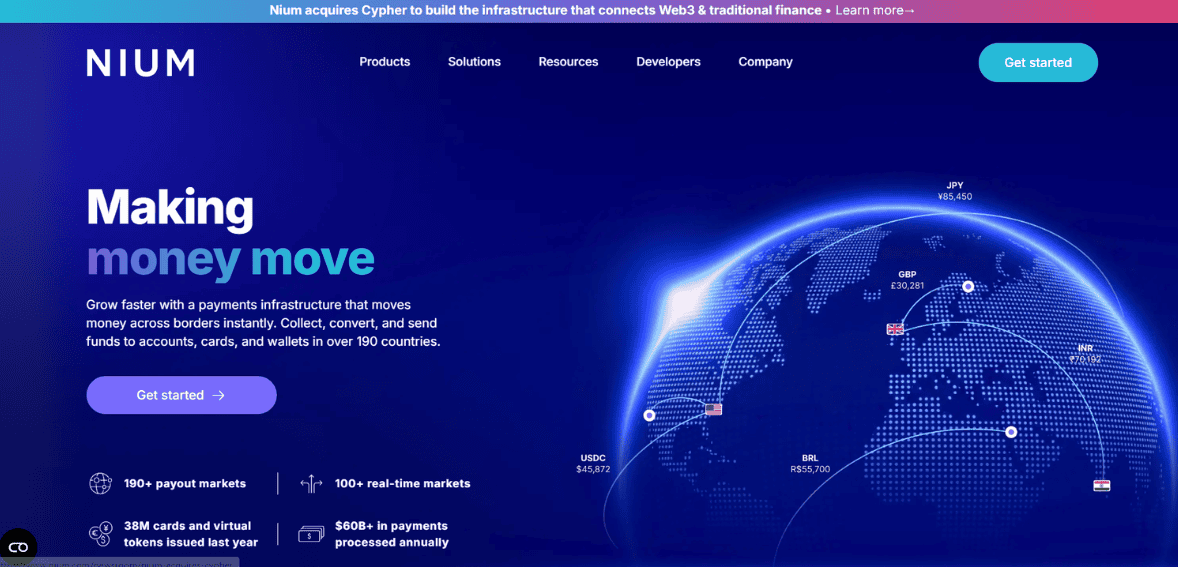
Nium is a Singapore-headquartered global payments infrastructure company that has undergone a genuinely significant strategic transformation since its founding. After starting off as consumer remittance platform Instarem in 2014, Nium Pte Ltd rebranded itself two years later when it launched its B2B payments business. That has since become the main company while Instarem is a subsidiary, accounting for 10% of the overall business. The enterprise payments platform is now capable of processing payments to the tune of USD 50 billion annually. Lets read more about Nium Review.

The pivot from consumer remittance to enterprise B2B infrastructure is not merely a marketing repositioning. It reflects a deliberate product and commercial strategy: the consumer remittance market that Instarem served is intensely competitive and margin-compressed, while the B2B cross-border payment infrastructure market is larger, stickier, and carries higher value per customer. The technology and banking relationships built during the Instarem years gave Nium a working cross-border payment network as its starting point, which it then extended and deepened specifically for enterprise and platform use cases.

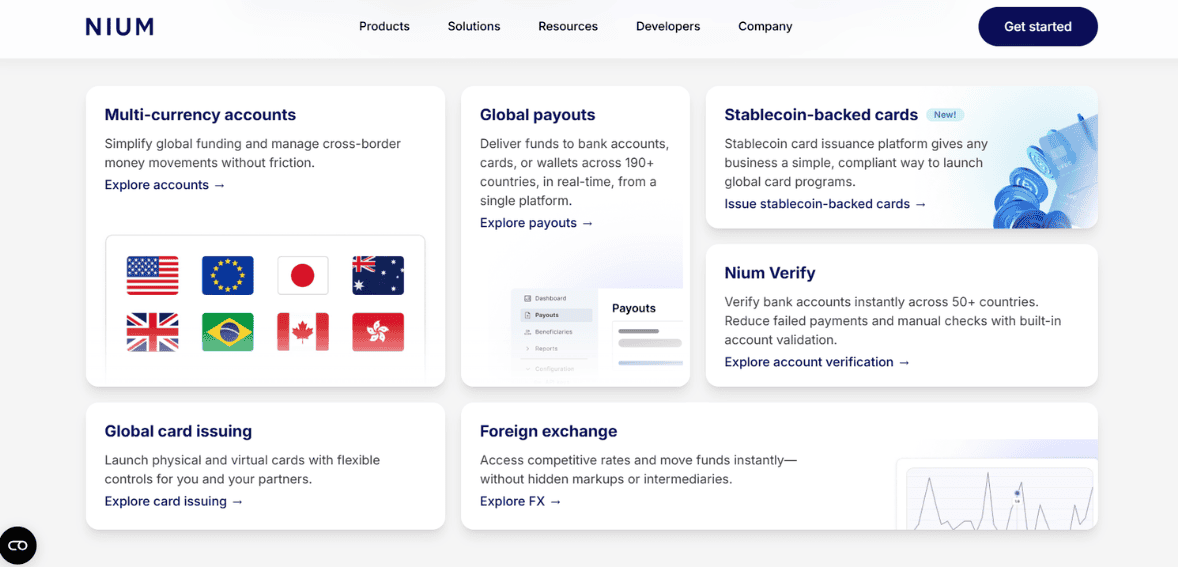
Nium provides global corporations with the ability to move money around. It allows making payments in over 190 countries, collecting in over 35 countries, and issuing cards in over 30 countries, using just one API. Using direct banking connections, local licenses, and compliance, Nium eliminates barriers to cross-border payments. Companies leverage Nium’s technology to make instant payments to gig economy workers, real-time settlements with suppliers, and integration of financial services into their applications.

The company has already raised over 300 million dollars in various financing rounds, reaching a valuation of approximately 1.4 billion dollars. Its investors include Visa, Temasek, Vertex Ventures, Rocket Capital, and other institutional investors. The investment by Visa is especially relevant in light of the strategy of Visa to invest in cross-border payment infrastructure companies instead of competing with them.

Company Background and Market Position | Nium Review

Nium Pte Ltd is headquartered in Singapore, where it holds a Major Payment Institution licence from the Monetary Authority of Singapore, allowing it to issue bank accounts and facilitate domestic and international money transfers. Apart from Singapore, it is regulated in the US, EU, Australia, Canada, Hong Kong, Indonesia, Japan, Malaysia, and India.

The depth and breadth of this licensing portfolio is one of Nium’s most significant competitive assets and one of the hardest to replicate quickly. Obtaining payment institution licences across multiple major Asian, European, and North American markets requires years of regulatory engagement, capital investment in each jurisdiction, and ongoing compliance maintenance. A fintech company beginning today to build a comparable licensing network would face a five-to-seven-year timeline before reaching anything approaching Nium’s current regulatory footprint.

Nium is a front runner both geographically and in payment services offered, being a holder of licenses in the biggest and fastest-growing markets around the globe. Geographical presence of Nium is determined by the company’s Asia-Pacific roots and its understanding that corridors that need the most attention when it comes to cross-border payments are those between Asia, Africa, and Latin America and not the corridors connecting the US and Europe that have been properly serviced already.

The list of customers includes banks, fintech companies, payroll services, travel management companies, and marketplaces, proving that Nium’s API-first infrastructure can support many enterprise and platform use cases. Fintech companies can provide improved global payment solutions and faster settlement choices. E-commerce platforms, B2B suppliers, and logistics marketplaces can rely on Nium for efficient supplier payouts, commissions, and refunding customers.

Core Payment Infrastructure and Network

With direct bank connections, local licenses, and compliance built in, Nium removes friction from cross-border payments. The direct bank connection model is the architectural foundation that differentiates Nium from payment orchestration layers that route through external acquirers or correspondent banks. By establishing direct connections to domestic banking infrastructure in each market, Nium enables transactions to enter and settle through local rails rather than the correspondent banking chains that SWIFT transactions traverse.

It facilitates cross-border payments in 70 supported currencies across 190 countries, with 80% of payments settled in real time. The 80% real-time settlement rate reflects the coverage of domestic real-time payment infrastructure in Nium’s most active corridors, including Faster Payments in the UK, SEPA Instant in Europe, UPI in India, PayNow in Singapore, and equivalent real-time rails in other major markets. The remaining 20% of transactions settle through standard clearing cycles in markets where real-time infrastructure is not yet available or where the specific payment method requires batch processing.

This global infrastructure helps businesses avoid the delays and fees associated with SWIFT-based systems. Nium meets high standards for security and compliance. Funds are held in safeguarded accounts where required, and Nium is regularly audited by global regulatory bodies.

The network architecture enables domestic payment experiences for cross-border transactions: when a business in the UK pays a supplier in India through Nium, the supplier receives the payment through domestic Indian banking rails at the speed and cost of a local transfer rather than a cross-border wire. This domestic settlement experience is the core value proposition that Nium offers relative to traditional international wire transfer infrastructure.

Collections: Receiving International Payments

Funds can be received in 35 markets, including Southeast Asia, UK, Hong Kong, Singapore, Australia, India, and the US. The collections capability allows Nium’s enterprise clients to receive payments from customers or counterparties in each of the supported markets as domestic bank transfers, providing local account details for each market without requiring the payer to initiate an international wire.

For organizations which bill their customers or collect payments from them in several geographies, being able to provide bank account details in each of those markets significantly enhances their ability to collect payments successfully. For instance, when a customer from the UK pays the Singapore-based marketplace using the local Faster Payments service, the process becomes much easier and more familiar compared to making an international SWIFT payment; at the same time, the marketplace gets its money settled much faster than would be possible with a cross-border wire.

The ability to collect payments from 35 countries is particularly useful for Nium’s APAC businesses which form a considerable portion of Nium’s customers, while also covering the most important Western markets where cross-border collections occur on a regular basis. Geographical scope of collection services is smaller than that of payouts due to the fact that setting up bank accounts for receiving collections is more complicated than sending out payouts via local payment networks.

The ability to have named virtual accounts in the collection-supported countries allows for automatically reconciling received payments by using the virtual account name as a way to identify the payment source.

Card Issuance Infrastructure

Card issuance in 30-plus countries through a single API gives Nium’s enterprise clients the ability to issue virtual and physical cards to their users, employees, or customers within the same infrastructure relationship that handles their cross-border payment and collection needs. The card issuance capability operates through Nium’s direct relationships with Visa and Mastercard as a certified issuer program manager in supported markets.

Corporate and virtual card issuance supports use cases including employee expense management, contractor payment cards, customer prepaid instruments, and platform-issued spending cards for marketplace sellers or gig workers. The programmatic card issuance through API allows Nium’s clients to create and manage cards at scale without manual provisioning, which is essential for platforms issuing cards to large numbers of users simultaneously.

Spending controls at the card level, including merchant category restrictions, transaction amount limits, and geographic constraints, give platform operators and enterprise finance teams granular authority over how issued cards are used without requiring card-by-card manual management. These controls are particularly important for corporate card programs where policy compliance cannot depend on individual cardholder discretion.

Real-time visibility into card transaction data allows Nium’s clients to monitor spending activity as it occurs rather than relying on end-of-day statement downloads, which improves the responsiveness of expense management workflows and enables faster identification of anomalous spending patterns.
Nium Review

Foreign Exchange and Rate Management

Nium deploys real-time, market-aligned FX rates that can be locked for up to 24 hours. The real-time FX rate feeds reflect current interbank market pricing rather than indicative rates that may have moved materially between quotation and execution. For businesses making FX decisions that affect contract pricing or supplier payment amounts, the accuracy of the quoted rate at the time of decision matters significantly.

A 24-hour rate lock feature provides businesses with a set period of time during which they can conduct their planned FX transaction at a pre-agreed rate without being subject to any daily volatility in FX rates. This feature is helpful when making a run payment where the FX rate must be agreed on before sending the instruction but the actual transaction will take place either on the same day or the next morning.

Competitive real-time FX rates with rate locking facility and real-time fees without any hidden costs, mainly absent of intermediary fees show Nium’s focus on FX transparency. Mentioning no hidden costs and lack of intermediary mark-ups is the way how the company addresses the issue that is often raised by the clients of the traditional cross-border payment infrastructure, which involves correspondent banks and each intermediary can take its fee without informing the client.

FX cost transparency is essential for the travel management and hospitality industry customers, which comprise a significant part of Nium’s enterprise customer base, as the margins in the bookings made by these customers are often quite tight.

Gig Economy and Workforce Payment Solutions

Businesses use Nium to pay gig workers instantly, settle suppliers in real time, and embed financial services into their platforms. The gig economy use case is one of Nium’s most actively developed enterprise segments, reflecting the commercial reality that globally distributed gig workforces represent one of the largest and fastest-growing cross-border payment flow categories in the current economy.

For gig platforms paying workers across multiple countries, the alternative to a Nium-style infrastructure is managing multiple bilateral payment relationships with local payment providers in each worker geography, or routing all payments through SWIFT wires that arrive days after the work is completed. Both alternatives create worker satisfaction problems at a time when platform choice and worker retention depend significantly on how reliably and quickly workers receive their earnings.

Real-time settlement to local payment methods in each worker’s home market, whether a bank account, mobile wallet, or prepaid card depending on what is available and preferred in that market, is the operational standard that gig workers in competitive labor markets increasingly expect. Platforms that cannot meet this expectation face worker attrition to competing platforms that can.

The embedded financial services capability allows gig platforms to go beyond simple payouts and offer their workers access to tools including expense cards, earned wage access, and savings products within the same platform experience. This embedded finance layer increases the value of the platform relationship to the worker and creates additional revenue opportunities for the platform operator.

Travel Industry Specialization

Travel is one of Nium’s most developed vertical use cases and reflects the specific payment complexity of the travel industry, where payment flows involve multiple currencies, multiple counterparties, and timing mismatches between when payments are collected from travelers and when payments are due to airlines, hotels, and other travel suppliers.

Travel management companies, online travel agencies, and corporate travel platforms use Nium to settle bookings with suppliers across currencies and markets without maintaining separate currency accounts or banking relationships for each settlement currency. The ability to pay suppliers in their preferred local currency, settled through domestic rails, reduces the FX and settlement friction that characterizes traditional travel payment workflows.

The Nium Travel product line, specifically tailored for this sector, includes supplier payment capabilities, virtual card issuance for travel bookings, and reporting tools designed around the reconciliation requirements of travel accounting. The vertical-specific product investment reflects Nium’s recognition that travel has specific operational requirements that a generic B2B payment platform does not address as effectively as a purpose-built solution.

The Embedded Finance Layer

Nium business account holders may also access the fintech’s other embedded finance products, including corporate cards, expense management tools, and API integrations. The embedded finance architecture allows Nium’s clients to offer financial services to their own customers without holding payment institution licences themselves, using Nium’s regulatory infrastructure and balance sheet as the underlying foundation.

This model is similar to what Currencycloud, reviewed earlier in this series, provides for banks and fintechs wanting to offer multi-currency services without building the underlying currency infrastructure. Nium’s version of this offering is particularly relevant for Asian and emerging market platforms that want to extend financial services to their users in markets where the local banking infrastructure creates barriers to direct banking relationships.

The API-first design of the embedded finance layer means that platform builders can create custom financial experiences for their users without being constrained by Nium’s own product interfaces. The underlying payment rails, compliance infrastructure, and banking relationships are accessible through the API and can be wrapped in whatever user experience the platform operator wants to build on top.

Pricing and Account Structure

Customers must pay a one-time account opening fee and a monthly maintenance fee. This fee structure reflects Nium’s positioning as an enterprise platform rather than a self-service product available without any fixed cost commitment. The one-time account opening fee and ongoing monthly maintenance fee create a baseline commercial relationship that is appropriate for enterprise clients but represents a barrier to entry for smaller businesses or developers wanting to evaluate the platform before committing.

Nium does not publish a standard rate card, and pricing for transaction fees, FX spreads, and card issuance is negotiated based on volume, the specific services engaged, and the commercial relationship. This is standard practice for enterprise B2B infrastructure providers but requires direct commercial engagement to obtain pricing information, which is a friction point for businesses in the early evaluation phase.

Real-time fees with no hidden charges, mostly free of intermediary charges, reflects the pricing philosophy of transparent per-transaction cost without the correspondent bank deductions that reduce the received amount in traditional wire transfers. The actual FX spread and transaction fees reflect the specific corridors and payment methods used, and businesses should request corridor-specific pricing for their most important payment routes during commercial discussions.
Nium Review

Security, Compliance, and Regulatory Standing

Nium meets high standards for security and compliance. Funds are held in safeguarded accounts where required, and Nium is regularly audited by global regulatory bodies. The safeguarding requirement, where customer funds are held in accounts separate from Nium’s own operational funds, is a regulatory condition imposed by financial services regulators in most of Nium’s licensed markets, providing a meaningful level of protection for clients’ funds in the event of Nium’s insolvency.

PCI DSS compliance covers the payment data security requirements for cardholder information handled through the card issuance programs. Anti-money laundering and know-your-customer verification are applied to the businesses and, through their own KYC programs, to the end users transacting through Nium-powered platforms. The regulatory auditing across Nium’s 40-plus licensed markets means that compliance practices are not self-certified but independently verified.

The Zero Hash partnership announced in October 2022 extended Nium’s payment infrastructure to include crypto-related experiences, adding stablecoin and digital asset payment capabilities alongside the fiat currency network. This reflects the growing convergence of traditional payment infrastructure and digital asset settlement rails.

Developer Tools and API Quality

The single API model that covers payments to 190 countries, collections in 35 markets, and card issuance in 30 countries is the architectural design decision that most directly serves the developer teams building on Nium’s infrastructure. Rather than integrating separate APIs for each payment direction, each currency zone, and each financial product, a single Nium API integration provides programmatic access to the full network capability.

API documentation quality and developer support are important evaluation criteria for platform builders who will spend weeks or months integrating Nium’s infrastructure before their product goes live. The investment in developer tooling, including sandbox environments, sample code, and technical integration support, directly affects the ease and speed of integration and the likelihood of implementation errors that create post-launch operational issues.

The enterprise-grade nature of the platform means that pre-sales technical engagement typically involves Nium’s solutions engineering team rather than a self-service evaluation path, which provides personalized integration guidance but requires more initial time investment than a platform with full self-service documentation.

Strengths, Limitations, and Who It Is Best For

Nium is a genuinely capable global payments infrastructure company with particular strength in Asia-Pacific payment corridors, real-time settlement across 80% of transactions, a licensing portfolio covering 40-plus markets that represents years of regulatory investment, and the embedded finance capability that allows platform businesses to offer financial services under their own brand without becoming regulated financial institutions. The 50 billion dollar annual processing volume validates the infrastructure at genuine enterprise scale. The Visa investor relationship provides network access and strategic alignment with the world’s largest card network. The vertical specialization in travel and gig economy reflects meaningful product investment beyond generic B2B infrastructure.

The limitations are primarily those of any enterprise-focused B2B infrastructure provider. The account opening fee and monthly maintenance fee create a baseline cost commitment that is appropriate for enterprise clients but creates friction for smaller businesses. Pricing requires commercial engagement and is not available for self-service evaluation. The single API marketing claim covers a broad range of capabilities, and the depth of specific features within each capability area should be verified for the specific use case rather than assumed based on headline coverage numbers. Collection markets at 35 are significantly fewer than payout markets at 190, which means the inbound payment reach is considerably more limited than the outbound reach.

Nium is best suited for enterprise businesses with significant cross-border payment flows who need real-time settlement across multiple markets through a single API, travel management companies and online travel agencies that need supplier settlement in multiple currencies without correspondent banking costs, gig economy platforms paying globally distributed workforces who need real-time local settlement in each worker’s home market, fintech companies and banks wanting to add multi-currency payment and card issuance capabilities to their own products through Nium’s licensed infrastructure, and Asia-Pacific businesses with significant payment flows across the region who benefit from Nium’s depth of local market coverage and banking relationships in that geography.

FAQs

Q1. What is the difference between Nium and Instarem, and are they the same company?

After starting off as consumer remittance platform Instarem in 2014, Nium Pte Ltd rebranded itself two years later when it launched its B2B payments business. That has since become the main company while Instarem is a subsidiary, accounting for 10% of the overall business. Instarem and Nium are part of the same corporate group under Nium Pte Ltd. Instarem is the consumer-facing remittance brand that allows individuals to send money internationally, while Nium is the B2B enterprise infrastructure brand serving banks, fintechs, payroll providers, and marketplaces. 

The two operate as distinct products serving different customer segments, but they share the same underlying payment infrastructure, banking relationships, and regulatory licences across the markets where Nium Pte Ltd operates. Businesses evaluating Nium for enterprise payment infrastructure and individuals evaluating Instarem for personal international money transfers are engaging with different commercial products of the same corporate entity, with the Nium enterprise platform representing the larger and strategically primary business.

Q2. How does Nium’s real-time settlement claim work in practice, and what percentage of payments actually settle in real time?

Nium facilitates cross-border payments in 70 supported currencies across 190 countries, with 80% of payments settled in real time. The 80% real-time rate reflects the coverage of real-time payment infrastructure in Nium’s most active corridors. When a payment is routed to a market where real-time clearing infrastructure exists and Nium has a direct connection to it, such as Faster Payments in the UK, SEPA Instant in Europe, UPI in India, or PayNow in Singapore, the settlement occurs within seconds of the payment being initiated. The remaining 20% of payments route through markets or payment methods where real-time clearing is not available, settling through standard batch clearing cycles that may take hours or the following business day. 

The specific real-time settlement rate for any individual business depends on their payment mix by market and payment method, meaning businesses with payment flows concentrated in markets with strong real-time infrastructure may see rates above 80%, while those with significant flows to markets without real-time clearing may see lower rates. Businesses should ask Nium specifically about the real-time settlement rate applicable to their priority corridors during the commercial evaluation rather than treating the 80% platform-wide figure as applicable uniformly across all their payment routes.

Q3. Is Nium suitable for small and medium-sized businesses, or is it primarily an enterprise platform?

Nium is primarily designed and positioned for enterprise and mid-market businesses rather than small businesses with simple payment needs. The one-time account opening fee and monthly maintenance fee create baseline costs that are appropriate for enterprise clients generating sufficient transaction volume to justify them, but may not be economical for smaller businesses with lower payment volumes. The enterprise-grade commercial engagement model, where pricing and account terms are negotiated through a sales process rather than available through self-service onboarding, is similarly oriented toward buyers who are making considered technology infrastructure decisions rather than small businesses wanting to start accepting payments immediately. 

Small and medium-sized businesses that need multi-currency accounts and cross-border payment capabilities are likely better served by direct-to-business platforms like Airwallex or Wise Business, which offer accessible self-service onboarding, transparent published pricing, and fee structures that are appropriate for lower volumes. Nium becomes the more compelling choice when a business has grown to the point where it needs API integration for programmatic payment operations, where its transaction volumes justify negotiated enterprise pricing, or where it wants to embed payment capabilities into its own platform rather than simply using payment services for its own operations.


Currencycloud Review

Currencycloud Review

Currencycloud is a London-headquartered B2B cross-border payments infrastructure platform that has operated since 2012 and was acquired by Visa in December 2021 for approximately 962 million dollars, or 700 million British pounds inclusive of cash and retention incentives. Founded originally as a foreign exchange solutions provider for banks and financial technology companies, Currencycloud built a reputation as one of the most capable and developer-friendly cross-border payment APIs available to financial institutions and fintech builders, supporting over 500 banking and technology clients with reach across more than 180 countries before the Visa acquisition. Lets read more about Currencycloud Review.

The Visa acquisition fundamentally changed the nature of what Currencycloud represents. It is no longer an independent fintech company pursuing its own strategic priorities but an integral component of Visa’s B2B cross-border payments strategy, now operating as part of what Visa calls Visa Cross-Border Solutions. That structure merges Visa’s existing cross-border and cash management capabilities with the technology and customer relationships that Currencycloud brought at acquisition. The resulting entity operates on a model Visa describes as B2B4X, meaning it primarily serves financial institution and fintech clients but does so with the ultimate objective of improving the end-user experience for individuals and businesses making international payments.

Currencycloud offers a comprehensive B2B cross-border solution for businesses dealing with international payments, all built through innovative APIs and cloud technology. They work with banks, financial institutions, and fintechs around the world. Based in London with offices in New York, Amsterdam, Cardiff, and Singapore, they deliver simple, clear cross-border infrastructure solutions for clients. The regulatory standing covers the UK, Canada, US, and EU, and the Visa ownership adds the institutional credibility and global network access of one of the world’s largest card networks to the technical capabilities that Currencycloud built independently.

Company Background and Market Position | Currencycloud Review

Currencycloud was founded in 2012 with a specific and commercially acute thesis: that banks and financial technology companies needed a better way to offer foreign exchange and multi-currency payment services to their own clients without building the underlying currency infrastructure from scratch. Rather than competing directly with banks for their customers, Currencycloud positioned as enabling infrastructure that banks and fintechs could embed into their own products, becoming the invisible rail beneath services that their customers experienced as part of their primary banking or fintech relationship.

The company raised over 160 million dollars from investors including BNP Paribas, Google Ventures, and others before the Visa acquisition, which reflected genuine institutional confidence in both the cross-border B2B infrastructure market and Currencycloud’s specific execution within it. Visa had been a strategic partner before becoming an acquirer, having invested in Currencycloud in 2020, which gave Visa visibility into the platform’s performance and client relationships before the full acquisition was announced in July 2021 and completed in December 2021.

Visa Cross-Border Solutions merges Visa’s existing cross-border and cash management capabilities with solutions resulting from Visa’s acquisition of Currencycloud. Operating on a B2B4X model, it primarily serves businesses but also prioritizes improving the end-user experience. This framing positions Currencycloud’s capabilities within a broader Visa strategic agenda rather than as an independent product competing for direct client relationships. For banks and fintechs evaluating Currencycloud as infrastructure, understanding that they are entering a relationship with Visa’s cross-border solutions division rather than with an independent fintech is important context for how the commercial relationship, product roadmap, and long-term direction will be managed.

The client roster that Currencycloud built pre-acquisition, and that Visa has maintained, reflects the quality of the infrastructure. Clients include banks, FX brokers, neobanks, payment service providers, and fintech platforms across European, North American, and Asia-Pacific markets. Their technology powers some of the hottest fintechs in the world, reflecting early adoption by growth-stage fintech companies that built their multi-currency capabilities on Currencycloud’s rails rather than building currency infrastructure independently.

Core Multi-Currency Account Infrastructure

Currencycloud can provide a single platform and multi-currency accounts that offer named accounts and multi-currency wallets to receive and collect funds, making it easier to get paid without processing headaches. The multi-currency account infrastructure is the foundational product that most Currencycloud clients build upon, providing the technical backbone for offering customers accounts that hold and transact in multiple currencies.

Named accounts give each end customer a set of local account details in their relevant markets, allowing counterparties in different countries to send payments as domestic transfers rather than cross-border wire transfers. This eliminates the correspondent banking intermediaries, delays, and fees that cross-border wires involve, and provides the sender with a familiar domestic payment experience regardless of where the ultimate beneficiary is located.

Multi-currency wallets allow customers of Currencycloud-powered platforms to hold balances in different currencies simultaneously, converting between them when needed rather than being forced to convert all incoming funds to a single base currency at the moment of receipt. This flexibility is essential for businesses and individuals who manage revenue and expenses across multiple currency zones, since forced conversion at arbitrary exchange rate moments creates FX exposure that discretionary conversion eliminates.

The reach across more than 180 countries means that the collection and payment infrastructure covers the vast majority of commercial cross-border payment flows relevant to the banks and fintechs that use the platform. Coverage depth in specific corridors matters as much as headline country count, and Currencycloud’s pre-acquisition work building direct connections to local payment rails in key markets provides the actual settlement infrastructure behind the coverage claim.

Foreign Exchange and Rate Transparency

Access real-time, wholesale FX rates across hundreds of currency pairs to convert funds, save costs, and boost revenue strategy. The FX capability is one of Currencycloud’s most consistently highlighted competitive advantages, and it was specifically cited by Visa as a reason for the acquisition, with the deal described as strengthening Visa’s foreign exchange capabilities by extending them to better serve financial institutions, fintechs, and partners.

Real-time wholesale FX rates, rather than indicative or snapshot rates, give Currencycloud-powered platforms the ability to provide their customers with current and accurate conversion pricing rather than rates that may have moved materially between quotation and execution. For businesses making FX decisions, rate timeliness directly affects the quality of the conversion and the predictability of the received amount.

End users encompass a diverse group, from individuals seeking transparent FX rates for remittances to small and medium-sized businesses looking to receive international payments without intermediary fees. The emphasis on FX rate transparency reflects a deliberate positioning against the opacity that characterizes traditional bank FX services, where the actual cost of currency conversion is embedded in a spread between the rate offered to the customer and the wholesale rate the bank accessed, without being disclosed as a line-item fee.

The FX infrastructure can be configured to allow Currencycloud’s clients, meaning the banks and fintechs using the platform, to set their own markup above the wholesale rate for their end customers. This creates a revenue opportunity for Currencycloud’s direct clients while maintaining the transparency advantage relative to the traditional correspondent banking model where multiple intermediaries each take an undisclosed spread.

Cross-Border Payments and Settlement

Simplify, control, and automate cross-border payments across a wide range of countries and currencies for efficient, low-cost transactions. The cross-border payment capability extends the platform beyond multi-currency account management into the active movement of funds across borders, covering both incoming collections and outgoing payments in a unified infrastructure.

The platform routes payments through local payment rails where these are available, bypassing SWIFT and correspondent banking chains for the routes where direct domestic connectivity provides faster settlement, lower cost, and more predictable arrival timing. For the routes where SWIFT remains the most practical option, the platform accesses SWIFT within the broader settlement infrastructure rather than routing all transactions through the correspondent banking system by default.

Settlement timing transparency is a specific focus of the platform’s design, reflecting the practical commercial importance of knowing when funds will arrive rather than relying on the uncertain timelines of correspondent banking chains. For businesses managing cash flow across currency zones, predictable settlement timing enables more confident cash management decisions than opaque processes where arrival timing can vary by days.

The payment management layer allows batching, scheduling, and automating of payment runs, which reduces the manual effort involved in executing regular cross-border payment obligations. For payroll processors paying international employees, for marketplaces disbursing seller payouts across currencies, and for any business with regular scheduled cross-border payment obligations, automation of the payment execution layer removes repetitive manual processing while maintaining audit records of each transaction.

Currencycloud Review

API Architecture and Integration Options

Design your cross-border financial ecosystem on your own terms: build using the APIs, get to market fast with the pre-built platform Currencycloud Direct, or use the out-of-the-box white-label solution. This three-path integration model reflects Currencycloud’s understanding that its clients range from technical fintech teams who want full API control to banks whose primary need is a deployable solution rather than infrastructure to build on.

The full API integration path gives development teams complete flexibility to build custom payment and FX experiences within their own applications, using Currencycloud’s currency and settlement infrastructure as the backend without constraining the front-end user experience to any Currencycloud-defined design. This path requires meaningful engineering investment but delivers the highest degree of product customization and the most seamless embedding into the client’s own platform.

Currencycloud Direct is the pre-built platform option for clients who want to launch multi-currency payment services without building a custom front end. The pre-built interface reduces time to market significantly relative to building from the API, at the cost of less flexibility in user experience design. For clients whose primary objective is adding a cross-border payment capability rather than building a distinctive user experience around that capability, the pre-built option removes months of front-end development from the launch timeline.

The white-label solution provides branded packaging of Currencycloud’s capabilities for clients who want to offer the services under their own brand but without the engineering investment of building against the raw API. This path is most relevant for banks and established financial institutions whose brand equity matters more than technical differentiation, and for whom the ability to offer multi-currency services under their existing brand is the primary commercial objective.

The platform offers features such as collecting and receiving funds, conversion, payments, transaction management, API integrations, and many more. It also offers a real-time balance account view and dashboard. The centralized dashboard gives clients operational visibility across their client base’s currency positions, transaction activity, and settlement status from a single interface.

Regulatory Standing and Compliance Infrastructure

Currencycloud’s regulatory coverage spans the UK, Canada, the United States, and the European Union, providing the legal operating authority to process payments across its primary markets. UK Financial Conduct Authority authorization is the foundation of the European regulatory standing, which through the pre-Brexit passporting framework and subsequent cooperation arrangements enables operation across EEA markets. US FinCEN registration and money transmitter licensing cover the American market. Canadian and EU licensing complete the core regulated market coverage.

The Visa acquisition adds the institutional regulatory standing and global compliance infrastructure of one of the world’s most scrutinized financial entities. Operating within Visa’s compliance framework means that the regulatory burden on individual clients using Currencycloud is reduced, since Visa’s own compliance programmes cover the underlying transaction processing infrastructure rather than requiring each Currencycloud client to maintain separate compliance coverage for the platform they build on.

PSD2 compliance is embedded in the platform’s European operation, covering the Strong Customer Authentication requirements and payment services regulation that applies to cross-border payment processing within the European Economic Area. PCI DSS compliance covers the payment data security requirements applicable to any entity handling payment information at commercial scale.

The FCA regulation specifically is described as providing accountability for how the platform handles client funds, the conduct of the business, and the resolution of complaints, reflecting the UK financial services regulatory framework’s emphasis on consumer and business protection alongside operational compliance.

The Visa Ownership Context

The December 2021 acquisition for approximately 962 million dollars was described by Visa as part of its network of networks strategy to facilitate global money movement. That framing, network of networks, is Visa’s description of its strategic direction: rather than only operating the Visa card network, Visa is building connectivity to other payment networks, rails, and infrastructure layers to position itself as the central hub for all forms of payment rather than only card-based consumer transactions.

The acquisition will strengthen Visa’s B2B cross-border payments offering, particularly in areas such as speed of FX processing and transparency of FX rates. This enables Visa to challenge in the increasingly strong and digitally focused B2B payments space in which Currencycloud has built a strong presence.

For clients evaluating Currencycloud in the context of this ownership, there are both advantages and considerations. The advantages include the financial stability and institutional credibility of Visa ownership, the potential for deeper integration with Visa’s global card network and payment infrastructure, and the resources available for product investment that a company of Visa’s scale can commit to a 962 million dollar acquisition. The considerations include the natural pace difference between an independent fintech and a division of a global financial institution, the strategic alignment between Currencycloud’s product direction and Visa’s broader priorities, and the question of whether the agility and client-responsiveness that characterized Currencycloud as an independent company will be maintained within a much larger organizational structure.

Whether it can continue with the same level of independence and quick action associated with a fintech company remains to be seen, as things could slow down as it integrates with a gigantic organisation like Visa. This is a legitimate and important concern for existing and prospective clients, and one that should be assessed through direct conversations with the Currencycloud commercial team about product roadmap direction and decision-making processes rather than assumed based on general observations about large company dynamics.

Currencycloud Review

Pricing Structure and Transparency

Currencycloud does not publish a standard rate card, and pricing is determined through direct commercial engagement based on client volume, the specific currencies and corridors required, and the integration model selected. This is standard practice for B2B infrastructure providers whose pricing is genuinely volume and feature-dependent rather than applicable at a uniform rate across all client sizes and use cases.

The FX pricing structure involves a spread above the wholesale rate that Currencycloud accesses, with clients typically receiving pricing that reflects their volume and the currency pair involved. Major currency pairs with deep liquidity carry narrower spreads than exotic or emerging market currency pairs where liquidity is thinner and hedging costs are higher. Clients then have the option to add their own markup when pricing their customers, creating a revenue opportunity on FX conversions that forms part of the commercial model for many Currencycloud-powered platforms.

Transaction fees for payments vary by payment type, corridor, and settlement method, with local rail payments typically carrying lower fees than SWIFT transactions due to the reduced correspondent banking infrastructure involved. Monthly platform fees may apply depending on the commercial structure agreed with the Currencycloud team.

Businesses evaluating Currencycloud should request a comprehensive pricing proposal that covers the specific currencies, corridors, and payment volumes relevant to their use case, including both the conversion spread and any transaction fees applicable to each payment type they plan to use. Understanding the all-in cost at their expected volume, rather than headline rates for individual transaction types, provides the most accurate basis for cost comparison against alternative providers.

Customer Support and Integration Experience

They deliver comprehensive, cross-border infrastructure solutions for clients including banks, fintechs, and FX brokers. The support model reflects the B2B infrastructure positioning: support is oriented toward the technical and commercial teams at financial institution and fintech clients rather than toward end consumers, and the relationship management structure typically involves dedicated commercial and technical account support for clients above a certain volume threshold.

The technical documentation and API quality are noted positively across independent review sources, with the platform described as developer-friendly in a way that reflects genuine investment in the developer experience rather than documentation as an afterthought. For the fintech teams building on Currencycloud’s APIs, the quality of documentation directly affects integration speed and the likelihood of correct implementation, and positive feedback on this dimension reflects a meaningful investment area.

There could be possible drawbacks: any technology outages or errors could be down to Currencycloud, or how the provider has integrated with Currencycloud. Meaning if errors occur, it may not be in your provider’s hands to fix it. You’re relying on the strength of relationship you have with your payment provider and the strength of relationship your provider has with Currencycloud, in order to get things solved.

This observation is particularly relevant for businesses that access Currencycloud indirectly through a bank or fintech that has built on Currencycloud’s infrastructure, rather than as direct API clients. The two-layer support structure means that issue resolution involves both the direct provider relationship and the underlying Currencycloud infrastructure, and the responsiveness of the resolution depends on both.

Strengths, Limitations, and Who It Is Best For

Currencycloud is a genuinely capable cross-border payment infrastructure platform with particular strength in multi-currency account management, real-time FX with wholesale rate access, and the API flexibility that fintech builders need to create custom cross-border payment experiences. The regulatory coverage across UK, EU, Canada, and US markets, the Visa ownership that adds institutional stability and global network access, and the pre-existing client base of over 500 banking and technology clients validate the platform’s operational capability and reliability.

The limitations are primarily scope and access-related rather than quality-related. Currencycloud is a B2B infrastructure provider: it does not serve end merchants or businesses directly but rather the financial institutions and fintech platforms that build services for those end clients.

Businesses that want direct access to cross-border payment infrastructure for their own treasury and payment operations need to either engage through a Currencycloud-powered bank or fintech, or qualify for direct API access as a platform builder in their own right. The Visa acquisition’s effect on product agility and strategic independence is a genuine consideration that current and prospective clients should assess through direct engagement with the commercial team. Pricing requires sales engagement and lacks the self-service transparency that some alternative providers offer.

Currencycloud is best suited for banks and traditional financial institutions that want to add multi-currency and FX services to their product offering without building currency infrastructure from scratch, fintech companies building cross-border payment products for their own customers who need embedded FX and multi-currency account infrastructure, FX brokers wanting to offer digital multi-currency payment services alongside their currency trading capability, neobanks and digital payment platforms serving internationally active customers who need multi-currency account and payment services, and payment service providers extending their settlement and collection capabilities into new currency corridors.

FAQs

Q1. Is Currencycloud still an independent company, or has it been fully absorbed into Visa’s corporate structure?

Currencycloud is no longer an independent company. Visa completed the acquisition in December 2021 for approximately 962 million dollars, and Currencycloud now operates as part of Visa’s cross-border solutions division. The product has been integrated into what Visa calls Visa Cross-Border Solutions, which merges Currencycloud’s capabilities with Visa’s existing cross-border and cash management infrastructure.

The Currencycloud brand continues to be used in commercial and developer-facing contexts, and the platform’s technology and client relationships have been maintained under Visa ownership. However, the strategic direction, product investment decisions, and commercial terms of the platform are now managed within Visa’s corporate structure rather than by an independent leadership team. Businesses evaluating Currencycloud should engage with Visa’s cross-border solutions commercial team and should expect the pace, commercial terms, and product roadmap to reflect the priorities of a global financial institution rather than those of an independent fintech pursuing growth-stage strategic objectives.

Q2. Can a business access Currencycloud directly, or does it only work through banks and fintech intermediaries?

Currencycloud operates on a B2B infrastructure model that primarily serves financial institutions and fintech platforms rather than end businesses directly. Banks, FX brokers, payment service providers, and fintech companies access Currencycloud through direct API integration or through the pre-built platform options, and then offer multi-currency and cross-border payment services to their own customers. End businesses, meaning companies that want to use multi-currency accounts or cross-border payment services for their own treasury and payment operations, typically access Currencycloud’s capabilities indirectly through one of the banks or fintech platforms that has built on Currencycloud’s infrastructure.

A business banking with a Currencycloud-powered neobank or using a Currencycloud-integrated FX platform is accessing Currencycloud’s rails indirectly without necessarily knowing it. Businesses that want direct API access to Currencycloud’s infrastructure need to qualify as a direct client, which typically requires meeting volume thresholds and going through a commercial engagement with the Visa Cross-Border Solutions team rather than self-service onboarding.

Q3. How does Currencycloud compare to Airwallex or Wise Business for a business that needs multi-currency accounts and cross-border payment capabilities?

The comparison depends significantly on whether the business is looking for direct-to-business services or infrastructure to build into their own product. Airwallex and Wise Business are direct-to-business platforms that offer multi-currency accounts, cross-border transfers, and in Airwallex’s case corporate cards and expense management, through a self-service relationship that any qualifying business can access. Currencycloud is primarily B2B infrastructure for financial institutions and fintech platforms rather than a direct-to-business service.

Businesses that simply want to use multi-currency accounts and make cross-border transfers for their own operational needs are better served by Airwallex or Wise Business, which offer self-service onboarding, transparent pricing, and direct account access without requiring the enterprise-grade commercial engagement that direct Currencycloud access involves. The appropriate use case for Currencycloud is a bank, fintech, or payment platform that wants to offer these capabilities to its own clients rather than a business that wants to use them directly for its own treasury operations.

Payoneer Review

Payoneer Review

International payments have become an essential part of modern business. Whether you are a freelancer working with overseas clients, an eCommerce seller on international marketplaces, or a company hiring remote talent, moving money across borders is no longer an occasional requirement. However, traditional banking systems often involve lengthy processing times, high transfer fees, and limited support for multiple currencies. As a result, businesses increasingly look for payment platforms that simplify global transactions while remaining reliable and secure. Lets read more about Payoneer Review.

Payoneer has established itself as one of the most recognised names in this space. Since its launch in 2005, the platform has focused on helping businesses and professionals send and receive international payments more efficiently. It offers multi-currency receiving accounts, global payment services, and integrations with numerous online marketplaces, making it a common choice for businesses that operate internationally.

That said, no payment platform is perfect. While Payoneer is praised for its extensive global network and business-friendly tools, some users have also reported concerns regarding account verification, customer support, or certain transaction fees. These experiences often depend on the user’s location, account activity, and business requirements.

What Is Payoneer and How Does It Work? | Payoneer Review

Payoneer is a financial technology company that specialises in cross-border payment services. Unlike a traditional bank, it does not function as a full-service banking institution. Instead, it provides businesses and professionals with tools that make receiving, holding, converting, and sending international payments much more convenient.

Once an account is created and verified, users can access receiving accounts in several major currencies, including US dollars, euros, British pounds, Canadian dollars, Australian dollars, and others where available. These accounts work like local bank accounts for eligible countries, allowing international clients or marketplaces to send payments without making expensive international wire transfers.

Funds received in Payoneer can either remain in the account, be converted into another supported currency, or be withdrawn to a linked local bank account. Businesses can also use Payoneer to pay suppliers, contractors, and freelancers in supported countries, reducing the complexity of international business payments.

One reason Payoneer has gained popularity is its integration with global marketplaces and platforms. Many online businesses receive payments directly from marketplaces into their Payoneer account, eliminating the need to manage multiple banking relationships across different countries.

Although the platform is relatively straightforward to use, some services and features vary depending on the user’s country, account type, and verification status. Understanding these regional differences is important before deciding whether Payoneer aligns with your business requirements.

Key Features That Make Payoneer Stand Out

Payoneer’s appeal lies in the combination of payment tools it offers within a single platform. Instead of focusing solely on international money transfers, it provides several features designed specifically for businesses operating across borders.

One of its strongest features is the ability to receive payments through local receiving accounts in multiple currencies. This makes it easier for international clients to pay using domestic bank transfers, while users avoid opening bank accounts in several different countries. The platform also supports currency conversion, allowing businesses to manage payments in different currencies without relying on separate financial providers.

Another valuable feature is its marketplace integration. Payoneer works with numerous global eCommerce and freelance platforms, making it convenient for sellers and independent professionals to receive earnings directly into their Payoneer account. For businesses that work with multiple marketplaces, this creates a more centralised payment management experience.

The platform also supports business-to-business payments. Companies can pay suppliers, contractors, and service providers internationally through Payoneer, often simplifying payment processes compared to traditional international bank transfers.

Users also benefit from reporting tools, transaction history, payment requests, and a mobile application that allows them to monitor balances and activity while away from their computers.

While these features make Payoneer highly versatile, not every service is available in every country. Certain payment options, cards, or receiving accounts may depend on local regulations and account eligibility. Prospective users should always verify which services are available in their region before opening an account.

Creating and Verifying a Payoneer Account

Opening a Payoneer account is designed to be a straightforward process, although verification can take longer depending on the information required. Users begin by selecting an account type and providing personal or business details, including their legal name, address, contact information, and banking details for future withdrawals.

After registration, Payoneer requires identity verification to comply with financial regulations and anti-money laundering requirements. Depending on the account type and country, users may need to submit government-issued identification, proof of address, business registration documents, or additional information regarding their business activities.

Verification is one area where user experiences vary considerably. Many applicants complete the process within a few business days, while others may be asked to provide supplementary documentation before approval. In some situations, Payoneer may temporarily limit certain account functions until verification is fully completed.

Although these procedures can feel time-consuming, they are common among regulated financial service providers handling international transactions. The verification process ultimately contributes to fraud prevention and regulatory compliance.

One positive aspect is that Payoneer generally provides guidance on missing documents or incomplete submissions through the account dashboard. However, users who require urgent account activation should allow sufficient time for the verification process rather than expecting immediate approval.

Overall, the account creation process is relatively user-friendly, but patience may be necessary if additional compliance checks are required.

Payoneer Review

Receiving International Payments Through Payoneer

Receiving international payments is arguably the platform’s strongest capability. Instead of asking overseas clients to send costly international wire transfers, Payoneer enables eligible users to receive funds through local receiving accounts in supported currencies. For clients, the payment often feels similar to making a domestic bank transfer, while recipients receive the funds within their Payoneer balance.

This setup is particularly useful for freelancers, consultants, agencies, software companies, exporters, and online sellers who regularly invoice international customers. Rather than maintaining separate foreign bank accounts, businesses can consolidate multiple currencies within a single Payoneer account before deciding when to withdraw or convert funds.

The platform also supports payment requests, allowing businesses to generate professional payment requests that clients can complete online. This adds flexibility for companies that invoice customers directly rather than relying solely on marketplaces.

Payment processing times vary depending on the payment method used by the sender. Transfers between Payoneer accounts are often completed relatively quickly, while bank transfers or card-funded payments may require additional processing time. Businesses should therefore avoid assuming that every transaction will arrive instantly.

Although Payoneer’s international receiving system is one of its biggest strengths, users should also review the applicable receiving fees, currency conversion costs, and withdrawal charges before relying on it as their primary payment solution. Understanding the complete fee structure helps businesses calculate their actual payment costs more accurately.

Sending Payments to Suppliers, Freelancers, and Contractors

Beyond receiving international payments, Payoneer also enables businesses to make cross-border payments to suppliers, freelancers, consultants, and contractors. This feature is particularly useful for companies working with remote teams or international vendors, as it reduces the reliance on traditional wire transfers, which can be both slow and expensive.

Businesses can send payments directly to other Payoneer account holders in supported countries. In many cases, these transfers are processed faster than international bank transfers, allowing recipients to access funds sooner. If the recipient does not use Payoneer, the platform may also support transfers to local bank accounts, depending on the country and available services.

For growing businesses, this functionality helps centralise outgoing and incoming payments within one platform. Instead of managing multiple banking relationships or third-party payment services, finance teams can track transactions from a single dashboard. Payment records and transaction histories are also easy to review, which simplifies bookkeeping and financial reconciliation.

However, businesses should be aware that transaction costs vary depending on the payment method, destination country, and currency involved. Exchange rates and conversion fees may also affect the final amount received by the recipient. Companies making frequent international payments should compare these costs with alternative providers before choosing a long-term solution.

Overall, Payoneer’s payment capabilities make it well suited for businesses with international operations. While it may not replace every banking service, it provides a practical alternative for organisations that regularly work with overseas professionals and suppliers.

Multi-Currency Accounts and Global Banking Features

One of Payoneer’s biggest advantages is its ability to support multiple currencies within a single account. Instead of opening separate bank accounts in different countries, eligible users can receive payments in major currencies such as US dollars, euros, British pounds, Canadian dollars, Australian dollars, and others where available.

These receiving accounts function similarly to local bank accounts. Clients paying from supported countries can transfer funds domestically, which often reduces both transfer costs and payment delays. This arrangement makes international business transactions feel considerably simpler for both parties.

Holding multiple currencies can also be beneficial when exchange rates fluctuate. Rather than converting every payment immediately, users have greater flexibility in deciding when to exchange funds or withdraw them to their local bank account. Businesses that invoice customers in different regions may find this particularly valuable.

The platform’s currency conversion tools are generally easy to use, although users should review the applicable exchange rates and conversion fees before completing transactions. Even relatively small differences in exchange rates can become significant for businesses handling large payment volumes throughout the year.

While the multi-currency system is one of Payoneer’s strongest features, availability differs between countries. Certain receiving accounts or currency options may not be offered everywhere due to local financial regulations. Prospective users should confirm which currencies and services are supported in their country before relying on Payoneer as their primary international payment platform.

Overall, the ability to manage several currencies from one account is a practical feature that simplifies global business operations and reduces the administrative burden associated with international banking.

Payoneer Fees Explained: What Does It Really Cost?

Pricing is one of the most important factors when evaluating any payment platform, and Payoneer’s fee structure deserves careful attention. Unlike subscription-based financial software, Payoneer generally charges users based on the services they use rather than requiring a monthly membership fee. While this approach offers flexibility, it also means costs can vary considerably between users.

Several different charges may apply depending on how an account is used. Receiving payments, withdrawing funds to a local bank account, converting currencies, sending payments, or accepting card-funded transactions may each involve separate fees. The exact amount depends on the payment source, currency, destination country, and account type.

Currency conversion deserves particular attention because exchange rates have a direct impact on the total amount users receive. Even when transfer fees appear reasonable, the effective conversion rate should be considered when comparing Payoneer with competitors.

The platform provides pricing information through its website and user dashboard, but businesses should take the time to understand which fees apply to their specific payment workflow. A freelancer receiving occasional client payments may incur very different costs from an exporter processing hundreds of international transactions each month.

One positive aspect is that Payoneer does not force users into expensive subscription plans simply to access core payment features. However, because several different fees can apply throughout the payment process, calculating the overall cost sometimes requires closer examination than with simpler payment services.

Overall, Payoneer’s pricing is competitive for many international businesses, but its value depends largely on how frequently the platform is used and which payment services are required.

Security, Compliance, and Account Protection

Financial security is naturally one of the biggest concerns when choosing an international payment platform. Businesses trust these services with sensitive financial information, customer payments, and business cash flow, making strong security measures essential rather than optional.

Payoneer employs several layers of security designed to protect user accounts and comply with international financial regulations. These include encrypted data transmission, identity verification procedures, fraud monitoring systems, and optional two-step verification for account access. Together, these measures help reduce the risk of unauthorised account activity.

Like many regulated financial service providers, Payoneer also performs compliance reviews on accounts and transactions. These reviews are intended to prevent fraud, money laundering, and other financial crimes. While such checks are necessary from a regulatory perspective, they can occasionally result in temporary payment delays or requests for additional documentation.

This area has generated mixed user feedback over the years. Some customers report smooth account management with minimal interruptions, while others have experienced temporary account limitations during compliance reviews. In most cases, these reviews require users to provide supporting documents before account access is fully restored.

Businesses that maintain accurate records, provide requested documentation promptly, and follow Payoneer’s terms generally experience fewer compliance-related issues. Nevertheless, companies handling time-sensitive payments should understand that regulatory reviews are a possibility with virtually any international financial platform.

Overall, Payoneer’s security framework aligns with what users would expect from a global payment provider, although compliance procedures may occasionally affect account convenience.

User Experience: Web Platform and Mobile App

Payoneer’s interface focuses on functionality rather than visual complexity. The web dashboard presents account balances, payment history, withdrawal options, currency management, and transaction activity in a relatively organised manner, making it accessible even for users who are new to international payment platforms.

Navigation is generally straightforward. Common tasks such as requesting payments, reviewing transactions, managing bank accounts, or checking verification status can usually be completed without navigating through multiple menus. For businesses handling frequent international payments, this simplicity contributes to greater efficiency during day-to-day financial operations.

The mobile application extends many of the platform’s core features to smartphones and tablets. Users can monitor incoming payments, review balances, receive notifications, and manage certain account functions while away from their computers. For freelancers and business owners who travel regularly, this level of accessibility is particularly useful.

Performance is generally reliable, although user experiences may differ depending on device type, operating system updates, and internet connectivity. As with most financial applications, occasional maintenance periods or feature updates may temporarily affect availability.

Customer support, however, remains one of the more frequently discussed aspects of the overall user experience. While many users receive satisfactory assistance, others report longer response times during complex account or verification issues. This appears to vary based on the nature of the enquiry and regional support availability.

Overall, Payoneer’s platform offers a clean and practical experience that prioritises usability. Although there is room for improvement in customer support responsiveness, the software itself is intuitive enough for both individual professionals and growing businesses.

Payoneer Review

Who Should Use Payoneer?

Payoneer is not designed for every type of user, but it serves several business segments particularly well. Freelancers who work with international clients, digital agencies, software developers, consultants, exporters, affiliate marketers, and eCommerce sellers are among the users who are most likely to benefit from its services. Businesses that regularly receive payments in foreign currencies or pay overseas contractors can often streamline their financial operations by using a single platform instead of juggling multiple bank accounts.

Online sellers using global marketplaces may also find Payoneer especially useful because of its integrations with many international platforms. Rather than transferring earnings through multiple intermediaries, eligible users can receive marketplace payouts directly into their Payoneer account and withdraw funds to their local bank account when needed.

Small and medium-sized businesses with growing international operations are another good fit. The platform offers enough flexibility to support cross-border payments without requiring the complexity of enterprise-level banking solutions. Multi-currency support and international payment capabilities make expansion into new markets more manageable.

On the other hand, Payoneer may not be the ideal choice for users who deal exclusively with domestic payments or those looking for a full-service banking experience that includes lending, savings accounts, or extensive investment products. Businesses with very specialised financial requirements may also prefer platforms tailored to their specific industry.

Ultimately, Payoneer works best for organisations and professionals that conduct regular international business and value convenience, multi-currency support, and marketplace connectivity over traditional banking features.

Payoneer Pros and Cons

Like any financial platform, Payoneer has strengths as well as limitations. Understanding both sides helps potential users decide whether the platform aligns with their business needs instead of relying solely on promotional claims.

One of Payoneer’s biggest strengths is its global reach. The platform supports users in many countries and offers receiving accounts in several major currencies, making cross-border payments considerably more convenient. Its partnerships with international marketplaces also simplify payment collection for online sellers and freelancers. The platform is generally easy to use, and businesses can manage incoming payments, outgoing transfers, and currency conversions from one account.

Another advantage is flexibility. Rather than charging a monthly subscription for basic account access, Payoneer’s costs are largely transaction-based. Businesses that use only selected services may therefore avoid paying for features they do not need.

However, there are also areas where users should exercise caution. The fee structure can be more complex than expected because different charges may apply depending on the payment source, currency conversion, withdrawal method, or transfer destination. Reviewing the pricing schedule before conducting large transactions is therefore essential.

Account verification and compliance reviews have also been points of discussion among users. While these procedures are important for regulatory compliance and fraud prevention, they can occasionally delay access to funds if additional documentation is requested.

Overall, Payoneer’s advantages outweigh its disadvantages for many international businesses, but understanding both the benefits and the trade-offs leads to more realistic expectations.

Payoneer vs Competitors: How Does It Compare?

Payoneer operates in a competitive market alongside providers such as Wise, PayPal, Airwallex, Skrill, Revolut Business, and several regional payment platforms. Each service has strengths that appeal to different types of users, so choosing the right option depends more on business requirements than on finding a universally “best” platform.

Compared with traditional banks, Payoneer usually offers greater convenience for international business payments. Multi-currency receiving accounts, marketplace integrations, and simplified cross-border transactions are features that many banks still do not provide as efficiently.

Compared with PayPal, Payoneer is often preferred by businesses that receive marketplace payouts or need dedicated receiving accounts in multiple currencies. However, PayPal generally enjoys broader consumer recognition and may be more suitable for businesses accepting direct online customer payments.

Wise is frequently praised for transparent exchange rates and international bank transfers, making it attractive for businesses focused primarily on low-cost currency conversion. Payoneer, meanwhile, offers a broader ecosystem for marketplace payments and business payment management.

Revolut Business and Airwallex provide additional banking-style features in some regions, including corporate expense management and advanced financial tools. However, service availability varies considerably depending on country and business eligibility.

Rather than viewing these platforms as direct replacements for one another, businesses should compare factors such as supported countries, payment methods, integration requirements, customer support, exchange rates, and overall transaction costs. The most suitable platform ultimately depends on how a business receives payments, where its customers are located, and how frequently international transactions occur.

Final Verdict: Is Payoneer Worth It?

Payoneer has earned its reputation as one of the leading international payment platforms by focusing on the needs of businesses that operate across borders. Its ability to receive payments in multiple currencies, integrate with global marketplaces, and simplify international transactions makes it a practical solution for freelancers, agencies, exporters, and growing companies.

The platform performs particularly well for users who regularly receive payments from overseas clients or marketplaces. Instead of opening foreign bank accounts or relying solely on traditional banking systems, businesses can manage much of their international payment activity from one account. The web platform is user-friendly, and the multi-currency functionality adds genuine convenience for businesses working with customers in different regions.

At the same time, Payoneer is not without drawbacks. Users should take the time to understand the fee structure before processing large payment volumes, as transaction costs vary depending on the services used. Compliance reviews and account verification procedures can also require additional documentation, which may occasionally delay access to funds. These experiences are not unique to Payoneer, but they are worth considering before adopting the platform.

Overall, Payoneer delivers solid value for businesses involved in international commerce. It may not replace every banking service, nor will it be the perfect choice for every user, but it provides a reliable set of tools for managing cross-border payments efficiently. Businesses that understand its pricing, comply with verification requirements, and choose the platform for the right use cases are likely to find it a capable and dependable payment solution.

Frequently Asked Questions

Is Payoneer safe for receiving international payments?

Yes. Payoneer uses encryption, identity verification, fraud monitoring, and regulatory compliance procedures to protect accounts and transactions. As with any financial platform, users should also enable two-step verification and follow recommended security practices.

What are the main fees associated with Payoneer?

Fees can vary depending on the type of transaction. Common charges may include receiving certain payments, currency conversion, withdrawals to local bank accounts, and specific international transfers. Reviewing the latest pricing for your country and payment method is recommended before using the platform.

Can individuals and small businesses both use Payoneer?

Yes. Payoneer is used by freelancers, consultants, agencies, online sellers, exporters, and small to medium-sized businesses. The features available may differ depending on the user’s country, account type, and verification status.

Thunes Review

Thunes is a Singapore-headquartered B2B payments infrastructure company that operates what it calls its Direct Global Network, a proprietary interoperability layer connecting otherwise fragmented payment systems across the world into a unified reach platform. The company does not compete with Stripe for eCommerce checkout or with Airwallex for multi-currency treasury management. It competes in a more specific and technically demanding space: providing the payout disbursement infrastructure through which other financial companies, platforms, and enterprises send money at scale to recipients across 140 countries through bank accounts, mobile wallets, cards, and stablecoin wallets through a single API connection. Lets read more about Thunes Review.

Thunes was founded in 2016 as the payments infrastructure spinout of TransferTo, a mobile payments platform that had been building remittance corridors since 2005. When TransferTo split, DT One retained the mobile top-up business and Thunes became a standalone B2B cross-border payments network, carrying forward the deep emerging market corridors and local payment method relationships that TransferTo had assembled over a decade. CEO Peter De Caluwe has led the company through a 150 million dollar Series D that pushed total funding to 362 million dollars at a valuation of approximately 900 million dollars.

The clients list of the company clearly shows that it is positioned in the enterprise end of the global payments value chain. The gig economy companies such as Uber and Deliveroo have partnered with Thunes for cross-border worker payouts. The super-apps such as Grab and WeChat from Southeast Asia have access to the network. The international fintech firms such as PayPal and Remitly leverage the infrastructure of Thunes for particular payout corridors.

The money transfer operators, banks, and payment service providers across the globe are part of the Thunes Direct Global Network. It is a B2B infrastructure company that is finally judged by how many end-users of its client companies get their payments via its rails rather than by how many merchants it processes cards for.

At the MPE Awards 2026, Thunes was awarded the Best Cross-Border Payment Solution award, and in June 2026, it launched its real-time US payout services using a direct link with a Tier 1 US financial institution.

Company Background and Market Position | Thunes Review

The TransferTo heritage gave Thunes something that most fintech companies attempting to build cross-border infrastructure from scratch lack: a decade of operational experience managing real-time corridors to emerging markets before the company existed under its current name. Building a remittance corridor to the Philippines, Kenya, or Pakistan is not a software engineering problem. It requires local regulatory licensing, banking relationships with domestic financial institutions, operational understanding of how local payment rails behave under various conditions, and established trust with local financial partners who control the final mile of each transaction. Thunes inherited this infrastructure rather than building it from scratch after the 2016 spinoff.

The acquisition of a controlling stake in Tookitaki in April 2022 added sophisticated AML and compliance platform capabilities that are now embedded in the Fortress Compliance Platform, Thunes’ proprietary compliance infrastructure. Tookitaki’s machine learning-based AML transaction monitoring was specifically designed for the multi-currency, high-volume, emerging market transaction patterns that standard AML tools handle poorly, which made it a strategically important addition for a network processing transactions across hundreds of currency corridors with diverse risk profiles.

Thunes has licenses in 50 markets and 50 Money Transmission Licenses in the United States and its territories, which form the regulatory basis for the legal operation of the network in each market. This extensive licensing framework forms one of the major competitive moats that Thunes has built up, as the acquisition and maintenance of money transmission licenses in 50 US states as well as the required regulatory permissions in other markets involve continuous investment that is hard to replicate within a short period of time.

The 14 Thunes offices located in Atlanta, Barcelona, Beijing, Dubai, Hong Kong, Johannesburg, London, Manila, Nairobi, Paris, Riyadh, San Francisco, and Shanghai represent the geographic presence of the firm in the markets it serves, rather than a mere formality.

The Direct Global Network Architecture

The Direct Global Network is the foundational concept that defines how Thunes differs from both traditional correspondent banking networks and standard payment gateways. Rather than routing cross-border payments through the sequence of correspondent banks that SWIFT transactions traverse, each adding processing time, fees, and opacity to the transaction, Thunes connects directly to local payment infrastructure in each market, enabling transactions to enter and exit the network through domestic rails at domestic speeds and costs.

The network currently reaches 12 billion bank accounts, mobile wallets, and stablecoin wallets across 140 countries, with 90 currencies supported for settlement. The scale of these numbers reflects the cumulative depth of the local banking and wallet partnerships that underpin the network rather than any single technical achievement: each endpoint type in each country requires specific banking or payment service relationships to enable.

The 99% real-time delivery rate for mobile wallet transactions, cited in independent network assessments, reflects one of the most practically important capabilities of the Thunes infrastructure for markets where mobile wallets have become the dominant financial access mechanism. In markets like Kenya where M-Pesa accounts are more prevalent than bank accounts, in the Philippines where GCash has achieved massive adoption, and in China where Alipay and WeChat Pay dominate consumer digital payments, reaching these wallet endpoints reliably and instantly is what makes a payout network genuinely useful for the recipient population rather than theoretically reachable but practically inaccessible.

Connected to over 60 real-time banking systems globally, Thunes routes transactions through domestic clearing networks in each market where these are available, bypassing SWIFT and correspondent banking chains for the majority of transactions where direct domestic connectivity is feasible. The SmartX Treasury System manages liquidity optimization across the network’s 90 currencies, reducing the pre-funding requirements that would otherwise make operating a multi-currency payout network prohibitively capital-intensive.

Core Disbursement Capabilities

Thunes is a disbursement-first infrastructure provider. The primary transaction direction is outbound, from the Thunes network member’s account to an end recipient’s bank account, mobile wallet, card, or stablecoin wallet. This disbursement orientation is distinct from the collect-and-disburse model of platforms like MANGOPAY or Airwallex, and it is an important context for businesses evaluating Thunes for use cases that involve both collection and disbursement.

Bank account payouts reach over eight billion bank accounts across the global network, supporting transfers through domestic clearing in markets where Thunes has direct banking relationships and SWIFT in markets where correspondent banking is still the most practical route. The June 2026 launch of real-time US payout services through ACH, Same-Day ACH, and real-time payment rails, built on a direct connection to a Tier 1 US financial institution, specifically addresses one of the most significant gaps in Thunes’ network for businesses sending money into the United States from overseas.

Mobile wallet payouts represent one of Thunes’ most distinctive capabilities relative to bank-focused competitors. The network connects to over 3 billion digital wallets including M-Pesa in East Africa, Alipay and WeChat Pay in China, GCash in the Philippines, and 120-plus others globally. For gig platforms, remittance services, and NGOs disbursing funds to recipients in markets where bank account penetration is limited but smartphone ownership enables mobile wallet access, this wallet reach is the difference between a network that works for their actual recipient population and one that technically functions but cannot practically deliver funds to the people who need them.

Card payouts to 15 billion cards across Mastercard, Visa, and UnionPay networks enable instant-access disbursements through the card rails that recipients already have in their wallets, providing an alternative to bank transfer that often settles faster and requires no separate registration. For earned wage access, insurance claim disbursements, and marketplace seller payouts, card-push capability provides a fast and familiar receipt mechanism for the recipient.

Stablecoin wallet payouts, added more recently, connect to stablecoin wallets across the network, providing an additional disbursement option for recipients who prefer to receive funds in digital assets rather than fiat currency. The Circle partnership enables this stablecoin capability, and it reflects the growing practical importance of stablecoin settlement for cross-border payouts, particularly in markets where currency volatility makes fiat payout receipts less predictable in value.

The SWIFT Pay-to-Wallets Bridge

One of Thunes’ most technically significant product offerings is the SWIFT Pay-to-Wallets bridge, which allows traditional financial institutions to route payments into mobile wallets globally without building custom API integrations for each wallet provider. Banks send transaction instructions through their existing SWIFT messaging infrastructure, which is familiar to every correspondent banking team, and the Thunes Direct Global Network handles the translation and settlement to the appropriate mobile wallet endpoint.

The bridge solves the challenge of an existing gap within the global payment system where banks are able to communicate via SWIFT while mobile wallets lack the capability of doing the same. Linking the two parties together usually means one of two things; either an integration between the two must be developed from scratch, or there is an intermediary who links the two. The SWIFT bridge makes Thunes intermediary so that banks can communicate to the 3+ billion mobile wallet users around the world using the systems they understand instead of having to develop new capabilities.

For those financial institutions looking to extend their cross-border payment capabilities, Thunes’ bridge provides a solution to get access to mobile wallets without having to develop new engineering capabilities required to link directly into each wallet’s APIs, which vary in complexity.

Thunes Review

The Fortress Compliance Platform

Compliance is a structural differentiator for Thunes rather than an operational overhead, and the Fortress Compliance Platform reflects an investment in compliance infrastructure proportional to the complexity of the markets the network operates in. Automated KYC, AML, and sanctions screening embedded in every transaction that flows through the network provides the compliance coverage required for a network operating across 140 countries, each with its own regulatory framework and risk environment.

The Tookitaki AML platform acquisition brought machine learning-based transaction monitoring specifically designed for the multi-currency, multi-corridor transaction patterns that standard rule-based AML tools handle poorly. In emerging markets where transaction patterns differ significantly from developed market norms, and where the typologies of legitimate transactions overlap more closely with suspicious activity patterns than in better-documented markets, the quality of the underlying AML model matters more than in standard compliance environments.

Regulation in 50 markets provides the legal operating authority to process payments across the network’s geographic footprint. This licensing breadth is not a theoretical capability but an active operational requirement: a payment network that lacks the regulatory authorisation to process transactions in a specific market cannot legally serve that corridor, regardless of its technical capability to route there. Thunes’ investment in obtaining and maintaining 50 market licences alongside the 50 US state money transmitter licences represents years of regulatory engagement and ongoing compliance management.

Gig Economy, Payroll, and Remote Workforce Payouts

The launch of a direct-to-workforce cross-border payout solution in March 2026 marked Thunes’ formal entry into the rapidly growing global gig economy and remote workforce payment market. The solution allows businesses to pay remote overseas teams, freelancers, and gig workers instantly into bank accounts, mobile wallets, and stablecoin wallets across 140 countries, 24 hours a day, seven days a week, through a single API integration.

The commercial rationale is clear from documented research: 90% of gig workers prioritize quick access to their funds when choosing payout systems. Platforms that cannot pay instantly, or that route payouts through slow correspondent banking chains, are at a commercial disadvantage in attracting and retaining gig workers who have multiple platform options. Thunes’ real-time payout capability directly addresses this preference, providing the instant access that gig workers prioritize through whatever payment method is most accessible in their specific market.

Clients conducting overseas payroll, managing international gig working platforms, making fast eCommerce refunds, processing insurance claims, and NGOs operating in hard-to-access payout markets are specifically cited as use cases where the workforce payout solution is already generating impact. This breadth of use cases reflects the versatility of the underlying payout infrastructure rather than a narrow specialist product, since the same API capability that pays a gig worker in Kenya through M-Pesa can pay an insurance claimant in the Philippines through GCash or an NGO beneficiary in Nairobi through a bank transfer.

Thunes Review

Pricing and Transparency

Thunes uses quote-based enterprise pricing, so there is no public rate card to compare. That model is reasonable for a network sale as long as the scoping process is specific. This characterization from an independent cross-border payment analysis accurately describes the pricing approach for a B2B infrastructure provider whose costs vary significantly by corridor, payment method, volume, and the specific capabilities engaged.

The commitment to pricing transparency within the platform is meaningful even without public rate cards: Thunes explicitly offers full visibility on transaction prices, currency conversions, and FX fees for payouts so businesses can easily understand the amount they will pay in the designated local currency. This transaction-level transparency, while not equating to pre-engagement rate publication, provides the operational cost visibility that finance teams managing high-volume payout operations need for reconciliation and cost management.

Before beginning technical integration, businesses should map their priority corridors and payout methods with Thunes’ commercial team, aligning the pricing discussion to the specific footprint they plan to use. This scoping process produces a pricing structure specific to the actual use case rather than a generic enterprise rate that may not reflect the economics of the specific corridors and payment methods the business actually needs. Businesses with heavy LATAM wallet payout needs will have a different cost structure than those primarily routing European bank transfers, and the pricing conversation should reflect those specifics.

Developer API and Integration Experience

Connect via API or Swift to make global money movement as simple as a local payment. The dual connectivity model, direct API for fintech-native organizations and SWIFT messaging for traditional financial institutions, reflects the breadth of Thunes’ intended client base from startups building new payment products to established banks extending their payout capabilities.

The single API connection that gives access to the full network reach across 140 countries, 90 currencies, and all supported endpoint types is the technical architecture that makes Thunes’ network model commercially compelling for businesses that want to add payout destinations as their geographic footprint grows without adding proportional integration complexity. Building separate bilateral integrations for each market and payment method would require a team of payment engineers and years of integration work to replicate what a single Thunes API connection makes available from day one.

Transaction duplication issues in payment processing and confirmation messages are noted in G2 reviews as a specific technical concern. The observation that payments confirmation sometimes shows duplicate entries that can lead to errors and confusion is a documented operational friction point that development teams should build error handling around rather than assuming clean single-occurrence transaction confirmations in all cases. This is a specific and practical integration consideration rather than a systemic reliability concern, but it warrants explicit attention in integration design.

Time zone-related support delays are also noted, reflecting that Thunes’ office base in Asia means that support response for queries from European or Americas-based clients may involve wait times that cross day boundaries. Businesses in these time zones should plan around this support timing characteristic.

Real-Time US Payout Launch and Network Expansion

The June 2026 launch of real-time US payout services is one of the most commercially significant recent developments in Thunes’ network expansion. The service is built on a direct connection to a Tier 1 US financial institution, enabling payouts in US dollars via ACH, Same-Day ACH, and real-time payment rails, available through the single Thunes API for businesses and payment providers outside the US sending funds into the country.

The US coverage is supported by the 50 Money Transmission Licences across states and territories that allow Thunes to connect directly to local clearing systems rather than routing through multiple third-party intermediaries. Each additional intermediary in a cross-border payment chain adds time, cost, and failure risk, and Thunes’ direct institutional connection addresses these frictions for what the company describes as a multi-trillion-dollar market gap in USD payments into the US.

The product design addresses the economic diversity of use cases by offering choice of settlement methods: lower-cost batch processing through ACH for businesses where processing cost matters more than settlement speed, and same-day or real-time rails for businesses where instant recipient access to funds is the priority. This optionality allows businesses to optimize their cost and speed trade-off rather than accepting a single settlement approach.

Strengths, Limitations, and Who It Is Best For

Thunes is a genuinely specialized and deeply capable B2B payout infrastructure platform whose strengths are most clearly realized in specific and well-defined use cases. The Direct Global Network’s reach across 140 countries, 12 billion endpoint connections across bank accounts, mobile wallets, and stablecoin wallets, the Fortress Compliance Platform embedded across all transactions, the SWIFT Pay-to-Wallets bridge, and the 50-market licensing infrastructure represent a coherent and substantial competitive position in the cross-border disbursement market. The enterprise client roster including Uber, Deliveroo, Grab, PayPal, and Remitly validates the network at genuine scale. The MPE Awards Best Cross-Border Payment Solution 2026 recognition reflects peer validation from practitioners rather than self-assessment.

The limitations are explicit and important. Thunes is a disbursement highway, not a full financial operating system. It does not provide multi-currency collection accounts, corporate card issuing, expense management, or treasury management tools alongside its payout capabilities. Businesses that need to both collect international payments and disburse funds need a complementary collection solution alongside Thunes, or a different provider that covers both directions.

Setup complexity and enterprise-only commercial engagement mean this is not an accessible starting point for small businesses or early-stage platforms evaluating their first cross-border payment infrastructure. Pricing requires sales engagement with corridor-specific scoping. Transaction duplication in confirmation messages is a documented technical concern that requires careful integration handling. Support timing across time zones can create response delays for businesses in Europe or the Americas.

Thunes is best positioned for PSPs and money transfer operators building or extending their payout network reach in corridors where mobile wallet delivery is essential, gig economy platforms needing real-time cross-border worker payments to diverse endpoints across emerging markets, global marketplaces disbursing seller payouts across dozens of countries through whatever payment method each seller prefers, enterprise payroll and employer-of-record providers managing cross-border compensation for globally distributed workforces, banks and financial institutions wanting to extend their payout capabilities into mobile wallet endpoints without building direct API integrations for each wallet provider, and NGOs and international organizations disbursing funds to beneficiaries in hard-to-reach markets where mobile wallet or local payment method coverage is the only practical delivery mechanism.

FAQs

Q1. Is Thunes suitable for a business that needs both to collect international payments and to disburse funds, or does it only handle outbound payouts?

Thunes is primarily a disbursement-first infrastructure provider. Its Direct Global Network is optimized for outbound payouts from the network member’s account to end recipients across 140 countries through bank accounts, mobile wallets, cards, and stablecoin wallets. The platform does not natively provide multi-currency collection accounts, local account details for receiving payments in different markets, or the treasury and expense management tools that businesses need to manage their inbound payment flows alongside outbound disbursements. 

Businesses that need to both collect international payments from customers or marketplace platforms and disburse funds to recipients will need either a complementary collection solution alongside Thunes, or a different provider whose platform covers both directions. Platforms like Airwallex, Nuvei, or MANGOPAY cover different combinations of collection and disbursement capabilities, and the right architecture depends on the specific balance of collection and disbursement volume, the geographies involved, and the payment methods required for each direction.

Q2. How does Thunes handle compliance across 140 countries, and what does the Fortress Compliance Platform actually do?

The Fortress Compliance Platform is Thunes’ embedded compliance infrastructure that applies automated KYC, AML, and sanctions screening to transactions flowing through the Direct Global Network across all 140 countries in the network’s reach. Rather than applying a single global compliance ruleset to all transactions, the Fortress platform incorporates local regulatory requirements specific to each market, reflecting that AML transaction monitoring requirements, sanctions screening standards, and KYC obligations differ across jurisdictions in ways that a generic compliance layer cannot adequately address. 

The Tookitaki AML platform acquisition in April 2022 added machine learning-based transaction monitoring specifically designed for the multi-currency, multi-corridor transaction patterns of an emerging market-focused payment network, where standard rule-based AML systems generate high false positive rates because legitimate transaction patterns in emerging markets resemble suspicious activity patterns calibrated for developed market norms. Thunes is licensed in 50 markets and holds 50 US state Money Transmission Licences, providing the legal operating authority alongside the technical compliance infrastructure to process transactions legally across the network’s geographic footprint.

Q3. What is the realistic timeline and process for a business to integrate with Thunes and begin live payouts?

Thunes is designed for enterprise and B2B platform clients rather than self-service individual business users, and the integration process reflects this positioning. The commercial engagement begins with a corridor mapping conversation in which the business identifies its priority payout countries, payment methods, and volume expectations, and Thunes’ commercial team scopes the relevant network capabilities and pricing. Following commercial agreement, technical integration uses Thunes’ API documentation to build connections to the desired endpoint types, with sandbox testing available for pre-production validation. 

The timeline from initial conversation to live production payouts typically spans several weeks to a few months, depending on the technical complexity of the integration, the number of corridors being activated, and the compliance documentation requirements for the specific business type and operating jurisdictions.

Businesses evaluating Thunes should allocate meaningful engineering resources to the integration and compliance documentation process rather than expecting a quick plug-and-play deployment, and should verify that the specific corridors and payment methods most important to their use case are available and performant within the network before committing to a full integration. Testing the priority corridors in the sandbox environment before going live is an important step that the documented duplicate confirmation message concern in G2 reviews makes even more important than it would otherwise be.

Airwallex Review

Airwallex Review

Airwallex is a global financial infrastructure platform founded in Melbourne, Australia in 2015 by Jack Zhang, Lucy Liu, Max Li, and Ki-Lok Wong, a group of founders with backgrounds spanning financial technology, engineering, and international business. Now headquartered in Singapore and San Francisco with significant operations in Hong Kong, the UK, and major Asia-Pacific markets, Airwallex has grown into one of the most funded fintech companies of its generation, raising over 900 million dollars in total funding and achieving a valuation in the range of 5.6 billion dollars at its last major funding round, backed by investors including Tencent, Sequoia Capital China, DST Global, and Lone Pine Capital. Lets read more about Airwallex Review.

The basic premise behind the platform was simple but commercially astute: international money transfer was too expensive, slow, and difficult for corporations, all due to the fact that international payment was conducted via correspondent bank relationships, an old-fashioned structure which only worked well in the past, when international business dealings were carried out not by digital companies but large businesses. Airwallex sought to solve the problem by developing its own connections to domestic payment rails in key markets and avoiding the use of SWIFT for the vast majority of international payments settlements.

By 2026, Airwallex is processing many international payments per year and provides its service to businesses from early stage start-ups paying their contractors abroad for the first time to medium-sized companies handling complex multi-currency treasury transactions. The platform is known for its superior foreign exchange rates, the quality of the multi-currency account structure, and its developing suite of embedded financial services.

Company Background and Market Position | Airwallex Review

Airwallex has moved its official headquarters from Melbourne to Singapore, though it maintains major offices in Melbourne, Hong Kong, London, San Francisco, Shanghai, Shenzhen, and Beijing. The Chinese market and Chinese-origin merchant base have been particularly important to Airwallex’s growth, and the company is described as one of the most popular cross-border payment tools for Chinese merchants going global and for foreign trade companies managing payments between China and overseas markets.

The investor base reflects this dual East-West positioning. Tencent, one of China’s largest technology conglomerates, is a significant backer. Sequoia Capital China, DST Global, and other Asia-Pacific-focused funds join Western institutional investors including Lone Pine Capital in the cap table. This investor geography is both a strength, providing deep network access and distribution in Asian markets, and a consideration for businesses whose suppliers, customers, or regulators have sensitivities around Chinese technology investment in payment infrastructure.

Airwallex has a range of financial services licenses across many jurisdictions, such as Singapore, Australia, the UK, Hong Kong, the US, Canada, and others, which allows it to function as a licensed payment institution in key jurisdictions without using just one jurisdictional license to gain passporting to other jurisdictions. This approach is an important risk management step that makes Airwallex different from the platforms which have just one license and passport through that license to other markets or via partnerships with local players.

Airwallex is a platform designed for small businesses that work with cross-border payments, and 73% of its reviewers are from small businesses and 27% from enterprises expanding global finance operations, according to Capterra. Such reviewer distribution proves that Airwallex has indeed become accessible to small business users who are able to work with it even without the presence of the separate finance department in an organization.

Multi-Currency Global Accounts

The Global Account is Airwallex’s foundational product and the starting point for most merchant relationships. It functions as a multi-currency business account that allows businesses to hold balances in over 20 currencies, receive payments in local currency from customers or marketplaces without forced conversion, and send payments through local rails rather than costly international wire transfers.

The local account details that Airwallex provides for major markets are one of the most practically valuable aspects of the Global Account. Businesses receive account numbers and routing details that allow counterparties in Australia, the UK, the EU, the US, Hong Kong, Singapore, and other markets to send money as if they were making a domestic transfer, rather than an international wire. For a business receiving payments from customers or marketplaces across multiple countries, the ability to collect those funds in the local currency of each market without requiring the payer to send an international wire is a meaningful friction reduction that improves both collection rates and the experience for the business’s counterparties.

Multi-currency holding allows businesses to park revenue in the currency it was received in, converting to the base currency only when needed or when the exchange rate is favorable rather than being forced to convert immediately at whatever rate is available at the time of receipt. This flexibility gives businesses with meaningful FX exposure a practical tool for managing currency risk without requiring sophisticated treasury instruments or relationships with specialized FX brokers.

The multi-currency account structure particularly benefits eCommerce businesses selling through major platforms like Amazon, eBay, Lazada, or SHOPLINE, which pay out in the local currency of each marketplace. Rather than converting these payouts to a single currency immediately and incurring marketplace conversion fees or unfavorable rates, businesses can receive each payout in the relevant local currency, hold it in Airwallex, and deploy it for relevant local expenses or convert strategically.

Foreign Exchange and Cross-Border Transfer Capabilities

The foreign exchange capability is widely cited as Airwallex’s most immediately tangible value proposition for businesses switching from traditional banking or platforms like PayPal. Unlike traditional banks or platforms like PayPal, Airwallex charges a fee of 0.5% to 1.0% depending on the currency, and is known for providing FX rates significantly better than traditional banks, often near mid-market pricing.

The specific FX pricing varies by currency pair, account tier, and volume. The rate from 0.2% above interbank is competitive for the Hong Kong market as reviewed in mid-2026, with the spread from mid-market narrowing for major currency pairs like USD, EUR, GBP, and AUD where liquidity is deepest and pricing competition is strongest. Less liquid currency pairs carry wider spreads, which is standard across the FX industry but worth understanding for businesses with material exposure to emerging market currencies.

There is also the 0.3% inbound receiving fee in Airwallex Hong Kong account dashboard which has been observed to be not available on its pricing page and may be charged to certain account types alone. This type of fee that can only be observed through the account itself demonstrates the lack of transparency in pricing that businesses must consider when they do not have access to the right information concerning pricing beyond the main page. This fee comes to 600 Hong Kong dollars at 200,000 Hong Kong dollars receiving per month and constitutes a material figure when compared to the monthly subscription fees for the smaller plan tiers.

The transfer speed to over 150 countries using both local and international transfer networks involves the use of rails such as the ACH rail in the US, the SEPA rail in the eurozone countries, the BACS and the faster payment rails in the UK and the APAC region. Majority of the transfers done using the local rails are completed on the same day and even within a few hours while those involving SWIFT rails normally take between one to three days and are associated with correspondent bank fees that affect the receipt.

Airwallex Review

Corporate Cards and Expense Management

Airwallex issues unlimited virtual or physical cards for teams, spending, and operations, with the corporate card offering functioning as both a payment tool and an expense management layer that eliminates many of the friction points associated with traditional corporate credit card programs.

Virtual cards can be issued instantly through the Airwallex dashboard, making them immediately available for online spending without waiting for physical card production and delivery. The instant issuance is practically useful for businesses that need to create project-specific or vendor-specific cards on short notice, or that want to issue cards to new team members as soon as they join rather than waiting through a traditional card application and delivery cycle.

Physical Visa debit cards are available for team members who need a card for in-person expenses or physical card acceptance scenarios. The Visa network acceptance means these cards work wherever Visa is accepted globally, which covers the vast majority of business spending scenarios.

Card-level spending controls allow companies to control spending limits, merchant category restrictions, and individual cardholder permissions without having to engage IT and go through an approval process. Card-level spending controls are especially useful when dealing with distributed teams, where there is no possibility for finance to control purchases on an individual level in real time but there is a need to have some controls against non-compliant spending.

It is important to consider the number of cardholders while calculating costs. Fee scheme for Hong Kong bank accounts involves an allowance of a certain number of cardholders before extra per-card fees come into play, and it becomes clear from our cost analysis that the optimal configuration for large distributed teams involves understanding the exact cardholder allowance for each plan before considering the subscription cost as the total cost of the card program.

Since Airwallex cards work together with a multi-currency account, it is possible for employees to spend money in foreign currencies without automatic conversion but by drawing from the relevant currency balances kept in the Airwallex account.

Airwallex Review

Embedded Finance and Platform Products

Beyond the direct-to-business products, Airwallex offers embedded finance capabilities for platforms and marketplaces that want to offer financial services to their own customers without becoming regulated financial institutions themselves. This product category, positioned similarly to Stripe’s platform and Rapyd’s fintech-as-a-service offering, enables software companies to embed multi-currency accounts, payments, and cards directly into their own product experience with Airwallex handling the underlying licensing and infrastructure.

The Embedded Finance product is described as enabling platforms to generate new lines of revenue by offering their own financial products. This revenue model, where the platform earns a share of the economic value generated by embedded financial services, follows the pattern that has driven significant commercial value in the fintech-as-a-service space. For software companies building tools for internationally distributed businesses, the ability to offer embedded payment and FX functionality alongside their core product creates a stickier product and a higher-value customer relationship.

API-first design makes the Embedded Finance product genuinely usable by development teams building custom financial workflows. The unified API surface that covers payment collection, cross-border transfers, FX, and card issuance allows platform builders to create customized financial experiences without managing separate integrations for each underlying capability, reducing the development effort and maintaining consistent data flows across the embedded finance product.

Customization options for payment workflows are limited, which may not suit complex transaction needs. This documented limitation is relevant for platform builders with highly specific workflow requirements that fall outside Airwallex’s standard API capabilities, and should be assessed during the technical evaluation phase rather than assumed to be accommodated.

Integrations and Accounting Connectivity

Airwallex integrates with ten third-party tools and platforms according to Capterra, covering accounting and operations apps including Xero, QuickBooks Online, NetSuite, and Odoo, plus eCommerce platforms such as Shopify, WooCommerce, SHOPLINE, Shoplazza, and Lazada.

The accounting integrations are described as sync rather than replacement, which is an important distinction that prevents a common implementation mistake. Airwallex is the payment and FX layer, not bookkeeping software. It pairs with Xero or QuickBooks rather than replacing them, and the value of the integration is that transactions processed through Airwallex flow automatically into the accounting system rather than requiring manual entry or CSV export. Businesses should set up the accounting integration from day one to prevent the reconciliation backlog that accumulates when Airwallex transactions and accounting records are managed separately.

The e-commerce platform integrations include plug-and-play plug-ins for Shopify and WooCommerce, offering online retailers an easy integration between their online store and Airwallex’s payments and currencies infrastructure. As far as US-based merchants are concerned, Airwallex offers them no-code plug-ins that allow localizing the checkout process, i.e., displaying currency options and payment methods based on the customer’s location.

Limited availability of integration with some accounting or ERP systems is the known limitation of Airwallex, which may become an issue for companies using non-standard accounting software or ERP systems, not included in the list of supported integrations. If your company uses SAP, Microsoft Dynamics, or any other ERP system, make sure you have proper integration with Airwallex first.

Security and Regulatory Compliance

The infrastructure meets the highest international standards, including PCI DSS, SOC1, and SOC2 compliance, reflecting the security investment appropriate for a regulated financial institution handling significant payment volumes across multiple jurisdictions.

The multi-jurisdiction licensing framework, with financial services licences in Singapore, Australia, the UK, Hong Kong, the US, Canada, and others, means that Airwallex operates under local regulatory oversight in each of its primary markets rather than relying on a single home-country licence with passporting arrangements. This regulatory structure provides local accountability in each market and ensures that customer funds in each jurisdiction are managed according to that jurisdiction’s specific safeguarding and compliance requirements.

Anti-money laundering and know-your-customer standards are enforced across multiple jurisdictions as part of the regulatory compliance framework, and transaction monitoring for fraud detection is applied to payment flows as standard operational procedure. Two-factor authentication is required for account access, providing baseline protection against unauthorized account access that is a standard expectation for any regulated financial institution.

Business verification is required during the account opening process, typically taking one to three business days for straightforward corporate structures. More complex ownership structures or higher-risk jurisdictions may extend this timeline, and businesses should initiate the verification process before they have an urgent payment to make rather than expecting same-day account activation.

Pricing Structure and Transparency

Airwallex uses a tiered subscription model with the specific tier structure varying by market. In Hong Kong, the three-tier structure covers Explore at no monthly fee, Grow at HKD 499 per month, and Accelerate starting at HKD 2,499 per month. Equivalent tier structures exist for Australian, UK, US, and Singapore customers with market-appropriate pricing.

The free Explore tier provides access to the core functionality including multi-currency accounts, transfers, and basic card capability, making it accessible for businesses wanting to test the platform before committing to a paid plan. The paid tiers unlock additional cards, higher transfer limits, enhanced support, and reduced FX spreads, with the economics of upgrading dependent on transaction volume and the value of the included feature expansions.

The 0.3% inbound receiving fee identified in account dashboard review rather than public pricing pages is the most important transparency gap merchants should investigate. At any meaningful monthly collection volume, this fee can materially change the all-in cost calculation relative to the headline subscription price. Businesses should contact Airwallex directly and request explicit written confirmation of all fees applicable to their specific account type and use case, including any receiving fees, before treating the published plan pricing as comprehensive.

Common complaints on Trustpilot focus on payment holds, slow issue resolution, and pricing changes that some users felt were not clearly communicated. The 3.3 out of 5 rating on Trustpilot across a larger sample sits below some fintech competitors in the same space, while G2’s smaller sample of 50 business users skews more positive, particularly on ease of use and integrations. This divergence suggests that the support and pricing communication experiences generate material dissatisfaction among a portion of users, even as the product’s core functionality and FX capabilities are broadly valued.

Customer Support

Airwallex offers customer support through email and live chat, with detailed guides and FAQs on the website to resolve common issues. While support is generally responsive, some users feel that more personalized assistance could enhance the experience. This characterization reflects the consistent pattern in independent reviews: the self-service documentation and knowledge base are well-developed, while complex issue resolution, particularly around payment holds, account verification issues, and pricing disputes, can involve longer resolution timelines than users expect.

Dedicated account managers appear to be available only to enterprise or large-scale clients, meaning smaller businesses may receive limited personalized support. This tiered support model is standard for fintech platforms at Airwallex’s scale but creates a service quality gap between enterprise clients who have named account contacts and smaller businesses navigating support through general channels.

Payment holds are documented as one of the more common friction points, with users describing holds on incoming transfers pending additional verification. This is a standard risk management mechanism for regulated financial institutions, but the communication around why a hold has been applied and how quickly it will be resolved affects how disruptive the experience is for the business affected. Improving the proactive communication around payment holds is one of the most consistent areas of improvement feedback in the independent review record.

Strengths, Limitations, and Who It Is Best For

Airwallex delivers genuine and well-documented value for its target audience: businesses with meaningful international payment flows who are paying too much for FX and waiting too long for cross-border transfers through traditional banking channels. The near mid-market FX rates, the multi-currency account infrastructure with local collection details in major markets, the instant virtual card issuance, the accounting integrations with Xero and QuickBooks, and the embedded finance capabilities for platform builders collectively represent a coherent and commercially valuable product for internationally operating businesses.

The limitations are equally real. The inbound receiving fee that appears in account dashboards but not consistently in public pricing documentation is a meaningful transparency gap. Payment holds without proactive communication create operational friction. Support quality for smaller accounts is limited to general channels rather than dedicated account management. Integration depth with some ERP and accounting systems beyond the specifically listed platforms requires additional development work. The Tencent investment and Chinese-market orientation, while commercially rational for Airwallex, is a consideration for businesses whose counterparties or regulators have sensitivities around Chinese technology investment in financial infrastructure.

The businesses best positioned to benefit from Airwallex are growth-stage and mid-market businesses with regular international payment flows in major currencies who are paying 2 to 4 percent in bank FX markups and want to reduce that to 0.5 to 1 percent, eCommerce businesses collecting revenue from multiple international marketplaces who need multi-currency holding accounts to manage collection without forced conversion, technology companies and SaaS businesses paying international contractors or employees who want to eliminate expensive wire fees, platforms and marketplaces building embedded finance features who need a regulated infrastructure partner without obtaining their own licences, and businesses expanding internationally who need local account details in multiple markets to collect payments domestically in each geography.

FAQs

Q1. Is Airwallex a bank, and are funds held in an Airwallex account protected by deposit insurance?

Airwallex is not a bank. It is a regulated payment institution holding financial services licences in the markets where it operates, including Singapore, Australia, the UK, Hong Kong, the US, and Canada. As a payment institution rather than a deposit-taking institution, Airwallex is not covered by the same deposit insurance schemes that protect funds held in bank accounts. 

In most jurisdictions, payment institutions are required to safeguard customer funds by holding them in segregated accounts at licensed banks, separate from Airwallex’s own operational funds, which provides a level of protection in the event of Airwallex’s insolvency. However, this safeguarding arrangement does not provide the same guarantee as deposit insurance schemes like the FDIC in the US or the FSCS in the UK, which protect specified amounts per customer per institution. 

Businesses holding significant balances in Airwallex should understand the specific safeguarding arrangements applicable to their account’s jurisdiction and factor the absence of deposit insurance into their assessment of how much operational cash to hold in the platform versus in a bank account with deposit protection.

Q2. What is the actual all-in cost of using Airwallex, and are there fees beyond the published subscription price?

The published subscription pricing for Airwallex’s plan tiers covers the monthly account fee, which ranges from zero on the free Explore tier to several hundred or thousand local currency units on paid tiers depending on the market. However, additional fees beyond the subscription apply to specific activities and may not be fully visible in the public pricing documentation. 

Documented fee categories include the FX spread on currency conversions, which ranges from 0.5% to 1.0% above the interbank rate depending on currency and volume tier, SWIFT transfer fees for payments that cannot be routed through local rails, and a 0.3% inbound receiving fee that has been identified in account dashboards for at least some Hong Kong account types and that is not consistently reflected in public pricing pages. 

The practical implication is that businesses should request a complete written fee schedule from Airwallex that covers all applicable charges for their specific use case and account type before treating the plan pricing as the total cost. Businesses should pay particular attention to the receiving fee if they collect significant inbound payment volumes, as this fee can materially change the cost calculation relative to the headline pricing.

Q3. How does Airwallex compare to Wise Business for international payments, and which is better for a small business?

Airwallex and Wise Business serve overlapping use cases with different product depth and pricing approaches. Wise Business is generally considered simpler to set up and better suited for small businesses with straightforward international transfer needs, with a transparent per-transfer fee model and a strong reputation for clear pricing. 

Airwallex offers more comprehensive features including multi-currency accounts with local collection details, corporate cards with expense management, embedded finance capabilities, and deeper eCommerce platform integrations, making it more appropriate for businesses with complex multi-currency operations or platform-building ambitions. For a small business primarily sending occasional international transfers or paying a few overseas contractors, Wise Business offers a simpler, more predictable, and potentially lower-cost experience for that specific use case. 

For a business collecting revenue from multiple international marketplaces, paying a distributed team in multiple currencies, and wanting integrated expense management alongside cross-border payments, Airwallex’s broader feature set justifies the additional complexity and the importance of understanding the full fee structure before committing.

Rapyd Review

Rapyd Review

Rapyd is a London-headquartered, Tel Aviv-rooted fintech-as-a-service platform that has positioned itself with considerable ambition as the AWS of fintech: a modular, API-first infrastructure layer through which businesses can embed payment acceptance, fund disbursement, digital wallets, card issuing, and compliance capabilities into their own products across more than 100 countries. Founded in 2016 by Arik Shtilman, Arkady Karpman, and Omer Priel, the company began as a digital wallet called CashDash before pivoting decisively toward enterprise B2B fintech infrastructure. Lets read more about Rapyd Review.

The scale of the business Rapyd has constructed is real. Rapyd has secured over 1.275 billion dollars in funding overall, and that includes an important 610 million dollar acquisition of PayU’s Global Payments Organization in 2023, increasing its presence in Eastern Europe, Central Europe, Colombia, and Africa significantly. The Valitor acquisition in 2022 for 100 million dollars resulted in Iceland becoming the hub of Rapyd in Europe and gave Rapyd acquiring abilities in the UK and EEA. By 2023, Rapyd had more than 250,000 merchant clients in 41 regulated countries, enterprise clients being Adidas, Google, Rappi, Uber, and Netflix which accounted for about 75% of the revenue.

Nonetheless, prior to conducting a conventional product review, one important development in 2026 must be mentioned directly. A Trustpilot reviewer reported in early 2026 that Rapyd informed customers through email that it cannot process any payments whether they are incoming or outgoing from the end of January 2026.

Company Background and Market Position | Rapyd Review

Rapyd’s founding story reflects a deliberate pivot from consumer payments toward the B2B infrastructure market that has driven the company’s most significant growth. The original CashDash eWallet that allowed ATM withdrawals without a physical card was an interesting consumer innovation, but the market opportunity Shtilman identified in cross-border business payments was substantially larger. The company’s repositioning toward businesses struggling with international payments, local regulatory compliance, and local payment method access gave Rapyd a focus area with genuine commercial urgency for its target customers.

The company’s valuation trajectory reflects both the genuine quality of its platform and the volatility of fintech valuations in the post-2021 environment. A 15 billion dollar peak valuation in early 2022 fell to approximately 8.7 billion dollars in July 2023 and to approximately 3.5 to 4.5 billion dollars by early 2025. This valuation compression, while significant, does not inherently indicate operational distress, as broader fintech valuations experienced similar corrections across the industry during this period. However, the combination of valuation decline and the January 2026 payment processing disruption referenced above warrants careful evaluation by businesses considering Rapyd as a long-term infrastructure partner.

Rapyd is a Top 20 Visa Acquirer with higher authorization rates and fewer lost sales, and holds licenses as a Visa and Mastercard acquirer in Europe, the UK, Israel, and Singapore. These direct acquiring licenses are meaningful infrastructure assets that distinguish Rapyd from pure payment orchestration layers that route to external acquirers for all transaction processing.

The company has stated ambitions for an IPO by 2026, though no confirmed IPO had occurred as of the time of this review’s research. The 2023 projection of 2 billion dollars in revenue and 400 million dollars in EBITDA by 2026, stated by Shtilman in August 2023, represented an aggressive growth target whose achievement status will be relevant for any business evaluating Rapyd’s financial stability.

Core Payment Infrastructure: Rapyd Collect

Rapyd Collect is the company’s payment acceptance product, enabling businesses to accept local payments globally across more than 900 payment methods in more than 190 countries. The breadth of local payment method coverage is genuinely one of Rapyd’s most distinctive competitive advantages and the primary reason enterprise businesses in fragmented international markets choose the platform over more limited alternatives.

The 900-plus payment methods span the full range of how consumers around the world prefer to pay: domestic credit and debit cards across Visa and Mastercard as well as local card networks, bank transfers through SEPA, ACH, PIX in Brazil, UPI in India, and equivalents across dozens of other markets, eWallets including GrabPay in Southeast Asia, M-Pesa in East Africa, and hundreds of others, and cash voucher options for markets where a significant portion of the population transacts primarily in cash.

For businesses that are trying to expand to markets such as Southeast Asia, Latin America, Africa, and the Middle East, which are different from Western markets, wherein there is one payment solution that reigns supreme, such as Visa and Mastercard, offering locally preferred payment solutions via a single API integration compared to multiple integration options per market that prefers a certain payment solution would be truly revolutionary infrastructure wise. SEA Gamer Mall utilizes Rapyd’s platform to accept payments in a manner that suits each Southeast Asian market, and other cases in gaming, eCommerce, education, and travel show that there is real commercial value in having such breadth.

The transactions process in over 150 currencies with Interchange++ pricing that involves the transparent fee structure that includes interchange fee, scheme fee, and acquirer fee for all card transactions. Interchange++ is more transparent than flat fee or bundled pricing models, but it is important to note that the actual rates need to be negotiated by the sales team at Rapyd directly.

Rapyd Disburse: Cross-Border Payouts

Rapyd Disburse sends funds quickly through bank transfers, mobile wallets, or cash pickup, and is described as ideal for gig platforms, B2B marketplaces, and remittance services. For businesses that not only collect payments from customers but also need to pay out funds to distributed recipients including sellers, contractors, gig workers, or suppliers, the combination of Collect and Disburse within a single platform reduces the complexity of managing separate collection and disbursement infrastructure.

Cross-border payouts are specifically highlighted as a strength, with the platform designed to move funds across borders through local payment rails rather than exclusively through international wire transfers, which are slower, more expensive, and less accessible in some markets. Kadmos, which pays seafarers securely across borders, represents the kind of use case where cross-border payout capability in local currencies and through locally accessible disbursement channels is operationally essential rather than a convenience.

Cash pickup disbursements are especially useful in regions where there are not many bank accounts in circulation but where there are many cash agent networks, including large chunks of Africa, South and Southeast Asia, and some parts of Latin America. Providing a way for cash disbursement using the same platform infrastructure used for card and bank transfer payments allows organizations to utilize these methods without having a separate cash disbursement solution.

Some delay in payments has been observed in customer feedback, considering that cross-border payments made across different regional rail infrastructures have varying settlement times for each country and payment mode. Companies utilizing the Rapyd Disburse platform should be aware of the settlement times for their respective markets and payment types.

Rapyd Wallet: Digital Wallet Infrastructure

Rapyd Wallet allows businesses to create branded digital wallets with KYC, multi-currency support, and balance management, with user-specific controls configurable to suit different business models. The wallet infrastructure is the foundational layer that connects the Collect and Disburse products, enabling funds received through Collect to be held within wallets before disbursement through Disburse or applied to other financial operations within the platform.

Multi-currency wallet capability allows businesses and their users to hold balances in different currencies within the same wallet infrastructure, which is relevant for platforms that collect in one currency and disburse in another, or that serve users who transact across multiple currency zones. The FX capabilities built into the wallet layer allow currency conversion at defined points in the payment flow, with the ability to lock in FX rates for brief periods to reduce exchange rate uncertainty during high-volatility periods.

Balance management and user-specific controls give platforms granular authority over what wallet holders can do with their balances, including spending limits, transfer permissions, and restrictions on how funds can be moved or withdrawn. This control layer is essential for platforms where the wallet serves a specific functional purpose rather than being a general-purpose consumer financial account.

Businesses building neobank or embedded finance products on Rapyd’s wallet infrastructure benefit from the underlying licensing and compliance infrastructure that Rapyd has assembled across its operating markets, avoiding the need to obtain separate e-money or payment institution licences in each market they serve.

Rapyd Review

Rapyd Issuing: Card Issuing Infrastructure

Rapyd Issuing provides virtual and physical card issuance with end-to-end card management including design, production, delivery, and reissuing. Virtual and physical Visa debit cards are available to eligible UK customers, with remote and direct authorization models for transaction control and configurable spending limits, ATM withdrawal controls, and merchant restrictions.

The card issuing capabilities enable businesses to issue spending instruments directly tied to their Rapyd wallet balances, thus completing the cycle between the money deposited into Rapyd-driven platforms and the ability of the users to spend the money via the standard card processing systems.

In the case of expense cards for corporate customers, the management capabilities offered by Rapyd Issuing, which include merchant category controls, spending caps, and ATM withdrawals management, constitute the management component needed for corporate card programs. In the case of payment cards issued to consumers within an embedded finance solution, the card management infrastructure makes it unnecessary for a separate card issuing agreement to be established.

The card design and manufacturing services provided by Rapyd are related to the full card program management scenario, including white label card programs, when the issuing platform’s branding is applied to the card rather than Rapyd’s.

Compliance as a Service

Rapyd handles KYC, AML, licensing, and PSD2 compliance, positioning the compliance infrastructure as a service delivered alongside the payment and financial infrastructure rather than a separate obligation the platform operator must manage independently.

Built-in KYC and KYB verification covers individuals and businesses across 170-plus countries, including document verification, liveness detection, and database screening against global watchlists and sanctions lists. For businesses that would otherwise need to source a separate identity verification provider alongside their payment infrastructure, the inclusion of KYC within the Rapyd platform eliminates a vendor relationship and reduces the integration complexity of connecting identity verification outcomes to payment permission decisions.

AML monitoring covers transaction screening and suspicious activity detection, providing the ongoing transaction monitoring required for payment businesses operating under financial services regulation in their various markets. PSD2 compliance for European operations, including Strong Customer Authentication implementation, is handled within the platform infrastructure rather than requiring separate technical integration for the SCA layer.

The licensing coverage that Rapyd has assembled across its operating markets is a meaningful operational asset for businesses that want to serve customers in regulated financial services markets without obtaining their own licences. Operating under Rapyd’s existing licences, rather than spending years and millions of dollars obtaining independent authorisation in each market, is one of the core value propositions of the fintech-as-a-service model.

Rapyd Review

Developer API and Integration Architecture

Rapyd is API-first and includes SDKs, hosted options, and sandbox access for rapid deployment. The unified API surface that covers Collect, Disburse, Wallet, Issuing, and Compliance within a single integration is the technical architecture that makes Rapyd’s all-in-one positioning credible rather than just a marketing claim.

Documentation quality is described as quite comprehensive, which makes the work much easier for developers, and the sandbox environment allows development teams to test integrations thoroughly before going live. The availability of hosted payment forms alongside the API integration path gives businesses without extensive technical teams an integration option that does not require building custom payment UI from scratch.

The platform is developer-heavy and less turnkey than purpose-built alternatives, which is an accurate characterization that aligns with Rapyd’s positioning as enterprise and mid-market infrastructure rather than a simple plug-and-play solution. Pricing can also scale quickly as transaction volumes grow, reflecting the usage-based commercial model that rewards growth but requires careful cost modeling as volume increases.

The platform’s breadth can be a double-edged sword: the platform is extensive, but start-ups looking for a pure white label PSP infrastructure may find it more developer-heavy and less turnkey than purpose-built alternatives. This observation is honest and accurate: Rapyd’s value is most clearly realized by organizations that will use a substantial portion of its capability rather than those needing only a subset of its features.

The January 2026 Payment Processing Disruption

A Trustpilot reviewer posting in early 2026 describes receiving email notification from Rapyd that the company cannot process any payments, incoming or outgoing, from the end of January 2026 onward, and urges customers to withdraw their money immediately. This is a serious operational signal that any business evaluating Rapyd as infrastructure must investigate directly before proceeding.

The specific scope and cause of this notification are not fully documented in publicly available information at the time of this review’s research. It is possible that this notification was specific to a particular product, market, or customer segment rather than a global operational shutdown. However, the language describing a notification sent to all customers via email about inability to process any payments, incoming or outgoing, is severe if accurate and broad in scope.

A second Trustpilot review describes Rapyd as not supporting merchants based in the Republic of Georgia at all, with this limitation not mentioned publicly, and presents this as a transparency concern around geographic limitations for a platform marketing itself as globally accessible. This is a separate but related concern about the gap between global marketing claims and actual service availability in specific markets.

Any business evaluating Rapyd for payment infrastructure should contact the company directly to understand the current operational status across their specific geographic markets and product requirements, and should request explicit written confirmation that the services they need are fully operational and available for their specific use case before beginning integration.

Pricing and Transparency

Because quotes are tailored, prospective clients must speak with Rapyd’s sales team. This opaque pricing model is standard for enterprise fintech infrastructure providers but creates friction for businesses that want to benchmark costs without entering a sales conversation.

Rapyd uses Interchange++ pricing for card transactions, a transparent fee structure consisting of three components: the interchange fee, the scheme fee, and the acquirer fee. This model is more transparent than flat-rate or bundled pricing because it explicitly separates the card network costs from the acquirer markup, allowing businesses to understand what portion of their transaction cost reflects card network pricing versus Rapyd’s own charge. The specific acquirer markup is negotiated based on volume and business profile.

High fees and slower settlements compared to local providers have been cited in independent reviews, which reflects the cost of accessing global infrastructure relative to a specialized local provider in any single market. For businesses that need coverage across many markets through a single integration, the all-in cost of Rapyd may still be lower than the aggregate cost of multiple local provider relationships despite higher per-transaction fees in individual markets.

The pricing can scale quickly as transaction volumes grow, reflecting a usage-based model that makes Rapyd expensive at scale relative to negotiated enterprise arrangements with direct acquirers. Businesses should model their expected annual transaction volume across each market and payment method before finalizing pricing to understand the cost trajectory as they grow.

Strengths, Limitations, and Who It Is Best For

Rapyd’s genuine strengths are substantial for the right customer profile. The breadth of 900-plus payment methods across 190-plus countries is among the most extensive in the market and addresses a real and specific problem for businesses expanding into markets where fragmented local payment preferences cannot be served by card-centric solutions. The unified API covering collection, disbursement, wallets, card issuing, and compliance reduces the vendor relationship complexity that global fintech businesses otherwise manage.

The Top 20 Visa Acquirer status and direct acquiring licences in Europe, the UK, Israel, and Singapore provide genuine processing infrastructure rather than pure orchestration. The acquisition of PayU’s GPO expanded geographic coverage into Eastern Europe and emerging markets in ways that non-acquisition-driven growth could not have matched quickly.

The limitations require honest acknowledgment. The January 2026 payment processing disruption reported on Trustpilot is a significant concern that must be investigated before any platform commitment. Pricing opacity requires sales engagement. Settlement delays in certain markets and payment methods affect cash flow predictability. Geographic claims of global coverage include markets where service is either limited or unavailable, creating transparency gaps between marketing and actual availability. The platform is developer-intensive and not appropriate for businesses with simple payment needs or limited technical resources. Valuation decline from 15 billion dollars to 3.5 to 4.5 billion dollars, while reflecting broader fintech market dynamics, adds context to the financial trajectory any long-term infrastructure partner evaluation should consider.

Rapyd is best positioned for global marketplaces that need local payment method coverage across multiple fragmented markets simultaneously, fintech companies building embedded finance products that need payment, wallet, and card infrastructure without obtaining their own licences, enterprise gig platforms managing cross-border contractor payouts across diverse geographies, travel and gaming platforms operating across Southeast Asia, Latin America, and other regions where local payment method acceptance is essential for conversion, and B2B platforms managing multi-currency treasury operations alongside transaction collection and disbursement.

FAQs

Q1. What happened with Rapyd’s payment processing in January 2026, and is the platform currently fully operational?

A Trustpilot reviewer in early 2026 described receiving an email from Rapyd stating that the company could not process any payments, incoming or outgoing, from the end of January 2026, and urging customers to withdraw funds immediately. The specific scope of this notification, whether it affected all customers globally, a specific product, a specific market, or a specific customer segment, is not definitively documented in publicly available information as of this review’s research. 

Any business evaluating Rapyd as payment infrastructure must contact the company directly to obtain explicit written confirmation of the current operational status of all services relevant to their specific use case and markets before beginning integration work. Relying solely on marketing materials or general website descriptions to assess operational status is insufficient given this documented concern. The January 2026 notification, if broadly scoped, would represent a serious operational disruption that materially affects the risk assessment of Rapyd as a long-term payment infrastructure partner.

Q2. How does Rapyd compare to Stripe or Adyen for a business that primarily needs to accept payments in Western markets?

For businesses operating primarily in Western markets where Visa and Mastercard dominate consumer payment behavior, Stripe and Adyen are typically stronger choices than Rapyd. Both offer more mature developer ecosystems, more established pricing transparency, more consistent settlement reliability, and a longer track record of enterprise-grade reliability in Western European, US, Canadian, and Australian markets. Rapyd’s comparative advantage is most clearly realized in markets where local payment method coverage matters significantly, specifically in Southeast Asia, Latin America, Africa, India, and Eastern Europe, where 900-plus local payment methods provide conversion advantages that card-centric platforms cannot match. 

For a SaaS company serving US and Western European customers, Stripe or Adyen will typically provide a simpler, more cost-effective, and more predictable payment infrastructure than Rapyd’s global-first architecture. For that same company expanding into Vietnam, Colombia, or Nigeria, Rapyd’s local payment method depth becomes a genuine operational differentiator that justifies the additional integration and cost complexity.

Q3. Does Rapyd support businesses based in all countries, and how should merchants verify their specific geographic eligibility?

Rapyd markets itself as a global payment platform operating across 100-plus countries, but specific geographic availability for merchants based in particular countries varies and is not fully disclosed in public marketing materials. At least one documented review describes a merchant based in the Republic of Georgia being informed after a lengthy onboarding process that Rapyd does not support merchants based in that country, with the limitation not mentioned publicly anywhere prior to that engagement. 

This transparency gap between global marketing claims and actual merchant eligibility creates operational risk for businesses that invest time in the evaluation and documentation preparation process before discovering they are ineligible. Any business based outside major established markets, specifically the US, UK, EU member states, and select other markets, should contact Rapyd directly at the earliest stage of evaluation to confirm explicitly whether merchants incorporated and operating in their specific country are eligible for merchant accounts, rather than assuming global marketing language implies eligibility.

MANGOPAY Review

MANGOPAY Review

MANGOPAY is a Luxembourg-based payment infrastructure provider built specifically for the operational realities of marketplace and platform payments, a segment that standard payment gateways were never designed to serve well. Founded in 2013 and headquartered in Luxembourg City, MANGOPAY operates as a licensed electronic money institution regulated by Luxembourg’s Commission de Surveillance du Secteur Financier, the CSSF, with its e-money issuer licence valid across all EEA countries. The platform is a brand of Leetchi Group and is part of Crédit Mutuel Arkéa, one of France’s major cooperative banking groups. Lets read more about MANGOPAY Review.

The central problem MANGOPAY addresses is one that anyone who has thought carefully about marketplace payments will recognise immediately. When a buyer purchases something from a seller on a platform like Vinted or Wallapop, the money does not simply flow from buyer to seller. It needs to be held in escrow until delivery is confirmed. The platform needs to extract its commission. The seller needs a payout. KYC regulations require identity verification for both parties. And if a dispute arises, funds need to be held pending resolution. Standard payment gateways handle card-in and card-out. Marketplace payments require orchestration across multiple parties, accounts, and timing controls simultaneously. That orchestration is MANGOPAY’s core capability.

With over 150 billion euros processed, 430 million wallets created, and 10 million users onboarded, MANGOPAY has demonstrated scale and reliability. Leading platforms like Vinted, Debenhams, Wallapop, Rakuten, Sorare, Malt, and Storfund use MANGOPAY to power complex flows, double transaction volumes, and streamline global operations. The platform was awarded Best Solution for Marketplaces and Platforms by Merchant Payments Ecosystem in March 2025, reflecting peer recognition within the industry for the depth of its marketplace specialization.

This review examines what MANGOPAY actually delivers, who it serves well, where its limitations apply most meaningfully, and what platforms should understand before integrating it as their core payment infrastructure.

Company Background and Market Position | MANGOPAY Review

MANGOPAY was founded in 2013 in Luxembourg, a regulatory and geographic choice that reflected deliberate positioning within the European financial services licensing framework. Luxembourg’s CSSF is one of the more rigorous European financial regulators, and an e-money institution licence from the CSSF carries regulatory weight across the full EEA, giving MANGOPAY legitimate and consistent operating authority across European markets without requiring market-specific licensing in each country.

MANGOPAY is a brand of Leetchi Group and is part of Crédit Mutuel Arkéa. It was granted an E-Money Issuer licence valid in all EEA countries. The Crédit Mutuel Arkéa parentage provides institutional backing and capital that distinguishes MANGOPAY from purely venture-backed fintech companies whose long-term operational stability depends on continued investor appetite rather than a profitable banking group parent.

Mangopay SA was specifically designed for this orchestration layer and launched back in 2013. The firm, headquartered in Luxembourg City, is a licensed electronic money institution regulated by the CSSF, a regulator of the financial sector in Luxembourg. MANGOPAY provides the payment infrastructure for some of Europe’s biggest platforms. For instance, Vinted, a platform with more than 50 million users, uses MANGOPAY for cross-border payments.

The user base demonstrates enterprise-grade use of the platform. Vinted is one of Europe’s biggest consumer marketplaces with multi-country operations and millions of active users. Other examples of platforms using MANGOPAY include different types of marketplaces, such as Rakuten (fashion resale), Wallapop, Sorare (collectibles of sports fans), and Debenhams (department stores’ e-commerce sites).

Mangopay is used mainly by medium-sized businesses (54% of all reviewers), with a particularly high adoption rate among automotive businesses (46%). Small businesses (46%) and construction (8%) and finance (8%) are also customers of Mangopay in order to process payments and hold, split, and make payouts of funds.

The E-Wallet Architecture: The Platform’s Technical Core

Every participant on a MANGOPAY-powered platform gets a dedicated e-wallet with a virtual IBAN. Buyers fund their wallet, sellers receive payouts from theirs, and the platform manages commissions through its own wallet. This three-party structure enables the complex money flows that marketplaces require, including split payments, delayed payouts, partial refunds, and platform fee deductions, all handled programmatically through the API. Platforms can create unlimited wallets and define custom payment rules for different transaction types.

This wallet-per-participant architecture is the foundational design choice that distinguishes MANGOPAY from a standard payment gateway. Rather than routing funds directly from payer to payee in a two-party transaction, MANGOPAY creates a structured intermediate holding layer where money sits in individually assigned wallets until the appropriate release conditions are met. Each wallet has a virtual IBAN, enabling direct bank transfers into and out of the wallet alongside standard card payments.

Users and platforms can instantly create as many e-wallets as needed via the API. Platforms can plug payment services into their own stack to build custom payment flows. The unlimited wallet creation capability is practically important for large marketplaces whose user base numbers in the thousands or millions. Each new user or seller can be assigned a wallet programmatically at registration without any manual provisioning step, enabling the marketplace to scale its payment infrastructure in direct proportion to its user growth.

Mangopay addresses the business challenge of secure and flexible financial transaction management for platforms that facilitate payments between multiple parties. The wallet architecture directly enables this multi-party management by creating auditable, individually tracked fund positions for every participant rather than maintaining an aggregated pool that requires complex internal reconciliation to attribute to specific users.

Escrow, Split Payments, and Payout Controls

Mangopay’s escrow service allows platforms to hold funds for any duration between buyer payment and seller payout. This is critical for marketplaces where goods need to be shipped, services need to be delivered, or disputes need resolution before money changes hands. Split payments divide a single transaction into multiple payouts, including the seller’s share, the platform’s commission, and optionally a third party’s cut such as a delivery service, all from a single transaction.

The escrow capability is one of the most operationally important features for product marketplaces and service platforms where the buyer-seller relationship involves a performance obligation between payment and settlement. For a fashion resale platform, the buyer should not release payment to the seller until the item arrives as described. For a service marketplace, payment should be held until the service is confirmed as delivered. MANGOPAY’s escrow mechanism handles these holding periods programmatically, releasing funds automatically when specified conditions are met or triggered by platform decision.

The split payments mechanism solves the issue of the extraction of commissions, which plays an important role within the economics of marketplace platforms. Instead of receiving payment from a transaction in its entirety and subsequently withdrawing the commission on the transaction, MANGOPAY divides the transaction at the time of settlement based on the rules defined by the platform. In one transaction, there could be several parts: the portion belonging to the seller, the commission that the platform receives, and the portion of a third party, for example, delivery services; all in one transaction.

Payout control allows platform owners to decide when and in what way money will be sent from e-wallets to an external bank account. The payout can take place according to the schedule of the platform owner, upon the occurrence of particular events, or via API. Such control is required for platforms which must settle certain debts with their sellers and whose sellers expect some kind of premium service like expedited payout options.

KYC, KYB, and Compliance Infrastructure

Mangopay provides features such as payment processing, e-wallet management, and compliance with regulatory frameworks including KYC and AML requirements. The built-in compliance infrastructure is one of MANGOPAY’s most practically significant advantages for marketplace operators, who face regulatory requirements to verify the identity of sellers and in some cases buyers before allowing them to receive or send funds through the platform.

Strong KYC/KYB verification procedures by Mangopay ensure compliance for freelancers, people and companies from 170+ countries, which makes it easy to comply with regulations. Built-in KYC/AML compliance solutions enable sellers and buyers to upload their identity documents using the API, and MANGOPAY will perform the required verification according to the regulator’s requirements without having to use any additional identity verification solution.

For marketplace owners, removing an additional identity verification vendor allows reducing integration and management costs related to the compliance side of the platform. Marketplaces that should verify the identity of the sellers before making the payment to them will be able to integrate the entire verification process via the MANGOPAY API without integrating another KYC solution in addition to the payment system.

The coverage of identity verification procedures in 170+ countries is important for marketplaces that operate internationally, where the necessity to verify the identity of sellers in different types of documents and languages implies a wide verification infrastructure. MANGOPAY’s investments in such wide geographical coverage of identity verification show the positioning of the solution for international and European marketplaces.

MANGOPAY Review

Payment Method Coverage

MANGOPAY supports 30-plus payment methods including Visa, Mastercard, Amex, SEPA Direct Debit, bank wire, Apple Pay, Google Pay, PayPal, iDEAL, Bancontact, Giropay, BLIK, MB WAY, and Satispay, covering major European and global methods.

This breadth of payment method coverage reflects MANGOPAY’s European marketplace focus, where consumer payment preferences vary significantly across national markets. iDEAL dominates in the Netherlands, Bancontact is essential in Belgium, BLIK serves Polish consumers, and MB WAY addresses Portuguese payment preferences. A European marketplace serving buyers across multiple countries needs to support these locally preferred methods rather than defaulting to international card networks that represent a smaller share of actual consumer behavior in each market.

A broad range of international and local payment methods focus on conversions through global banking coverage. The connection between payment method breadth and conversion rates is well-supported by research: offering consumers their preferred payment method at checkout meaningfully reduces abandonment rates compared to presenting only card options to buyers who habitually use bank transfer methods.

SEPA Direct Debit coverage enables the recurring payment flows relevant to platforms with subscription or retainer elements alongside marketplace transactions. Bank wire support covers the higher-value transactions common in B2B marketplace contexts where transfer amounts exceed typical card transaction thresholds. The combination of card, wallet, local bank transfer, and direct debit methods in a single integration reduces the technical overhead of managing multiple payment method integrations independently.

FX and Multi-Currency Infrastructure

MANGOPAY offers flexible FX infrastructure for global money movements and multi-currency payments. Platforms can lock in FX rates for a brief period. The exchange rate won’t change for the lock-in period, offering a benefit in volatile currency markets.

The FX lock-in capability addresses a specific and commercially meaningful risk for international marketplace platforms: when a buyer pays in one currency and the seller receives payment in another, the platform and its users are exposed to exchange rate movements between transaction initiation and settlement. MANGOPAY’s ability to lock in rates for a defined period reduces this exposure, giving platforms predictable FX costs that can be factored into commission structures and pricing models without unexpected variability.

The exchange rates can be locked in by the platforms temporarily. There will be no change in the exchange rate for the entire locking period. It is an advantage that comes with the FX rates during times when the currency market is very volatile. Multi-currency wallet capabilities allow the platform to store money in different currencies through the wallet architecture. This enables the marketplace operating across different currency regions to program its currency positions instead of converting at every stage of transactions. This FX solution provides the freedom for users to know what to convert, when, and how much it would cost them.

In case of the marketplaces operating with transactions involving buyers and sellers from two different currency regions, this FX infrastructure is more convenient as compared to other platforms that use only one base currency for all transactions.

AI-Driven Fraud Prevention

MANGOPAY’s end-to-end white-label infrastructure provides embedded finance features such as Virtual IBANs, FX, and acquirer-agnostic payment processing with automated reconciliation. AI-driven fraud detection, identity verification, and dynamic orchestration ensure compliance and safeguard every transaction.

To ensure platform security, MANGOPAY leverages an AI-driven fraud prevention system that analyzes user behavior and device data to detect potential fraud. The integration of fraud prevention within the payment infrastructure rather than as a separately sourced overlay is a meaningful practical advantage for marketplace platforms, where fraud patterns span both buyer and seller behavior and require visibility across both sides of the transaction relationship.

The platform has 360-degree fraud protection using AI and darknet insight, spanning the entire user journey from onboarding, checkout to post-payment without any effort needed for implementation by the platforms. Darknet insights are included in the discussion due to the company’s acquisition of Nethone, a Polish company offering fraud intelligence services with behavioral analysis and dark web monitoring technology to be used in MANGOPAY’s anti-fraud infrastructure. It is evident in the listing of MANGOPAY in the G2 marketplace as Nethone-MANGOPAY.

In the case of marketplace platforms, there is a unique type of fraud known as Seller fraud, which entails fake goods sold, non-delivery, and even identity fraud on the sellers’ side, unlike the regular consumer card fraud experienced by eCommerce merchants.

Developer API and Integration Complexity

Mangopay has good technical support and quite comprehensive documentation, which makes the work much easier for developers. The documentation quality is consistently noted as a positive across independent reviews, and it reflects genuine investment in developer enablement for a platform whose adoption is entirely dependent on technical teams successfully completing complex integrations.

However, the integration complexity itself is a well-documented limitation that platforms should plan for explicitly. Integration complexity is significantly higher than Stripe. Expect weeks of development, not days. The multi-week integration timeline reflects the genuine complexity of the platform’s capabilities rather than a documentation failure: building a full marketplace payment flow with wallets, escrow, split payments, KYC verification, and payout controls requires meaningful engineering investment regardless of documentation quality.

We started an experiment with it but finally dropped it because of the difficulty of the integration compared with competitors. This experience, while representing a platform that ultimately did not proceed, illustrates the real decision point that some teams face: MANGOPAY’s architecture is purpose-built for marketplace complexity, and that same complexity that gives it depth for genuine marketplace use cases creates a higher barrier to entry for platforms with simpler payment requirements.

The API is inconsistent, sometimes with edgy behavior not fully documented, and the support is not really helpful. This specific criticism of API consistency and edge case documentation is a practical limitation that development teams should be aware of. Complex platforms inevitably encounter edge cases, and the degree to which those cases are documented and supportable directly affects how smoothly integrations progress beyond the standard happy-path flows.

Pricing Structure

MANGOPAY uses a flexible, usage-based pricing model that adapts to business activity. A tiered pricing model applies: the higher the payment volumes, the lower the fees. No surprises, no hidden fees. Pay only for what you use.

Published estimates suggest card transaction fees starting around 1.8% plus a fixed fee, with payouts from approximately 0.20 euros. Exact rates require a sales consultation as pricing is tailored to each platform’s volume and payment mix. The absence of a public rate card is a consistent point of criticism across independent reviews, though it is standard practice for platform-infrastructure providers whose pricing is genuinely volume-dependent and contract-negotiated rather than applicable at a uniform rate across all client sizes.

Within five business days after the start of the month, MANGOPAY will generate an invoice. If the cumulative fees collected by the platform are sufficient to cover the invoice amount, MANGOPAY will initiate a collection of funds automatically. This monthly invoicing approach, where fees are collected in arrears based on the prior month’s activity, differs from the per-transaction fee deduction model used by many standard payment gateways. Platforms should understand this billing timing and ensure their operational cash flow accommodates monthly fee collection.

The main disadvantage of this software is the price charged for transfers made. This observation, from a Portuguese-language review, reflects the general pattern that MANGOPAY’s pricing, while justified by the depth of its marketplace capabilities, can feel expensive for platforms whose use case does not fully leverage those capabilities.

MANGOPAY Review

Customer Support and Contractual Concerns

The main problem is that they change the contractual conditions unilaterally, with very little room for adaptation. They impose new technical requirements, eliminate free functionalities, and start charging for essential services without prior negotiation. This creates great uncertainty and forces the diversion of resources to resolve imposed urgencies.

This documented complaint from a G2 reviewer captures what is, alongside integration complexity, the most serious operational concern associated with MANGOPAY for established platform clients. Unilateral changes to contractual conditions, particularly changes that eliminate functionality that was previously included or add charges to services that were previously free, create real operational and financial risk for platforms whose payment infrastructure is deeply integrated with MANGOPAY’s API.

At times, lack of responsiveness from support teams is noted in independent reviews, while other reviewers specifically highlight account management quality positively: Excellent account manager and the Nethone team described as following up frequently and coming to discussions well-prepared with ideas for improving the algorithm.

The support experience appears to vary significantly depending on account size and the specific account management relationship, which is consistent with a platform whose enterprise clients receive more dedicated and responsive support than smaller platform operators who interact primarily through standard support channels.

Strengths, Limitations, and Who It Is Best For

MANGOPAY is a genuinely powerful and deeply capable payment infrastructure platform for its intended use case. The wallet-per-participant architecture, escrow and split payment functionality, built-in KYC and AML compliance, 30-plus payment method coverage, FX infrastructure with rate locking, AI-driven fraud prevention through the Nethone integration, and CSSF regulatory licence covering the full EEA collectively constitute one of the most comprehensive marketplace payment infrastructures available in the European market. The scale proof points, Vinted with 50 million users, Wallapop, Rakuten, Sorare, and others, confirm that the infrastructure performs at enterprise scale under real commercial conditions.

The limitations are real and should inform the evaluation decision. The integration complexity is substantially higher than standard payment gateways, requiring weeks of development and meaningful engineering investment to implement correctly. API consistency issues in edge cases create friction during complex integrations. Pricing requires sales engagement and can feel expensive relative to simpler alternatives when the full feature set is not being utilised. The documented pattern of unilateral contractual changes that impose new requirements or charges without prior negotiation creates operational risk for platforms that have deeply integrated the system and cannot easily switch providers. Customer support quality varies meaningfully by account tier.

MANGOPAY is focused exclusively on marketplace use cases and is not suitable for simple eCommerce or SaaS subscription billing. This is an honest and important scope limitation that platforms should verify applies to their use case before investing in integration.

The platforms best positioned to benefit from MANGOPAY are European or internationally operating marketplaces facilitating buyer-seller transactions that require escrow, split payments, and KYC compliance, sharing economy platforms where multi-party money flows and performance-based payment release are central to the business model, crowdfunding platforms that need compliant fund holding and distribution infrastructure, fintech companies building embedded finance features that require a licensed e-money institution as their infrastructure partner, and any platform operating across European markets where deep local payment method coverage across iDEAL, Bancontact, BLIK, and other national methods is commercially essential for conversion.

FAQs

Q1. Is MANGOPAY suitable for a simple eCommerce business that wants to accept payments online?

No. MANGOPAY is purpose-built for marketplace and platform payment flows where multiple parties are involved in each transaction, and it is explicitly not intended for standard eCommerce checkout or SaaS subscription billing.

The platform’s wallet architecture, escrow functionality, split payment capabilities, and KYC compliance infrastructure are designed to address the specific complexity of multi-party transactions where funds need to be held, distributed, and verified across buyers, sellers, and platforms simultaneously. For a business that simply wants to accept card payments on a website and receive funds directly, the complexity and cost of a MANGOPAY integration would significantly exceed what is needed, and a straightforward payment gateway like Stripe, Mollie, or a similar provider would be a more appropriate and cost-effective choice.

Platforms should ask themselves whether their payment flow genuinely involves holding funds on behalf of multiple parties, splitting transactions across different recipients, and verifying seller identities before allowing payouts. If the answer is yes, MANGOPAY’s capabilities are directly relevant. If the answer is no, a simpler alternative is almost certainly the better fit.

Q2. How does MANGOPAY’s licensing affect its availability and compliance posture for European marketplace operators?

MANGOPAY holds an e-money institution licence granted by Luxembourg’s Commission de Surveillance du Secteur Financier. This licence is valid across all EEA member states through the European financial services passporting framework, meaning that a single Luxembourg licence gives MANGOPAY legitimate operating authority across EU and EEA markets without requiring country-specific licensing in each market. For European marketplace operators, this regulatory grounding provides meaningful compliance assurance: MANGOPAY operates under consistent EU financial services regulation, is subject to ongoing regulatory oversight and capital requirements from the CSSF, and maintains full compliance with PSD2 and associated strong customer authentication requirements.

The EU licensing also means that all payment data is processed within EU jurisdiction under GDPR, which is relevant for platforms with data residency requirements or whose customers have specific concerns about EU data protection compliance. Platforms building on MANGOPAY as their payment infrastructure can reference its regulatory standing as part of their own compliance documentation, though they retain their own obligations as platform operators under applicable regulations.

Q3. What should a platform expect in terms of integration timeline and technical investment when building on MANGOPAY?

Platforms should plan for a substantially longer integration timeline than they would expect from a standard payment gateway. Independent assessment consistently places the realistic integration timeline at several weeks rather than the days that simpler gateways require, reflecting the genuine complexity of implementing the full wallet, escrow, split payment, KYC, and payout architecture that makes MANGOPAY valuable for marketplace use cases.

The integration complexity is not primarily a documentation problem but a capability depth issue: building a correct implementation of multi-party payment flows, conditional fund release, identity verification workflows, and payout scheduling requires meaningful engineering design and testing investment. Platforms should specifically plan for extended testing of edge cases, including split payment scenarios, escrow release under different conditions, and KYC verification flows for different identity document types, since reviewers note that API behavior in edge cases is not always fully documented.

The development team should allocate dedicated engineering capacity over the integration period rather than treating MANGOPAY integration as a background task alongside other development priorities. For platforms that have successfully completed the integration, the operational benefits of having escrow, split payments, and compliance built into the payment infrastructure are significant, but they come after an investment period that should be planned for explicitly in project timelines and budget.

Mollie Review

Mollie Review

Mollie is a Dutch payment service provider that has grown from a focused iDEAL integration tool into one of Europe’s most valuable fintech companies, serving over 250,000 businesses across the continent with a platform that deliberately prioritizes simplicity, transparency, and European payment method depth over global breadth or enterprise complexity. Founded in 2004 in Amsterdam by Adriaan Mol, Mollie has grown to serve over 200,000 businesses across Europe, processing billions of euros annually. The company has raised over 800 million dollars in funding and was valued at 6.5 billion dollars, making it one of Europe’s most valuable fintech companies.

The company’s positioning is unusually clear and honest for a payments provider. Mollie is not trying to compete with Stripe on global coverage or with Adyen on enterprise complexity. Its stated focus is making European payments simple, transparent, and reliable for small and medium-sized businesses, and the platform’s design choices consistently reflect that priority. No monthly fees, no setup costs, no minimum volume commitments, next-business-day payouts as standard, and a published per-transaction rate for every supported payment method are the commercial commitments that have driven adoption across the Benelux, DACH, French, Italian, Spanish, and British markets.

Mollie differentiates through SMB accessibility rather than enterprise scale or developer sophistication. Where Stripe targets technical teams and Adyen serves enterprise merchants, Mollie positions as the middle ground: professional payment infrastructure without enterprise complexity. This positioning is both commercially sensible and genuinely useful for the 94% of Mollie reviewers who are small businesses, a figure that confirms the platform has found and retained its intended audience.

Company Background and Market Position

Adriaan Mol founded Mollie in Amsterdam in 2004, initially as a focused tool for Dutch merchants to accept iDEAL payments, which were and remain the dominant online payment method in the Netherlands, accounting for over 70% of Dutch online transactions. The decision to start with a single, deeply important local payment method rather than attempting broad coverage from day one reflected a deliberate product philosophy that has characterized Mollie throughout its history.

From that focused beginning, Mollie expanded to cover every significant European local payment method, all accessible through a single, clean API. Today Mollie serves over 200,000 businesses across Europe. The expansion from iDEAL specialist to pan-European payment platform was achieved without the foreign acquisitions or complex corporate restructuring that have characterized many competitors, reflecting organic product development rather than portfolio assembly through M&A.

Mollie is regulated by De Nederlandsche Bank as a payment institution with continuous regulatory oversight, capital requirements, and operational standards. As a Dutch firm based in Amsterdam, it falls fully under the purview of EU regulations. Regulatory underpinning as a part of the European regulatory framework, not as a foreign company trying to gain entry into the European market, gives a sense of structure in terms of data handling, regulatory compliance, and applicability of EU consumer regulations to Mollie.

The unique combination of high growth rates and profitability makes Mollie stand out against many other fintech companies focused primarily on growth and not profitability. The involvement of Blackstone Growth at the forefront gives an indication that the business model has been institutionalized. High growth rate combined with profitability indicates sustainable unit economics and not growth driven by marketing expenditures, which makes the business less risky for investors/customers who need to evaluate whether the company is a viable long-term partner. For a firm considering a payment platform partner from a sustainability perspective, Mollie’s profitability in addition to its high growth rate is a unique advantage over loss-making competitors who depend on investment money to continue their operations.

Core Payment Processing Capabilities

Mollie processes credit and debit card transactions across all major networks including Visa, Mastercard, American Express, and Cartes Bancaires, the French card network with significant domestic penetration in France. Digital wallet acceptance covers Apple Pay and Google Pay at the same rate as card processing. The core infrastructure provides API integration for custom implementations alongside mobile-optimized checkout flows.

The transaction pricing model is genuinely transparent and publicly published, which is a meaningful differentiator from processors that require sales engagement to obtain even basic rate information. Card payments start from 0.25 euros plus 1.8% per transaction for European cards. Non-European card transactions carry a higher rate of 2.8% to reflect the higher interchange costs associated with non-EEA issued cards. This explicit distinction between European and non-European card pricing is honest and practically useful for merchants evaluating their cost exposure based on their customer geography.

Mollie offers next business day payouts as standard. If a customer pays on Monday, the funds are typically in the merchant’s bank account on Tuesday. This is faster than many competitors that operate on a T+2 or T+7 schedule. Weekly or monthly payout schedules can also be configured. The speed and predictability of settlement timing matters considerably for small business cash flow management, and next-business-day standard settlement without a premium tier requirement is a genuine operational advantage.

Strong Customer Authentication under PSD2 is handled by Mollie’s infrastructure, with dynamic 3D Secure applied where required by regulation without imposing friction on transactions that do not require strong authentication. The automatic risk-based application of SCA, rather than applying it universally, improves checkout conversion by avoiding unnecessary authentication steps for low-risk transactions while maintaining regulatory compliance for those that require it.

European Local Payment Methods: The Core Differentiator

The breadth and depth of European local payment method support is Mollie’s clearest competitive advantage over global processors for European merchants, and it deserves detailed examination because the conversion implications of offering locally preferred payment methods versus defaulting to international card acceptance are commercially significant.

iDEAL, the most popular payment method in the Netherlands, costs a flat 0.29 euros per transaction with no percentage fee. For a Dutch merchant processing a 50-euro transaction, the Mollie iDEAL cost of 0.29 euros compares favorably to the card processing cost of approximately 1.15 euros at the standard European card rate. At scale, this cost differential across a high-iDEAL transaction mix is financially material. More importantly, offering iDEAL rather than defaulting to card-only checkout prevents checkout abandonment from Dutch customers who prefer bank transfer payment.

With Bancontact, which is the most used card and bank payment method in Belgium, merchants get charged 0.39 euros per transaction through Mollie. On the other hand, Stripe charges 1.4% + 0.25 euros for the Bancontact payment method. With Bancontact usage being very high for Belgian merchants, this results in a substantial cost saving. SEPA Direct Debit allows for bank debit from eurozone member states at the cost of 0.25 euros + 0.4%-0.9%, depending on the transaction type, and is ideal for recurring payments for subscription or membership businesses that operate in the EU market.

Other European payment methods that Mollie provides support for include SOFORT in Germany and Austria, Klarna (Buy Now Pay Later) in several countries in Europe, Twint in Switzerland, Przelewy24 in Poland, EPS in Austria, and Giropay in Germany, among many others for different national markets. Altogether, there are more than 35 payment methods on the Mollie platform.

Mollie Review

Pricing Structure and Transparency

Mollie charges per transaction with no monthly fees. All pricing is publicly listed. This publishing of rates is genuinely distinctive in the payment processing industry, where opacity around pricing is the norm and merchants are typically required to engage in sales conversations to obtain even approximate cost information.

The absence of monthly fees means the total cost of ownership is often lower for businesses with variable or seasonal transaction volumes. Mollie’s effective rate for a typical European debit card transaction is around 0.25 euros plus 0.2%, which is significantly cheaper than flat-rate processors like Stripe which charges 1.5% plus 0.25 euros for European cards. This cost advantage reflects EU interchange fee regulation, which caps consumer debit card interchange at 0.2% and consumer credit card interchange at 0.3%, meaning that processors passing through actual interchange costs at these regulated rates are structurally more cost-effective than flat-rate processors that bundle higher margins into a simplified rate.

A Pro plan at 20 euros per month offers lower transaction rates alongside one hardware terminal license for merchants whose transaction volume makes the monthly fee worthwhile relative to the per-transaction savings. The pay-as-you-go free tier with no monthly commitment suits businesses with lower or variable volumes who want professional payment infrastructure without fixed costs during periods of reduced activity.

Mollie also provides an enterprise pricing option for high-transaction volume merchants that comes with a separate account management and priority customer support services. The need for this enterprise pricing option arises from the fact that although the transparent pricing provided by the service might be highly competitive, it does not fully maximize the interests of the biggest merchants which could benefit more from customized rate negotiation.

It has been noted in some reviews on Capterra that the pricing is sometimes confusing in particular market conditions where one needs to know the difference between domestic and non-domestic card categories. The pricing model in Italy seemed to be a little confusing and even expensive because of the confusion about domestic cards and various other categories of fees.

Mollie Connect: Marketplace and Platform Payments

Mollie Connect is a marketplace and platform payment solution that allows onboarding of sub-merchants, processing payments on their behalf, and splitting funds between multiple parties. It is comparable to Stripe Connect and is suitable for European marketplaces, SaaS platforms, and crowdfunding sites that need to facilitate payments between buyers and sellers.

The OAuth-based onboarding flow within Mollie Connect allows marketplace operators to bring sellers onto the platform while ensuring KYC verification is completed for each seller as part of the onboarding process, which satisfies the regulatory requirements for marketplace payment flows under European financial services law. The split payment capability automatically distributes transaction funds between the seller, the marketplace commission, and any other designated parties at the point of settlement, eliminating the manual fund distribution step that marketplace operators would otherwise need to manage.

For European marketplace businesses specifically, the value of Mollie Connect operating entirely within the EU regulatory framework, rather than requiring reliance on a foreign-regulated payment infrastructure, provides both compliance simplicity and the full coverage of European local payment methods for marketplace buyers and sellers across the continent.

The depth of Mollie Connect’s features is more limited than Stripe Connect for complex marketplace architectures, and platform businesses with sophisticated routing requirements, multi-currency sub-merchant settlement, or highly customized commission structures may find that the feature set requires supplementation or that the enterprise tier is necessary to access the depth they need.

Mollie Terminal: In-Person Payments

Mollie Terminal extends the platform’s payment acceptance to physical environments, providing card terminals that connect to the same Mollie dashboard used for online payments. Transactions from both channels appear in a unified overview, simplifying reconciliation for businesses that operate both online and offline.

One of the operational benefits of using Mollie as a payment solution for the combination of online and in-person transactions is a unified dashboard. Since there is no need to reconcile transactions from different payment systems for different transaction types, merchants who have both channels get a real operational benefit from this payment system. Nowadays, unification of in-person and online transactions data becomes a requirement for the payment platforms; however, the level of their unity changes among providers, and integration by Mollie is praised for its practical simplicity.

With the Pro plan, which costs 20 euros per month, one terminal license is included, with additional terminals charged at the same price per month per terminal. In cases when the business is mostly conducted online and only occasionally requires in-person payments, having an opportunity to use a terminal via the same service becomes very useful. All of the latest in-person payment options, such as contactless tap-to-pay, chip cards, and QR codes, are available through the terminal.

Developer Tools and Integration Ecosystem

Mollie delivers payment acceptance across multiple channels through a unified platform supporting over 35 payment methods, including digital wallets, credit cards, and European local payment options. The core infrastructure provides API integration for custom implementations alongside mobile-optimized checkout flows.

The Mollie API is well-documented for a payment provider of its size and profile, with integration guides, sample code, and a test environment that allows developers to validate their implementation before going live with real transactions. The test environment specifically receives positive mentions from users, with one Capterra reviewer noting that the setup was fairly easy and the test environment worked well.

Ecommerce platform integrations cover the major platforms relevant to European merchants, with pre-built integrations for WooCommerce, Magento, Shopify, PrestaShop, BigCommerce, and others reducing the development effort of connecting an existing online store to the Mollie payment infrastructure. For merchants running on these platforms, the integration path involves installing a Mollie plugin rather than building a custom API integration from scratch.

The API and developer documentation, while functional, are not as comprehensive or polished as Stripe’s. Fewer SDKs, fewer code examples, and a smaller developer community mean more self-reliance is needed. This honest assessment from independent reviewers positions Mollie appropriately for developers evaluating it: capable and accessible for standard integration requirements, but less supported by the ecosystem of community resources, third-party libraries, and documented edge case solutions that Stripe’s much larger developer community has built over years.

Mollie Review

Recurring Payments and Subscription Billing

Recurring Payments automates subscription billing across multiple payment methods for SaaS and membership businesses. The subscription billing capability covers both card-based recurring charges and SEPA Direct Debit mandates, giving European subscription businesses the choice between card-stored subscription billing and the bank account debit approach that many European B2B and utility customers prefer.

SEPA Direct Debit subscriptions are particularly relevant for European SaaS businesses and membership organizations whose customers are more comfortable with bank account debit for recurring services than with stored card billing. The SEPA mandate framework, which provides customers with clear authorization and dispute rights under EU banking regulation, is the appropriate mechanism for recurring payments in many European business contexts and Mollie’s support for it within the subscription billing flow addresses a genuinely European business requirement.

The subscription billing functionality within standard Mollie payment links is noted as being limited to one-time transactions, with recurring billing requiring either the Subscriptions API or a third-party billing layer on top. Plain Mollie payment links are one-time only. For recurring, use the API or a billing platform like PayRequest’s Subscriptions feature. Merchants who want recurring billing should verify the specific implementation approach required for their use case before assuming that payment link functionality will cover recurring collection automatically.

Customer Support and Onboarding Experience

Mollie’s five-minute onboarding process is one of the platform’s most frequently cited practical advantages, and the speed of account activation is consistent with the no-monthly-fee, no-minimum-commitment positioning. Businesses can create an account, complete verification, and begin accepting payments in a short timeframe without the extended underwriting process that characterizes some payment providers.

User feedback on customer support is mixed and consistent across multiple review platforms. Positive experiences describe clear guidance, good follow-up, and helpful responses. Negative experiences describe slow response times, customer support that is not the best, with slow responses to questions regarding payments, and occasional frustration during onboarding or account issue resolution.

Some users report good contact with customer service while others describe poor communication during onboarding or account issues. This variability in support quality is a recurring theme across Mollie reviews on both Capterra and Software Advice, suggesting that the support experience is inconsistent enough to be a legitimate consideration rather than a minor edge case.

For straightforward integration and operational questions, the knowledge base, documentation, and community resources provide reasonable self-service capability. For issues requiring account-level intervention, the support response quality and speed vary in ways that merchants dependent on timely issue resolution should factor into their evaluation.

Strengths, Limitations, and Who It Is Best For

Mollie is a genuinely excellent payment platform for its intended audience: European small and medium-sized businesses that want simple, transparent, professionally capable payment infrastructure with deep local payment method support and no monthly fee commitment. For European SMBs, Mollie typically offers better value and a simpler integration experience than Stripe, particularly for businesses with a high proportion of European local payment method transactions where Mollie’s per-method flat rates are significantly lower than Stripe’s percentage-based rates for the same methods. The profitability alongside growth, the EU regulatory grounding, the published pricing, next-business-day settlement, and the five-minute onboarding all reflect a platform that has optimized for accessibility and operational simplicity rather than feature maximalism.

The limitations are equally real and deserve honest acknowledgment. Mollie requires a European business entity to open an account. The platform is designed for merchants operating in European markets. Businesses outside Europe should consider Stripe, Adyen, or Checkout.com instead. The geographic constraint is not a flaw in the context of the platform’s deliberate positioning, but it is a hard eligibility requirement that non-European businesses need to understand upfront. Currency support at approximately 20 currencies is more limited than global alternatives. Enterprise-grade features including advanced analytics, custom routing, and sophisticated marketplace architectures are less developed than what Checkout.com or Adyen offer at that tier. Developer documentation and community resources, while functional, fall short of Stripe’s ecosystem depth. Customer support quality varies.

The businesses best positioned to benefit from Mollie are European eCommerce retailers who want to maximize conversion through local payment method availability in their target markets, subscription and SaaS businesses operating in European markets that need SEPA Direct Debit alongside card billing for their recurring payment flows, marketplace and platform businesses operating within the EU regulatory framework that need sub-merchant onboarding and split payment capability, hospitality and food service businesses in Europe that want unified online and in-person payment management through a single dashboard, and any European SMB that wants professional payment infrastructure with transparent per-transaction pricing and no monthly commitment.

FAQs

Q1. Can a non-European business use Mollie for payment processing?

No. Mollie requires a European business entity to open an account and is designed for merchants operating in European markets. This is a hard eligibility requirement rather than a preference. Businesses incorporated and operating outside Europe cannot open Mollie accounts. The platform’s acquiring relationships, regulatory framework, and operational infrastructure are built around the European payment landscape, and its payment method coverage reflects European consumer preferences rather than global breadth. 

Non-European businesses seeking payment processing should evaluate Stripe, Adyen, Checkout.com, or other providers with global merchant eligibility. European businesses with significant non-European customer bases can use Mollie for their European payment method coverage while evaluating whether to supplement with a global provider for non-European card acceptance, which independent reviewers have noted is a practical approach for businesses with mixed European and global customer geographies.

Q2. How does Mollie’s pricing compare to Stripe for a European business with a mix of card and local payment method transactions?

For businesses with a significant proportion of European local payment method transactions, Mollie is typically meaningfully less expensive than Stripe on a per-transaction basis. Bancontact through Mollie costs 0.39 euros flat compared to Stripe’s 1.4% plus 0.25 euros for the same method. On a 50-euro Bancontact transaction, Mollie charges 0.39 euros while Stripe charges approximately 0.95 euros, a differential of approximately 0.56 euros per transaction that compounds at scale for Belgian merchants with high Bancontact volume. 

For iDEAL, Mollie’s flat 0.29 euros per transaction compares favorably to Stripe’s iDEAL pricing. For standard European card transactions, Mollie’s 0.25 euros plus 1.8% compares to Stripe’s 1.5% plus 0.25 euros for European cards, with the comparison depending on transaction size. The break-even point where Mollie and Stripe cost the same for a European card transaction is approximately 14 euros, with Mollie being cheaper above that amount. For businesses processing a mix of high-value card transactions and local payment methods, the all-in cost comparison almost universally favors Mollie for European-focused merchant volumes.

Q3. What should businesses know about Mollie’s customer support before committing to it as their payment infrastructure?

User feedback on Mollie’s customer support is mixed, with some users describing clear guidance and good follow-up while others report slow responses and poor communication during onboarding or account issues. The variability in support experience is consistent enough across multiple independent review platforms to represent a genuine operational consideration rather than a minority complaint. For businesses whose payment operations are mission-critical and who need reliable, fast support when issues arise, this inconsistency is worth factoring into the evaluation. 

Practical steps to manage support risk include thoroughly testing the integration in the sandbox environment before going live to minimize post-launch issues, building familiarity with the documentation and knowledge base so that common questions can be self-resolved, and considering the Pro plan if its enterprise pricing tier access provides dedicated account management for your volume. Businesses that have evaluated Mollie and prioritize support depth alongside European local payment method coverage may also want to compare TouchBizPay, Checkout.com, and other European providers that offer stronger enterprise support structures.

Velocity Merchant Services Review

Velocity Merchant Services Review

Velocity Merchant Services, operating variously as VMS and Velocity LLC, is a merchant account provider and payment processor founded in Downers Grove, Illinois. The company was established in approximately 1997 to 1999 by Dema Barakat, who had previously worked as an employee of EVO Merchant Services before registering her independent sales organization and launching Velocity. The company is operated as a husband-and-wife partnership, with Dema Barakat serving as founder and president and Danoush Khairkhah as CEO. Velocity operates as a registered ISO and MSP of Deutsche Bank AG, New York, and functions as a reseller of First Data, now Fiserv, and EVO Payments International processing services. Lets read more about Velocity Merchant Services Review.

Before proceeding, it is necessary to note a naming confusion that affects online research for this company. A separate entity called Velocity Processing operates in the payment processing space and has received strongly positive reviews from its own customers. Velocity Processing and Velocity Merchant Services are different companies with different ownership, different geographic bases, and entirely different reputations in the market. Any merchant conducting due diligence should confirm specifically which entity they are evaluating, since the two names appear in close proximity across payment processing review websites and the quality differential between them is significant.

Company Background and Market Position | Velocity Merchant Services Review

Velocity Merchant Services was founded in the late 1990s in the Chicago metropolitan area, growing out of Dema Barakat’s experience within the EVO Payments International organization before she established her own ISO. The company describes itself as a smaller-sized supplier with a merchant portfolio numbering in the thousands, which accurately positions it as a regional or niche ISO rather than a nationally dominant processor.

The company operates from 3051 Oak Grove Road, 2nd Floor, in Downers Grove, Illinois, and employs approximately 50 individuals across its operations. Revenue has been reported at approximately 22.8 million dollars, reflecting the modest scale appropriate to a company serving several thousand merchants rather than hundreds of thousands. The business model follows the standard ISO structure: VMS manages the merchant relationship, sales, and account management layer, while the actual processing infrastructure is provided by First Data via Fiserv and EVO Payments International.

Dema Barakat’s background within EVO Payments before founding VMS reflects the common career path in the ISO industry, where experienced payment professionals leverage their institutional knowledge and industry relationships to establish independent sales organizations serving regional merchant bases. The personal involvement of the founder in customer complaint resolution, noted in independent reviews where Barakat is described as sometimes getting directly involved with customers regarding complaints and pricing, reflects the owner-operated character of the business and can be a genuine differentiator for merchants who value accountability and personal engagement.

The company serves merchants across groceries, restaurants, retail shops, salons and spas, automotive businesses, and other professional services, with specific EBT processing capability for grocery and convenience store clients distinguishing VMS from processors that focus exclusively on standard card acceptance.

Core Payment Processing Capabilities

Velocity Merchant Services offers a range of services tailored to various business needs including credit and debit card processing, ACH and check payments, mobile and virtual terminals, and POS solutions. This breadth of payment type coverage addresses the standard requirements of the small and medium-sized business customer base that VMS targets.

All major credit and debit card networks are accommodated, including Visa, Mastercard, Discover, and American Express for in-person, online, and card-not-present transaction contexts. EBT and SNAP card processing is a particular type of service that separates VMS, catering to the unique needs of grocery and convenience stores working with government assistance program participants as clients. The current company website highlights the availability of hardware for SNAP terminals, including options such as dual screen SNAP terminals and small chip-EBT certified terminal devices.

Contactless payment acceptance covers NFC-enabled payments made via contactless cards and mobile wallets, such as Apple Pay. The platform addresses the current payment preferences of consumers as well as the increasingly expected ability to complete payment by simply tapping a card on the terminal device. EMV chip card processing allows for the safety of in-person chip-authenticated transactions provided by this option.

ACH and check processing are other services included in payment type processing, extending the list of payments processed through the platform to include direct bank transfer payments and paper check management.

Clover POS Systems and Hardware

Velocity Merchant offers POS systems through Clover, providing businesses with an integrated solution for managing transactions. The Clover ecosystem is one of the more recognized POS platforms in the US small business market, offering a range of hardware options from compact card readers to full countertop station configurations, supported by an app marketplace that extends functionality into inventory management, staff scheduling, and customer engagement tools.

The hardware lineup through VMS includes Clover Go and iCharge for mobile payment processing. Clover Go can accept both EMV chip and swipe card payments while iCharge only accepts swipe card payments, but both offer reporting, addition of tips, and the ability to email or text receipts. Clover Mobile is also available as a full POS system that can be carried, accepting EMV, contactless, and swiped card payments, which gives field-based merchants a complete POS capability rather than a basic card reader.

The equipment rental history of VMS contains an important and documented concern that merchants should understand before agreeing to any hardware arrangement. Independent reviews note that vendors who signed Velocity equipment rental contracts before October 2014 were generally unaware that they were entering a separate deal with Northern Leasing, which caused considerable confusion. The company subsequently moved equipment leasing to First Data Global Leasing, which has its own documented complaint history around long-term non-cancellable lease agreements. Any merchant being offered a hardware lease rather than a purchase arrangement should request the complete lease terms, calculate the total cost over the full lease period, compare that to the outright purchase price of equivalent hardware, and understand explicitly that a lease agreement is a separate contractual obligation that persists independently of the processing relationship.

Velocity Merchant Services Review

Virtual Terminal and eCommerce Capabilities

Virtual terminals from Velocity enable businesses to process payments remotely, ideal for companies that handle orders over the phone or by mail, allowing for secure payment acceptance without the need for physical card readers. The cloud-based virtual terminal and gateway allows merchants to accept payments online through an eCommerce website or by entering card information directly into a payment form.

Recurring billing functionality supports subscription businesses and any merchant that bills customers on a regular schedule, automating the charge process and eliminating the need to manually initiate each billing cycle. VMS syncs with QuickBooks for easy order management, which reduces the manual data entry required to connect payment records with accounting software for merchants who manage their bookkeeping in QuickBooks.

Website design services represent an unusual addition to the VMS offering relative to most payment processors. The company provides complimentary website design and setup services for eCommerce merchants, offering templates and an in-house design capability that helps new online sellers establish their digital presence alongside their payment acceptance capability. The websites are described as formatted for any device and offering multiple features, which addresses the growing importance of mobile-optimized eCommerce for businesses whose customers increasingly shop through smartphones.

The ProPak custom-designed POS system combines payment acceptance with sales reporting and inventory management tools, positioning it as a more complete business management solution than a bare-bones payment terminal. The system is described as enhancing efficiency, lowering operating costs, and supporting business development through sales data capture and analysis.

Zero Fee Processing

Zero Fee Processing eliminates credit card processing fees for your business, so you keep more of every sale while keeping checkout simple for your customers. This surcharge passthrough model, under which credit card processing fees are passed to the customer rather than absorbed by the merchant, has become a mainstream offering across the merchant services industry following regulatory and card network rule changes that made merchant surcharging legally permissible in most US states.

It is simple in practice; when the client makes payment using a credit card, a small charge amounting to the processing cost is placed on the payment total. The merchant gets the total from the sale transaction without any deduction for the processing cost. The use of debit cards is exempted from this surcharge, and the customer is made aware of the surcharge at the point of transaction.

It offers a commercial advantage to small businesses with tight margins in that the credit card processing cost burden is avoided. There is the need to ensure, however, that the merchant is legally permitted to place the surcharge, which only applies in a few states; this also requires an assessment of how the merchant’s customer base will react to the surcharge in their specific market environment.

Merchant Cash Advance and Business Funding

Velocity Payment Systems offers merchant cash advances, which can help when cash runs short, providing up to 275,000 dollars in 72 hours according to its website. The availability of working capital through the same company that provides payment processing follows a common industry pattern, positioning VMS as a more comprehensive small business financial services provider rather than a narrow payment processing utility.

As with any merchant cash advance product, the effective cost of capital should be carefully evaluated before accepting a cash advance, since the convenience of fast funding and no formal credit check comes at a cost that is typically significantly higher than conventional business financing when expressed as an annualized rate. The repayment mechanism, where a percentage of daily card sales is automatically applied toward the advance balance, means that repayment accelerates during busy periods and slows during slow periods, which can be commercially appropriate for seasonal businesses but makes the total repayment timeline difficult to predict precisely.

Merchants considering a VMS cash advance should request the specific factor rate applicable to their advance, calculate the total cost of capital over the expected repayment period, and compare that against alternative financing options including business lines of credit, equipment financing, and SBA loan programs before treating the convenience of 72-hour funding as a sufficient reason to accept the advance.

Pricing Structure and Transparency Issues

Velocity Merchant Services does not publish its rates or fees on its website. VMS claims to have the lowest fees in the industry and that it provides transparent pricing with no unexpected processing fees, and follows an interchange-plus pricing model. The claim of transparent pricing is worth examining carefully in the context of the documented complaint record, which suggests a significant gap between this stated commitment and the experience of multiple merchants who felt they were not fully informed about the fee structure at the time of signup.

As per documented information from independent sources, the standard contract terms of VMS include a three-year agreement with a one-year automatic renewal, an early termination fee of 395 dollars, and an annual PCI compliance fee of 120 dollars. Transaction rates vary between 1% and 4.99% depending on whether the transaction was done by swiping, keying in, or virtual terminal transactions; it is quite a broad spectrum because of the variability brought about by the reseller discretion pricing model that is common among ISOs. The monthly minimum fee also applies to some accounts.

VMS will not allow you to cancel your services without paying a fee of between 495 and 1,500 dollars. The company does not tell you anything about this when you sign up for the application. You learn it when you attempt to terminate their services. As per the documented merchant experience, the fact that the cancellation fee varies from 495 to 1,500 dollars and yet is way more than the ETF of 395 dollars indicates that liquidated damages clauses in contracts can result in exit costs that are higher than the stated ETF.

Velocity Merchant Services Review

Contract Terms and the Liquidated Damages Concern

The contract terms at Velocity Merchant Services contain a provision that has generated specific and repeated merchant complaints: the liquidated damages clause that can impose exit costs well above the nominal early termination fee. This payment processor offers a three-year contract with one-year auto-renewal through EVO Payments. A 395 dollar early termination fee applies. In addition, the contract may require liquidated damages, which require repayment of the company’s losses in the event of early cancellation.

The practical implication of a liquidated damages provision is that the actual cost of exiting the contract early is not capped at the stated 395 dollar ETF but can be calculated as a function of the company’s claimed financial losses from the premature termination, which can result in substantially higher charges. The documented merchant feedback citing cancellation fees in the 495 to 1,500 dollar range is consistent with this liquidated damages calculation producing exit costs above the nominal ETF figure.

The three-year initial term with one-year automatic renewal means that merchants who miss the cancellation window are committed to an additional year of service, and the combination of the renewal trap with the liquidated damages exit cost creates a financial environment where remaining in the relationship even when dissatisfied is economically preferable to exiting. This structural dynamic reduces the accountability incentive for the company to resolve service quality issues proactively.

Merchants considering VMS should request the complete written agreement before signing, specifically ask whether the contract contains a liquidated damages provision and how that provision is calculated, confirm the exact early termination fee amount, identify the cancellation notice requirement and the specific method by which notice must be submitted, and calendar the cancellation deadline before signing rather than discovering it when they want to leave.

Customer Support Patterns

The customer support picture at Velocity Merchant Services presents a significant contrast between the experiences of satisfied and dissatisfied merchants. Positive reviews, including those attributed to personal outreach from the CEO and founder, describe responsive, helpful representatives and effective issue resolution. There are 13 positive reviews that argue Velocity Merchant Services has been extremely helpful with resolving issues and has excellent customer service.

The negative feedback is more detailed and more recent. Poor customer service: sold us on a new credit card and EBT reader, unable to use it for the past two weeks, lost much of our business; they don’t return our calls, don’t fix our problems. A second review in early 2026 also mentioned poor customer service, saying that the service was rude and terrible, mentioning one of the representatives by name. A merchant said that he was told by the customer service that there would be just a 35-dollar fee to cancel his account before he found out that he had actually been charged 500 dollars.

Persistent cold calling is another problem that concerns not only the merchants who signed up with VMS, but all merchants. Based on 26 Google reviews, the main problem reported is the cold calling: the VMS employees continued calling them even though they made it clear that they didn’t want their services. Unsolicited and persistent sales calls after having explicitly requested to stop calling are part of the sales practices that have attracted regulatory attention in the industry.

Strengths, Limitations, and Who It Is Best For

Velocity Merchant Services offers genuine product breadth for a small regional ISO, including EBT and SNAP processing for grocery and convenience stores, Clover POS integration, mobile payment solutions through Clover Go and iCharge, recurring billing, QuickBooks integration, complimentary website design services for eCommerce merchants, Zero Fee Processing surcharge capability, and working capital through merchant cash advances. The personal involvement of the founder in customer issue resolution and the owner-operated character of the business can provide a degree of accountability and responsiveness that larger, more impersonal processors cannot match for the right merchant relationship.

The limitations are significant and consistently documented. The contract structure, featuring a three-year term, liquidated damages provisions that can produce exit costs well above the nominal ETF, four-year equipment lease terms through First Data Global Leasing, and automatic annual renewal, creates substantial financial risk for merchants who sign without fully understanding the exit implications. The documented complaint patterns around deceptive sales practices, undisclosed cancellation fees, post-cancellation billing disputes, rude customer service, and persistent unsolicited calling reflect systemic concerns rather than isolated incidents. The pricing opacity and the wide rate range of 1% to 4.99% require careful independent verification before accepting any quoted rate as final and complete.

The merchants best positioned to consider Velocity Merchant Services are small businesses in the Chicago metropolitan area that specifically need EBT and SNAP processing alongside standard card acceptance, those who value a local owner-operated relationship with a small ISO, and merchants who conduct thorough contract review and negotiate explicitly on cancellation terms before signing. Merchants who prioritize pricing transparency, contract flexibility, and straightforward exit terms are better served by providers with more favorable standard contract structures.

FAQs

Q1. Is Velocity Merchant Services the same as Velocity Processing, and how can I tell the difference?

No, these are completely separate companies with no relationship to each other. Velocity Merchant Services, also operating as Velocity LLC, is based in Downers Grove, Illinois, was founded by Dema Barakat, operates as a registered ISO and MSP of Deutsche Bank AG, and resells First Data and EVO Payments International processing services. It has accumulated a documented pattern of complaints around deceptive sales practices and contract terms. 

Velocity Processing is a different company entirely, operating from a different location with different ownership and management, and has received strongly positive reviews from its customers for competitive pricing and professional service. When researching either company, verify the headquarters location, the founder and leadership, the ISO registration details, and the specific website domain to confirm you are evaluating the correct entity. The payment processing review websites that cover both companies in close proximity can make this confusion easy to fall into if you are reading quickly rather than verifying the company details for each specific review.

Q2. What is the true cost of exiting a Velocity Merchant Services contract, and why do some merchants report paying far more than the stated 395 dollar ETF?

The 395 dollar early termination fee listed in available contract documentation is the nominal ETF, but the contract also contains a liquidated damages provision that can produce exit costs substantially above this figure. Liquidated damages clauses require the departing merchant to repay the company’s calculated financial losses from the premature contract termination, which is a different and potentially much larger figure than a flat cancellation fee.

The merchant feedback citing cancellation costs in the 495 to 1,500 dollar range is consistent with liquidated damages calculations producing higher charges than the stated ETF in certain circumstances. In addition, equipment rental agreements with First Data Global Leasing are separate four-year contracts that continue independently of the processing relationship, meaning a merchant who exits the processing agreement early still owes the remaining lease payments on rented equipment. 

The combination of the ETF, potential liquidated damages, and remaining lease obligations can create total exit costs that merchants did not anticipate when signing. Before signing any VMS agreement, request explicit written confirmation of the maximum possible exit cost under all applicable provisions, including both the ETF and the liquidated damages calculation methodology, so that you enter the relationship with a clear and complete understanding of the financial consequences of early termination.

Q3. Does Velocity Merchant Services genuinely offer interchange-plus pricing, and how should merchants verify they are actually receiving it?

Velocity Merchant Services claims to follow an interchange-plus pricing model, which is the more transparent and generally merchant-favorable pricing structure compared to tiered or bundled pricing. However, the documented complaint pattern of merchants discovering fees significantly higher than what was described during the sales process suggests that the pricing structure applied to actual accounts does not always reflect the interchange-plus model in a straightforward or easily verifiable way. To verify that you are genuinely receiving interchange-plus pricing, request a written statement template that shows how each transaction will be reflected on your monthly bill, specifically looking for line items that show the actual interchange cost as a separate figure from the processor’s fixed markup. 

On a genuine interchange-plus statement, you should see the actual card network interchange rate applied to each transaction plus a consistent fixed markup, rather than broad tier categories that obscure the underlying interchange cost. Compare your first three months of actual statements against this template and raise any discrepancies in writing immediately. If the statement does not clearly itemize interchange costs separately from the processor markup, or if the effective rates across your actual processing volume are significantly above what interchange-plus benchmarks for your card mix would suggest, you may not be receiving the pricing model that was represented to you during the sales process.

Total Merchant Services Review

Total Merchant Services Review

Total Merchant Services, commonly known as TMS, is a payment processing company with roots tracing back to 1996, making it one of the longer-tenured merchant account providers in the United States. Headquartered in Woodland Hills, California, the company operates as a registered ISO and MSP of Wells Fargo Bank and built its early reputation as one of the fastest-growing merchant account providers in the country, eventually serving approximately 100,000 merchants across retail, mobile, mail order and telephone order, and eCommerce business types. Lets read more about Total Merchant Services Review.

In 2017, North American Bancard acquired Total Merchant Services. TMS continues to operate under its own brand name following the acquisition, while relying on Global Payments for back-end processing support, reflecting the layered ownership and infrastructure relationships that are common across the merchant services industry. Joe Kaplan serves as the current CEO of the company.

It is worth noting upfront that Total Merchant Services should not be confused with Total Merchant Resources, an unrelated business funding company headquartered in New Jersey that has gained visibility through an appearance on Shark Tank with investment from Kevin O’Leary. The naming similarity between these two companies has caused confusion in online reviews, and this review covers Total Merchant Services, the payment processor, exclusively. This review examines what TMS offers, its pricing transparency, its documented complaint patterns, and what merchants should understand about the NAB ownership structure before engaging with the company.

Company Background and Market Position | Total Merchant Services Review

Total Merchant Services traces its origins to 1996, placing its founding in the same general era as many of the established ISOs that built the foundation of the modern US merchant services industry. The company grew over two decades into a payment processor of meaningful scale, employing approximately 270 people and serving roughly 100,000 merchants by the time it had established itself as a recognized name in small business payment processing.

The registered ISO and MSP relationship with Wells Fargo Bank provided TMS with the acquiring bank infrastructure necessary to process transactions, while the company’s own technology and sales organization handled merchant acquisition, onboarding, and account management. This structure, common throughout the ISO industry, means that TMS functions as the customer-facing relationship and technology layer while Wells Fargo’s banking infrastructure handles the underlying settlement and risk management functions.

The 2017 acquisition by North American Bancard represented a significant change in TMS’s ownership while preserving its brand identity in the market. NAB is one of the larger independent sales organizations in the US payments industry, and the acquisition brought TMS into a broader corporate family alongside other NAB-owned processing brands. Following the acquisition, TMS’s back-end processing support transitioned to Global Payments, adding another layer to the infrastructure relationships underlying the TMS merchant experience.

Despite the ownership changes, TMS has maintained its position as what independent reviewers describe as a mid-size credit card processor known for its merchant account services and POS solutions. The company’s continued operation under its own brand for more than eight years following the NAB acquisition suggests a degree of commercial viability and brand value that justified maintaining TMS as a distinct customer-facing identity rather than fully absorbing it into NAB’s primary brand.

Core Payment Processing Capabilities

Total Merchant Services provides merchant accounts that allow businesses to process all major credit cards, including Visa, Mastercard, American Express, and Discover, alongside debit card and EBT card acceptance. This breadth of payment type coverage addresses the full range of standard consumer payment methods that most retail, hospitality, and service businesses encounter.

Funding gets marketed to the merchant’s bank account within two days, which constitutes a competitive timeframe of settlements as compared to other processors with a slower settlement period. Fast availability of settlement funds is of great significance for small enterprises that operate with tight budgets, and an assured 48-hour commitment in terms of settlement is a definite advantage if this service is consistent.

The company’s Internet Processing is a service that enables card-not-present processing by serving as a secure web-based platform or a virtual terminal where transactions can be run by using the web browser interface as well as a physical card terminal. In addition, such a virtual terminal capability allows for linking a website to different types of online shopping carts, making it possible for eCommerce merchants to process credit cards, debit cards, gift cards, and eChecks online.

Processing of EBT cards is a distinct feature of the company in relation to the processing of groceries and food merchants. Such processing of government benefits program cards under one merchant account is of great importance for retailers.

Mobile Payment Processing with Payment Jack

Total Merchant Services offers a mobile payment solution branded as Payment Jack, providing a card swiping device that connects to a merchant’s smartphone, transforming the phone into a portable card acceptance terminal. The card swiper and the accompanying software are provided free of charge, which removes a cost barrier for merchants who want to add mobile payment capability without a hardware investment.

Supporting both swiped and keyed transaction entry means that Payment Jack allows the merchant the ability to enter transactions depending on whether the customer’s card is present or not. Real-time authorization allows both swipe and key entry transaction type, meaning that merchants do not have to wait for batch processing to find out whether the transaction has been authorized. This is crucial for merchants dealing in mobile or field work since they have to confirm the payment first before providing the requested service or releasing any products to the customer.

Signature capture through touch screen devices serves as the necessary documentation needed to protect the merchant against any payment disputes that may arise, by capturing signatures as traditional card terminals do but within a mobile application interface. Email receipts serve the purpose of giving customers the receipt of the transactions done through their email account, instead of providing paper receipts that mobile merchants do not necessarily have the means to print.

Access to transaction histories and reports on phone or via web account allows mobile merchants to view all transaction details from their mobile transactions just as they would view transactions from their fixed terminals.

Total Merchant Services Review

POS Solutions and the Groovv Platform

Total Merchant Services offers POS systems including the Groovv POS platform, which independent reviews describe as an advanced offering within the company’s overall product lineup. The POS systems are sold in bundles that include touchscreen tablets, EMV and NFC-enabled payment devices, and the supporting software, providing merchants with a complete hardware and software package rather than requiring them to source components separately.

The software accompanying the POS hardware includes inventory management and financial reporting functionality, extending the platform’s utility beyond pure transaction processing into the broader operational management that retail and hospitality businesses need. For merchants who want a single integrated system covering payment acceptance, inventory tracking, and financial reporting, the Groovv platform consolidates these functions rather than requiring separate vendor relationships for each.

EMV chip card support and NFC contactless payment acceptance within the POS hardware ensure compatibility with modern consumer payment preferences and provide the fraud liability protection associated with chip-authenticated transactions. The combination of these capabilities with the touchscreen tablet interface reflects POS hardware design choices that became standard across the industry following the broader shift toward tablet-based POS systems.

Free credit card readers and portable swipers are advertised as part of the TMS hardware offering, though independent reviewers note that the specific terms required to qualify for free equipment, including any associated contract commitments, are not always clearly disclosed. Merchants should request the specific terms attached to any free equipment offer before assuming there is no associated cost or commitment.

Additional Services: Gift Cards, Loyalty, and Merchant Cash Advance

Beyond core payment processing, TMS offers a range of additional services that extend the platform’s value for merchants seeking a more comprehensive relationship with a single provider. Gift card programs allow merchants to issue branded stored-value cards, generating the incremental revenue and customer acquisition benefits that gift card programs typically provide for retail and hospitality businesses.

Loyalty programs capability exists along with gift cards, which allows merchants to provide incentives and retain their customers through an organized system of loyalty programs. The availability of loyalty programs in conjunction with gift cards in a single merchant account as opposed to other independent vendor accounts streamlines the management of the customer engagement tools offered by TMS.

Merchant cash advance solutions are available through TMS. This funding solution involves providing working capital to a merchant in exchange for future sales of card purchases. Since this type of funding usually comes with higher rates compared to business lending from banks and other financial institutions, merchants considering merchant cash advances should compare the effective cost of capital against that of other types of loans.

Services for mobile social marketing are relatively rare among merchant service offerings, indicating that TMS has traditionally operated not only as a pure payment processor, but also as a provider of various marketing solutions and customer engagement solutions.

Pricing Structure and Transparency

Total Merchant Services does not publish its rates or fees on its website, a pattern consistent with the broader merchant services industry but one that creates meaningful friction for merchants trying to compare costs before entering a sales conversation. The company’s pricing varies depending on business type, the specific cards accepted, and the merchant’s processing volume, requiring direct engagement with a sales representative or a quote-comparison service to obtain specific rate information.

Independent review aggregators have noted that obtaining an accurate, fully disclosed quote benefits from using a neutral third-party comparison service rather than relying solely on TMS’s own sales process, reflecting a broader industry pattern where direct sales engagement can produce rate quotes that are not fully itemized at the point of initial presentation.

The complaint record specifically and consistently cites unexpectedly higher fees than what was discussed during the sales process as one of the primary sources of merchant dissatisfaction. This pattern, combined with documented deceptive sales practices complaints, suggests that the gap between what is presented during the sales conversation and what actually appears on monthly statements has been a recurring issue for a meaningful number of TMS merchants.

Merchants engaging with TMS should request a complete written fee schedule covering all transaction rates by card type, monthly service fees, statement fees, PCI compliance fees, batch fees, and any minimum monthly charges before signing, and should compare this written documentation against their actual first few months of statements to verify that the disclosed terms match what is actually billed.

Contract Terms and Early Termination Fees

Contract terms at Total Merchant Services have generated a consistent volume of complaints centered on expensive early termination fees and difficulty canceling accounts. The combination of these two issues, an ETF that is described as expensive and a cancellation process that is described as difficult to navigate, compounds the financial and administrative burden on merchants who want to exit the relationship.

Documented complaints describe situations where merchants continued to be billed monthly fees, in one case 39.95 dollars per month, for extended periods after they believed they had successfully cancelled their account and stopped using the service. The inability to reach a representative who could process the cancellation, combined with the observation that account representatives are described as responsive and helpful until the merchant wants to leave the relationship, after which they no longer respond, reflects a structural incentive problem common across the ISO industry where sales-oriented account management does not extend equal attention to retention-resistant cancellation requests.

Equipment return disputes have also appeared in the complaint record, with one merchant describing a collection action initiated for unreturned equipment more than a year after they had returned it, requiring them to provide proof of return shipment to resolve a dispute that should have been settled at the time of the original return. This kind of administrative breakdown, where equipment return tracking and account closure status are not properly reconciled internally, creates avoidable stress and financial risk for merchants who have already fulfilled their contractual obligations.

Merchants should document every step of the cancellation process in writing, retain proof of equipment, return shipment with tracking confirmation, and follow up with written confirmation requests if account closure or equipment receipt is not confirmed within a reasonable timeframe.

Total Merchant Services Review

Security and PCI Compliance

Total Merchant Services maintains PCI DSS compliance across its processing infrastructure, providing the baseline security certification required for handling cardholder data. Independent reviews specifically highlight TMS’s security and PCI DSS compliance as a positive aspect of the company’s offering, suggesting that the technical security infrastructure itself has not been a significant source of merchant complaints relative to the commercial and contractual issues documented elsewhere.

Encryption and anti-fraud mechanisms are built into the processing system by default, providing a minimum level of security appropriate for both face-to-face and card not present transaction situations. The Groovv POS system offers chip card capability, which ensures that any transactions done in-store are secured against liability in the same way as transactions completed by chip card.

With regard to eCommerce merchants and use of the company’s virtual terminal and shopping cart functionality, the security of transactions will vary depending upon the individual gateway and shopping cart used, and merchants need to investigate what security certifications apply to their individual set-up.

The association with Global Payments due to the recent acquisition of the NAB group means that transaction security infrastructure benefits from Global Payments’ standards, a good aspect considering the large size of Global Payments compared to other companies in the industry.

Customer Support and Sales Practice Concerns

Customer support at Total Merchant Services presents a pattern that the company’s own independent reviewers have specifically analyzed: a meaningful distinction between issues originating from sales agent interactions during signup versus the quality of ongoing customer service after the account is established.

A significant portion of the complaints filed against TMS appear to stem from interactions with sales agents during the signup process, including deceptive sales tactics and rate misrepresentation, rather than from issues encountered with customer service representatives in subsequent account management. This distinction is meaningful but does not fully exonerate the company, since an effective customer service team should be capable of identifying and resolving issues stemming from problematic sales conduct before those issues escalate to public complaint forums and regulatory bodies.

The documented experience of merchants who found their assigned account representative responsive and helpful during the active relationship but unreachable upon attempting to cancel reflects a customer support model that is functionally oriented toward retention rather than balanced service throughout the full lifecycle of the merchant relationship. For merchants who are satisfied with their pricing and service and have no intention of leaving, this pattern may never become relevant. For merchants who eventually want to switch providers or close their account, the support experience at that critical juncture has been a consistent source of frustration.

The 68 BBB complaints documented over a three-year period, combined with upwards of 100 reviews across various consumer protection websites citing scam-like or ripoff characterizations, represent a volume of negative feedback that merchants should weigh seriously, while also recognizing that complaint volume should be evaluated in the context of the company’s overall merchant base of approximately 100,000 businesses.

Strengths, Limitations, and Who It Is Best For

Total Merchant Services is a long-established, mid-size payment processor with genuine product breadth covering standard card processing, mobile payments through Payment Jack, advanced POS capability through the Groovv platform, EBT acceptance, and a range of additional services including gift cards, loyalty programs, and merchant cash advances. The 48-hour funding commitment, the PCI DSS compliance infrastructure, and the backing of Global Payments’ processing infrastructure following the NAB acquisition provide a credible operational foundation for the company’s processing capabilities.

The limitations are well-documented and consistent across independent review sources. Pricing lacks public transparency and the gap between sales-quoted rates and actual billed amounts has been a recurring source of merchant complaint. Contract terms, including early termination fees and the difficulty of the cancellation process, have generated a meaningful volume of negative feedback. The pattern of responsive account management during the active relationship contrasted with unresponsiveness during cancellation attempts reflects a structural service gap that merchants should anticipate and plan around. The naming confusion with the unrelated Total Merchant Resources business funding company adds an additional layer of due diligence complexity for anyone researching the company online.

The merchants best positioned to engage successfully with Total Merchant Services are those who conduct thorough upfront contract review, obtain written and itemized fee disclosure before signing, negotiate firmly during the sales process recognizing that rates and terms are not fixed, and maintain careful documentation throughout their relationship with the company, particularly around any equipment returns and cancellation requests. Merchants who prioritize contract flexibility and pricing transparency above the convenience of free equipment and bundled additional services may find better-suited alternatives among processors with more transparent and merchant-favorable standard terms.

FAQs

Q1. Is Total Merchant Services the same company as Total Merchant Resources, which appeared on Shark Tank?

No, these are two entirely separate and unrelated companies whose similar names have caused significant confusion in online reviews and research. Total Merchant Services, the subject of this review, is a payment processing company founded in 1996, headquartered in Woodland Hills, California, registered as an ISO and MSP of Wells Fargo Bank, and acquired by North American Bancard in 2017. It provides merchant accounts, POS systems, and payment processing services. 

Total Merchant Resources is a separate business funding and lending platform headquartered in New Jersey that gained visibility through an appearance on the television show Shark Tank, securing investment from Kevin O’Leary. Total Merchant Resources is in the business funding and loan space, not payment processing. When researching either company, verify the specific business activity described, the headquarters location, and the corporate history described to confirm you are evaluating the correct entity, since the naming similarity makes it easy to conflate reviews, complaints, and business activities between the two.

Q2. What is the relationship between Total Merchant Services, North American Bancard, and Global Payments?

Total Merchant Services was acquired by North American Bancard in 2017. Following this acquisition, TMS has continued to operate under its own brand name in the market, maintaining its distinct customer-facing identity, sales relationships, and product offerings rather than being fully absorbed into the North American Bancard brand. For back-end processing infrastructure, TMS relies on Global Payments, one of the largest payment technology companies in the world, to handle the underlying transaction processing and settlement functions. 

This three-layer structure, where TMS is the customer-facing brand and sales organization, North American Bancard is the corporate parent and owner, and Global Payments provides the back-end processing infrastructure, is a common arrangement in the merchant services industry where branded ISOs maintain distinct market identities while relying on larger processing organizations for the technical infrastructure underlying their services. Merchants engaging with TMS today are entering a relationship that involves all three of these organizations in different capacities, even though their direct point of contact and account management relationship will be with TMS specifically.

Q3. What steps should a merchant take to avoid the early termination fee and cancellation difficulties documented in TMS complaints?

Avoiding the documented pattern of expensive early termination fees and difficult cancellation processes requires proactive steps both before signing and throughout the merchant relationship. Before signing, request the complete written merchant agreement and identify the specific contract term length, the automatic renewal provisions, the exact early termination fee amount, and the required cancellation notice period and submission method. 

Ask specifically whether the contract term can be shortened or whether the early termination fee can be reduced or waived as part of the negotiation, since these terms are frequently more flexible than initially presented. During the active relationship, maintain a calendar reminder for the cancellation notice deadline well before the contract renewal date, since missing this window typically triggers automatic renewal for an additional term. 

When initiating a cancellation, submit the request in writing through the specific channel identified in the merchant agreement rather than relying solely on a phone call to your account representative, and request written confirmation that the cancellation has been received and processed. If you are returning leased or company-owned equipment as part of the cancellation, use a shipping method that provides tracking and delivery confirmation, and retain that documentation indefinitely in case of a later dispute about whether the equipment was returned.

If continued billing occurs after a confirmed cancellation date, dispute the charges with your bank immediately and file a written complaint with the company, escalating to the Better Business Bureau or the Consumer Financial Protection Bureau if the issue is not resolved promptly.