
Author Archives: Linda Mae

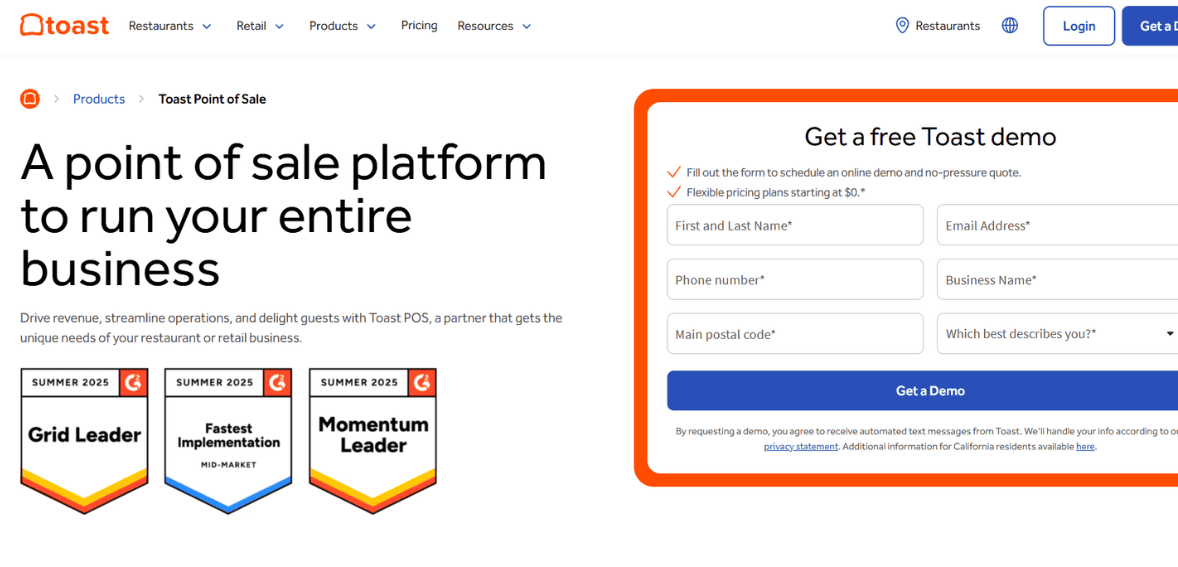
Toast POS Review

Toast POS Review

Toast is the dominant restaurant technology platform in the United States. Founded in 2012 in Boston, Massachusetts by Steve Fredette, Aman Narang, and Jonathan Grimm, the company has grown from a startup with a focused mission of building technology specifically for restaurants into a publicly traded commerce platform listed on the NYSE under the ticker TOST, serving over 127,000 restaurant locations globally as of mid-2026. The company generated 6.15 billion dollars in revenue in 2025, a 24% increase over 2024, added a record 30,000 net new locations during 2025, and reported an annualized recurring run-rate of 2.2 billion dollars as of March 31, 2026. Lets read more about Toast POS Review.

This is not coincidence; rather, it speaks to a company that has found true product-market fit in an industry characterized by experienced, skeptical operators who will drop a technology system if it does not live up to its promises in the midst of a hectic service cycle. The scale at which Toast operates is a testament to the actual operational utility of the platform.

Toast is built solely for the restaurant industry and no other. There is no retail, no healthcare, no government, nor any other industry that can be served by Toast software. Everything about Toast – hardware, software, features – was built on the assumption of running a restaurant, from fast order processing, to frequent drink spillages, to a POS failure being a business-critical event for Friday night dinner service. This singular focus is both Toast’s competitive advantage and its defining attribute.

The goal of this review is to discuss what Toast really offers, how much it costs beyond the sticker price, where the platform fails to deliver, and what you need to know about the platform before signing a multi-year contract with serious exit costs.

Company Background and Market Position | Toast POS Review

Toast’s founding in 2012 preceded the widespread adoption of cloud-based POS systems in the restaurant industry by several years, and the company spent its early period converting a market that was heavily dominated by legacy on-premise POS systems from companies like Aloha, Micros, and Squirrel. The transition from these systems was not simply a software upgrade but a fundamental shift in how restaurant technology was delivered, maintained, and updated, and Toast positioned itself as the cloud-native alternative that would render legacy systems obsolete.

The company went public in September 2021 at a share price of 40 dollars, raising significant capital that accelerated product development, sales team growth, and the expansion of the platform’s feature set beyond the core POS into adjacent restaurant management functions. The IPO made Toast one of the more high-profile restaurant technology listings of the post-pandemic period, though the subsequent stock price performance reflected the broader correction in high-growth technology valuations.

One of the co-founders and the company’s CEO, Aman Narang, steered this company to maturity from growth at any cost to growth in location, margin, and profit as seen in the achievements of the year 2025 and the first quarter of 2026, when the net income was 126 million dollars and adjusted EBITDA was 179 million dollars. These numbers speak of a company that is way beyond the discussion of whether its economic model is sustainable.

A lot has happened since the company’s inception with respect to the environment in which it operates. Companies such as Lightspeed Restaurant, Shift4’s SkyTab, Square for Restaurants, TouchBistro, and Revel Systems compete for the restaurant POS services in addition to competition from Oracle MICROS and NCR Voyix for the enterprise segment. To counteract the competitive pressure, the company invests more in product development, enters into the strategic partnership with American Express in Q2 2025, expands to the UK, Ireland, Canada, and Australia and introduces Toast Drive-Thru for enterprises in 2026.

Core POS Capabilities

Toast’s core POS functionality reflects years of refinement specifically within food service environments, and the depth of restaurant-specific features is one of the most consistent themes across the platform’s positive reviews. The system handles the full order management lifecycle from initial entry through kitchen production and final payment, with each stage of the process connected through the same integrated platform rather than through separate systems that require data to move between them.

Order entry covers the full range of modification complexity that restaurant menus require. Size variants that affect topping costs, ingredient substitutions, allergy accommodations, course sequencing for multi-course meals, and split ordering between different preparation stations are all handled within the standard order entry flow rather than requiring workarounds. The kitchen display system routes items to the appropriate preparation station simultaneously with order entry, eliminating the manual ticket production step that legacy systems required and reducing the time between order placement and kitchen production beginning.

Tableside ordering through Toast Go handheld devices allows servers to enter orders at the table rather than returning to a fixed terminal, which reduces the round-trip time between order placement and kitchen submission and decreases the transcription errors that occur when servers write orders manually and re-enter them at a terminal. The Toast Go 3, launched internationally in April 2026, adds a 6.52-inch screen, over 24 hours of battery life, and cellular connectivity as a backup to Wi-Fi, maintaining order entry capability if the venue’s wireless network experiences issues during service.

Payment processing at tableside eliminates the traditional bring-the-check-then-bring-the-card-then-bring-the-receipt payment cycle, reducing table turn time in environments where this cycle has been a bottleneck. Order and Pay functionality allows guests to order and pay directly from their own smartphones using a QR code, which became standard customer behavior during the pandemic and has remained a preferred option for a meaningful segment of diners.

Hardware Ecosystem and Durability

Toast’s hardware is purpose-built for restaurant environments and designed to survive the specific physical hazards of commercial kitchen and dining room conditions. Spill resistance, heat tolerance, and the kind of physical durability that survives a busy service environment without requiring careful handling are design requirements rather than marketing claims, and they reflect real and significant operational value for restaurants where equipment is handled roughly and conditions are demanding.

The hardware lineup covers the full range of restaurant deployment configurations. The Toast Flex countertop terminal handles standard fixed POS stations in quick-service and casual dining environments. The Toast Kiosk supports self-service ordering for quick-service restaurants and counter-service environments where operator labor costs make attending ordering less economical. Kitchen display systems replace paper tickets in the kitchen, eliminating the waste, illegibility, and loss risk associated with paper-based kitchen communication. The Toast Go 3 handheld covers tableside ordering and payment for full-service environments.

The hardware costs are not disclosed in Toast’s official website and have consistently been noted as one of the downsides in all independent reviews of this restaurant management system. Hardware prices depend on various factors including the total number of terminals required, the mix of the required devices, and whether the devices will be bought upfront or paid for via the ‘pay-as-you-go’ plan provided by Toast. Hardware prices have been estimated in the range of $609 – $1,339 per kit. Enterprise-level hardware solutions require custom pricing.

The use of a proprietary hardware ecosystem is a significant commitment choice made by restaurants deciding to use Toast restaurant management systems. Toast’s terminals cannot be used with any other POS systems while other POS systems cannot be used with Toast’s hardware terminals. In other words, choosing Toast restaurant management means committing to using its hardware solution for the entirety of the restaurant’s engagement with this platform.

Toast POS Review

Payment Processing: Rates, Model, and the Bundling Trade-off

Toast requires all merchants to use Toast’s integrated payment processing. Third-party processors cannot be connected to the Toast platform. This is one of the most commercially significant facts about the platform and one that deserves straightforward explanation rather than minimization.

The payment processing rates vary depending on the software plan selected. The Starter Kit free plan carries rates of 2.99% plus 15 cents per card-present transaction. The paid POS plan at 69 dollars per month reduces the card-present rate to 2.49% plus 15 cents. Card-not-present transactions, including online ordering, are charged at 3.5% plus 15 cents regardless of plan. These rates are competitive within the context of bundled POS-plus-payments platforms and compare favorably to Square’s equivalent rates.

The critical commercial consideration is what Toast’s processing rate costs at scale compared to what a restaurant with significant processing volume could negotiate through an independent interchange-plus arrangement. At 50,000 dollars in monthly card volume, the difference between Toast’s bundled rate and a negotiated interchange-plus rate of approximately 0.10% to 0.20% above actual interchange could amount to 200 to 400 dollars per month. Over a standard two to three-year contract, that differential accumulates to between 4,800 and 14,400 dollars. For restaurants processing higher monthly volumes, the differential is proportionally larger.

Toast can increase processing rates during a contract with 30 days notice. This provision in Toast’s standard agreement means that the rate a restaurant agrees to at signing is not guaranteed for the duration of the contract. Restaurants should ask specifically about this provision and understand that their effective processing cost may increase before their contract term ends.

The bundling trade-off is real; Toast’s integrated processing delivers cleaner data flow between payment and POS systems, simpler vendor management, and the operational benefits of a single provider relationship. Whether those benefits justify the premium over negotiable third-party processing rates depends on the specific restaurant’s volume and the value they place on operational simplicity versus cost optimization.

Pricing Plans and the True Total Cost

Understanding what Toast actually costs requires looking beyond the headline plan rates to the total monthly spend that most restaurants end up paying. Most restaurants pay 150 to 300 dollars per month total, not the zero to 69 dollar base price.

The Starter Kit plan is genuinely free for the monthly software fee but carries the higher 2.99% plus 15 cents processing rate and is limited to one to two terminals, which constrains it to the smallest single-location operations. The POS plan at 69 dollars per month is the entry point for the standard commercial offering with lower processing rates.

The Restaurant Basics package at 110 dollars per month combines POS with employee management tools at four dollars per employee, making the actual monthly cost dependent on headcount. The Growth plan beginning at 165 dollars per month adds online ordering and delivery service capabilities. The Build Your Own custom tier covers enterprise and multi-location deployments with pricing that scales with location count and feature requirements.

Most reputable restaurants make use of other services offered by Toast including Online Ordering, Delivery Services, the loyalty program, Gift Card Management, Marketing Tools, and XtraChef back-office management system. All these have additional charges per month in addition to the basic package subscription rate. For example, a mid-sized full-service restaurant subscribing to some of the add-ons under the growth plan could incur charges in the region of 300 to 500 dollars per month for software only.

What a prospective Toast subscriber needs to evaluate honestly about the service includes all subscription fees involved including the basic package fees, the additional add-on fees according to the services that one requires, the hardware charges amortized according to the contract period and the monthly payment process fees. The single most important thing to do in terms of business is to ask for an accurate cost projection according to one’s own specific setup before subscribing.

Online Ordering and Delivery

Toast stands out for its online ordering capabilities. The platform’s integration between online ordering and the POS is one of its most consistently praised features, and it addresses one of the most operationally problematic aspects of restaurant digital commerce: the disconnection between orders placed through third-party delivery platforms and the restaurant’s own POS and kitchen systems.

Toast Online Ordering provides a restaurant-branded digital ordering experience that connects directly to the POS, automatically routing orders to the kitchen display system without requiring staff to manually re-enter orders received through a tablet. This eliminates the human error and delay associated with third-party tablet management, which is one of the most common operational complaints from restaurants managing multiple delivery platform relationships.

Guests can easily order and schedule meals online, save orders, pre-order meals and use express checkout for a seamless experience. The ability to save order preferences and use express checkout reduces the friction of repeat digital orders, which supports the customer retention objective that online ordering is meant to serve.

Toast Delivery Services provides a first-party delivery fulfillment option using a network of third-party delivery drivers, allowing restaurants to offer delivery without signing the full commission agreements of major third-party delivery platforms. This positions Toast as a viable first-party alternative to DoorDash, Uber Eats, and Grubhub for restaurants whose delivery volume is sufficient to justify the operational investment but who want to avoid the 25 to 30 percent commission structures of the major aggregators.

Third-party platform integrations are also available for restaurants that want to maintain their presence on DoorDash and Uber Eats while routing those orders through the Toast POS rather than managing a separate tablet, consolidating all incoming orders into the same kitchen management flow regardless of their source.
Toast POS Review

Inventory and Back-Office Management

Toast’s inventory management tools provide real-time stock tracking that updates automatically with each sale, low stock alerts, and direct reorder capability from within the POS system. Unlike many other POS platforms that require third-party apps for reordering, Toast streamlines this process, saving time and effort for restaurant operators.

The xtraCHEF by Toast software offers functionalities like invoices management, recipe costing, and food cost analytics as an additional offering. For restaurants in which food cost is the most critical factor influencing margin optimization, having invoice costs connected with recipes and sales performance data gives insights into food cost efficiency and identifies any problems with waste, pricing, and vendor prices well before any real financial impact occurs.

Ordering purchases inside the inventory module provides the option to order goods whenever inventory levels go below certain thresholds. This functionality will be especially useful in restaurants with many ingredients of varying freshness requirements and frequency of purchase. Ordering items based on inventory will reduce the burden on kitchen management, who otherwise need to keep track of their stock levels and know when and how to order each ingredient.

Inventory management for multiple locations makes it possible to analyze inventory levels in several restaurants at once through a centralized dashboard, which is useful for chain restaurants or other groups of restaurants where the inventory and purchasing management impact all locations.

Team Management and Payroll

Toast’s team management capabilities cover scheduling, time tracking, labor cost analysis, and integration with the Toast Payroll product, creating an end-to-end labor management system within the same platform as the POS. The connection between labor scheduling and POS sales data in the same environment allows operators to evaluate labor cost as a percentage of revenue in real time and adjust staffing decisions based on actual business performance rather than forecasts.

The Restaurant Basics package at 110 dollars per month plus four dollars per employee includes these team management tools alongside the core POS, which makes the all-in pricing for this configuration dependent on headcount in a way that operators need to model explicitly. A restaurant with 25 employees on the Restaurant Basics plan pays 210 dollars per month before add-ons, which is the effective starting point for the team management inclusion.

Toast Payroll, available as a separate product, extends the labor management connection through to actual payroll processing, tax filing, and direct deposit. The direct integration between the POS time tracking and the payroll system eliminates the data transfer step between time and attendance records and payroll processing, reducing the administrative burden and the error risk associated with manual data entry between systems.

Contract Terms and the Long-Term Commitment

Contract terms are one of the most practically important aspects of the Toast relationship and one that a significant number of independent reviews flag as a meaningful consideration. Contracts run two to three years. This multi-year commitment, combined with the proprietary hardware lock-in, means that a restaurant choosing Toast is making a decision whose financial and operational consequences extend well beyond the initial onboarding period.

Early termination fees apply to both the software agreement and any hardware financing arrangement, meaning that exiting Toast before the contract term ends carries costs across multiple dimensions. The specific ETF amounts are not published publicly and should be requested in writing during the sales process.

Be prepared to sign a long-term contract if you choose to go with Toast. This consistent advice from independent reviewers reflects the reality that the contract terms are a meaningful commitment rather than a flexible month-to-month arrangement. Restaurants that are uncertain about their long-term platform choice or that anticipate significant operational changes within the next two to three years should factor the exit cost explicitly into their evaluation.

The processing rate increase provision, which allows Toast to raise rates with 30 days notice, means that the economics agreed to at signing may not hold through the full contract term. Restaurants should ask specifically about any rate increase history for existing customers and request contractual rate stability protections if possible before signing.

Strengths, Limitations, and Who It Is Best For

Toast POS delivers on its promise: a restaurant-focused system built for real service environments. The kitchen display system integration, tableside ordering through Go handhelds, the online ordering platform, the inventory management tools, and the team management capabilities together constitute a genuinely comprehensive restaurant operating system that is more deeply integrated and restaurant-specifically designed than any competing platform at comparable scale. The 24/7 customer support available even on the free Starter plan, the durability of the purpose-built hardware, and the financial strength of a publicly traded company with 2.2 billion dollars in annualized recurring revenue provide operational assurance that many restaurant operators value highly.

The limitations are real and consistently documented. The mandatory proprietary payment processing creates a price premium relative to what high-volume restaurants could negotiate independently, and the 30-day notice provision for rate increases means this premium is not contractually fixed. The two to three-year contract with hardware lock-in and early termination fees creates significant switching costs that reduce flexibility. The add-on cost structure means total monthly spend climbs quickly beyond the headline plan prices for restaurants that activate the full feature set. The limited offline mode is a genuine operational concern for restaurants in locations with unreliable connectivity.

The restaurants best positioned to benefit from Toast are established full-service, quick-service, and casual dining operations that want a single integrated vendor for POS, payments, online ordering, delivery, team management, and back-office analytics. Multi-location operators who need centralized reporting and management across sites, enterprise restaurant groups who can negotiate favorable multi-unit contract terms, and new restaurants that want professional POS infrastructure without upfront hardware capital through the Starter Kit will all find genuine value. Independent restaurants with simple menus and lower processing volumes, highly cost-conscious operators who want to optimize payment processing rates, and businesses that prioritize contract flexibility over platform depth should evaluate the total cost and commitment implications carefully before choosing Toast over a more flexible alternative.

FAQs

Q1. Can I use my own payment processor with Toast, and what happens if I want to switch processors?

Toast does not allow merchants to use third-party payment processors. The platform requires all payment processing to run through Toast’s integrated payment system, and there is no configuration option that connects an external processor to the Toast POS. This is a firm platform requirement rather than a negotiable commercial term. For restaurants that are currently processing payments through a different provider and are evaluating a switch to Toast, the migration means ending the existing processor relationship and accepting Toast’s bundled processing rates. 

For restaurants processing significant monthly volumes, the comparison between Toast’s bundled rates and what they could negotiate through an independent interchange-plus arrangement is an important financial analysis to complete before signing. Toast’s processing rates for card-present transactions are 2.49% plus 15 cents on paid plans, which is competitive within the bundled POS-payments market but typically above what a high-volume restaurant could negotiate with a direct processor. The processing rate increase provision, allowing Toast to raise rates with 30 days notice, is an additional factor in this analysis.

Q2. What is the real total monthly cost of Toast for a typical full-service restaurant?

The headline pricing of zero dollars for the Starter Kit and 69 dollars per month for the POS plan understates what most full-service restaurants actually pay. A realistic total monthly cost for an established full-service restaurant using Toast’s core features typically falls between 150 and 300 dollars per month in software fees before payment processing costs. A restaurant on the Growth plan at 165 dollars per month that activates Toast Online Ordering, the loyalty program, and basic marketing tools can reach 250 to 350 dollars per month in software fees alone. 

Adding xtraCHEF back-office tools, payroll, and additional add-ons pushes the fully loaded software cost higher still. A mid-sized full-service restaurant with a comprehensive feature activation can reach 400 to 500 dollars per month in software fees. These costs are separate from payment processing fees, which apply as a percentage of all card transactions. Restaurants evaluating Toast should request a complete cost estimate for their specific configuration, including all add-ons they plan to activate and an estimate of processing costs at their expected monthly card volume, before comparing the total cost against alternatives.

Q3. How does Toast’s contract structure work, and what are the risks of the long-term commitment?

Toast’s standard merchant agreements involve contract terms of two to three years, which is longer than many competing POS platforms and creates meaningful financial and operational consequences for restaurants that want to switch platforms before the term ends. Early termination fees apply to the software agreement, and separate financing terms apply to any hardware acquired through Toast’s pay-as-you-go model, meaning exit costs can accumulate across both dimensions simultaneously. The proprietary hardware ecosystem means that Toast terminals cannot be repurposed for a different POS platform, and a restaurant switching away from Toast effectively writes off the current market value of its Toast hardware unless it can sell the equipment to another Toast user. 

The processing rate increase provision adds a further dimension: Toast can raise its payment processing rates during the contract term with 30 days written notice, which means the economics agreed to at signing are not contractually guaranteed for the full term. Restaurants considering Toast should request the specific ETF amount that would apply to their contract, ask about the rate increase history for existing customers, and evaluate the total potential exit cost before signing. Restaurants that are uncertain about their long-term technology direction or that anticipate significant operational changes in the next two to three years should factor the switching cost explicitly into their platform selection decision rather than treating it as a consideration they can revisit later.


SynapseFI Review

SynapseFI Review

SynapseFI, formally Synapse Financial Technologies, Inc., is no longer an operating company. It filed for Chapter 11 bankruptcy on April 22, 2024, and its collapse triggered one of the most consequential consumer financial harm events in modern fintech history. More than 100,000 end users lost access to over 265 million dollars in funds held across the platform’s banking partner network. Lets read more about SynapseFI Review.

A shortfall of between 46 and 96 million dollars existed between what Synapse’s records showed end users were owed and what the partner banks actually held. As of the CFPB’s September 2025 enforcement action and the agency’s December 2025 allocation of 46 million dollars toward restitution, many affected consumers had still not recovered their full balances more than a year after the bankruptcy.

Company Background and Market Position | SynapseFI Review

Synapse Financial Technologies was founded on April 14, 2014, by Sankaet Pathak, then in his mid-twenties, in San Francisco. Pathak had previously co-founded Zen Payroll, which later became Gusto, though he departed before the company achieved its most significant growth. His founding premise for Synapse was straightforward and, at the time, genuinely compelling: the infrastructure required to launch banking and financial products was prohibitively expensive and technically complex for the wave of fintech startups that wanted to offer deposit accounts, debit cards, and payment services to their customers. By building a centralized platform that handled the compliance, bank partnerships, and technical integrations, Synapse could allow fintech companies to launch banking products in weeks rather than years.

The company built a substantial operation on this premise. By the end of 2022, Synapse had reached 18 million end users, completed 91 million annualized transactions, processed 76 billion dollars in annualized transaction volume, and achieved cash-flow positive status. It was ranked among the top 100 financial services companies on the Inc. 5000 fastest-growing private companies list. It had contracts with approximately 20 banking partners and served roughly 100 fintech companies whose own customers ultimately relied on Synapse’s infrastructure for their banking services. Companies including Yotta, Juno, Copper, Dave, and Relay used Synapse’s platform to power their consumer and business banking products.

The company raised funding from investors including Trinity Ventures and Andreessen Horowitz. Its valuation reached unicorn status, above one billion dollars, at some point before the bankruptcy, reflecting the market’s significant confidence in both the BaaS model and Synapse’s execution of it.

The Banking as a Service Model Synapse Built

Understanding what Synapse actually did requires a clear explanation of the banking-as-a-service model it operated within, because the architecture of that model is both what made Synapse valuable as an infrastructure provider and what created the conditions for catastrophic failure.

A banking-as-a-service company like Synapse operates as a technology and ledger intermediary. Fintech companies, the companies actually facing consumers, do not hold banking licenses. They cannot legally hold deposits. To offer their customers what looked and functioned like a bank account, they partnered with FDIC-insured banks. But connecting directly with a bank requires significant compliance infrastructure, regulatory work, and technical integration that most small fintech companies could not afford or manage independently.

Synapse was at the heart of all of this. Fintech companies were connected with the technology of Synapse through its APIs that allowed for the creation and management of customer accounts, issuance of debit cards, payments processing, and Know Your Customer and compliance. On the other hand, Synapse was connected with partner banks including Evolve Bank & Trust, American Bank, Lineage Bank, and AMG National Trust Bank. Funds of customers were stored in FBO accounts, which referred to one bank account where the money of thousands of individuals could be stored. Synapse kept track of which individual owned how much from the total sum of the bank account balance.

All of this implied that the safety of customers’ funds was ensured by the following three factors; insurance of partner banks by the FDIC, solvency of partner banks, and accurate records on the ledger of Synapse. Both of the first two were true. Not so with the latter.

Core Products and Services During Operation

During its operational years, Synapse offered fintech companies a suite of products that covered the core infrastructure components of a banking product. Deposit account management through the FBO account structure allowed fintech companies to offer their customers accounts that held real money at real FDIC-insured banks, accessible through the fintech’s own app interface. End users deposited money into accounts that technically existed at the partner bank, with Synapse maintaining the per-user balance record in its own ledger system.

Debit card issuance was handled through Synapse’s card program management capability, connecting partner banks and card networks to allow fintech companies to issue branded debit cards to their customers without managing card network relationships independently. Card transaction processing ran through the Synapse infrastructure, with transaction records flowing into the ledger system alongside deposit balances.

Payment processing covered ACH transfers, which enabled direct deposit, bill payment, and peer-to-peer money movement through the accounts. This payment infrastructure was the functional backbone of the banking experience that fintech companies built on top of Synapse, and its reliability during the operating years was a genuine strength of the platform.

KYC and compliance services handled customer identity verification, Bank Secrecy Act compliance, and anti-money laundering screening on behalf of fintech companies and their partner banks. This compliance infrastructure was one of the most significant barriers to entry that Synapse removed for fintech operators, allowing companies to launch regulated financial products without building their own compliance teams from scratch.

The Modular Banking product, launched in 2022, and the Global Cash product introduced in the same year reflected Synapse’s ambition to extend beyond its core US deposit and card infrastructure toward a more comprehensive global financial services platform. These products were still developing when the company’s financial and operational difficulties escalated.

The Relationship with Evolve Bank and the Growing Dispute

The relationship between Synapse and Evolve Bank and Trust is the central operational context for understanding the collapse, and it deserves careful examination because the dispute between the two companies directly produced the conditions that froze customer funds.

Evolve Bank and Trust was Synapse’s largest banking partner and the bank that held the most significant portion of Synapse’s end-user funds. The relationship was commercially central to Synapse’s business model: Evolve provided the FDIC-insured banking infrastructure behind a substantial share of the fintech products Synapse enabled.

In late 2023, the relationship began deteriorating. Evolve demanded that Synapse maintain a reserve of approximately 50 million dollars as a condition of continuing the partnership. Synapse, whose financial position was weakening following Mercury’s departure from the platform, could not satisfy this demand. The dispute over reserve requirements and the settlement of end-user balances between the two organizations created a growing discrepancy between Synapse’s internal ledger records and Evolve’s records of what the bank held on behalf of Synapse’s end users.

Mercury, one of Synapse’s largest and highest-profile fintech clients, migrated off the Synapse platform in late 2023. The loss of Mercury’s transaction volume, and the settlement of Mercury’s customer balances as part of that migration, is a disputed but significant element in the balance sheet of what went wrong. Pathak has alleged that Mercury’s migration created approximately 92 million dollars in shortfall in funds held at Evolve. Evolve and others dispute this characterization.

As the dispute escalated and Synapse’s financial position deteriorated, the company began discussions with TabaPay about an acquisition that would have used TabaPay’s resources to resolve the balance discrepancy and continue operations. Synapse filed for Chapter 11 bankruptcy on April 22, 2024, with the TabaPay acquisition intended to proceed through the bankruptcy process.

The Bankruptcy, the TabaPay Failure, and the Account Freeze

The sequence of events following the bankruptcy filing moved quickly and disastrously. The TabaPay acquisition was the last viable path to a resolution that would have preserved customer access to their funds, and its collapse destroyed that path.

TabaPay’s acquisition of Synapse required a closing condition: Evolve Bank needed to fully fund the FBO accounts to cover the balance discrepancy before the deal could close. Evolve refused to do so, disputing both the existence of its obligation and the accuracy of Synapse’s records about the shortfall amount. TabaPay withdrew from the acquisition on May 8, 2024, citing the failure to meet the closing conditions.

Three days after TabaPay’s withdrawal, on May 11, 2024, a crisis point was reached. Synapse cut Evolve’s access to the dashboard system that Evolve used to maintain customer accounts, an action that Synapse characterized as a response to non-payment but that Evolve characterized as a sudden system shutdown without notice. Evolve froze the funds it held in response, citing inability to verify transactions and confirm end-user balances without access to Synapse’s systems.

The impact on users was instant and drastic, as those who were storing their money using Synapse’s technology stack, from Yotta to Juno to Copper, and other platforms, logged into their applications in the morning only to see their accounts frozen. Direct deposits could not be made. Scheduled payments did not go through. Funds to cover rental payments, emergencies, and business operations were held within an account that neither the company nor anyone else was able to access because the ledger system that showed who had ownership of which portion of the aggregated funds was down or wrong.

These were people describing actual difficulties in life on public forums and bankruptcy filings. One user stated how they had been forced to borrow money to pay for rent and relocation services while they could not access their own money. Another mentioned having over twenty thousand dollars in a Yotta account, and unable to access those funds.

The Ledger Discrepancy: What Went Wrong Technically

The specific technical failure at the heart of the Synapse collapse was the inaccuracy of its ledger records, which the CFPB’s August 2025 enforcement action specifically cited as a violation of consumer protection laws.

In the FBO account structure, all end-user funds at a given bank are held in a single pooled account. The only way to determine how much of that pooled balance belongs to any specific end user is through the intermediary’s internal ledger. Synapse’s ledger was the definitive record of individual balances across its network of partner banks. When the ledger was accurate and the pooled bank balances matched the sum of individual ledger entries, the system worked. When they diverged, there was no simple way to determine which end users were owed what, because the bank’s records only showed the aggregate pooled balance, not individual ownership.

The complaint made by the CFPB, filed on August 21, 2025, and entered by the court on September 12, 2025, stated that Synapse violated the Consumer Financial Protection Act of 2010 by failing to keep proper record-keeping of the location of the consumers’ funds. This enforcement action showed that the issue of poor record-keeping was not due to the final dispute with Evolve; instead, it was Synapse’s ongoing inability to manage its ledger infrastructures according to the true locations of its funds in the partner banks.

According to the bankruptcy trustee who used to be the FDIC chair, Jelena McWilliams, there was an estimated gap between Synapse’s record-keeping and what was being kept by the partner banks of 65 to 96 million dollars during different times of the process. It was documented in court files that the total amount the end-users needed for reimbursement was around 265 million dollars, and the partners were holding about 219 million dollars. Hence, the gap was around 46 million dollars, which was allocated to restitution in December 2025.

The Regulatory and Legal Aftermath

The Synapse collapse generated regulatory and legal activity across multiple fronts that continued through 2025 and into 2026, and understanding this aftermath is essential context for evaluating the broader BaaS risk landscape.

The CFPB’s enforcement action against Synapse was filed on August 21, 2025, and entered by the bankruptcy court on September 12, 2025. The action alleged that Synapse violated the Consumer Financial Protection Act by failing to maintain adequate records of consumer fund locations and failing to adequately oversee the banking partners and fintech companies in its network. The consent order required the allocation of available funds toward restitution for affected consumers.

Yotta, whose customers had initially lost access to over 100 million dollars in funds, filed a lawsuit against Evolve Bank in September 2024, alleging grotesque misconduct, fraud, and negligence. Yotta’s lawyers described Evolve as having a rotten core, reflecting the deep attribution of blame that the fintech directed at the bank partner rather than accepting shared responsibility for the infrastructure failures.

The Federal Reserve, which supervises Evolve as a state-chartered member bank, issued enforcement actions against Evolve related to its BaaS activities. These enforcement actions addressed Evolve’s oversight of its fintech partners and its internal controls around the FBO account structure, confirming that the bank’s conduct in managing its Synapse relationship was not consistent with sound banking practices.

Evolve maintained throughout the proceedings that Synapse’s own recordkeeping failures, not Evolve’s conduct, were the primary cause of the consumer harm. The assignment of blame between Synapse and Evolve remained contested as of early 2026, with active litigation between various parties including Yotta’s lawsuit against Evolve continuing in the courts.

The Industry Impact and Regulatory Response

The Synapse collapse had consequences that extended well beyond the specific companies and end users directly affected, reshaping how regulators, banks, and fintech operators think about the BaaS infrastructure model.

Federal banking regulators issued joint guidance on BaaS arrangements in mid-2024, clarifying supervisory expectations for banks that partner with fintech companies. The guidance emphasized that banks retain full responsibility for compliance with banking laws and regulations regardless of what technology intermediaries do on their behalf, and that the delegation of compliance functions to BaaS providers does not reduce the bank’s regulatory accountability. This guidance effectively raised the bar for bank oversight of BaaS relationships, with direct implications for how BaaS providers structure their operations.

As per the analysis in the Yale Journal of International Affairs published in January 2026, the Synapse collapse proved that there is a requirement for mandatory disclosures during account opening that explain clearly the custodial structure, scope of deposit insurance, involvement of middleware firms, and degree of regulation. According to this analysis, any financial product marketing itself with the promise of safety provided by the bank must be providing safety in the same way as that provided by a bank.

In the case of the BaaS industry specifically, the Synapse collapse led to the phase of consolidation. Many BaaS players had grown rapidly due to their business models being solid as the deposits with their partners were FDIC insured. After the Synapse collapse incident, there were doubts regarding the assumption of FDIC insurance covering the failure of the intermediary firm. It became evident that FDIC insurance covers failure of banks but not of intermediaries who maintain record of shares of pooled bank accounts.

SynapseFI Review

Lessons for Fintech Operators and BaaS Customers

For fintech companies evaluating BaaS providers today, the Synapse collapse provides a set of specific and practical lessons that should inform due diligence and risk management. Ledger accuracy is the single most critical operational requirement in the BaaS model. A BaaS provider that cannot maintain accurate, real-time reconciliation between its internal ledger records and the actual balances at its partner banks creates existential risk for its fintech clients and their end users.

Any fintech evaluating a BaaS provider should understand specifically how the provider reconciles its ledger against bank records, how frequently that reconciliation occurs, what controls exist to detect discrepancies, and what remediation processes are triggered when discrepancies are identified. These are not technical questions for engineers to answer in isolation. They are questions that fintech founders and financial officers need to understand and verify before relying on any BaaS infrastructure for their customers’ financial assets.

Single-partner bank concentration is the operational risk factor that the Synapse case made very evident. Having all or most of the end-user funds hosted by a single banking partner such as Evolve caused any issue arising between Synapse and the single banking partner to spell doom for the whole platform. Providers of BaaS who work with multiple banking partners and where end-user funds are dispersed are safer than providers who have one dominating banking partner.

Continuity is a very important factor when assessing the BaaS ecosystem. Failure to put into place a contingency plan in the event of failure of the BaaS provider such as the Synapse bankruptcy, particularly failure to establish whether there is a mechanism in case access to users’ funds was lost in the event of Synapse’s shutdown, was a very serious weakness of the ecosystem. Any fintech company that operates on top of a BaaS ecosystem needs to find out how its clients’ funds are handled in the event of a BaaS shutdown.

Strengths the Platform Had During Operation

Honest evaluation requires acknowledging what Synapse genuinely delivered during its operational years, even in the context of documenting its catastrophic failure. The platform’s API infrastructure and developer tooling were widely regarded as well-constructed and accessible. Fintech companies that used Synapse reported that launching banking products was faster and less expensive than building direct bank partnerships independently, which validated the core premise of the BaaS model. The compliance infrastructure, KYC tooling, and bank partner network that Synapse assembled represented genuine operational value that hundreds of fintech companies relied on to bring financial products to market.

The platform’s scale achievements, 18 million end users, 91 million annualized transactions, and 76 billion dollars in annualized volume as of 2022, were real operational metrics that reflected genuine demand for the infrastructure it provided. For the substantial period during which Synapse’s ledger was reasonably accurate and its banking relationships were functional, millions of end users accessed financial services through apps powered by Synapse that they would not otherwise have had access to.

The mission of expanding access to financial services for underbanked populations was meaningfully advanced by the platform during its operational years. Partnerships like the one with Glance Capital to serve gig workers, and the platform’s stated focus on financial inclusion, reflected genuine ambitions that were delivered in part during the period of stable operations.

Strengths, Limitations, and What Replaced It

SynapseFI no longer exists as an operating platform, and no evaluation of its current suitability is possible or relevant. What replaced Synapse in the BaaS market, and what the collapse means for evaluating current alternatives, is the more practically useful framing for anyone reading this review today.

The BaaS market has continued operating following the Synapse collapse, with providers including Unit, Treasury Prime, Stripe Treasury, Column Bank, and others serving the fintech banking infrastructure market. The collapse accelerated a shift toward direct bank partnerships and BaaS arrangements with more rigorous oversight, more frequent reconciliation, and more explicit contractual protections for fintech operators and their end users than the Synapse model provided.

For fintech companies evaluating BaaS infrastructure today, the Synapse collapse provides a checklist of failure modes to guard against: insufficient ledger reconciliation frequency, excessive concentration of end-user funds at a single bank partner, inadequate contractual protections for service continuity, weak governance of the relationship between the BaaS provider and its banking partners, and marketing of bank-level safety to end users without adequate disclosure of the intermediary risk inherent in the FBO account structure.

The CFPB enforcement action confirmed that regulators now view inadequate recordkeeping by BaaS intermediaries as a violation of consumer protection law rather than simply an operational failure. This regulatory clarity, while arriving too late to prevent the harm to Synapse’s end users, has raised the compliance bar for BaaS providers operating today and should inform the due diligence framework of any fintech company evaluating infrastructure that involves pooled bank accounts and intermediary ledger management.

FAQs

Q1. Is SynapseFI still operating, and can fintech companies still use it as a BaaS provider?

SynapseFI is no longer operating. Synapse Financial Technologies, Inc. filed for Chapter 11 bankruptcy on April 22, 2024, and the company has not resumed operations. Its website, synapsefi.com, has been archived. The bankruptcy proceedings continued through 2024 and into 2025, with the CFPB filing an enforcement action against the defunct company on August 21, 2025, and the court entering a consent order on September 12, 2025. The enforcement action addressed recordkeeping violations that directly caused consumer financial harm, confirming that the platform’s failure was not simply a commercial bankruptcy but involved regulatory violations that affected tens of thousands of consumers. 

Fintech companies that were using Synapse as their BaaS infrastructure at the time of the bankruptcy had to migrate their customers to alternative providers under extremely difficult conditions, with many customers experiencing extended periods of inability to access their funds during the transition. No new integrations with Synapse are possible, and no part of the platform’s infrastructure remains available for commercial use.

Q2. Were end users’ funds protected by FDIC insurance during the Synapse collapse, and did they recover their money?

The FDIC insurance situation in the Synapse collapse illustrates one of the most important and widely misunderstood aspects of the fintech banking model. The partner banks holding Synapse’s end-user funds, including Evolve Bank and Trust, were FDIC-insured institutions. FDIC insurance protects depositors when a bank fails. It does not protect depositors when the intermediary maintaining the records of who owns what portion of a pooled bank account fails or maintains inaccurate records. 

Because Synapse’s ledger was inaccurate, and because there was a documented shortfall of approximately 46 million dollars between what Synapse’s records showed end users were owed and what the partner banks actually held, the question of who was entitled to what portion of the pooled bank balances could not be resolved by reference to standard FDIC processes.

The CFPB allocated 46 million dollars toward restitution through its December 2025 enforcement action, which represents some recovery for affected consumers. Whether individual end users have fully recovered their losses depends on the specific amounts involved, the allocation methodology used by the bankruptcy trustee, and the outcome of ongoing litigation including Yotta’s lawsuit against Evolve. Many consumers had still not recovered their full balances more than a year after the bankruptcy filing.

Q3. What should fintech companies evaluating BaaS providers today learn from the Synapse collapse?

The Synapse collapse provides several specific and actionable lessons for fintech operators evaluating BaaS infrastructure. First, verify the frequency and methodology of ledger reconciliation. Ask specifically how the BaaS provider reconciles its internal records against actual bank balances, how often this occurs, what controls exist to detect and flag discrepancies, and what remediation processes are triggered automatically when discrepancies arise. Second, assess bank partner diversification. Understand how end-user funds are distributed across banking partners and what concentration risk exists if a single banking relationship deteriorates or terminates. 

Third, evaluate contractual continuity protections. Understand specifically what happens to your customers’ accounts and access to their funds if the BaaS provider ceases to operate, and verify that the contract and technical architecture provide a recovery path independent of the BaaS provider’s ongoing operational status. Fourth, review end-user disclosure obligations.

Post-Synapse regulatory guidance is clear that marketing banking products powered by FBO structures requires transparent disclosure of the intermediary’s role, the scope of deposit insurance, and the risks associated with the pooled account structure. Fifth, conduct ongoing monitoring rather than one-time due diligence. The Synapse failure developed over months of deteriorating bank relationships and worsening ledger accuracy before the public bankruptcy event. BaaS clients who were monitoring their provider’s financial health and compliance status had more opportunity to migrate before the crisis point than those who relied on their initial due diligence without ongoing reassessment.

Sterling Payment Technologies Review

Sterling Payment Technologies is a Tampa, Florida-based payment processing company that operated as an independent merchant services provider from its founding in 2001 until its acquisition by EVO Payments International in January 2017. Founded by Ronald Nolte and led through its acquisition years by Paul Hunter, Sterling built a reputation as a nationally recognized provider of integrated payment solutions, growing to approximately 143 employees and 7.5 million dollars in annual revenue without raising outside venture capital or private equity funding, a genuinely rare achievement in a capital-intensive industry. Lets read more about Sterling Payment Technologies Review.

The company’s independence ended with the EVO acquisition, and the Sterling brand was subsequently subsumed into EVO’s operations, with the Sterling website eventually redirecting to EVO’s platform. The ownership chain did not stop there: in August 2022, Global Payments Inc., one of the largest payment technology companies in the world, announced its acquisition of EVO Payments for 4.3 billion dollars in an all-cash transaction, which closed on March 24, 2023. Sterling Payment Technologies now sits several layers deep within Global Payments’ global infrastructure, having passed from independent operation through EVO and into the Global Payments organization within a six-year period.

Company Background and Market Position | Sterling Payment Technologies Review

Sterling Payment Technologies was founded in 2001 in Tampa, Florida by Ronald Nolte, making it one of the longer-tenured independent merchant services companies in the southeastern United States by the time of its EVO acquisition. The company built its business through a combination of direct merchant relationships and an ISO and reseller distribution network, which allowed it to reach a geographically dispersed merchant base beyond what a direct sales force operating from a single Tampa headquarters could access.

The company was self-funded throughout its independent operation, reaching 7.5 million dollars in annual revenue and a disclosed valuation of approximately 22.4 million dollars without raising venture capital or outside investment. For a payment processing company operating in an industry where capital is typically a significant competitive requirement, this bootstrapped growth reflects genuine operational discipline and a business model that generated sufficient cash flow to sustain and expand operations organically.

Sterling positioned itself as a provider of integrated payment solutions for businesses across a range of verticals, with particular emphasis on value-added services including encryption tools, out-of-scope payment applications, mobile payment solutions, and cloud-based POS reporting platforms. This integrated solutions focus distinguished Sterling from pure payment processing ISOs that competed solely on transaction rates and hardware, and it was the specific capability that EVO’s CEO James Kelly cited when announcing the acquisition, describing Sterling as accelerating EVO’s growth in the integrated solutions market.

The EVO acquisition in January 2017 ended Sterling’s independent existence. The Sterling website was redirected to EVO’s platform, and new merchant accounts were established under the EVO brand rather than under Sterling. EVO Payments was itself acquired by Global Payments in March 2023 for 4.3 billion dollars, completing the two-stage consolidation of Sterling into one of the world’s largest payments companies.

Core Payment Processing Capabilities

Sterling Payment Technologies provided a comprehensive suite of electronic payment acceptance capabilities organized around the core transaction types that US businesses require. Credit and debit card processing covered all major card networks including Visa, Mastercard, American Express, and Discover, with support for both card-present and card-not-present transaction environments.

EMV chip card acceptance was a feature Sterling developed and marketed, reflecting the US market’s transition to chip cards following the October 2015 liability shift that made EMV compliance a commercial necessity for merchants who wanted to avoid counterfeit fraud chargeback liability. High-speed, dial, and wireless terminal configurations accommodated different physical merchant environments and connectivity situations, giving merchants flexibility in how they deployed payment acceptance hardware without requiring a single specific connectivity approach.

Fleet card processing was a specific capability that distinguished Sterling from payment processors focused exclusively on standard consumer credit and debit networks. Fleet cards issued by companies including WEX, Voyager, and Mastercard Fleet are used by businesses managing vehicle fuel and maintenance costs, and accepting these cards requires specific network relationships and processing capabilities beyond standard credit card acceptance. For fuel retailers, fleet management businesses, and merchants with significant commercial vehicle customer bases, the inclusion of fleet card processing within the standard offering rather than as a separate specialist product was a practical convenience.

Electronic Benefits Transfer processing allowed merchants to accept EBT cards issued to participants in government assistance programs, covering both SNAP food benefits and cash benefits. For grocery stores, convenience stores, and other food retailers with lower-income customer demographics, EBT acceptance is a commercial and in some cases regulatory necessity, and its inclusion in Sterling’s standard processing capability meant these merchants did not need a separate provider relationship for this payment type.

Integrated Payment Solutions and Value-Added Services

The integrated payment solutions positioning that Sterling maintained through its independent operation and that EVO specifically cited as the acquisition rationale was built around several capabilities that went beyond basic card acceptance.

Encryption solutions offered by Sterling covered point-to-point encryption implementations that protected cardholder data from the moment of card entry through the point of processing. The out-of-scope payment application concept, which Sterling specifically marketed, referred to payment processing configurations where the merchant’s own systems never touched raw cardholder data, substantially reducing the PCI DSS compliance scope the merchant needed to address. By keeping cardholder data within a certified environment that was architecturally separate from the merchant’s own business systems, the compliance burden on the merchant was reduced from a complex assessment to a simplified self-assessment questionnaire.

Mobile payment applications allowed merchants to accept card payments through smartphones and tablets, extending payment acceptance to environments where fixed terminals were not practical. The mobile capability was integrated with the same reporting infrastructure as standard terminal transactions, maintaining data consistency across payment channels rather than creating a separate reporting stream for mobile-processed transactions.

Cloud-based POS reporting platforms gave merchants access to transaction data, sales analytics, and business performance information from any internet-connected device, which was a meaningful capability during a period when most merchant reporting required physical access to a terminal or back-office system. Remote access to reporting data allowed business owners and managers to monitor payment activity without requiring on-site presence, which was particularly relevant for multi-location businesses and owners who were not at their primary location full-time.

Custom application development was described as a Sterling capability, with the company creating tailored payment applications for businesses with specific operational requirements that standard off-the-shelf products did not accommodate. This custom development capability served the ISV and reseller partner channel that was a significant part of Sterling’s distribution model.

Sterling Payment Technologies Review

Gift Cards, Loyalty Programs, and Fleet Processing

Beyond standard card acceptance, Sterling offered a range of adjacent payment-related services that added operational value for specific merchant types and business models. Gift card programs allowed merchants to issue branded gift cards redeemable for purchases at their own locations. Gift cards drive incremental revenue, introduce new customers through recipients who have not previously patronized the business, and generate float from cards that are never fully redeemed. Managing a gift card program through the same platform as payment processing simplified the operational management of the program and ensured that redemptions were recorded consistently alongside standard payment transactions in the reporting system.

Proprietary rewards programs created an additional way to enhance customer engagement through the use of loyalty programs rather than just gift cards. As pointed out by the previous example, retail stores and restaurants that operate in competitive markets and cannot differentiate their products through pricing can benefit from creating a customer retention strategy through the use of loyalty programs that provide customers with rewards or points that are redeemable for certain privileges.

The fleet card processing option was another way to differentiate the service provided to merchants whose clients included fleet managers. The opportunity to accept fleet-specific cards, like the WEX or Voyager cards, under the normal processing service agreement with no need to create a separate agreement or set up a special terminal for this type of processing was a practical solution for merchants that had business customers and processed fleet cards.

Check authorization and conversion services made a final touch to the list of payment methods accepted. These two types of services offered merchants a way to authorize and convert a paper check to an electronic transaction.

The Sterling Funding Merchant Cash Advance Program

Sterling offered a merchant cash advance product through its Sterling Funding program, providing working capital to merchants for business needs including equipment purchases, inventory acquisition, advertising expenses, and operational requirements. Applications were stated to be typically approved within 48 hours, and funding amounts up to 250,000 dollars were described as available with no application fee.

The EZpay product offered a complementary working capital facility structured as a third-party billing arrangement where a portion of future card sales was automatically applied toward repayment. Like the merchant cash advance, EZpay required no credit check, with repayment deducted automatically from daily card sales.

Merchant cash advances and similar revenue-based financing products deserve honest evaluation that goes beyond the convenience of the approval process. The effective cost of capital for these products is typically significantly higher than traditional business loans expressed as an annual percentage rate, because the flat fee charged on the advance does not account for the accelerating cost of capital as the advance is repaid quickly through strong sales periods. The 48-hour approval timeline and no credit check positioning, while convenient for merchants who cannot qualify for or do not want traditional bank financing, reflect the higher-risk nature of these products from the lender’s perspective, which is priced into the cost to the borrower.

Merchants considering any merchant cash advance product, including those offered through Sterling’s program, should calculate the effective annual cost of the funding and compare it explicitly against alternative financing options including business lines of credit, equipment financing, and SBA loan programs before accepting the convenience of fast approval as a substitute for cost analysis.

Pricing Structure and Contract Terms

Sterling Payment Technologies’ pricing structure prior to the EVO acquisition involved a tiered pricing model with specific fee elements that independent payment industry analysts documented in detail. Understanding these terms is relevant context for any merchant who has a legacy Sterling agreement, as the terms negotiated at signup may still be in effect depending on the contract status and how the EVO and Global Payments transitions affected their specific account.

The standard Sterling agreement was a three-year contract through Chase Paymentech as the acquiring bank, with automatic renewal for one-year periods unless formal cancellation notice was provided before the renewal date. The early termination fee was 395 dollars, which applied if a merchant exited the agreement before the three-year term expired. A PCI compliance fee that could approach 150 dollars annually applied alongside the standard transaction fees, and a monthly minimum fee was documented as applicable though the specific amount was not disclosed in standard contract documentation.

The tiered pricing structure adopted by Sterling in its typical contracts led to classification of transactions into qualified, mid-qualified, and non-qualified tiers based on application of different rates for each one. The terms of agreement were graded as C by independent reviewers for being marginally higher in cost than industry standards, particularly owing to the early termination charge and the three years period required for providing services.

More than 30 bad reviews about Sterling were gathered from consumer websites, with complaints revolving around undisclosed fees, poor quality of customer care services, and unauthorized charges after cancellation of the subscription. An example of an unfair charge following disconnection of service, as seen in the Sterling reviews, is the complaint lodged by a nonprofit organization regarding having been forced to pay a hefty fee for non-compliance.

The EVO Payments Acquisition and Its Implications

The January 2017 acquisition of Sterling Payment Technologies by EVO Payments International marked the end of Sterling’s independent operation. EVO Payments described the strategic rationale as accelerating its growth in the integrated solutions market, with Sterling’s products, sales network, and management team strengthening EVO’s existing integrated payments offering.

EVO Payments International was a NASDAQ-listed payment technology and services provider with operations in more than 50 markets and support for over 150 currencies. The acquisition of Sterling brought a domestically focused integrated payments business into a company with significantly broader geographic reach, with the stated intention of exporting Sterling’s integrated payment capabilities to EVO’s international markets and giving Sterling’s existing partners access to international expansion opportunities.

As a result of the acquisition, Sterling’s merchants found themselves operating according to EVO’s operational procedures, contract terms, and support systems. Indeed, Sterling’s website was changed to redirect to that of EVO. As far as the contract terms applicable to accounts opened before the acquisition, these terms would be based on the terms of agreement between EVO and each merchant. It is important to note, however, that merchants whose agreements with Sterling were expiring around the time of acquisition were renewing their contracts with new terms set by EVO.

Indeed, the company’s history of customer complaints and its reputation as viewed by independent observers in the payment industry did not differ significantly from that of Sterling. EVO was regarded by independent analysts as an average merchant services company, offering average terms for merchants; a fairly typical scenario when the ISO is bought out.

The Global Payments Acquisition and Current Status

The ownership chain for Sterling Payment Technologies did not end with EVO. On August 1, 2022, Global Payments Inc. announced a definitive agreement to acquire EVO Payments for 34 dollars per share in an all-cash transaction valued at approximately 4.3 billion dollars. The transaction closed on March 24, 2023, making EVO, and by extension Sterling’s legacy operations, a part of Global Payments’ global infrastructure.

Global Payments is one of the largest payment technology companies in the world, processing transactions for more than 4.5 million merchant locations and serving over 1,500 financial institutions globally. The combined adjusted net revenue of Global Payments and EVO exceeded 9.8 billion dollars at the time of the transaction announcement, placing the combined entity at a scale where any individual legacy Sterling merchant account represents an infinitesimally small part of the overall business.

For merchants who were originally Sterling customers and have been progressively migrated through EVO and now into Global Payments’ infrastructure, this ownership progression means that the merchant experience is now defined entirely by Global Payments’ operational practices, contract terms, and support infrastructure rather than by anything related to Sterling’s original business model or culture. The Global Payments platform carries its own extensive merchant feedback history, its own contract term structure, and its own support infrastructure, all of which should be evaluated on their current merits rather than through the lens of what Sterling Payment Technologies was before 2017.

Sterling’s original website domain now redirects to EVO’s platform, which has itself been absorbed into Global Payments’ structure. Merchants looking for information about their current account status, applicable contract terms, or support channels should engage with Global Payments directly rather than attempting to navigate to legacy Sterling or EVO contact information that may no longer be actively monitored.

Security and PCI Compliance

Sterling Payment Technologies was PCI DSS compliant, meeting the data security requirements established by the major card networks for organizations handling cardholder data. The out-of-scope payment application architecture, which was one of Sterling’s marketed differentiators, was specifically designed to reduce the PCI compliance burden on merchants by keeping cardholder data within Sterling’s certified processing environment rather than within the merchant’s own systems.

Point-to-point encryption was put in place in all of Sterling’s transaction processing network to protect cardholder data in its transmission from the time of the transaction to the completion of the settlement process. Sensitive card information would be replaced with non-sensitive tokens to eliminate risks related to storing the actual data within the merchant networks.

These two solutions promoted by Sterling as added values that would differentiate it from other providers now represent industry-standard expectations and not competitive benefits, as seen in how quickly the payment security landscape changed in the years that followed the launch of Sterling. The PCI DSS compliance framework itself has gone through several updates since the foundation of Sterling, and the compliance procedures followed by Sterling under the new Global Payments network are consistent with current expectations and not those that existed back then.

In the evaluation of the security status of any merchants using their existing Sterling account, it is important to note that the appropriate benchmark is not Sterling’s but Global Payments’ present security framework, as these are the ones actually handling their payments.

Sterling Payment Technologies Review

Customer Support History and Complaint Patterns

Customer support is an area where Sterling Payment Technologies generated a documented pattern of complaints that is worth examining honestly for context, particularly given that these patterns have influenced the reputation that the EVO and Global Payments brands now carry.

Independent review aggregators identified over 30 negative reviews across consumer platforms, with the three most common complaint themes being non-disclosed fees, substandard customer service quality, and unwarranted charges continuing after cancellation. Although company representatives addressed many of these complaints on the day they were posted, the responses did not fully resolve the concerns of the merchants who posted them, indicating that the issues involved substantive disputes rather than simple misunderstandings.

The complaint pattern around post-cancellation charges is particularly instructive. Multiple merchants described situations in which they believed they had successfully terminated their Sterling account, only to discover that charges continued, sometimes including PCI non-compliance fees for an account they believed to be closed. This pattern of continued billing after cancellation is one of the most commonly documented issues across the broader merchant services industry and was not unique to Sterling, but its presence in Sterling’s complaint record is relevant context for merchants evaluating what happened to their accounts through the EVO and Global Payments transitions.

The 24/7 customer support described in Sterling’s marketing materials covered general support availability, with specific B2B merchant services hours Monday through Friday during business hours. For merchants experiencing urgent payment processing issues outside normal business hours, the distinction between general support availability and specialized merchant services support could mean that complex account issues were not fully resolvable through after-hours support channels.

Reporting and Analytics Capabilities

Sterling’s cloud-based POS reporting platform was one of its marketed differentiators, providing merchants with online access to transaction data, sales analytics, and business performance reporting from any internet-connected device. The cloud-based delivery model addressed the limitation of terminal-dependent reporting that constrained many competing merchant services products of the era.

Transaction reporting covered standard data requirements for daily reconciliation and financial oversight, including transaction history by date range, payment method breakdown, settlement summaries, and batch reporting. The accessibility of this data from any browser-equipped device without requiring physical presence at the terminal gave merchants and managers the ability to monitor business performance remotely, which was a meaningful operational improvement for multi-location businesses and owner-operators who were frequently away from their primary business location.

Since the reporting solution offered by Sterling had been integrated into its POS solutions, this meant that data on sales transactions and payment transactions were being managed within the same reporting system and not two different systems like in the case where the payment data comes from another vendor. This was one of the benefits of using integrated solutions compared to pure payment ISOs whose reports were focused on payment transactions only.

As for the EVO and later the Global Payments changes of ownership, the actual reporting solution used by Sterling would have been gradually integrated into the reporting solution of the acquiring company. If you were utilizing Sterling reporting tools while the company was still operating as an independent company, please check with your account manager what reporting tools have been made available now.

Strengths, Limitations, and Who It Is Best For

Sterling Payment Technologies, as it existed during its independent operation from 2001 to 2017, was a competently operated regional merchant services provider with genuine value-added capabilities in integrated payment solutions, out-of-scope payment architectures, and a broader payment type coverage that included fleet cards and EBT alongside standard credit and debit. The bootstrapped growth to 7.5 million dollars in revenue without outside investment, the development of integrated POS and payment reporting capabilities before these became industry standard, and the specific recognition of its integrated solutions business as the primary acquisition rationale for EVO Payments all reflect genuine operational and product achievement.

The limitations documented during the independent operation included tiered pricing that independent analysts characterized as slightly more expensive than industry averages, a three-year contract with a 395 dollar early termination fee, PCI compliance fees that were not uniformly disclosed at the point of signup, and post-cancellation billing complaints that reflected inadequate account closure processes. These are not unusual limitations in the context of the broader merchant services industry, but they are worth documenting honestly rather than overlooking.

As things stand, an analysis of Sterling Payment Technologies to see whether it is a suitable payment processing solution translates into analyzing Global Payments, since the company owns the underlying system and the customer relationships, accounts, and agreements formerly belonging to Sterling through the series of acquisitions that included EVO.

Sterling no longer exists as a separate entity, its agreement provisions are no longer necessarily in force for merchants whose agreements were renewed at any point in time, and the service level experienced by merchants can no longer be associated with Sterling but with Global Payments. Merely trying to understand the level of service delivered by a provider offering local, integrated payment solutions such as Sterling used to, would be pointless in this context.

FAQs

Q1. Is Sterling Payment Technologies still operating as an independent company, and who owns it today?

Sterling Payment Technologies no longer operates as an independent company. The brand ceased independent operation following its acquisition by EVO Payments International in January 2017. The Sterling website was redirected to EVO’s platform confirming the brand consolidation, and new merchant accounts were established under the EVO name rather than Sterling. 

EVO Payments itself was subsequently acquired by Global Payments Inc. in a 4.3 billion dollar all-cash transaction that closed on March 24, 2023. Sterling’s legacy operations, its merchant accounts, its processing infrastructure, and any ongoing relationships with its original partner network now sit within Global Payments’ global infrastructure, which processes transactions for more than 4.5 million merchant locations worldwide. Merchants who were originally Sterling customers and have not received explicit communication about their account transition should contact Global Payments directly to confirm the current status of their account, the applicable contract terms, and which support channels apply to their specific situation.

Q2. What were the key complaints about Sterling Payment Technologies, and are those issues likely to continue under EVO and Global Payments?

The documented complaints about Sterling Payment Technologies centered on three recurring themes: non-disclosed fees that merchants discovered on their statements after signing up, customer service that was described as substandard in resolving billing disputes and account issues, and continued charges after merchants believed they had successfully cancelled their accounts. 

These complaint patterns are not unique to Sterling and are among the most commonly documented issues across the broader merchant services industry, particularly for processors that use ISO distribution networks where sales agent practices are variable and the quality of contract disclosure depends on the individual agent. Whether these specific patterns continued under EVO ownership and now under Global Payments is something that would need to be assessed through current merchant feedback about those specific entities rather than projected from Sterling’s pre-2017 record. 

Global Payments is a significantly larger organization with more formal compliance and operational processes than an independent ISO of Sterling’s scale, which in principle should result in more consistent merchant practices, though larger scale does not automatically translate to better individual merchant experiences.

Q3. What should a merchant do if they believe they have a legacy Sterling account and are unsure of the current terms and ownership?

A merchant who entered a payment processing relationship with Sterling Payment Technologies and is uncertain about their current account status should take several practical steps. First, review your most recent processing statements to identify the entity that is currently billing you and the contact information printed on those statements. Following the two acquisitions, billing and correspondence may be coming from EVO Payments or Global Payments rather than Sterling.

Second, locate your original merchant agreement and identify the contract term, automatic renewal provisions, and cancellation notice requirements. If your original agreement has been automatically renewed since the EVO acquisition in 2017, your current terms may reflect EVO’s or Global Payments’ standard agreement rather than your original Sterling terms. 

Third, contact the entity currently billing you directly and request confirmation of your current contract term, the applicable rates and fees, the cancellation process and required notice period, and any early termination fee that would apply. Request this information in writing rather than relying on a verbal confirmation from a support representative. Fourth, if you have concerns about unauthorized charges or billing discrepancies, document each charge with dates and amounts, submit a written dispute to your current account administrator, and if the issue is not resolved, file a complaint with the Consumer Financial Protection Bureau, which accepts payment processing complaints and maintains a public database of complaint records.

Spreedly Review

Spreedly Review

Spreedly occupies a specific and increasingly important position in the payments technology landscape: it is a payments orchestration platform, not a payment processor. That distinction is foundational to understanding what Spreedly does, who it serves, and why comparing it directly to Stripe or Adyen misses the point. Spreedly does not process payments itself. It provides the infrastructure layer that sits between a merchant or platform and the payment processors they use, enabling them to connect to multiple payment services through a single integration, route transactions intelligently across those services, and vault payment data securely without locking it to any single processor. Lets read more about Spreedly Review.

Founded in 2008 and headquartered in Durham, North Carolina, Spreedly has spent nearly two decades building what it describes as the world’s leading open payments platform, processing more than 50 billion dollars in gross merchandise value annually across more than 100 countries. The company raised 75 million dollars in a growth equity round in November 2019 led by Spectrum Equity, bringing total funding to approximately 80 million dollars. The platform is led by CEO Justin Benson and serves merchants, platforms, and fintech companies across a wide range of industries.

The core value proposition is straightforward and compelling for businesses at a certain scale of payment complexity: rather than building and maintaining separate integrations with every payment gateway, processor, or payment service a business needs, Spreedly provides one integration through which the business can access over 120 payment gateways and services globally. Card data is vaulted in a PCI-compliant environment and can be used across any supported gateway without requiring customers to re-enter payment details. This review examines how well the platform delivers on that promise and what businesses should understand before committing to it as a core infrastructure component.

Company Background and Market Position | Spreedly Review

Spreedly was founded in 2008 during an era when payment gateway fragmentation was beginning to create real operational problems for businesses that needed to process payments across multiple channels, markets, or processors. The founding insight was that storing payment credentials securely and making them portable across processors was a foundational problem that every business with complex payment needs would eventually need to solve, and that solving it at the infrastructure level once was more efficient than every business solving it separately.

The company’s early development focused on building a payment vault, the secure storage of tokenized card data in a PCI-compliant environment accessible across multiple processing endpoints. As the payments ecosystem expanded and businesses began operating across more markets and payment services simultaneously, Spreedly evolved from a vaulting-first product toward the broader payments orchestration concept that now defines its identity.

The Spectrum Equity investment of 2019 was a key inflection point, providing the funding necessary to drive infrastructure investments, hire a global team, and create the innovative capabilities in routing, network tokenization, and fraud integration that set the platform apart from its simple vault-and-proxy competitors. As described by the company, the stage at this time allowed for a robust infrastructure to be built up and a global team to be hired as the demand for payment flexibility and scalability increased.

Spreedly works with a range of clients ranging from merchants requiring complex multi-payment processor configurations, through marketplaces and platforms needing to handle the payment processing for their own merchants or consumers, to fintech firms developing payment solutions on Spreedly’s infrastructure and large enterprises dealing with payment complexity around the world. Spreedly operates in the payments orchestration category, a category seeing greater adoption as more companies realize the risks involved with relying on a single payment processor in terms of both costs and reliability.

The Payments Orchestration Concept

Understanding what payments orchestration actually means in practice is essential context for evaluating whether Spreedly is the right solution for any given business. Payments orchestration is the intelligent management of payment transactions across multiple payment services through a unified platform, with the goal of optimizing authorization rates, minimizing processing costs, maintaining payment continuity when any individual processor experiences downtime, and enabling entry into new markets without building new processor integrations from scratch.

The problem that orchestration solves is real and significant for businesses at a certain scale. A mid-market eCommerce company processing in multiple countries needs different payment processors for different markets, since the best processor for US transactions is not necessarily the best for European or Asia-Pacific transactions. Maintaining separate integrations with each processor is expensive engineering work. When customer card data is stored in one processor’s vault, switching to a different processor requires customers to re-enter their payment details, which creates churn risk for subscription businesses. And when a single processor experiences an outage, there is no fallback if the business has not built redundancy into its payment architecture.

Spreedly’s response to this problem is the single integration approach: build once to Spreedly’s API, and access any combination of the 120-plus supported payment gateways and services without additional integration work. Card data vaulted in Spreedly’s PCI-compliant environment can be used across any supported gateway, eliminating the data portability problem. Routing rules can direct transactions through different gateways based on any combination of transaction characteristics, enabling both cost optimization and geographic appropriateness. Backup routing provides automatic failover when a primary processor is unavailable, maintaining payment continuity without manual intervention.

For businesses whose payment complexity justifies this infrastructure, the value is genuine. For businesses with simple, single-processor payment needs, the orchestration layer adds cost and complexity without corresponding benefit.

The Payment Vault: Spreedly’s Foundational Capability

The PCI-compliant payment vault is the foundational capability on which everything else Spreedly does is built. When a customer enters their payment details through Spreedly’s payment form, those details are stored as a secure token in Spreedly’s vault rather than in the merchant’s own systems or in any specific payment processor’s environment. That token can then be used to process transactions through any of Spreedly’s supported gateways without requiring the customer to re-enter their card details.

The practical implications of processor-agnostic vaulting are significant for several specific business scenarios. For subscription and recurring billing businesses, card portability means that switching from one payment processor to another does not require reaching out to every subscriber to re-enter their payment details, which would cause significant involuntary churn. For marketplace and platform businesses managing payment methods on behalf of sub-merchants or end users, centralized vaulting provides a single source of truth for payment data rather than fragmented storage across multiple processor relationships.

PCI Level 1 compliance is the highest certification that can be achieved by payment service providers, and this level is achieved by Spreedly within its vault infrastructure. Thus, companies using the vault solution provided by Spreedly for storing customer cards do not need to be responsible for PCI compliance in terms of storing card holder information, because the information is kept in the certified system of the provider. Thus, the PCI compliance burden that would otherwise have to be dealt with by the business itself, either through self-certification or via self-hosting the card holder information, is avoided thanks to Spreedly.

Furthermore, the vault allows some advanced functionalities to be used along with the basic one of storing the data securely. Tokens issued by Visa and Mastercard for the card network can be used, where the customer PAN is replaced with tokens issued by the network which update automatically when the card changes its number. Support for digital wallets such as Apple Pay or Google Pay allows seamless payments using both wallets and cards from one point.

Spreedly Review

Transaction Routing and Intelligent Orchestration

Transaction routing is the operational heart of Spreedly’s payments orchestration capability and the feature that most directly delivers on the promise of payment flexibility and redundancy. Rather than sending every transaction to the same payment processor regardless of its characteristics, Spreedly’s routing engine directs each transaction through the gateway most likely to result in a successful authorization at the lowest cost, based on rules defined by the merchant or platform.

Routing rules can be configured based on any combination of transaction attributes: card type, card issuing country, transaction amount, currency, business unit, customer segment, or any other parameter the business defines. A practical example: a US-based eCommerce merchant with international customers might route US domestic card transactions through their primary US processor, EU card transactions through a European acquirer with better authorization rates for those cards, and high-value transactions above a certain threshold through a processor with more favorable rates for large purchases. This routing configuration is maintained centrally in Spreedly rather than requiring code changes to the merchant’s application.

Backup routing offers automatic failover capabilities: if the primary processor fails or gives an error, Spreedly will be able to reroute the transaction to a secondary processor automatically without the need for detection by the merchant, who then initiates a manual retry. In business situations in which the availability of the payment process translates into revenue generation, automatic processing in case of a processor failure that does not require any technical intervention is of considerable value.

The routing can offer cost efficiencies by taking advantage of the fact that different processors have different charges based on the type of cards used. Routing a transaction to the processor with the best rate for the particular transaction would result in reduced processing costs for merchants who process high volumes of transactions. The magnitude of cost efficiency achieved through the process depends entirely on the nature of the merchant, its processors, and rate disparities among them.

Gateway Integrations and the Payment Services Marketplace

The breadth of Spreedly’s gateway and payment service integrations is one of its most cited practical strengths. With over 120 payment gateways supported globally, the platform provides access to an extensive range of acquiring relationships, alternative payment methods, fraud services, and authentication providers through a single integration point.

Major global payment gateways including Stripe, Adyen, Braintree, Authorize.net, Worldpay, and many others are part of the integration directory, alongside regional processors and local payment methods relevant to specific geographies. Fraud and risk management services from providers like Kount, Sift, and others are available through the orchestration layer, enabling merchants to add or switch fraud providers without re-engineering their payment flow. 3D Secure authentication services are similarly available as a modular addition rather than a processor-specific feature.

Capterra reviewers specifically note that vaulting is seamless and allows use of payment methods across multiple processing endpoints, with advanced features including network tokens, digital wallet support, and easy payment orchestration. This reflects the genuine value that the integration ecosystem delivers for merchants who need to work across multiple providers.

A limitation noted honestly by both independent reviewers and Spreedly’s own user feedback is that integration quality is not uniform across the full directory. Integrations that are newer, less frequently used, or built earlier in the platform’s history may have less depth in terms of supported features than the most popular and most actively maintained gateway integrations. Merchants planning to use a specific less-common gateway integration should verify the feature completeness of that specific integration rather than assuming it matches the depth of the flagship integrations.

Security, Compliance, and Fraud Prevention

Spreedly’s security architecture is built around the requirements of handling payment data at scale across a global customer base, with PCI Level 1 compliance as the foundational certification. The vault design ensures that card data is captured and stored within Spreedly’s certified infrastructure rather than in the merchant’s systems, reducing the merchant’s direct exposure to the most sensitive aspects of payment data security.

End-to-end encryption protects card data from the point of capture through storage and use in transaction processing. The tokenization architecture means that the tokens used across the merchant’s systems and in routing to gateways have no exploitable value if intercepted, since they are references to the underlying card data stored in Spreedly’s vault rather than the card data itself.

Network tokenization, in which Spreedly takes the stored PAN information and replaces it with network tokens provided by Visa and Mastercard, provides an extra layer of security that is separate from the tokenization performed by Spreedly itself. These network tokens are dynamically managed, so they are refreshed any time that the underlying card changes, which not only improves the security since there is no build-up of old card information, but also increases authorization because the payment credential used in recurring payments is always up-to-date.

Integrations with fraud tools via the orchestration layer give merchants the opportunity to send transaction information through different fraud and risk assessment tools provided by various third parties before completing the payment authorization process. By doing so, merchants can create flexible fraud prevention solutions by changing which fraud tools are used in real-time, without having to modify the payment integration. Strong Customer Authentication in accordance with PSD2 guidelines through 3D Secure 2.0 verification is available via Spreedly as a payment processing service through the orchestration layer.

Developer Tools and API Architecture

Spreedly’s API architecture is designed for technical teams building payment capabilities into platforms, applications, and commerce systems, and the developer experience is a significant factor in its adoption. The single API integration model is the foundational developer proposition: build one integration to Spreedly’s standardized API and access the full range of supported gateways and payment services without writing separate integration code for each.

The API covers the full payment lifecycle: payment method creation and vaulting, transaction processing across any supported gateway, recurring charge management against stored payment methods, refund and void operations, and routing configuration management. The consistency of the API surface across different underlying gateways means that developers do not need to learn the quirks of each individual processor’s API, which significantly reduces the engineering overhead of working with multiple payment services simultaneously.

Documentation quality is a frequently mentioned positive in user reviews, with the platform described as easy to understand and implement. Sample code and integration guides reduce the time from initial API exploration to working implementation, and the availability of a sandbox environment supports thorough pre-production testing. One reviewer noted that testing requires payment in the sandbox environment, which they described as increasing the risk of integration bugs since their team runs fewer automated tests against Spreedly to avoid cost, a practical limitation worth factoring into testing strategy.

The open product roadmap that Spreedly maintains and shares with customers is noted positively in user feedback, with one longtime customer describing the company as eager to grow with us and working on enhancements that matter to our business. An open and transparent product roadmap is a meaningful commitment for a platform that businesses integrate deeply into their payment infrastructure, since it allows customers to plan their own development work with awareness of what platform capabilities are coming.

Spreedly Review

Pricing Structure and the Fee Increase Controversy

Pricing at Spreedly is custom and volume-based, with Capterra listing a starting price of approximately 2,000 dollars per month as a flat rate. Actual pricing depends on transaction volume and the specific product configuration, with per-transaction orchestration fees charged on top of the processing fees paid to the underlying payment gateways. The combination of monthly platform fees and per-transaction fees means the all-in cost of Spreedly needs to be evaluated against the specific volume and gateway mix of any given merchant.

The most significant and clearly documented concern in Spreedly’s user feedback is a pattern of dramatic price increases applied with minimal notice to long-standing customers. A G2 review from a customer who described ten years of reliable platform use details a monthly fee increase from approximately 6,000 dollars to over 16,000 dollars, nearly tripling the cost without meaningful prior warning or justification. The reviewer described this as destabilizing for companies that rely on Spreedly as a core infrastructure component, noting that the abrupt shift poses significant financial and operational risk.

This specific complaint is not an isolated incident in the user feedback. The pattern of significant price increases without adequate notice for customers who have deeply integrated the platform reflects a commercial practice that sits in direct tension with the platform’s positioning as a trusted infrastructure partner. For businesses considering Spreedly, the pricing concern is not whether the platform is worth its cost at the initial rate but whether that rate will remain stable over the multi-year timeframes that deep payment infrastructure integration implies.

Merchants evaluating Spreedly should request explicit contractual protections around pricing stability, including the notice period required before rate increases, any caps on the magnitude of permitted increases in a given period, and the remedies available to the merchant if price changes are made outside the agreed terms. Treating pricing stability as a contractual matter rather than a commercial assumption is the appropriate posture given the documented pattern of significant increases.

Reporting and Analytics

Spreedly provides reporting and analytics through its platform dashboard, covering the transaction data that merchants need to manage payment operations across their multi-gateway environment. Transaction reporting, success rate tracking by gateway, and routing performance analytics are available, giving merchants visibility into how their payment operation is performing across the full processing stack rather than just within any single gateway’s reporting environment.

The ability to view authorization rates, decline patterns, and processing performance across multiple gateways simultaneously is one of the analytically distinctive aspects of an orchestration platform relative to managing each processor relationship separately. A merchant with three active gateway relationships can see in a single view which processor is performing best for which transaction types, which card types are declining at higher rates on which processors, and where routing changes might improve overall authorization rates.

Settlement and reconciliation across multiple gateways is a genuinely complex reporting challenge that Spreedly’s consolidated view helps address. When transactions are processed through multiple processors, reconciling payment data across those separate settlement reports is labor-intensive if each processor’s data is managed independently. Spreedly’s unified reporting environment reduces that complexity by providing a central view of transaction outcomes regardless of which gateway processed each transaction.

For businesses that need to export payment data into external business intelligence tools or accounting systems, Spreedly provides API access to transaction data that enables integration with downstream reporting environments. The depth of available export data and the ease of connecting to specific BI or accounting platforms should be verified during evaluation, since data export requirements vary considerably across different business types.

Strengths, Limitations, and Who It Is Best For

Spreedly is a genuinely well-built payments orchestration platform with real and documented value for businesses that have reached the level of payment complexity it is designed to address. The PCI-compliant vault with cross-gateway portability, the breadth of 120-plus gateway integrations, intelligent transaction routing and failover, network tokenization, modular fraud tool integration, and a single API model that eliminates the engineering overhead of maintaining multiple processor integrations are all genuine capabilities that deliver measurable operational and financial benefits for the right customer profile.

The limitations are equally real and documented. The pricing concern is the most significant: the pattern of dramatic price increases applied with minimal notice to long-standing customers is a material risk for businesses that integrate Spreedly deeply into their payment infrastructure, and it requires contractual protections rather than commercial trust. Integration quality is not uniform across the full gateway directory, and merchants planning to use less-common integrations should verify feature completeness specifically. The orchestration layer adds per-transaction cost on top of processor fees, and the net economics of this cost need to be validated against the actual routing optimization benefits achievable at a specific merchant’s volume and card mix.

The businesses best positioned to benefit from Spreedly are those with genuine payment complexity: platforms and marketplaces that need to manage payment processing across multiple gateway relationships, subscription businesses that need processor-agnostic card vaulting to maintain flexibility, global merchants who need to route transactions through different regional processors for authorization optimization, fintech companies building payment products that require a flexible and programmable payment infrastructure, and any business that has grown beyond the operational limits of a single-processor payment architecture and needs redundancy, portability, and intelligent routing without rebuilding their entire payment integration.

FAQs

Q1. Does Spreedly replace a payment processor, or does it work alongside existing processor relationships?

Spreedly does not replace payment processors. It is a payments orchestration layer that sits between a merchant’s application and the payment processors they use. Spreedly does not process transactions itself or hold acquiring relationships with card networks. Instead, it vaults payment data in its PCI-compliant environment and routes transactions to whichever payment gateway or processor a merchant has configured, based on the routing rules the merchant defines. 

Merchants still need to establish their own accounts with the payment processors they want to use, negotiate their own processing rates with those processors, and comply with each processor’s terms and conditions. What Spreedly provides is the technical infrastructure to connect to and route across multiple processors through a single API, to vault card data portably across those processors, and to optimize transaction routing without requiring separate integration work for each processor relationship. The cost of Spreedly’s orchestration layer is additive to the processing fees paid to the underlying gateways.

Q2. How does the Spreedly vault work, and what happens to vaulted card data if a merchant wants to leave the platform?

When a customer enters their payment details through a Spreedly-enabled payment form, those details are tokenized and stored in Spreedly’s PCI Level 1 compliant vault. The merchant receives a token that represents the stored card, and all subsequent transactions, recurring charges, and cross-gateway routing use that token rather than the underlying card data. The vault is gateway-agnostic, meaning the same token can be used to process transactions through any of Spreedly’s 120-plus supported gateways without requiring the card to be re-entered. 

This is the mechanism that makes processor switching possible without subscriber churn for recurring billing businesses. Regarding data portability if a merchant wants to leave Spreedly, this is an important question to clarify contractually before committing to the platform. The ability to export vaulted payment tokens in a format usable by a successor platform, or to transfer card data to a new vault, determines whether leaving Spreedly would require customers to re-enter their payment details. Merchants should ask specifically about data export policies, the format of exported data, and any fees associated with data retrieval upon contract termination before signing.

Q3. How significant is the per-transaction orchestration fee, and when does Spreedly’s cost become worth it?

The per-transaction orchestration fee Spreedly charges sits on top of the processing fees paid to the underlying payment gateways, meaning the total cost of any transaction processed through Spreedly is the gateway processing fee plus Spreedly’s orchestration fee. Whether this additional cost is justified depends on what the merchant gains from the orchestration layer. For a merchant using a single payment processor with no plans to add additional processors, no need for cross-gateway portability, and no requirement for intelligent routing, the orchestration fee adds cost without corresponding benefit and a direct integration with the processor is likely more economical. 

For a merchant routing across multiple processors and achieving meaningful authorization rate improvements through routing optimization, the incremental revenue from recovered transactions may substantially exceed the orchestration fee. For a subscription business that needs processor-agnostic card vaulting to maintain flexibility, the cost of the vault may be justified by the operational freedom it provides even without significant routing optimization.

The break-even analysis is merchant-specific and depends on transaction volume, card mix, the authorization rate differential achievable through routing, and the alternative cost of building and maintaining direct processor integrations. Independent analysis suggests orchestration fees in the range of one to ten cents per transaction depending on volume, which should be modeled against the specific benefits achievable in the merchant’s payment environment before committing.

Simplify Commerce Review

Simplify Commerce Review

Simplify Commerce is a payment gateway product developed and operated by Mastercard, designed to give small business owners and developers a straightforward way to accept payments online without extensive technical setup or a prior relationship with a payment processor. Operating at simplify.com/commerce, the platform sits within Mastercard’s broader payment gateway services infrastructure and carries the institutional weight of one of the world’s largest card networks behind its processing reliability and security standards. Lets read more about Simplify Commerce Review.

The name itself represents the product vision quite accurately. Simplify Commerce was developed to make it easier to implement a functional eCommerce payment system quickly, aiming for merchants who seek to accept payments via credit card as fast as possible, and for developers seeking to avoid an overly complicated integration procedure. It is worth mentioning that Mastercard specifically developed this platform to compete directly with such developers’ friendly processors as Stripe through its worldwide brand reputation, competitive transaction fees, and easy-to-integrate software libraries for multiple platforms, including iOS, Android, and web.

Another aspect one should consider is that Simplify Commerce operates as a white label gateway for Mastercard’s acquiring bank partners. As a result, merchants can receive Simplify Commerce functionality via other brands according to the financial institution they use, and the Commonwealth Bank of Australia acts as an example here, providing small business merchants with Simplify Commerce functionality using its own brand.

Company Background and Market Position | Simplify Commerce Review

Simplify Commerce is a Mastercard product rather than an independent company, which gives it a fundamentally different market position than most payment processors reviewed in this series. Mastercard is a publicly traded technology company in the global payments industry whose network connects consumers, financial institutions, merchants, governments, and businesses across more than 210 countries and territories. That global infrastructure is the foundation on which Simplify Commerce’s processing capability is built.

Mastercard developed Simplify Commerce as part of its strategy to extend payment acceptance capabilities to small and medium-sized businesses that might otherwise rely on generalist processors or struggle to integrate payment functionality into their digital operations. The platform was designed to democratize access to professional-grade payment infrastructure by removing the technical complexity and the need for extensive prior relationships with acquiring banks that traditionally acted as barriers to entry for smaller merchants.

The white-label nature of partner acquisition is a significant strategic aspect of the Simplify Commerce merchant onboarding process. By choosing not to develop a merchant-facing sales team big enough to go toe to toe with its competition like Stripe and Square in the space of small businesses, Mastercard has chosen to distribute the Simplify Commerce technology platform via its acquiring bank partners and make available to the smaller merchants under their own brands.

In relation to the gateway services portfolio offered by Mastercard, Simplify Commerce takes a place next to the Mastercard Payment Gateway Services product line; the enterprise-level version of the same underlying platform infrastructure used for enterprise-level use cases. Getting this family context enables the merchants to know better about the actual value proposition behind Simplify Commerce – the access to the payment gateway services platform on behalf of the small businesses.

Core Payment Processing Capabilities

Simplify Commerce provides credit and debit card acceptance for online and mobile transactions, built on Mastercard’s processing network with the reliability and security standards that network implies. All major card networks are supported through the gateway, giving merchants the ability to accept Visa, Mastercard, American Express, and Discover without needing separate processing relationships for each network.

The platform is designed primarily for card-not-present eCommerce and mobile commerce transactions, which is where its technical architecture is strongest. Card-present in-person payment acceptance is also available through the mobile app functionality, extending the platform’s coverage to merchants who operate across both online and physical selling environments without requiring separate providers for each channel.

The transaction process is facilitated via MasterCard’s payment gateway solution, providing high-speed transaction authorizations, real-time transaction settlement functionality, and a reliable transaction process that is characteristic of network operators. High-speed processing and real-time transaction authorization are presented by the partner company as one of its core strengths, given the importance of speed and efficiency in terms of transaction processes, considering the requirements of eCommerce businesses that rely on speedy transaction processes for their customer checkout experience.

Settlement of transactions within the same day is listed among the capabilities offered by the partner, addressing the issue of cash flow faced by small business owners in that their payment proceeds are settled the same day, unlike multiple business days that would be necessary otherwise. Settlement of transaction amounts can vary based on the relationship between the acquiring banks and the merchant, depending on the acquiring bank channel that the particular merchant utilizes through Simplify Commerce.

The White-Label Architecture and Acquiring Partner Network

One of the most structurally distinctive aspects of Simplify Commerce relative to standalone payment gateways is its white-label architecture, which allows acquiring bank partners to offer the Simplify Commerce technology to their small business customers under the bank’s own branding and within the bank’s existing merchant relationship context.

For acquiring banks, this model addresses a specific competitive challenge: small business merchants who want to accept online payments often turn to third-party processors like Stripe or PayPal rather than their existing business bank, weakening the bank’s relationship with those merchants and reducing the bank’s share of the merchant’s financial services activity. By offering a white-labeled Simplify Commerce solution under their own brand, acquiring banks can retain the merchant’s payment processing relationship, present a professionally developed eCommerce gateway without the cost of building one from scratch, and strengthen their position as a comprehensive small business financial services partner rather than simply a deposit account provider.

From the merchant’s perspective, the use of the white label design indicates that merchants will come into contact with the technology of Simplify Commerce via their acquiring bank and not through Mastercard directly. One known example is the Commonwealth Bank of Australia which has integrated the Simplify payment gateway into its portfolio as a CBA solution using the CBA brand while relying on Mastercard’s Simplify system technology-wise.

There are important ramifications when the Simplify Commerce technology is used by merchants through a white-labeled design such as the one above. It can mean that pricing schemes, support standards, terms, and features available will be according to the commercial arrangements of the acquiring bank rather than based on what is included in the product specification of Simplify Commerce. Merchants should seek clarification as to the terms associated with their specific acquiring partners.

Payment Gateway Integration Options

A key element of Simplify Commerce’s design is the range of integration options it offers, which covers the spectrum from non-technical merchants who want a ready-to-use hosted checkout to developers who want complete control over the payment flow through a full API integration.

The hosted payment page option sends customers to a Simplify-hosted checkout environment to enter their card details, keeping sensitive card data off the merchant’s own systems entirely. This approach dramatically reduces the merchant’s PCI DSS compliance scope because cardholder data is processed within Mastercard’s certified infrastructure rather than within the merchant’s technology environment. Three-Domain Secure authentication is mandatory on the hosted payment page option, providing an additional layer of fraud protection for card-not-present transactions that also shifts chargeback liability away from the merchant for successfully authenticated transactions.

The non-hosted direct integration option processes transactions in the background within the merchant’s own website, meaning customers do not leave the merchant’s site to complete payment. This delivers a more seamless checkout experience from the customer’s perspective and gives the merchant complete control over the payment page design and user flow. The trade-off is that this integration approach places more responsibility on the merchant’s own systems for secure card data handling, which increases the PCI compliance requirements the merchant must meet.

Shopping cart plugin integrations are available for a range of popular eCommerce platforms. WooCommerce integration was historically available as a core payment option but has since been removed from WooCommerce’s core catalog and retired, though existing users can continue without disruption and the plugin remains accessible through WordPress.org for new users who specifically seek it out. Merchants using WooCommerce as their primary eCommerce platform should be aware of this retired status and assess whether the plugin’s backward compatibility and the absence of ongoing updates is appropriate for their situation relative to more actively maintained payment gateway alternatives.

Additional platform integrations are supported through a shopping cart plugin ecosystem, covering the most widely used eCommerce platforms to reduce the development effort of connecting an existing online store to the Simplify Commerce gateway.

Developer Tools and API Ecosystem

Developer experience was a central design priority for Simplify Commerce from the beginning, and Mastercard invested specifically in building software libraries that development teams would find genuinely useful rather than creating minimal documentation as an afterthought to a gateway product designed primarily for non-technical merchants.

The open Simplify platform gives developers access to APIs and Software Development Kits for iOS, Android, and web environments. WWT, the technology partner that built the mobile SDKs for Mastercard, approached the development brief with a stated goal of producing libraries that the development team itself would want to use, resulting in tested, well-documented SDKs with sample applications that exhibit the end-to-end cart and checkout process. The inclusion of working sample applications within the SDK is a practical differentiator from documentation-only developer resources that require developers to construct their own understanding of how the pieces fit together in a real implementation.

The API architecture supports flexible integration for merchants and developers who want to build custom payment experiences within their own applications. Sample source code and engineering support are available to developers building on the platform, which accelerates the integration process and reduces the risk of implementation errors that arise from interpreting documentation without supporting examples.

Pre-order processing and automatic order creation for successful payments are supported through the integration, which automates key eCommerce workflow steps that would otherwise require custom development to connect payment confirmation with order management. This automation reduces the technical scope of building a complete eCommerce payment flow on top of the Simplify gateway.

For acquirers and merchants who want to incorporate Simplify’s features into their own sites through white-label implementations, the open platform architecture supports this customization, allowing organizations to brand the payment experience consistently with their own identity while leveraging Mastercard’s gateway infrastructure beneath it.

Kounta Review

eCommerce and Online Store Capabilities

Beyond the pure payment gateway function, Simplify Commerce has been positioned as a more comprehensive eCommerce enablement tool for small business merchants who need to establish an online selling presence rather than simply adding payment functionality to an existing website.

The platform supports the creation of an online store, acceptance of payments, and management of customers through a unified interface, which addresses the small merchant who is starting from scratch with digital commerce rather than an established operator adding a payment capability to an existing technology stack. The stated goal of enabling small business owners to take their businesses online without requiring IT expertise or coding knowledge reflects the platform’s accessibility positioning relative to developer-first gateways that assume technical sophistication in their user base.

The mobile invoicing functionality on the other hand is facilitated through the Simplify Commerce mobile app which allows for merchants to request payments from their customers via their smartphone and receive payment without being physically present. The mobile invoicing feature makes the platform applicable not only for brick-and-mortar stores but also for service-oriented businesses and professional firms that send payment invoices to their clients rather than collecting payment using the regular checkout process.

The use of such a range of tools in one product is intended to simplify the process of managing several tools by merchants for running their e-commerce activities and can be of great importance for those merchants who have just started their journey into digital commerce and seek to utilize one product to cover all their needs.

Pricing and Transaction Fees

Pricing at Simplify Commerce is one of the areas where the direct product and the white-label distribution model create meaningful differences in what different merchants pay, and understanding this distinction is important for merchants evaluating cost.

The direct Simplify Commerce product has been cited in third-party payment gateway reviews as offering a transaction fee of approximately 2.75%, which positions it competitively relative to the standard 2.9% plus 30 cents per transaction charged by Stripe and many comparable gateways. This rate was highlighted as a meaningful competitive advantage when the platform was first gaining attention in the small business market, and Mastercard’s stated ambition was to compete with domestic processors by offering the lowest available transaction rates alongside the brand trust of the Mastercard network.

When the merchants access Simplify Commerce via the acquiring bank partner, pricing offered would depend on the commercial decisions made by the acquiring bank regarding the pricing of the white labeled solution for its merchants. Thus, the pricing would be significantly influenced by the acquiring institution as well as the bundle created by the acquiring partner in combination with the Simplify solution. Merchants in such a scenario would need to ask for a written pricing structure from their acquiring partner.

There is no monthly fee for active accounts mentioned as one of the characteristics in product documentation associated with Simplify. The fact could be attributed to the target audience of the platform; namely, the small merchants that do not process a large number of transactions and do not want to bear any recurring charges before generating stable revenue from the store. However, there might be inactivity fees for such accounts.

Security and PCI Compliance

Security is an area where Mastercard’s institutional position as a global card network operator translates into genuine product strength for Simplify Commerce. The platform is PCI DSS certified, meeting the Payment Card Industry Data Security Standards that govern how cardholder data is transmitted, processed, and stored within the payment infrastructure.

PCI DSS certification provides meaningful assurance for merchants and their customers that the card data flowing through the Simplify Commerce gateway is handled according to rigorous, independently audited security standards. For small merchants who do not have dedicated security teams or IT resources to manage payment security independently, the PCI compliance certification of the gateway reduces the compliance burden on the merchant’s own systems, particularly when the hosted payment page integration is used.

End-to-end encryption protects cardholder data during transmission through the payment flow, ensuring that sensitive card details are not exposed at any point between the customer’s entry of their card number and the completion of processing by the gateway. The mobile SDK encryption library specifically supports sending both swiped and keyed-in payment information without the merchant’s application ever handling raw sensitive card data, which is an important security property for mobile commerce implementations.

Tokenization supports secure storage of customer payment details for repeat transactions, enabling subscription billing and stored card functionality without requiring merchants to retain raw card numbers in their own systems. Three-Domain Secure 2.0 authentication on the hosted payment page integration provides the modern authentication framework that reduces fraud liability for merchants processing online transactions and improves the authentication experience relative to the original 3DS standard.

Prohibited Business Categories and Eligibility

Simplify Commerce maintains a Prohibited Businesses list that defines the merchant categories the platform will not serve, which is relevant for any merchant evaluating the platform for a business type that might fall in or near a restricted category.

The existence of a formal prohibited businesses list is standard practice for payment gateways operating under card network policies, and Mastercard’s gateway products apply these restrictions in accordance with card scheme rules and applicable laws. Merchants in high-risk categories, including but not limited to online gambling, adult content, certain financial products, and other categories that card networks restrict, should review the specific prohibited business list before initiating the signup process rather than assuming their business type is eligible.

The near-instant approval process that Simplify Commerce describes for the merchant signup experience reflects an automated underwriting approach that makes decisions quickly for standard merchant categories. The speed of approval is a genuine convenience for merchants with eligible business types, but it also means that merchants who are approved quickly should not interpret that speed as confirmation that their specific business model has been reviewed in detail. Account reviews can occur post-approval for accounts that display transaction patterns inconsistent with the business description provided during signup.

Merchants who are uncertain whether their business type falls within acceptable categories should contact Mastercard or their acquiring partner directly before integrating the gateway into their checkout flow, since discovering ineligibility after a full technical integration creates avoidable disruption to the merchant’s operations.

Reporting and Administrative Tools

Simplify Commerce provides reporting and administrative tools through its merchant portal that cover the standard operational data requirements for managing online payment activity. Transaction reporting, online refund processing, and settlement tracking give merchants visibility into their payment activity and the ability to manage exceptions without requiring phone calls or manual intervention for routine operations.

Tailored reporting is described as a feature within the platform, allowing merchants to configure the data views most relevant to their operations rather than being limited to fixed standard report formats. For merchants who need to reconcile payment data with their accounting systems on a regular basis, the ability to export or configure reports in formats compatible with their accounting tools reduces the manual reconciliation effort that mismatched data formats create.

Online refund capability within the merchant portal allows customer service staff to process refunds directly from the reporting interface without requiring access to the payment terminal or a separate refund request process. This is a practical operational feature for eCommerce merchants who handle customer service and payment management through the same team, reducing the friction of processing routine refunds for returns, cancellations, or service disputes.

The integration of reporting with the broader administrative tools in the merchant dashboard gives operators a consolidated view of their payment activity alongside their customer and order management functions, which is consistent with the platform’s positioning as a complete small business eCommerce management tool rather than a narrow payment processing utility.

Current Status and the Mastercard Gateway Ecosystem

An important context for merchants evaluating Simplify Commerce in 2026 is understanding how the product fits within Mastercard’s evolving gateway services strategy and what that means for its long-term development trajectory.

Simplify Commerce is the small business access point within Mastercard’s broader Payment Gateway Services family, which also encompasses the enterprise-grade Mastercard Payment Gateway Services offering for larger merchants and more complex payment environments. The broader Mastercard gateway infrastructure connects merchants to over 240 acquiring partners worldwide, supports more than 35 payment types, and is positioned as the foundation for Mastercard’s Merchant Cloud unified commerce initiative.

The WooCommerce plugin retirement is a notable signal about the platform’s current active development status for the US direct-to-merchant market. When WooCommerce removes a payment gateway from its core catalog and marks its documentation as no longer being updated, that reflects an assessment that the integration is no longer being actively maintained at the level required for a core supported option. Existing WooCommerce merchants using Simplify Commerce can continue without disruption due to backward compatibility, but new WooCommerce merchants should consider whether building on a retired integration is the right foundation for a payment infrastructure they will depend on.

For merchants accessing Simplify Commerce through an acquiring bank partner, the ongoing development and support trajectory is partly determined by the acquiring institution’s investment in the white-label product rather than solely by Mastercard’s own development priorities. Active acquiring partners who are investing in their Simplify-based offerings will provide a more developed experience than partners who adopted the technology early and have not kept pace with updates.

Strengths, Limitations, and Who It Is Best For

Simplify Commerce delivers on its core promise for a specific and well-defined audience: small business merchants who want to accept payments online through a simple, low-friction setup backed by one of the world’s most recognized and trusted payment brands. The competitive transaction rate, the dual integration options accommodating both non-technical merchants and developers, the well-documented mobile SDKs built specifically to be useful rather than merely compliant with documentation requirements, the PCI DSS compliance coverage, and the institutional security standards of Mastercard’s network are genuine strengths that merit consideration alongside other small business payment gateways.

The limitations are equally real. The WooCommerce plugin retirement signals reduced active development investment in the direct-to-merchant US product, which raises questions about the long-term roadmap for merchants building on the platform. The white-label distribution model means that the pricing, support, and feature experience varies considerably depending on which acquiring partner a merchant engages through, making it difficult to form a consistent assessment of what merchants can expect. The platform’s primary focus on card-not-present eCommerce transactions, while appropriate for its target market, means in-person retail merchants with sophisticated POS requirements will find the hardware and physical commerce capabilities limited relative to dedicated POS-first providers.

The merchants best positioned to benefit from Simplify Commerce are small eCommerce businesses in the United States that want a straightforward, Mastercard-backed payment gateway with competitive transaction rates and minimal technical setup requirements, developers building payment functionality into web or mobile applications who want clean, well-documented SDKs alongside a flexible API, and small merchants who bank with an acquiring institution that offers a white-labeled Simplify Commerce product and want to consolidate their payment processing with their existing banking relationship.

FAQs

Q1. Is Simplify Commerce a standalone payment processor or a Mastercard product, and does that distinction matter for merchants?

Simplify Commerce is a Mastercard product, operating as a payment gateway service built on Mastercard’s global payment infrastructure and offered both directly to small business merchants at simplify.com/commerce and as a white-label solution for Mastercard’s acquiring bank partners to offer under their own branding. The distinction matters for merchants in several ways. First, the processing reliability and security standards of the gateway reflect Mastercard’s institutional infrastructure rather than those of a standalone startup, which is a meaningful assurance for merchants who care about the stability of the payment provider underpinning their business operations. 

Second, merchants accessing Simplify Commerce through an acquiring bank partner are subject to that bank’s commercial terms, pricing, and support practices rather than a uniform Simplify Commerce product specification, which means the experience can vary significantly depending on the acquiring institution. Third, as a Mastercard product rather than an independent company, the platform’s development roadmap and long-term investment level are determined by Mastercard’s broader strategic priorities for its gateway services portfolio, which may not prioritize the small business direct product in the same way an independent company focused solely on that market would.

Q2. The WooCommerce integration appears to have been retired. Does that mean Simplify Commerce is being discontinued?

The retirement of the Simplify Commerce plugin from WooCommerce’s core catalog does not confirm that Simplify Commerce as a product is being discontinued, but it is a signal worth taking seriously in the context of evaluating the platform’s active development status for the US direct-to-merchant market. WooCommerce’s decision to remove the plugin from its core catalog and stop updating documentation reflects an assessment that the integration was not being maintained at the level required for ongoing inclusion as a supported core option. 

Existing WooCommerce merchants using the integration can continue without disruption due to backward compatibility, and the plugin remains accessible through WordPress.org for new users who specifically seek it out. For merchants building new eCommerce infrastructure, the question of whether to build on a retired integration depends on their risk tolerance for working with a gateway that may not receive active feature updates aligned with WooCommerce’s current development direction. Merchants who want to use Simplify Commerce with WooCommerce should review the current state of the plugin, confirm that it is compatible with their version of WooCommerce, and assess whether the absence of ongoing updates creates risk for their specific integration requirements.

Q3. How does Simplify Commerce compare to Stripe for a small business merchant choosing their first payment gateway?

The comparison between Simplify Commerce and Stripe for a small business starting out depends on the specific priorities of the merchant. Simplify Commerce’s competitive advantage is primarily its transaction rate, which at approximately 2.75% is below Stripe’s standard 2.9% plus 30 cents, and its Mastercard brand backing, which some merchants and customers find reassuring. The setup process for Simplify Commerce is designed to be fast and accessible for non-technical merchants, and the hosted payment page option reduces PCI compliance complexity. Stripe’s competitive advantages include a significantly more extensive developer ecosystem, active ongoing development, broader global payment method support beyond cards, more extensive reporting and analytics tools, and a substantially larger community of developers with integration experience. 

Stripe’s WooCommerce integration is actively maintained as a core supported option. For a merchant whose primary concern is the lowest possible transaction fee and who is satisfied with standard card payment acceptance through a reputable gateway, Simplify Commerce is a legitimate option. For a merchant who anticipates growing international sales, needing recurring billing management, wanting access to a broad developer ecosystem, or requiring ongoing platform updates and new payment method support, Stripe’s more actively developed platform is likely the more durable foundation for a payment infrastructure that will need to evolve alongside the business.

SecureNet Payment Systems Review

SecureNet Payment Systems holds a specific and historically significant place in the evolution of payment processing technology. Founded in 1997 and headquartered in Austin, Texas, SecureNet was the first payment processor to implement a single stack of APIs for all transaction types, across all development languages, across all channels, covering POS, mobile, and eCommerce through a single cloud-based integration. That distinction, achieved at a time when most processors were still building siloed solutions for each transaction environment, established SecureNet as a genuine technology pioneer in the payments industry. Lets read more about SecureNet Payment Systems Review.

SecureNet was able to obtain around $18 million in private funding, with investments from Chicago private equity firm Sterling Partners, before growing to process over $12 billion in yearly transaction volume prior to being bought out. SecureNet was bought out by global payment solutions provider Worldpay in 2015 for an undisclosed amount of money, integrating SecureNet’s technology and merchant base into Worldpay’s global network.

The SecureNet brand no longer exists as an independent entity. Merchants who have joined SecureNet have become Worldpay clients, with all the contract terms, pricing schemes, and customer service infrastructure that are relevant to their accounts managed by Worldpay. This review provides information on SecureNet’s original platform, what was truly innovative about it, and what merchants should know about their Worldpay account management experience.

Company Background and Market Position | SecureNet Payment Systems Review

SecureNet Payment Systems was founded in 1997 in Rockville, Maryland, before eventually establishing its primary operations in Austin, Texas. The company built its reputation on a specific and compelling technical thesis: that the fragmentation of payment processing across separate systems for in-store, mobile, and eCommerce transactions was an unnecessary operational burden for merchants, and that a unified cloud-based platform could handle all three through a single integration point.

That thesis was well ahead of industry practice at the time. In the early 2010s, when SecureNet launched its PayOS platform, most payment processors required merchants to maintain separate vendor relationships and separate technical integrations for their physical POS terminals, their mobile payment readers, and their eCommerce checkout. SecureNet’s single API stack eliminated that complexity, giving developers a single integration point that worked across every transaction channel and supported any programming language.

By the time Worldpay announced its acquisition agreement in November 2014, SecureNet was processing billions of dollars annually for a growing merchant base and had established itself as a recognized technology leader in multi-channel commerce payment processing. Worldpay CEO Tony Catalfano described the acquisition rationale as combining SecureNet’s innovative software integration with Worldpay’s direct acquirer distribution advantages and partnership management strengths.

Worldpay, the parent company of SecureNet, was also founded in the UK in 1989 under the brand name Streamline. It later went through several acquisitions, including one by The Royal Bank of Scotland, during which time its name was changed to RBS Worldpay. In 2010, its name was changed back to Worldpay; in 2017, it was sold to another entity called Vantiv for $10 billion, and in 2019, it was bought for $35 billion by Fidelity National Information Services.

Finally, it was sold out from FIS in 2023 and sold again to Global Payments in January 2026 for roughly $24.25 billion. Therefore, the current Worldpay operating organization under which SecureNet is also operated is a subsidiary of Global Payments Inc., with dual headquarters in Cincinnati and London.

The PayOS Platform: What SecureNet Built

Understanding what SecureNet was before the acquisition is an important context for evaluating whether the platform’s original technology capabilities remain a meaningful differentiator within the Worldpay ecosystem. The PayOS platform was SecureNet’s flagship product and the technical achievement that distinguished it in the market.

PayOS was described at its 2013 launch as the most innovative payment technology operating system directly connected to the major card networks available in the market at that time. Its architecture was built around a flexible, adaptive, and scalable set of APIs that gave developers access to a complete payment operating system through which they could design their own user experience, merchant management, onboarding workflows, and payment environment without being constrained by a rigid, proprietary interface.

SecureNet’s single API stack supported eCommerce, mobile, POS, merchant onboarding, business analytics, and risk management functions via a single suite of connectors. The benefit for software engineers was substantial: instead of having to integrate with different APIs depending on the channel, understand how each unique system worked, and maintain multiple integration paths throughout the life cycle of the product, a development team would simply have to develop their application using SecureNet’s API stack once and then deploy it in every transaction environment used by the merchant.

The cloud architecture is the key enabler of this approach. As all transaction types were channeled through the cloud computing technology rather than local hardware-dependent software, SecureNet was able to provide consistent behavior and single integration points for what was otherwise considered to be fundamentally different transaction environments. Inventory management and data analytics were also incorporated into the cloud infrastructure, which gave merchants an option to manage their businesses via the same system as they did their payment processing.

Core Payment Processing Capabilities

SecureNet provided direct credit and debit card processing for Visa, Mastercard, American Express, Discover, and Diners Club, covering the full range of major card networks a US merchant base would need. As a registered ISO of Wells Fargo Bank N.A. in Walnut Creek, California, and Eagle Bank N.A. in Bethesda, Maryland, the company maintained dual acquiring bank relationships that provided processing infrastructure alongside its proprietary technology platform.

ACH electronic payment processing was also part of the product suite, enabling merchants to accept bank transfer payments alongside card transactions. Electronic invoice presentment and payment capability allowed merchants to send invoices digitally and collect payment through the same platform, reducing the disconnect between billing systems and payment collection that many businesses manage through separate tools.

SecureNet’s eCommerce software was able to provide a range of features for retailers and merchants in terms of building and managing an online presence, as well as accepting payments, due to the company’s branding as a commerce platform as opposed to a payment gateway. The mobile payment processing feature, which uses card readers on smartphones along with the mobile API, made it possible to use the same payment functions in field services, events, and mobile retail environments.

For merchants who had to accept recurring payments from their customers, the SecureNet tokenization feature would make it possible to store the card details of the customers securely in order to charge them again without having to present their card again. This feature was necessary for businesses that relied on subscription services, installment plans, or other recurring payments.

Developer Tools and API Architecture

The developer experience was arguably SecureNet’s most distinctive competitive advantage, and it was the primary reason Worldpay pursued the acquisition. At a time when developer-friendly payments platforms were beginning to reshape expectations in the market, led by Stripe’s rise and the growing influence of the API-first philosophy in financial technology, SecureNet had built a developer infrastructure that compared favorably to the best in its class.

The single stack of payment APIs, built to work across all transaction types and all development languages, gave developers genuine flexibility that most processor integrations did not offer. The ability to write integration code in any language and have it work consistently across POS, mobile, and eCommerce reduced the barrier to entry for development teams whose preferred language was not one of a narrow set of supported options.

The PayOS developer portal provided API documentation, integration guides, and the ability for developers to design their ideal user experience, merchant management workflow, and payment environment. This was a genuinely developer-empowering approach rather than a documentation-only afterthought, reflecting an understanding that the quality of developer tools directly affected adoption and retention among the technical teams who made platform selection decisions.

The flexible architecture that allowed integration for all types of transactions in all development languages across all channels was the technical foundation of SecureNet’s ISV and reseller partner program. Software companies and technology partners could build SecureNet’s payment processing into their own applications through the API, creating embedded payment experiences for their own end-users without requiring those users to manage separate processor relationships.

Omnichannel Payment Architecture

The unification of in-store, mobile, and eCommerce payment processing under a single cloud-based platform was SecureNet’s defining architectural contribution to the industry, and it is worth examining in some detail because it represented a genuinely ahead-of-its-time approach to a problem the industry is still working to solve comprehensively.

Traditional payment processing divided the transaction world into physically and technically separate domains. A retail merchant would have a countertop terminal connected to an acquiring bank through a dedicated phone or IP line, managed by one processor. The same merchant’s website would use a payment gateway provided by a different company, generating separate reporting. If the merchant also took mobile payments at events or through field sales staff, that would be a third system with its own reporting, integration, and provider relationship.

SecureNet’s cloud architecture introduced a layer of central processing that sat between the merchant and the card networks, directing all transactions irrespective of the origination channel through the same cloud-based infrastructure. This resulted in all POS transactions, mobile-reader transactions, and Web transactions being reported within the same system, producing the same data structure for analysis, and settling through the same reconciliation process.

For multichannel merchants, this provided an operational efficiency benefit. Reconciliation would be a single process as opposed to three. Payment information from customers would be in one database as opposed to different databases depending on the channel used by the customer. Application programming interfaces would also remain consistent across channels. Such an omnichannel approach has become standard in the industry today; however, SecureNet was one of the first to provide such functionality in a production environment.

Inventory Management and Analytics

Alongside payment processing, SecureNet integrated inventory management and data analytics capabilities into the PayOS platform, extending the system’s role from pure payment acceptance toward broader merchant operations management. This integration was a deliberate product decision that positioned SecureNet as a commerce platform with payments at its core rather than a payment processor with analytics bolted on as an afterthought.

Inventory management within the payment platform allowed merchants to track stock levels, product performance, and purchasing patterns through the same system that processed their transactions. For retail businesses, the connection between sales velocity and inventory position is fundamental to avoiding stockouts and overstocking, and having this data generated automatically as a byproduct of payment processing eliminates a significant manual reconciliation effort.

The data analytics aspect gave merchants insight on transaction patterns, time-period and channel-based sales performance, and performance indicators based on their payment data. In this way, SecureNet made its platform not only a payment-processing tool but also a provider of business intelligence, which added significant value to merchants who would like to analyze their performance without having to spend extra money on a different data analytics platform.

After the acquisition of Worldpay, however, all those functions became integrated into the larger Worldpay platform framework, where the Genius POS system serves as the inventory management and analytics platform for retail businesses. It is yet another question whether the precise level of analysis offered by SecureNet as an independent system is still supported in the larger Worldpay ecosystem.

The Worldpay Acquisition: What Changed

The 2015 Worldpay acquisition of SecureNet fundamentally changed the nature of the merchant relationship for SecureNet customers, and understanding those changes is essential for any merchant who is evaluating what they are actually engaged with today.

The most immediate change was contractual. As soon as SecureNet was acquired, Worldpay’s standard merchant agreement terms became the operative terms for SecureNet accounts. Worldpay’s standard contract at that time, and continuing today, involves a three-year term with automatic one-year renewals unless a 90-day cancellation notice is provided before the renewal date. The early termination fee is up to 295 dollars, and the contract gives Worldpay the right to change fees for service provided that email notice is sent at least 20 days before the fee change takes effect, without requiring affirmative merchant consent.

This contractual structure meant that SecureNet merchants who had signed up under different terms were now subject to Worldpay’s framework, with its associated fee change provisions and cancellation requirements. BBB complaints from merchants who originally signed with SecureNet reflect frustration at discovering mid-contract that the terms they understood were no longer the ones being applied.

The pricing structure also changed. Worldpay’s standard pricing has historically defaulted to tiered pricing models, which are generally less transparent and more expensive than interchange-plus pricing for most merchant types. Independent statement auditors have documented that effective January 2026, Worldpay implemented rate increases of 0.05% to 0.80% on mid-qualified and non-qualified transactions for tiered pricing merchants, changes that were not publicly announced and were discovered only through merchant statement audits. A 35 dollar per month minimum fee was also implemented in January 2026.

Ecentric Payment Systems Review

Pricing Structure and Fee Transparency

Worldpay, the entity under which all SecureNet accounts are now managed, does not publish its pricing publicly. Rates are quoted individually through the sales process and vary based on business type, transaction volume, card mix, and the specific pricing model applied to the account. This absence of public pricing creates meaningful friction for merchants who want to benchmark their costs without entering a sales conversation.

Verified rate structures from merchant agreements and independent audits indicate that Worldpay’s pricing for card-present transactions runs at approximately 2.9% plus 30 cents per transaction, with keyed-in transactions at approximately 3.3% plus 30 cents. Qualified transactions are available at a slightly lower rate of approximately 2.7% plus 30 cents. These rates apply under tiered pricing models; interchange-plus pricing is available but must be specifically requested and negotiated rather than offered as the default.

Additional fees that apply on top of transaction rates include monthly service fees, a PCI compliance fee ranging from 15 to 25 dollars monthly, an annual fee of approximately 69 dollars for IRS 1099 reporting, batch fees, gateway fees for virtual terminal or eCommerce processing, and technical support fees. Equipment leases through ISOs carry their own separate fee structures ranging from 12 to 48 months.

Effective January 2026, the previously noted 35 dollar monthly minimum fee and mid-tier and non-qualified rate increases represent material cost changes that were not communicated through public pricing updates. Merchants should monitor their statements monthly and specifically request a full itemized fee breakdown rather than relying on the headline transaction rate when evaluating the true cost of the Worldpay relationship.

Contract Terms and Merchant Agreements

The Worldpay merchant agreement that governs all SecureNet accounts contains several provisions that have generated a consistent pattern of merchant complaints and that any merchant should understand clearly before signing or continuing service.

The three-year contract term with automatic annual renewal is the most consequential provision. The 90-day cancellation notice requirement before the renewal date means that a merchant who misses the cancellation window is committed to another full year of service, including any fees added or increased during that renewal period. BBB complaints document multiple instances of merchants who believed they had successfully communicated a desire to cancel, only to find that the cancellation was not processed correctly and that Worldpay continued billing, sometimes for months.

The fee change provision is particularly important under the current Worldpay ownership structure. The contract gives Worldpay the right to change any fee or rate by providing email notice at least 20 days before the change takes effect. If the merchant does not respond requesting cancellation, the fee change is treated as accepted by the merchant. This provision has been invoked to add fees that were not present in the original agreement, and the January 2026 rate increases documented by independent auditors appear to have been implemented through this mechanism.

Cancellation requires a specific written process that must be completed through formal channels rather than through a sales representative or phone call. One BBB complaint documents a situation in which a merchant spent over five hours on hold attempting to cancel, was told by a sales representative that a cancellation fee would not apply given the circumstances, and was then charged the full termination fee. Merchants seeking to cancel should request and retain written confirmation of cancellation and should monitor their bank accounts for continued charges after the confirmed closure date.

Security and PCI Compliance

SecureNet was PCI DSS Level 1 certified as an independent processor, the highest certification level available for payment service providers, and this certification has been maintained within the Worldpay infrastructure. PCI DSS Level 1 requires annual on-site security audits by a Qualified Security Assessor, quarterly network scans, and comprehensive compliance with the full set of Payment Card Industry Data Security Standards.

Encryption and tokenization are standard features of the processing infrastructure, protecting cardholder data in transit and enabling secure recurring billing without storing raw card numbers in merchant systems. AVS and CVV verification are included as fraud prevention tools, reducing the risk of card-not-present fraud for merchants processing online or phone transactions.

Advanced users can access customizable fraud rules and velocity filters that flag suspicious transaction patterns or behaviors, though these tools require manual setup and configuration rather than working out of the box. For merchants in elevated-risk categories, the availability of customizable rules is a meaningful feature, though the configuration burden means less technically sophisticated operators may not fully utilize the available protection.

Worldpay’s current security infrastructure includes AI-driven fraud detection, which has become increasingly standard across enterprise payment platforms in 2026. For merchants who have been concerned about proactive communication around emerging security threats or compliance changes, this is an area where the Worldpay platform has historically been less forthcoming than some competitors who provide active merchant education around security developments. Merchants in regulated industries or those experiencing elevated chargeback rates should request specific guidance from their Worldpay account manager on the fraud monitoring capabilities available to their account type.

Reporting and Analytics

The reporting infrastructure available to merchants through the Worldpay platform covers the standard operational requirements for transaction management and financial reconciliation. Real-time transaction reporting, settlement summaries, batch reports, and chargeback tracking are available through the merchant portal, providing the visibility into payment activity that day-to-day business operations require.

For merchants who valued SecureNet’s integrated inventory management and analytics capabilities, the transition to Worldpay’s platform introduced the Genius POS system as the primary analytics and inventory management tool for retail merchants. Genius POS provides predictive inventory management, employee management tools, loyalty program support, and reporting capabilities that partially replicate what SecureNet’s integrated commerce platform provided, though the specific depth and customization available through the original PayOS platform may not be fully replicated in the Worldpay environment.

The Worldpay merchant portal provides 24/7 access to account activity and report generation, which is a functional baseline for standard merchant reporting needs. For merchants with sophisticated analytical requirements, particularly those who valued the multi-channel data unification that was central to SecureNet’s original platform, the reporting available through Worldpay’s standard merchant portal may require supplementation with external analytics tools or data exports into a separate business intelligence environment.

Customer Support

Customer support under the Worldpay platform presents a divided picture that reflects the gap between the platform’s institutional scale and the individual merchant experience. Worldpay holds a 4.3 out of 5 rating on Trustpilot across nearly ten thousand reviews, which is one of the stronger ratings in the merchant services category and reflects genuine positive experiences from a significant portion of its merchant base. Business.com has named Worldpay a top credit card processor for retail specifically on the basis of the Genius POS system and inventory management capabilities.

The negative feedback is equally consistent and well-documented. Worldpay’s BBB profile shows 168 complaints closed in the last three years, with an average customer review rating of 1 out of 5 stars on the BBB platform, reflecting the distinction between the BBB’s procedural rating of the company and actual merchant satisfaction. Common themes in negative feedback include hold times of 15 to 120 minutes on support calls, inconsistent resolution of billing disputes, difficulty navigating the cancellation process, and charges continuing after merchants believed their accounts had been closed.

For merchants who originally chose SecureNet partly because of a desire for a more technology-focused, developer-friendly provider, the transition to Worldpay’s support model represents a significant change in the nature of the relationship. SecureNet’s support was oriented toward the technical teams and developers building integrations on its platform, while Worldpay’s support infrastructure is organized around a much larger and more diverse merchant base with widely varying technical sophistication levels.

Strengths, Limitations, and Who It Is Best For

SecureNet Payment Systems was a genuinely innovative payment technology company that built something meaningful: the industry’s first unified cloud-based payment processing platform covering POS, mobile, and eCommerce through a single API stack. The PayOS architecture was a real technical achievement that anticipated the direction the industry would take, and the platform’s developer-friendly design attracted merchants and ISV partners who valued integration flexibility and technical capability over the lowest possible headline rate.

The limitations of engaging with what SecureNet has become are substantial and deserve honest acknowledgment. The brand no longer exists as an independent entity. The contract terms, pricing, and support infrastructure are those of Worldpay, which is now itself a Global Payments subsidiary following the January 2026 acquisition. The fee transparency limitations, three-year contracts with annual renewal traps, the pattern of fee increases applied through the email notice mechanism, and the documented difficulty of the cancellation process are Worldpay’s characteristics, not SecureNet’s, and they represent a meaningful departure from the clean and transparent technology-focused merchant experience that SecureNet built its reputation on.

Merchants who are researching SecureNet because they are evaluating payment processors should understand that they are effectively evaluating Worldpay, and should approach that evaluation with the care that Worldpay’s contract terms and fee change provisions require. High-volume retail merchants who can negotiate interchange-plus pricing, utilize the Genius POS system’s inventory management capabilities, and have the internal capacity to audit monthly statements and manage the renewal window carefully may find genuine value in the platform. Smaller merchants, those who prioritize pricing transparency, or those who cannot commit to actively monitoring their account may find the platform’s commercial structure creates more risk than the processing capabilities justify.

FAQs

Q1. Is SecureNet Payment Systems still operating as an independent company, and can merchants still sign up directly with SecureNet?

SecureNet Payment Systems no longer operates as an independent company. The company was acquired by Worldpay in 2015 and has been fully integrated into Worldpay’s platform and operations since that time. The SecureNet brand, website, and independent merchant account products have been absorbed into the Worldpay infrastructure. Merchants who signed up with SecureNet are now Worldpay customers, subject to Worldpay’s standard merchant agreement terms, pricing structures, and support channels. 

Any new merchant who contacts SecureNet will be redirected to Worldpay’s sales and onboarding process. Worldpay itself has also undergone significant additional ownership changes since the SecureNet acquisition, including a 2017 acquisition by Vantiv, a 2019 acquisition by FIS, a 2023 spin-off from FIS, and a January 2026 acquisition by Global Payments. The entity now operating under the Worldpay name is a subsidiary of Global Payments, one of the largest payment technology companies in the world.

Q2. What was SecureNet’s PayOS platform, and is that technology still available through Worldpay?

PayOS was SecureNet’s flagship cloud-based payment operating system, launched in 2013 and recognized as the payment industry’s first unified API stack for processing all transaction types including POS, mobile, and eCommerce through a single integration point in any programming language. The platform also included inventory management and business analytics tools integrated with payment data. Following the Worldpay acquisition, SecureNet’s technology assets were absorbed into Worldpay’s broader platform, and the PayOS brand was discontinued as an independent product. 

The specific capabilities of the original PayOS platform have been partially replicated within Worldpay’s infrastructure, including the Genius POS system for retail inventory management and reporting. However, the degree to which the original developer API flexibility, unified omnichannel architecture, and integrated analytics of PayOS have been preserved within Worldpay’s larger and more complex platform ecosystem is not fully transparent from public documentation. Merchants who specifically value PayOS capabilities should ask Worldpay’s technical team directly about the current availability of equivalent features.

Q3. How should a merchant who is currently on a SecureNet or Worldpay contract navigate the cancellation process if they decide to switch providers?

Canceling a SecureNet account, which is now administered as a Worldpay account, requires careful attention to timing and process to avoid being locked into an additional contract term or incurring avoidable fees. The standard contract involves a three-year term with automatic annual renewal, and cancellation notice must be provided in writing at least 90 days before the end of the current term. The first step is to locate the original merchant agreement and identify the contract end date and the specific cancellation notice requirements. 

The cancellation notice must be submitted through the formal written channel specified in the agreement, not through a phone call or verbal communication to a sales representative, as verbal cancellation notices have been a source of disputes where Worldpay continued billing after a merchant believed the account was closed. Request written confirmation of receipt of the cancellation notice and retain that confirmation for your records. After the confirmed account closure date, monitor your bank account for any continued charges and dispute them in writing immediately if they appear. If unauthorized charges continue after confirmed cancellation, the Consumer Financial Protection Bureau accepts payment processing complaints and is an appropriate regulatory escalation channel.

Secure Trading Review

Secure Trading Review (Now Trust Payments)

Secure Trading is a name that carries significant history in the UK and European payments industry, but merchants searching for it in 2026 need to understand one important fact upfront: the company rebranded to Trust Payments following its acquisition in 2019 and no longer operates under the Secure Trading name. The platform, the technology, and the team have continued and evolved under the Trust Payments brand, which is the entity merchants will actually be contracting with today. Lets read more about Secure Trading Review.

Founded in 1997 and originally headquartered at Canary Wharf in London, Secure Trading spent over two decades building a reputation as a secure, independent, and technically capable payment gateway and merchant account provider. Its independence from banking groups was a deliberate positioning choice that allowed it to advise clients impartially on acquiring bank relationships, shopping cart partners, and eCommerce platform selection without conflicts of interest. That positioning carried forward into Trust Payments, which today operates from London, Malta, and the United States, serving over 20,000 businesses and processing more than five billion pounds in annualised payment volume.

Company Background and Market Position | Secure Trading Review

Secure Trading was founded in 1997 and became part of the UC Group in 1999, operating as a privately held, independent payments business for two decades. Its Canary Wharf headquarters and its deliberate positioning outside banking group ownership gave it both a credible London financial district presence and genuine independence in client advice, since it had no proprietary banking product to push when recommending acquiring partners.

In 2019, Secure Trading was acquired and relaunched under the Trust Payments brand, a transition that represented more than a name change. The relaunch brought investment in technology infrastructure, product development, and geographic expansion, with Trust Payments describing its mission as creating truly Converged Commerce through unified pay-in, pay-out, and customer journey technologies. The company maintained Secure Trading’s email domain conventions for existing users, but all new merchant relationships are established under the Trust Payments brand.

Laurence Booth was appointed as CEO in March 2025, with Luke Flomo joining as Chief Revenue Officer in May 2025, signaling continued executive investment in commercial growth. The company employs approximately 412 staff across four continents as of early 2026, making it a mid-sized operation relative to global payment giants like Adyen or Worldpay but meaningfully larger than a niche regional provider.

Trust Payments holds an Authorised Payment Institution license from the UK Financial Conduct Authority, Principal Memberships with Visa and Mastercard, money transmission licenses in the US, and gaming vendor licenses in multiple jurisdictions. This regulatory coverage across payment processing, acquiring, and gaming-specific compliance reflects the breadth of sectors the platform serves and the regulatory seriousness with which it approaches its regulated market clients.

Core Payment Processing Capabilities

The payment processing infrastructure at the heart of what was Secure Trading and is now Trust Payments covers the full suite of standard card acceptance alongside a meaningful range of alternative payment methods. Visa, Mastercard, American Express, JCB, and PayPal are all supported, covering the major card networks and one of the most widely used digital wallet ecosystems. The platform accepts transactions in over 160 currencies, with settlement available in 15 like-for-like settlement currencies including GBP, EUR, and USD, making it genuinely functional for international commerce rather than simply claiming multi-currency support while settling everything into a single base currency.

Prepaid vouchers, gift cards, and alternative payment methods are supported alongside traditional credit and debit card transactions, giving merchants the flexibility to accept the payment types their specific customer base prefers. The company has historically been willing to add new payment options for clients who require them, which reflects its roots as a bespoke, service-oriented gateway rather than a rigid platform with fixed payment method support.

The platform acts as a gateway and an acquirer via its acquiring.com feature within the EU, meaning that the merchants do not have to establish two connections; one for the gateway and another for the acquiring bank but only interact with Trust Payments as one entity responsible for both operations. Such an approach saves time and may lead to quicker settlements compared to solutions where the merchant deals with two separate parties. Transaction response times and uptime are highlighted as operational features of the company. The fact that in July 2024 the platform will process more than one billion pounds worth of transactions is indicative of the company’s ability to support high transaction rates without compromising performance.

The Converged Commerce Platform

The Converged Commerce platform is Trust Payments’ flagship strategic concept and the most important thing to understand about what the company has built since the Secure Trading acquisition. Rather than being purely a payment gateway, Trust Payments has invested in building a unified commerce infrastructure that brings together payment processing, in-store POS, online eCommerce, mobile commerce, loyalty programs, digital signage, and customer data management under a single integrated platform.

The concept addresses a genuine and growing merchant challenge: as payment channels multiply, managing separate vendor relationships for in-store POS, online payment gateway, mobile commerce, and loyalty programs creates data fragmentation, operational complexity, and an inconsistent customer experience. Converged Commerce brings these functions together so that transaction data, customer behavior, and loyalty activity are visible in one place and can be managed through a unified interface.

The Trust Retail segment of the platform caters to retail needs by not only focusing on payments but also providing digital signage management and stock management through a cloud-based digital signage solution that is hardware agnostic, enabling retailers to manage their promotions from one single interface across all their stores. Trust Retail was demonstrated during the Retail Technology Show in 2026, highlighting the fact that the company invested heavily in creating commerce technology for retail purposes and not just offering payment solutions along with loyalty programs.

The hospitality sector comprises hotels and food services where the company offers next-day settlements, multi-currency support, deposit/prepayment processing automation, and chargeback management. The company even provided comprehensive information regarding what hotel property management systems require from their payments partner in 2026.

Secure Trading Review

Supported Industries and Sector Specialization

One of Secure Trading’s historical strengths, which has been preserved and extended under Trust Payments, is its willingness and capability to serve a broader range of industry types than many mainstream processors accept. The platform’s risk tolerance is described as medium to high by independent analysts, reflecting its active engagement with regulated and higher-risk sectors that other providers often decline.

Gaming and online gambling is one of the most significant of these sectors. Trust Payments holds gaming vendor licenses in multiple US jurisdictions, and the Secure Trading heritage includes deep expertise in gaming payment processing, where the regulatory complexity, rapid payment velocity, and chargeback exposure require specialized risk management rather than generic fraud tools. For gaming operators seeking a processor with genuine sector knowledge rather than a reluctant exception to standard underwriting policy, the platform’s gaming credentials are a meaningful differentiator.

Travel is yet another area in which Trust Payments has created industry-specific knowledge by catering to specific industry issues such as pre-payment collection, long gaps between booking and travel dates, foreign currency transactions, and high chargeback levels due to disruptions in the travel process. Other industries served include financial services, foreign exchange, and cryptocurrencies, which require an FCA Authorised Payment Institution license in their dealings with regulated entities.

In retail, hospitality, and eCommerce markets, the Converged Commerce platform serves the more traditional customer base, with its omnichannel capability being the main source of its value proposition. For traditional players that do not have complex regulatory requirements, the Converged Commerce platform offers its competitive edge based on technology capability and commerce functionality.

Payment Gateway and Integration Options

The Secure Trading gateway, now operating as Trust Payments’ gateway infrastructure, offers multiple integration paths that accommodate merchants across a wide range of technical sophistication levels. Hosted payment pages allow merchants to redirect customers to a Trust Payments-hosted checkout environment, eliminating the need for the merchant to handle raw card data in their own systems and dramatically reducing their PCI DSS scope. The hosted page can be customized to reflect the merchant’s branding, maintaining visual consistency without compromising the security benefits of off-site card data capture.

API integration provides full customization capability for merchants who want complete control over the payment flow within their own application or website. The TRU Connect gateway is the branded API product that allows businesses to build custom payment experiences while routing transactions through Trust Payments’ processing infrastructure. This suits technically capable merchants, ISVs, and platform businesses that need payment flows embedded within their own product rather than redirecting to a third-party page.

The MYSТ (My Secure Trading) back-office solution offers merchants a website portal for transaction reporting, handling refunds, managing settlements, and conducting account management. The self-service portal has always been a part of the original Secure Trading offering and has evolved alongside the Trust Payments payment platform.

The shopping cart/eCommerce platforms can include many well-known platforms such as X-Cart, WHMCS, among others, with the help of the integration modules that facilitate easier connections from the current store into the payment gateway. The developer sandbox solution allows you to perform the pre-production integration testing, which is a mandatory process when creating any integrations before moving into production with live transactions.

In-Person and Mobile Payments

The Trust Payments platform has extended meaningfully beyond the online gateway heritage of Secure Trading into in-person and mobile payment acceptance. Physical point-of-sale terminals are available for in-store environments, with the SoftPOS by Trust Payments application enabling contactless payment acceptance on Android-powered devices without dedicated hardware. This turn-any-device-into-a-terminal capability reduces hardware costs and operational complexity for merchants whose staff move around a sales floor, restaurant, or event space rather than operating from a fixed checkout point.

The ePOS product delivers an electronic POS solution built specifically for retail and hospitality environments, with mobile-first software, intuitive interface design, and seamless Android compatibility. The cloud-hosted architecture means that software updates are delivered automatically rather than requiring manual terminal updates, which reduces the IT maintenance burden for multi-location merchants managing large terminal estates.

For telephone payment environments, the platform supports MOTO transaction processing through its virtual terminal, enabling staff to enter card details received by phone into a secure web-based interface. This capability is important for businesses that take payment information through non-digital channels and need a secure, compliant way to process those transactions without compromising customer card data.

Payment link generation allows merchants to send customers a secure URL through which they can complete payment on their own device, which is particularly useful for service businesses that invoice after service delivery, travel businesses collecting booking deposits, and any operation where the merchant and customer are not simultaneously present in a payment interaction.

Multi-Currency and International Capabilities

The international payment capabilities of the platform represent one of its clearest strengths relative to processors with primarily domestic or regional focus. Accepting transactions in over 160 currencies while settling in 15 like-for-like currencies gives merchants genuine flexibility to trade internationally without forcing all their global revenue through a single settlement currency that may not match their operating expenses.

The independent, non-bank-affiliated structure that Secure Trading originally built, and that Trust Payments has maintained, means the platform can negotiate banking relationships globally on behalf of clients rather than being constrained to a single acquiring bank’s geographic footprint. The platform connects to more than 50 global banks for multi-acquirer processing, which provides both geographic coverage and the ability to route transactions through the optimal acquiring relationship for a given market or card type.

In terms of merchants who are venturing into new markets, there is a need to have the capacity of taking payments through local payment methods alongside international card networks. This is because the capacity by Trust Payments to take payment in other ways apart from the use of card networks will allow merchants to have payment methods preferred in such markets where the use of cards as payment methods may be minimal, hence avoiding lost opportunities.

Settlement of transactions in different currencies lowers the costs related to foreign exchange for businesses having revenues in multiple currencies as it eliminates the need to convert all revenues to one currency before settlement.

Fraud Prevention and Risk Management

Security and fraud prevention sit at the core of what Secure Trading was built around, and Trust Payments has invested in extending that heritage with modern fraud management tools. The infrastructure uses AES256 encryption, SSL certificates with a minimum TLS 1.2 standard for all data in transit, and quarterly security scanning through the Qualys PCI platform with independent Qualified Security Assessors in both the UK and US. Continuous perimeter monitoring, dark web monitoring, and CIA triad maintenance protocols reflect a security posture that goes beyond checkbox compliance into active operational security management.

3D Secure 2.0 is supported for online transactions, providing the modern authentication framework that shifts fraud liability away from the merchant for authenticated transactions while delivering a smoother authentication experience than the original 3D Secure standard. The improved authentication flow reduces the friction associated with strong customer authentication requirements under PSD2 regulations in European markets.

For gaming and high-risk sector clients, the fraud management tools available through the platform are more sophisticated than those offered to standard merchants, reflecting the higher velocity and higher risk profile of gaming transactions. Velocity checks, behavioral analysis, and sector-specific risk rules address the specific fraud patterns that gaming operators encounter rather than applying generic retail fraud logic to a fundamentally different transaction environment.

Chargeback management support is available, with the platform publishing guidance and operational support around chargeback prevention and dispute resolution for specific sectors including hospitality and retail. The aim of 90% or higher authorization rates cited in the company’s hospitality sector content reflects the commercial impact of declined transactions and the platform’s investment in maximizing legitimate transaction approval rates.

Pricing Structure and Fees

Pricing at Trust Payments follows the standard pattern for gateway and acquiring providers of its profile: rates are not published publicly and require direct engagement with a sales representative to obtain a quote. This lack of upfront transparency is a consistent criticism from merchants who prefer to benchmark costs before entering a sales conversation, though it is standard practice across the segment of the market in which Trust Payments competes.

Independent analysis indicates that Trust Payments pricing is customized based on business type, transaction volume, industry sector, and geographic processing requirements. The platform’s medium-to-high risk tolerance for sectors like gaming and financial services means that risk premium pricing may apply to merchants in those categories relative to lower-risk retail clients.

For the gateway component, monthly gateway fees and per-transaction charges apply alongside card scheme fees. The specific structure of acquiring fees depends on whether the merchant is using Trust Payments as the acquirer directly, which is possible through the EU acquiring.com capability, or routing to an external acquiring bank through the gateway, in which case the acquiring bank’s fees are separate from the gateway charges.

Merchants should request a fully itemized written quote covering monthly platform fees, per-transaction fees, card scheme fees, currency conversion fees, and any charges specific to the features or integrations they plan to use. Given the breadth of the platform and the number of optional components including Converged Commerce tools, loyalty, and digital signage, the all-in cost of a comprehensive deployment can differ substantially from a basic gateway-only pricing discussion.

Secure Trading Review

Contract Terms and Merchant Agreements

The Trust Payments merchant agreement establishes a one-year contract term that automatically renews for additional one-year periods unless a written cancellation notice is provided 180 days before the end of the current term. This is an important detail that merchants must calendar carefully. A 180-day cancellation notice requirement means that a merchant who decides to switch providers must initiate that process approximately six months before their desired exit date, or they will be committed to another full year of the agreement.

The 180-day notice window is longer than what many competing processors require, and it has practical implications for businesses whose operational or strategic circumstances can change faster than a six-month horizon. Merchants should identify this notice requirement at the point of signing and build a calendar reminder accordingly rather than discovering it when they want to make a change.

Merchants are required to fulfill their financial obligations for monthly and transaction fees for the duration of the contract term if they choose to cancel, which functions similarly to a liquidated damages clause in practical effect. The one-year maximum duration limits the financial exposure relative to three-year contracts with similar provisions, but the 180-day notice requirement effectively extends the commitment period for practical purposes.

No active class action lawsuits or FTC complaints have been identified against Trust Payments as of the research for this review, which is a positive indicator relative to some competitors reviewed in this series. The small number of negative reviews that exist include some complaints about customer service responsiveness, specifically difficulty reaching account managers and slow response to support requests, which is worth noting in the context of evaluating the support model.

Security and PCI Compliance

Trust Payments holds PCI DSS Level 1 certification, the highest tier of compliance available, covering its payment gateway and data handling infrastructure. For merchants using hosted payment pages, the PCI DSS compliance burden on the merchant’s own systems is substantially reduced because cardholder data is captured and processed within Trust Payments’ certified environment rather than within the merchant’s technology stack.

The quarterly security scanning regimen using the Qualys PCI platform and independent QSAs in both the UK and US reflects a compliance process that is operationally integrated rather than performed as an annual checkbox exercise. Continuous dark web monitoring and perimeter monitoring add proactive threat detection alongside the periodic compliance assessments.

For merchants in regulated industries who face their own sector-specific compliance obligations alongside PCI DSS, such as gaming operators under gambling commission requirements or financial services firms under FCA oversight, Trust Payments’ experience serving these sectors means the compliance conversation starts from a position of familiarity rather than requiring extensive education of the payment provider about the merchant’s regulatory environment.

The GDPR-compliant data handling framework, maintained under UK data protection law post-Brexit and under EU GDPR for European merchant clients, is part of the operational infrastructure rather than a separate compliance layer. Merchants operating across UK and EU markets can work with a single provider whose data handling obligations span both regulatory environments without requiring separate agreements for each.

Customer Support

Customer support at Trust Payments is described by the platform as 24/7 multilingual support with phone access for direct assistance. For an international platform serving clients across multiple time zones and language environments, the multilingual capability and round-the-clock availability are baseline requirements rather than premium features, and their presence reflects the operational seriousness of a provider with a genuinely global client base.

Published positive feedback from merchants highlights the responsiveness and technical knowledge of the support team, with one enterprise client specifically noting the flexibility of Trust Payments’ technology paired with the responsiveness of the team at all levels, and the ability to get enhancements signed off and executed quickly without multiple tiers of approvals. This kind of feedback from a named client relationship reflects a high-touch support model that is characteristic of mid-market payment providers competing on service quality against larger, more bureaucratic alternatives.

The negative feedback that exists, primarily on Trustpilot, includes complaints about difficulty reaching account contacts, with one reviewer describing a month-long attempt to resolve issues and an inability to get responses from their assigned account manager or PCI consultant. This pattern of responsive sales and onboarding support followed by harder-to-reach ongoing account management is a common failure mode for growing payment companies and one that prospective merchants should investigate by asking specifically about post-sale support structure, account manager continuity, and escalation paths during the evaluation process.

Strengths, Limitations, and Who It Is Best For

Trust Payments, operating on the foundations that Secure Trading built over nearly three decades, is a platform with genuine technical depth, meaningful international capability, and a credible track record in regulated and complex industry sectors that many mainstream processors do not serve. The Converged Commerce concept is strategically coherent and increasingly relevant as merchants face pressure to unify fragmented payment and commerce data. The FCA authorization, dual Visa and Mastercard principal memberships, EU acquiring capability, gaming and financial services licensing, and multi-acquirer connectivity to over 50 global banks represent a genuinely capable and regulated global payments infrastructure.

The limitations are real. Pricing requires direct engagement and is not benchmarkable without a sales conversation. The 180-day cancellation notice requirement creates a practically longer commitment than the one-year contract term implies. Customer support quality appears uneven, with some merchants experiencing excellent responsiveness and others struggling to reach their account contacts. The platform’s strongest capabilities are most relevant for merchants with multi-channel, international, or regulated sector complexity, and businesses with simple, single-channel, domestic payment needs may find the platform’s breadth exceeds what they need at a cost that does not reflect the value they are actually using.

The merchants best positioned to benefit from Trust Payments are those with international payment requirements across multiple currencies and markets, businesses in gaming, travel, financial services, or other regulated sectors where specialist processor knowledge matters, mid-market and growing businesses that want a Converged Commerce platform rather than a point solution for a single payment channel, and eCommerce businesses operating across UK and EU markets that need a provider with credible compliance coverage in both regulatory environments.

FAQs

Q1. Is Secure Trading still operating, or has it been fully replaced by Trust Payments?

Secure Trading no longer operates as an independent entity or under its original brand. The company was acquired in 2019 and relaunched as Trust Payments, which is now the operating brand for all merchant-facing products, services, and commercial relationships. The underlying technology platform, gateway infrastructure, and team have continued under Trust Payments, and some legacy documentation and integrations still reference Secure Trading in technical materials and platform identifiers. 

Merchants who used Secure Trading previously and are evaluating their options should engage directly with Trust Payments, as that is where the platform, the support team, and the contractual relationships sit. New merchant accounts are established exclusively under the Trust Payments brand, and the Secure Trading name is maintained only for historical context and legacy system continuity rather than as an active commercial brand.

Q2. Is Trust Payments suitable for high-risk industries like online gaming, and what specific credentials does it have in that sector?

Trust Payments has genuine credentials in gaming and other regulated higher-risk sectors that go beyond a general willingness to accept applications. The company holds gaming vendor licenses in multiple US jurisdictions, which is a regulatory requirement for payment providers serving licensed gambling operators in those markets. The Secure Trading heritage included extensive gaming sector experience, and this expertise has been maintained and expanded under Trust Payments. 

For online gaming operators, the practical implications are meaningful: the platform understands the specific fraud patterns, chargeback dynamics, rapid payment velocity, and regulatory reporting requirements of gaming transactions rather than applying retail payment logic to a fundamentally different environment. Merchants in gaming, online gambling, sports betting, or related regulated sectors should still conduct the full onboarding and underwriting process and cannot assume automatic approval, but the platform’s sector knowledge means the conversation starts from a position of informed engagement rather than institutional unfamiliarity.

Q3. What should merchants know about the cancellation process and the 180-day notice requirement before signing with Trust Payments?

The 180-day written cancellation notice requirement in the Trust Payments merchant agreement is the most operationally significant contract term that merchants should understand before signing. In practical terms, it means that if a merchant decides to change payment processors, they must provide formal written notice approximately six months before their desired exit date, or they will be contractually committed to another full annual term. 

Merchants should identify and calendar the cancellation deadline at the point of signing, which means marking the date approximately 180 days before each annual renewal date as a prompt to assess whether the relationship should continue. When the time comes to cancel, the notice should be submitted through the formal written channel specified in the merchant agreement rather than communicated verbally or informally. Merchants should also request written confirmation that the cancellation notice has been received and accepted, and should confirm the specific date on which their account will close and all billing will cease. Monitoring account activity and billing after the confirmed closure date is advisable to ensure that charges do not continue past the agreed exit point.

QuickFee Review

QuickFee Review

QuickFee occupies a distinctly focused corner of the payments industry that most processors do not address: the chronic accounts receivable problem facing professional services firms. Founded with a clear mission to help accountants, lawyers, and other professionals get paid faster, QuickFee is a publicly listed financial technology company trading on the Australian Securities Exchange under the ticker QFE. Headquartered in Dallas, Texas, with operations in both the United States and Australia, the company has spent nearly two decades building payment, financing, and AR automation tools specifically for the professional services sector. Lets read more about QuickFee Review.

The platform brings together three interconnected capabilities: standard digital payment acceptance through cards and ACH, client financing that allows invoices to be paid over three to twelve months while the firm receives full payment upfront, and practice management software integration through QuickFee Connect that automates the entire engagement-to-cash workflow. The combination addresses not just how clients pay, but why they delay paying and what firms can do to structurally reduce that friction.

In September 2025, Aiwyn, a Charlotte-based accounting technology platform backed by KKR and Bessemer Venture Partners, acquired QuickFee’s US payments business, including QuickFee Pay Now and QuickFee Connect, in a reported $26 million deal. QuickFee continues to operate its financing business independently. This review covers what the QuickFee platform has built and what professional service firms evaluating it today need to understand, including that recent ownership change and what it means in practice.

Company Background and Market Position | QuickFee Review

QuickFee was founded with a sharp and honest observation: professional services firms, despite their expertise and client relationships, are notoriously slow at collecting payment for their own work. Long billing cycles, fee objections, and the professional awkwardness of chasing payment from valued clients create a persistent cash flow problem across accounting, legal, and consulting practices worldwide. QuickFee positioned itself as a specialist solution to this specific problem rather than a generalist payment processor trying to serve every market.

The company is led by Founder and CEO Bruce Coombes, who has guided the business through its ASX listing and international expansion. Jennifer Warawa served as President of QuickFee North America, bringing her background in the accounting software industry to the role of building relationships with the major US practice management systems and IPA-ranked firms.

Market penetration within the accounting industry could be a valid signal of the importance of the firm. QuickFee reaches 40% of the IPA Top 300 accounting firms in the USA, representing an impressive level of penetration in a defined target market. The high penetration level in large companies from the professional services market indicates real value offered by the company in the marketplace, as opposed to the general marketing message. In total, the company managed to fund professional services worth more than $300 million for their customers around the globe.

The September 2025 sale of the US payments business to Aiwyn marked a strategic pivot for the company, allowing QuickFee to focus on its core financing capabilities while transitioning its US payment processing and integration customers to Aiwyn’s broader accounting platform. The financing business continues to operate independently under the QuickFee brand.

Core Payment Processing Capabilities

QuickFee’s payment processing capability, delivered through its Pay Now product, covers the essential digital payment methods that professional services clients prefer: credit and debit cards across Visa, Mastercard, and American Express, and ACH and EFT bank transfers. The platform does not attempt to replicate the breadth of a general-purpose processor. Instead it delivers a payment experience specifically optimized for the invoicing workflows of professional firms.

The payment portal is branded to each firm and accessible 24 hours a day, seven days a week, giving clients the flexibility to pay whenever it is convenient for them rather than requiring phone calls during business hours or mailing checks. This accessibility alone addresses one of the most common reasons for delayed payment: the friction of having to take a specific action during a narrow window of time.

ACH processing is an especially valuable service in regard to professional service providers dealing with high-value invoices. The reduction in fees charged in case of ACH compared to credit cards is an advantage which ensures that firms processing high-value invoices minimize their costs through either persuading their clients to make payments using the bank transfers process or making it mandatory. QuickFee offers transparency in fee structures and surcharges to facilitate cost recovery from clients using credit cards.

Client payment information can be stored on file within the portal for repeat transactions, reducing friction for clients who pay regularly. Recurring ACH plans are also supported, which is useful for firms that have ongoing retainer relationships or monthly billing arrangements with clients. International credit cards are accepted, with a simplified form structure for non-US cardholders. International ACH is not currently supported, which limits the platform for firms with significant overseas client billings.

QuickFee Finance: The Advice Now, Pay Later Model

The most distinctive element of QuickFee’s offering, and the one that most clearly separates it from general payment processors, is its financing solution, marketed under the “Advice Now, Pay Later” concept. This product allows professional service clients to spread invoice payments over three, six, nine, or twelve months while the firm receives full payment upfront within a few days of the payment plan being established.

The mechanics are straightforward. When a client cannot or chooses not to pay a large invoice immediately, the firm proposes a payment plan through the QuickFee portal. The client agrees to terms and sets up an ACH-funded repayment schedule. QuickFee funds the full invoice amount to the firm quickly, and the client repays QuickFee directly over the agreed term at a nominal interest rate. The firm receives complete payment without waiting, avoids the awkward dynamic of chasing a valued client, and eliminates the collections friction that occupies significant administrative time at many practices.

There is no cost to the firm for offering this financing option. The interest cost is borne by the client, who benefits from the ability to spread a large fee over time in a way that fits their cash flow. QuickFee explicitly describes this as not factoring, a distinction that matters for professional services relationships: the firm retains the client relationship throughout, and the financing arrangement operates in the background without changing the client’s perception of who they are dealing with.

The financing is available for commercial clients only. Consumer loans are not offered. This is an important scope limitation for firms serving individual clients rather than business clients, though most accounting and legal practices have a predominantly commercial client base to which this distinction applies straightforwardly. Firms with significant consumer-facing billing, such as family law practices, should verify eligibility of their specific client types before relying on the financing feature as a core part of their collections strategy.

QuickFee Connect: Practice Management Integration

QuickFee Connect is the integration layer that transforms the platform from a standalone payment portal into an embedded component of a firm’s existing practice management workflow. The distinction matters considerably in practice: without integration, payment collection requires staff to manually match payments to invoices, send reminders, and update records across systems. With Connect, much of that work is automated.

Connect integrates with the leading US accounting practice management platforms, covering Wolters Kluwer CCH ProSystem fx, Wolters Kluwer CCH Axcess Practice, Thomson Reuters Practice CS, IRIS Practice Engine, and PracticeERP. When a new invoice is posted in the practice management system, Connect can automatically trigger a personalized payment email to the client with a pre-populated payment link containing their invoice details. Follow-up reminders can be automated on a schedule, removing the need for staff to manually track and chase outstanding invoices.

From the customer’s point of view, the procedure is made as straightforward as possible. An e-mail with only one payment link is sent; the customer then clicks on the link and finds that all fields in the form have been automatically filled out. All that remains is for him/her to select the payment method and proceed with the payment. The portal reflects the firm’s branding, maintaining the professional appearance of the relationship while the payment mechanics operate behind it.

Payment reconciliation back into the practice management system is automated, which is one of the most practically valuable aspects of the integration. Traditional invoicing takes up to 250 hours a year in manual reconciliation and follow-up work at many accounting firms, according to QuickFee’s own research. Reducing that to near-zero through automation is a genuine time savings that has a direct impact on billing efficiency and staff capacity for client work.

One area noted in user feedback is that the initial setup within CCH Axcess requires navigating multiple configuration steps, and some users found the setup process somewhat cumbersome before the integration was fully operational. This is a reasonable trade-off for the ongoing automation it enables, but firms should allow adequate implementation time rather than expecting immediate out-of-box function.

Supported Professional Services and Industries

QuickFee’s platform is purpose-built for professional services and is specifically not a general-purpose payment processor. The industries it serves well are those characterized by high-value invoices, ongoing client relationships, fee objections as a cause of delayed payment, and reliance on practice management software to manage billing. Accounting and tax firms are the primary focus, followed by law firms, with some capability extended to consultancies, market research firms, and other professional service businesses.

For accounting firms, the reach of the platform in the IPA Top 300 demonstrates its importance on a very meaningful level. The fact that the platform scales well for firms that begin at one million dollars in revenue per year means that mid-sized firms can use it too, not only the biggest firms. It deals with all aspects of the billing and collections process particular to accounting firms.

Law firms represent another well-supported sector. For nearly twenty years QuickFee has offered legal practices payment portal access, ACH and credit card acceptance, and financing plans, with the understanding that fee recovery in legal services carries its own relationship dynamics that benefit from flexible payment options. Trust accounting requirements in legal billing add compliance considerations that QuickFee accommodates by keeping payment processing and trust accounts appropriately separate in its guidance documentation.

Consultancies and market research firms can use the platform, though the financing solution requires commercial client invoices above certain thresholds. Smaller service businesses or those billing at lower invoice values may find that fewer of their specific client billings qualify for payment plan arrangements, though the Pay Now payment portal remains useful regardless.

Pricing Structure and Fees

QuickFee’s pricing structure is more transparent than many payment processors, though full details still require direct engagement with the company. From what is publicly available and documented through independent sources, the pricing model separates the financing product from the payment processing component, each with different cost structures.

For the QuickFee Finance product, there is a one-time setup fee of $400 and no ongoing costs to the firm. The interest cost associated with client payment plans is borne entirely by the client, making the firm’s cost of offering this feature relatively predictable and capped at the setup fee.

For the payment portal, pricing starts from $39 per month, which covers the online payment portal with ACH and card acceptance. This is a transparent entry price that makes cost assessment straightforward for smaller firms evaluating whether the ongoing fee is justified relative to the time savings and collections improvement the platform delivers.

Credit card surcharging is supported, allowing firms to pass card processing fees on to clients who choose to pay by card. For firms that implement this option, the effective net cost of credit card processing can be reduced substantially. One firm noted in published testimonials that it realized approximately $140,000 in annual savings after implementing QuickFee’s surcharging option, a figure that reflects the impact at a larger practice with significant card payment volume.

For QuickFee Connect, pricing follows a subscription model that varies by firm size, with the company describing it as competitive and designed to be accessible to practices starting at $1 million in revenue. Exact pricing requires a direct conversation with the sales team. Firms should request a detailed cost breakdown covering setup fees, monthly subscription fees, per-transaction fees, and any charges associated with financing plan administration before committing.

Accounts Receivable Automation

The AR automation capability embedded within QuickFee, particularly through the Connect integration, represents one of the platform’s most meaningful operational contributions. For professional services firms where partners and staff spend significant unbillable time managing collections, the automation of routine AR tasks directly improves firm economics.

The automated workflow covers the complete engagement-to-cash cycle. After an engagement letter is accepted or an invoice is posted, the system can trigger email delivery of the invoice to the client with a personalized payment link. Automated reminders follow on a configurable schedule, reducing the need for staff to manually monitor overdue accounts and initiate follow-up communications. When payment is received, reconciliation updates the practice management system automatically.

The impact on AR aging is documented in user testimonials. One firm reported reducing the time for a historically slow-paying client from eight months to one day after implementing QuickFee. While individual results depend heavily on client behavior and the specific implementation, the general direction of impact, faster payment through reduced friction and multiple options, is consistently reported across the firm base.

The loan listing report available within the QuickFee portal provides visibility into all active payment plans, showing remaining principal, current business exposure, and plan status. This gives firm administrators a consolidated view of their financing portfolio without requiring manual reconciliation of individual plan agreements. For firms with multiple active payment plans running simultaneously across their client base, this centralized view is an important operational tool.

Ecommpay Review

Security and Compliance

QuickFee maintains PCI Level 1 compliance, the highest tier of Payment Card Industry Data Security Standard certification. This is the same certification held by large enterprise processors and reflects a rigorous independent audit process covering data handling, network security, and operational controls. For professional services firms handling sensitive financial information about their clients alongside payment data, having a payment partner operating at this level of security assurance provides meaningful compliance coverage.

Encryption protects payment data in transit and at rest within the portal. The white-labeled, branded portal architecture means that client payment data is processed through QuickFee’s secure infrastructure rather than through the firm’s own systems, limiting the firm’s direct PCI scope in a way that reduces the compliance management burden on the practice.

For law firms specifically, the intersection of client trust accounts and payment processing carries additional regulatory considerations. QuickFee’s guidance addresses the separation of payment processing from trust account management, though law practices should verify the specific trust accounting requirements in their jurisdiction and ensure their implementation of QuickFee is consistent with applicable bar association rules.

Client payment information stored within the portal, including saved ACH and card details, is maintained under QuickFee’s security controls rather than within the firm’s own data environment. This reduces the risk of a firm-level data breach compromising client payment credentials, though it also means firms depend on QuickFee maintaining consistent security standards for that stored data.

The Aiwyn Acquisition and What It Means for Existing Clients

The September 2025 acquisition of QuickFee’s US payments business by Aiwyn is the most significant recent development for any firm currently using or evaluating QuickFee’s Pay Now or Connect products. Understanding what this means in practical terms is important before making platform decisions.

Aiwyn is a KKR and Bessemer Venture Partners-backed technology company building a comprehensive platform for accounting firms, covering payments, practice management, client experience, and AI tax solutions. The $26 million acquisition of QuickFee’s US payments operations was strategic for Aiwyn in expanding its payment and collections capabilities and gaining an established customer base of accounting firms.

Where QuickFee clients are concerned, however, the official standpoint seems to be that of continuity: existing payment services will continue to function and the clients will also have the ability to utilize the enhanced features of the Aiwyn platform. The financing segment of QuickFee will remain separate and independent, with the partnership between QuickFee and Aiwyn offering Pay Later.

The practical implications for firms are that their primary relationship for US payment processing and Connect integration support now sits with Aiwyn rather than QuickFee directly. Firms should confirm their current contract status, understand what support channels apply post-acquisition, and assess whether Aiwyn’s broader platform aligns with their technology strategy. For firms who were with QuickFee specifically because of its standalone simplicity, integrating into a larger platform may change the nature of the relationship they signed up for.

Customer Support and Onboarding

Customer support at QuickFee has been consistently highlighted as a genuine strength across independent reviews. The platform offers each firm a dedicated account manager from onboarding through the active relationship, which is a notably personal support model for a software-as-a-service product. The ability to call a named contact who knows your firm’s setup and can provide specific guidance rather than routing through a general support queue is a meaningful differentiator.

Onboarding is handled with dedicated training included at no additional cost, and the company states that most firms can be up and running with a payment portal within 48 hours of signing up. For the Connect integration with practice management systems, the setup timeline is slightly longer due to the configuration required within the practice management system itself, though the overall process is described as manageable with QuickFee’s implementation support.

Automated payment reminders and the reduction of manual collection calls are a secondary but important support benefit. Firms report that the automated reminder system significantly reduces the uncomfortable interactions between staff and clients around overdue invoices, freeing partner and administrator time for higher-value activities. For firms where collections discomfort has led to undercharging or delayed billing, this change in dynamic has value beyond pure time savings.

The underwriting process for the financing product is worth noting as a potential friction point. One Capterra reviewer described being declined for the financing product based on personal credit information discovered during a public records search, despite the application being presented as straightforward. This experience highlights that QuickFee applies underwriting standards to firms seeking to offer its financing product, and firms with any credit profile complexity should discuss eligibility directly before building the financing feature into their client-facing offering.

Reporting and Analytics

QuickFee provides reporting tools within the firm portal that cover the key operational data professional services firms need to manage their AR and payment activity. Standard reports include transaction history, settlement summaries, and the loan listing report for active payment plans.

The loan listing report is particularly valuable for firms with multiple active financing arrangements running simultaneously. It provides a consolidated view of all payment plans including total outstanding principal, per-plan balance, and the firm’s current exposure across its financing portfolio. This single view reduces the need to track individual plans manually and gives finance administrators the information needed to manage risk exposure across their client base.

AR aging visibility is available through the integration with practice management systems, where Connect enables firms to see the status of invoices sent, payments received, and outstanding balances within their existing workflow environment. This integration means the reporting is embedded where the firm already manages its billing rather than requiring a separate reporting tool to reconcile.

Advanced analytics, such as client payment behavior trends, plan utilization rates, or predictive AR modeling, are not a primary feature of the current platform. Firms requiring that level of business intelligence will need to export data into separate tools. However, for the core operational reporting needs of a professional services firm managing billing and collections, the available reports cover the practical requirements well.

Limitations and Known Gaps

Honest evaluation of QuickFee requires acknowledging the areas where the platform is limited, either by design or by practical experience from current users.

The mobile application is available only for iOS, leaving Android users without the same mobile payment experience. In a professional environment where most client interactions happen through desktop and web portals rather than mobile, this limitation is less critical than it would be for a consumer-facing payment product, but it is still a meaningful gap for any firm or client whose workflow relies on Android devices.

The credit card processor is a separate entity from QuickFee’s core platform, which means firms engaging with the full payment processing offering need to manage two separate agreements. One Capterra reviewer specifically cited this as a complication, noting that it requires coordination between two provider relationships rather than a single integrated contract. Firms should factor this into their evaluation of administrative complexity and support routing.

Setup complexity within certain practice management systems, particularly CCH Axcess, has been noted as somewhat cumbersome in user reviews. The multiple configuration steps required to connect the payment portal with the practice management system require careful attention and adequate setup time, and firms who rush this process may experience integration issues that require support intervention to resolve.

The financing product’s underwriting requirements mean not all firms will qualify, and not all clients will qualify for payment plans even at firms that are eligible. Commercial client requirements and invoice thresholds limit the financing solution’s applicability across the full billing portfolio of any given firm, so firms should not plan on financing as a universal collections solution for all client invoices.

Strengths, Limitations, and Who It’s Best For

QuickFee is a genuinely well-designed platform for a specific and underserved problem. Its combination of payment processing, client financing, and practice management integration addresses the accounts receivable challenge of professional services firms in a cohesive way that no general-purpose processor offers. The 40% penetration of IPA Top 300 accounting firms, the $300 million in funded fees, and the consistent positive feedback around support quality and AR reduction all reflect a platform that works as intended for its target market.

The Aiwyn acquisition in September 2025 introduces transition uncertainty that firms should evaluate actively. The product continues to operate, the financing business remains independent, and existing clients have been told their tools are unchanged. However, a $26 million platform acquisition is a material change in the service relationship, and firms should understand how support, pricing, and product direction may evolve under the new ownership before making long-term platform commitments.

The platform is best suited to accounting and tax firms with at least $1 million in annual revenue that rely on practice management systems compatible with QuickFee Connect, that bill commercial clients at invoice values where financing plans are meaningful, and that are committed to reducing the administrative burden of manual collections. Law firms managing significant commercial client billing will also find genuine value. Smaller practices, consumer-facing professional services businesses, or firms with very simple billing arrangements may find the platform more than they need, though the entry-level payment portal pricing remains accessible enough to warrant evaluation even for simpler use cases.

Conclusion

QuickFee stands out as a niche, purpose-built solution for professional services firms struggling with slow payments and inefficient collections. Its blend of payment processing, client financing, and workflow automation directly addresses real operational pain points, particularly for accounting and legal practices. Strong market penetration and consistent user feedback reinforce its practical value. However, the 2025 Aiwyn acquisition introduces an element of transition that firms should evaluate carefully. Overall, QuickFee remains a compelling option for mid-sized, commercially focused firms seeking faster cash flow and reduced administrative burden, provided they assess integration fit, eligibility for financing, and evolving platform ownership dynamics.

FAQs

Q1. Now that Aiwyn has acquired QuickFee’s US payments business, does QuickFee still operate independently and what happens to existing customers?

As of September 2025, Aiwyn acquired QuickFee’s US payments business including QuickFee Pay Now and QuickFee Connect in a reported $26 million transaction. QuickFee continues to operate its financing business independently and remains an ASX-listed company. Existing US customers of QuickFee’s payment products are now served under the Aiwyn platform umbrella, with the stated commitment that they can continue using their existing solutions while gaining access to Aiwyn’s broader capabilities including practice management and AI tax tools.

The partnership between the two companies means Aiwyn’s customers can access QuickFee’s Pay Later financing product. Firms currently using QuickFee Pay Now or Connect should confirm their account status, understand their primary support contact under the new structure, and review any changes to contract terms or pricing that the transition may have introduced.

Q2. Does the QuickFee financing solution cost anything to the firm, and how does the client pay interest?

The QuickFee financing solution is structured so that the firm incurs no ongoing cost for offering it to clients. There is a one-time setup fee of $400 to activate the financing capability. When a client chooses a payment plan, they agree to repay QuickFee directly over the selected term of three, six, nine, or twelve months at a nominal interest rate. The firm receives full payment of the invoice amount upfront, typically within a few days of the payment plan being approved.

The client pays the interest on top of the invoice principal to QuickFee. This model means firms can offer a genuinely useful cash flow benefit to clients without absorbing any of the financing cost themselves. It is explicitly not factoring, and the firm retains the client relationship throughout the repayment period without the client needing to interact with a third-party collections entity.

Q3. Is QuickFee suitable for law firms, and are there any specific considerations around trust accounting?

QuickFee explicitly serves law firms alongside accounting practices and has done so for nearly twenty years. The platform supports ACH, eCheck, credit card, and financing plan payments through a secure portal that can be white-labeled to reflect the firm’s branding. For law firms, the most important practical consideration is trust accounting compliance, which varies by state bar association rules.

QuickFee’s payment portal is structured to process payments in a way that keeps operating and trust account flows appropriately separated, but firms must implement their specific workflow correctly to ensure compliance with applicable rules around when funds may be transferred from a client trust account to the firm’s operating account. Law firms should review their state bar’s requirements around electronic payment acceptance and trust accounting before activating any payment platform, including QuickFee, and should seek specific guidance from their bar association or a legal accounting specialist if there is any ambiguity in how the platform’s workflow maps to their compliance obligations.

Priority Payment Systems Review

Priority Payment Systems has traveled a considerable distance from its origins as a traditional merchant credit card processor. Founded in 2005 and headquartered in Alpharetta, Georgia, the company has grown through a series of strategic acquisitions and rebranding exercises into Priority Technology Holdings, Inc., a publicly traded payments and financial technology company listed on NASDAQ under the ticker PRTH. What began as a regional merchant services provider now operates at genuine scale, serving over 800,000 clients and processing more than $115 billion in annual payments volume. Lets read more about Priority Payment Systems Review.

The company’s evolution reflects a deliberate strategy to move beyond basic payment acceptance toward what it calls a Unified Commerce Platform, combining merchant acquiring, banking as a service, B2B payments, and embedded finance capabilities under one technology roof. Key milestones include a 2014 merger with Cynergy Data, a 2021 acquisition of Finxera to add banking-as-a-service functionality, and a 2023 acquisition of Plastiq, the B2B bill pay and working capital platform, which significantly expanded Priority’s reach into business spend management.

Company Background and Market Position | Priority Payment Systems Review

Priority Payment Systems was launched in 2005 by Thomas Priore, who continues to serve as Chairman and CEO. The company’s early years were focused on building a traditional merchant acquiring business before a series of strategic moves transformed it into something considerably more ambitious. The 2013 partnership with TSYS for payment processing services provided a solid backend foundation. The 2014 merger with Cynergy Data, a New York-based processor, expanded Priority’s merchant portfolio and geographic reach significantly, and the combined entity was restructured as Priority Holdings, LLC.

The company went public in 2018 on NASDAQ, providing access to capital that accelerated its acquisition strategy. The 2021 acquisition of Finxera added banking-as-a-service infrastructure, enabling Priority to offer embedded banking, stored value accounts, and card issuing capabilities alongside its existing payments platform. The 2023 acquisition of Plastiq added B2B bill pay and working capital tools to the portfolio. The combined entity now operates as Priority Technology Holdings, Inc. and markets its full offering under the Priority Commerce brand.

Priority competes in several overlapping markets simultaneously: traditional merchant services for SMBs, integrated payments for ISVs and software platforms, B2B commercial payments, and banking-as-a-service for enterprise clients. This breadth is a genuine differentiator relative to single-focus processors, but it also means the platform’s quality and relevance varies considerably depending on which segment of its offering a given merchant actually needs.

Core Payment Processing Capabilities

At its foundation, Priority Payment Systems provides full-service merchant acquiring across credit cards, debit cards, and ACH payments. The company operates as a non-bank merchant acquirer, meaning it handles the complete transaction lifecycle including authorization, clearing, settlement, and funding directly rather than routing through a third-party acquirer for every transaction. This ownership of the acquiring relationship gives Priority greater control over the merchant experience and more flexibility in pricing and feature customization.

It processes all major network transactions from cards such as Visa, MasterCard, American Express, and Discover. Transactions on ACH networks are processed by Priority Payment Systems; this process is especially useful for B2B merchants, for companies that have recurring transactions, and merchants with high-volume transactions in which card processing costs are too much compared to the volume of the transaction.

The backend processing platform from Priority Payment systems is based on MX Merchant platform where merchant management takes place. Since this platform manages everything related to payment processing, reports, invoices, and tools used by businesses will all be found in one platform rather than several. The size of the payment processing platform, over $115 billion per year through over 800,000 clients, shows that the company has real infrastructure depth. It means merchants can trust that the underlying payment processing platform has been tested extensively and will handle their transactions without any issue.

The MX Merchant Platform

MX Merchant is Priority’s flagship technology product and the centerpiece of its merchant-facing offering. It is an integrated payment processing and business management system designed to consolidate transaction management, invoicing, recurring billing, customer data, and reporting into a single platform. Understanding MX Merchant is essential to evaluating whether Priority is the right fit for a given business.

The platform is organized into several functional modules. MX Storefront is an eCommerce tool that enables merchants to accept payments online and build a digital storefront within the MX ecosystem. MX Express is an iOS mobile app for card acceptance on the go, supporting tips, voids, returns, and digital receipts from a smartphone. MX Invoicing handles invoice generation, recurring payment scheduling, and payment tracking. MX Insights is an analytics tool that provides transaction data analysis, competitive benchmarking, and cardholder demographic insights, making it one of the more distinctive features in Priority’s stack.

The platform is customizable, which allows it to be configured to the specific needs of different business types and industries. This flexibility is genuinely valuable for businesses with non-standard workflows or those operating across multiple sales channels. However, merchants should be aware that MX Merchant is also licensed to other payment processors as a white-label platform. This means that the product is sold and supported through multiple channels, and the quality of support and configuration assistance can vary significantly depending on which reseller or ISO a merchant is working with.

Priority Payment Systems Review

POS Systems and Hardware

Priority Payment Systems offers a range of POS hardware and software solutions targeted at different business environments. The hardware lineup includes terminals and POS systems from established manufacturers including Poynt, Ingenico, Clover, and PAX Technologies, giving merchants a variety of options depending on their preference for functionality, form factor, and price point.

Clover, which is widely regarded as one of the stronger POS platforms in the SMB market, is available through Priority’s offering. Clover’s app marketplace allows merchants to extend the functionality of their POS system with third-party integrations for inventory management, loyalty programs, staff scheduling, and other operational tools. However, as with any Clover deployment, merchants should understand that the Clover ecosystem is not compatible with other hardware brands, meaning hardware flexibility is limited once a Clover system is in place.

In particular for the restaurant business, Priority provides special POS setups which facilitate table management, online ordering via the e-tab solution, and kitchen display capabilities. Retail merchants benefit from inventory control and sales tracking features through the POS level. The possibility to integrate POS equipment with the back-end of the MX Merchant solution allows for a link between the merchant’s transactions, reports, and client management tools.

Merchants are advised to pay special attention to the hardware costs either through buying outright or through leasing. It seems that equipment leasing in the merchant services space has traditionally been a matter of controversy with many merchants locked into multi-year leases on hardware equipment which could be purchased more cheaply outright.

Passport: Banking as a Service for SMBs

One of Priority’s more distinctive offerings relative to traditional payment processors is the Passport product, a banking-as-a-service solution designed specifically for SMB merchants. Passport transforms Priority’s role from payment processor into a broader financial services partner, offering merchants faster access to funds, corporate debit cards for employees, vendor payment capabilities, interest-bearing savings accounts, and money market accounts, all within the Priority platform.

The faster funding component is particularly relevant for cash-flow-sensitive small businesses. Rather than waiting for the standard one-to-two business day settlement cycle, Passport allows merchants to access funds more quickly, reducing the gap between when a sale is made and when the money is available for business use. For businesses operating on tight working capital, this can be a meaningful operational advantage.

Corporate debit cards issued through Passport give business owners a way to manage employee spending without needing a separate business banking relationship for that function. Vendor payment capabilities within the same platform further reduce the number of financial tools a merchant needs to manage simultaneously.

The Passport offering reflects Priority’s strategic direction as a unified commerce platform rather than a narrow payment processor. For merchants who want to consolidate more of their financial operations with a single provider, Passport represents genuine added value. That said, merchants should evaluate the specific terms, interest rates, and fees associated with Passport accounts relative to dedicated business banking products before treating it as a complete substitute for a traditional business bank account.

Plastiq and B2B Payment Capabilities

Priority’s 2023 acquisition of Plastiq significantly expanded its B2B payments capabilities and brought a new dimension to what the platform can offer businesses managing vendor relationships and working capital. Plastiq was originally built to solve a specific and common problem: many businesses want to pay suppliers by credit card to earn rewards and preserve cash, but most suppliers only accept checks or ACH. Plastiq bridges that gap.

With Plastiq Pay, businesses will be able to use credit cards to pay suppliers that do not accept cards as a form of payment. Using the service provided by Plastiq, the actual payment will be made through the preferred medium used by the supplier; however, the business will charge its credit card and enjoy the benefits associated with the payment terms and rewards from its credit card. For businesses that make payments to suppliers through vendor spend, there is no doubt that they will enjoy improved cash flow management as a result.

Through Plastiq Accept, businesses will have the ability to accept payments through credit card and avoid paying merchant fees on their own through the fee passthrough method. The suite of API available for Plastiq Connect extends Plastiq’s services to marketplaces, platforms, and enterprise resource planning platforms.

Plastiq’s inclusion into the priority platform makes Priority capable of handling finance teams for growing companies that require better solutions in accounts payable and receivable rather than just payment solutions. The company has indeed expanded its market, but it will probably take time before its merchants fully recognize the value of Plastiq.

Specialized Industry Solutions

Beyond its general merchant services offering, Priority Payment Systems has built several specialized products targeting specific industries, which is worth understanding separately because these vertical tools can represent meaningful added value for businesses in the relevant sectors.

LandlordStation is a payment solution designed specifically for property managers and landlords, enabling online rent collection, tenant payment portals, and lease management tools integrated with the payment processing layer. For property management businesses that deal with high volumes of recurring monthly payments from tenants, having a purpose-built payment tool rather than a generic invoicing system can meaningfully reduce administrative friction.

PayRight is a healthcare-specific payment management system that aims to handle billing, co-pay, and recurring payments for their clients. Considering how complicated the billing process is in healthcare and the need for a convenient way of paying, a dedicated solution would be more efficient than the conventional merchant terminal.

Moreover, e-tab allows restaurants to conduct online orders from their website through which the customer can choose meals from the menu and place an order with payment. The relevance of such an option has increased greatly during and after the acceleration of online ordering trends in the pandemic era. As a result, Priority’s restaurant merchants would have an advantage over other companies using third-party ordering systems.

Finally, CBD payment solutions are offered as a niche product that is important for Priority to pursue. This service becomes important because traditional processors often refuse or restrict merchant accounts of CBD-related companies. Thus, having an open approach toward serving this segment, provided there is no risk involved, will allow Priority to capitalize on its advantage over competitors.

Pricing Structure and Fees

Pricing at Priority Payment Systems follows the pattern common across most traditional merchant services providers: rates are customized per merchant, not published publicly, and require direct engagement with a sales representative to obtain a quote. This lack of upfront transparency is a recurring criticism from merchants evaluating the platform, and it creates real friction for businesses trying to compare processors without committing to a sales conversation.

Priority does offer interchange-plus pricing, which is the more transparent and generally more merchant-favorable pricing model compared to tiered pricing. Under interchange-plus, the actual card network interchange cost is passed through at cost, and the merchant pays a fixed markup on top of that. Independent reviewers with access to Priority statements have reported markups ranging from approximately 0.12% plus $0.10 per transaction for high-volume merchants processing $300,000 or more monthly, to 0.40% plus $0.02 per transaction at lower volumes. American Express transactions have been observed at markups as high as 0.60% plus $0.02 per transaction.

Additional fees apply across various categories including monthly service fees, statement fees, batch fees, and PCI compliance fees. Early termination fees are a standard feature of Priority contracts, and the three-year contract term that appears to be standard creates meaningful commitment risk if the relationship does not work out as expected. Merchants should request a comprehensive fee schedule in writing before signing, specifically asking about monthly minimums, annual fees, and any fees associated with specific features or integrations they plan to use.

Priority Payment Systems Review

Contract Terms and Merchant Agreements

Contract terms at Priority Payment Systems have been a consistent source of merchant complaints, and this area requires careful attention during the evaluation and sign-up process. The standard contract length appears to be three years, with early termination fees applying if a merchant exits the agreement before the term ends. Automatic renewal provisions are common in the industry and should be specifically identified and understood before signing.

The use of independent sales organizations and agents to sell Priority’s services introduces variability into the onboarding process. Merchants whose accounts are set up through a third-party ISO or agent may find that cancellations, billing disputes, or account changes require navigation through both the agent and Priority directly, which can create confusion about accountability and extend resolution timelines. BBB complaints for Priority frequently involve situations where a merchant believed they had canceled their account through an agent, only to discover that Priority continued billing because the cancellation was not properly processed.

In May 2025, Priority Technology Holdings and a partner agreed to a $19.5 million settlement to resolve a class action lawsuit in California related to telephone solicitations. The case alleged that a third-party sales agent recorded sales calls without consent, affecting nearly 19,000 businesses in California. While Priority denied direct wrongdoing and settled to avoid prolonged litigation, the case illustrates the legal exposure that can arise from a distributed, agent-based sales model where oversight of third-party conduct is incomplete.

Merchants should request all contract documents before signing, identify the cancellation process and required notice period in writing, confirm early termination fee amounts, and establish direct contact with Priority’s corporate support team rather than relying solely on their sales agent for account management.

Security and Compliance

Priority Payment Systems takes a comprehensive approach to payment security, covering the core requirements merchants need to protect cardholder data and maintain compliance with industry standards. The platform’s security infrastructure operates under the ControlScan PCI compliance management system, which provides merchants with tools and support for meeting Payment Card Industry Data Security Standard requirements.

ControlScan is available through Priority as a marketplace application and includes direct compliance consultations, PCI compliance tools, and ongoing support for the compliance process. For smaller merchants who lack dedicated IT or security resources, having structured compliance assistance integrated into the payment relationship is a practical benefit that reduces the risk of inadvertent non-compliance.

Encryption and tokenization are standard features of the platform’s transaction processing, ensuring that sensitive cardholder data is protected both in transit and at rest. These measures are foundational to any modern payment security architecture and represent the minimum expectation for any processor handling card data at scale.

Priority’s proprietary processing solutions are supported by nationwide money transmission licenses and include automated risk management, underwriting, and full AML, BSA, and OFAC compliance infrastructure. This regulatory coverage is particularly relevant for merchants using the Passport banking-as-a-service features, where the obligations extend beyond standard payment security into broader financial compliance.

Merchants in industries with elevated fraud risk should discuss the specific fraud monitoring and chargeback management tools available to their account type before assuming that the standard security package meets their exposure level.

Reporting and Analytics

One of the more differentiating aspects of Priority’s platform relative to basic merchant processors is the depth of its reporting and analytics capabilities, primarily delivered through the MX Insights component of the MX Merchant suite. MX Insights goes beyond standard transaction reporting to offer competitive benchmarking, cardholder demographic analysis, and spending pattern data, tools that are typically reserved for enterprise-level platforms.

For SMB merchants, having access to this kind of data within the same platform used for daily payment processing is genuinely useful. Understanding how your customer base compares to competitors in the same geography or category, what demographics are driving revenue, and how transaction patterns change seasonally can inform business decisions that go well beyond payment management. This positions MX Insights as a business intelligence tool, not merely a reconciliation aid.

Standard reporting features cover transaction history, settlement summaries, batch reports, and chargeback tracking. These operational reports meet the day-to-day accounting and reconciliation needs most merchants encounter. The merchant portal provides 24/7 access to account activity, and report customization allows merchants to filter data by date range, transaction type, and other parameters.

For merchants using multiple Priority products across the Passport, Plastiq, and MX Merchant layers, consolidated reporting across these functions remains an area to verify specifically, since multi-product deployments can create data silos that require active management to keep aligned.

Customer Support

Customer support at Priority Payment Systems presents a pattern familiar from the broader merchant services industry: institutional capability exists at the corporate level, but the experience an individual merchant actually receives varies considerably depending on how their account was established and who is responsible for ongoing service.

Priority offers 24/7 customer support through its corporate service channels, and the company has received industry recognition for its call center operations. For merchants with direct corporate relationships, particularly those in higher-volume tiers or with specialized industry integrations, the support experience tends to be more responsive and more technically capable.

The challenge lies in Priority’s distributed sales model. Merchants onboarded through independent sales organizations or resellers often find that their primary support relationship is with the ISO or agent rather than with Priority directly. When issues arise involving billing disputes, account cancellations, or equipment problems, the handoff between the agent and Priority’s corporate team can be slow and frustrating. BBB complaints frequently describe merchants who spent weeks or months trying to resolve cancellation-related issues because neither the agent nor Priority’s corporate team took clear ownership of the problem.

Positive reviews, including those from the Priority Payments Local branch, highlight the value of being assigned a dedicated account representative who responds quickly and consistently. This level of service is achievable within the Priority ecosystem but is not uniformly guaranteed across the full merchant base. Merchants evaluating Priority should ask specifically about who their primary support contact will be post-sale and what the direct escalation path to Priority’s corporate team looks like before committing.

Strengths, Limitations, and Who It’s Best For

Priority Payment Systems has evolved into a genuinely comprehensive payments and financial technology platform that offers more than most traditional merchant processors. The MX Merchant platform is well-designed and feature-rich, the Passport banking-as-a-service offering adds real value for cash-flow-focused SMBs, the Plastiq acquisition has meaningfully extended B2B capabilities, and the vertical-specific tools for landlords, healthcare providers, and restaurants show real investment in industry-relevant solutions. Processing scale, interchange-plus pricing availability, and publicly traded corporate governance are all positive markers.

The limitations are equally real. Pricing transparency requires direct sales engagement, which creates friction in the evaluation process. The three-year contract with early termination fees represents significant commitment risk. The distributed sales model through ISOs and independent agents creates uneven merchant experiences, and the volume of complaints around difficult cancellations and unexpected fees is a consistent pattern across independent review platforms. The 2025 California class action settlement, while resolved without admission of wrongdoing, reinforces the concern that third-party sales practices have not always aligned with the standards that corporate-level operations promote.

The merchants best positioned to benefit from Priority Payment Systems are those with higher processing volumes who can negotiate favorable interchange-plus rates, businesses in the vertical markets where Priority has built specialized tools, ISVs and software companies seeking an embedded payments partner through the Passport API layer, and B2B-focused businesses that can leverage the Plastiq integration for vendor payment management. Merchants with simpler needs or those prioritizing pricing transparency and contract flexibility may find more straightforward value elsewhere.

FAQs

Q1. What is the difference between Priority Payment Systems and Priority Technology Holdings, and does it matter which entity a merchant is dealing with?

Priority Payment Systems is the original merchant services brand, founded in 2005, which subsequently became Priority Technology Holdings, Inc. (NASDAQ: PRTH) following a series of acquisitions and a 2018 public listing. The merchant-facing brand now operates as Priority Commerce. For most merchants, the entity they interact with for payment processing is the Priority Payment Systems division, which functions as the acquiring and merchant services arm within the broader Priority Technology Holdings structure.

The distinction matters primarily in the context of understanding what products are available. The full suite, including Passport banking services and Plastiq B2B payment tools, sits within Priority Technology Holdings, while the core acquiring and MX Merchant products have historically been the domain of the Priority Payment Systems business unit. Merchants should clarify with their account representative exactly which products are included in their agreement and which entity is responsible for delivering each component of the service.

Q2. How does Priority Payment Systems pricing compare to other processors, and is there room to negotiate?

Priority does offer interchange-plus pricing, which is generally considered more transparent and cost-effective than tiered pricing models used by many competing processors. Independent analysis of Priority statements suggests that markup rates for high-volume merchants can be quite competitive, while lower-volume merchants tend to pay higher markups. Pricing is not published and requires direct negotiation with a sales representative, which means the rate a merchant receives depends significantly on their volume, business type, and the specific ISO or sales channel they engage through. There is room to negotiate, particularly on the markup percentage, monthly fees, and early termination terms.

Merchants should obtain quotes from multiple processors before committing, request a full written fee breakdown rather than just the headline rate, and specifically ask about American Express transaction pricing, which has been observed at higher markups than Visa and Mastercard rates.

Q3. What should merchants know about canceling a Priority Payment Systems contract?

Canceling a Priority Payment Systems contract requires careful attention to the process and timing. Standard contracts appear to include a three-year term with an early termination fee, and automatic renewal provisions mean that failing to provide timely written notice before the contract renewal date can lock a merchant into another term. The required notice period should be specified in the contract and should be calendared well in advance.

Cancellation requests should be submitted in writing directly to Priority’s corporate customer service team, not solely through a sales agent or ISO, as agent-mediated cancellations have been a source of disputes where the cancellation was not processed correctly. Merchants should request written confirmation of cancellation, confirm that all automatic billing has stopped, and monitor their bank account for continued charges after the cancellation date. If unauthorized charges continue after confirmed cancellation, the appropriate steps include disputing the charges with your bank and filing a complaint with the Consumer Financial Protection Bureau if the issue is not resolved promptly.

Plug’n Pay Technologies Review

Plug’n Pay Technologies Review

In a payments industry dominated by well-funded fintech newcomers and heavily marketed platforms, Plug’n Pay Technologies quietly represents something increasingly rare: a company that has been doing this since the internet was young. Founded in 1996 and based in Long Island, New York, Plug & Pay Technologies, Inc. is one of the original pioneers of eCommerce payment solutions in the United States. While names like Stripe and Square tend to dominate modern conversations about payment processing, Plug’n Pay has spent three decades building a stable, feature-rich platform that continues to serve over 80,000 merchants across business, government, education, and nonprofit sectors. Lets read more about Plug’n Pay Technologies Review.

Today, the company positions itself as a leader in Zero Cost Credit payment solutions, a model that allows merchants to eliminate credit card processing fees entirely by passing those costs to customers who choose to pay by card, while always offering a no-fee debit option. That framing reflects how the platform has evolved: it is no longer just a gateway company, but a cost management and payment strategy tool for organizations that need reliability, compliance, and flexibility without complexity.

Company Background and Market Position | Plug’n Pay Technologies Review

Plug’n Pay Technologies was founded in 1996, making it one of the true first movers in internet payment processing. At a time when most businesses had not yet considered eCommerce as a viable sales channel, the company recognized that the internet would create a sustained demand for secure, scalable transaction infrastructure. That early conviction shaped the platform that exists today.

The company operates as a registered Partner/ISO of Elavon, Inc., one of the largest payment processors in North America, which underpins its transaction processing reliability. This relationship is important context: Plug’n Pay functions as a gateway and merchant services provider that sits atop established processor infrastructure, giving merchants the benefit of a specialized feature set without sacrificing the stability of a major processing network behind it.

In its thirty-year history, Plug’n Pay has been able to serve a wide range of clientele, from small businesses, large corporations, governmental organizations, educational establishments, and non-profits. These varied types of customers are a result of careful selection and design of products for underrepresented sectors such as the public sector and membership-based organizations that require their services.

Though revenue statistics are not published as regularly as those of other processors, Plug’n Pay’s ability to operate effectively for almost three decades in an extremely consolidating and competitive market carries significance in and of itself. Having survived and maintained relevance between 1996 and 2026 means that this platform has had to perform well to continue serving its clients.

Core Payment Processing Capabilities

At its core, Plug’n Pay is a payment gateway and merchant account provider that enables businesses to accept credit cards, debit cards, and electronic checks through a secure online environment. The platform processes transactions in real time, handling authorization, verification, and settlement across all major card networks. For most merchants evaluating it, these foundational capabilities will be the baseline against which everything else is measured.

Credit and debit card processing is available for both card-present and card-not-present environments. The platform supports EMV chip card transactions through its POS devices, as well as online card entry through its hosted gateway. This dual-channel capability means merchants operating in both physical and digital sales environments can manage payment acceptance through a single provider relationship rather than stitching together multiple vendors.

ACH /eCheck processing services are available on this platform, allowing the merchants to accept bank transfers along with other payments. This feature proves quite helpful when dealing with B2B transactions or making recurring charges, when clients prefer not using their credit card for transactions. Integration of eCheck processing within the same reporting framework as card processing makes it easier to reconcile transactions.

The software used on this platform works on a UNIX-based architecture with the help of Sun servers and Oracle application software. This clearly shows that the company focuses more on stability and reliability rather than following technological trends. The availability of the system is at 99.97%, and redundant systems are provided at different layers of the network to avoid any sort of downtime.

Plug’n Pay Technologies Review

The WebXpress Gateway: The Platform’s Technical Core

The WebXpress Processing Gateway is Plug’n Pay’s primary product and the engine that powers most of what the platform does. Understanding it is essential to evaluating whether Plug’n Pay is the right fit for a given business. WebXpress is a fully hosted gateway, meaning it runs entirely on Plug’n Pay’s secure servers rather than requiring merchants to manage their own SSL or payment infrastructure. This architectural choice reduces the technical burden on merchants significantly.

One of WebXpress’ practical strengths is its flexibility in integration methods. Merchants can choose between a simple HTML-based integration, essentially embedding a form that points to Plug’n Pay’s servers, or a full Remote API that allows developers to build completely custom checkout experiences within their own applications. Both methods access the same complete feature set, and merchants can switch between them at any time without losing functionality. This flexibility accommodates both non-technical operators and development teams without requiring separate products.

Shopping cart integration is also well-supported. Plug’n Pay maintains a growing list of compatible shopping cart platforms, including WooCommerce, X-Cart, PrestaShop, and OpenCart, with plug-in integrations that reduce the technical lift of connecting an eCommerce store to the gateway. For merchants already running established online stores on these platforms, the integration path is relatively straightforward.

The gateway also includes multi-currency support, a virtual terminal for manual transaction entry, real-time reporting, and customizable customer confirmation emails, a feature set that covers the operational needs of most standard online merchants without requiring additional paid add-ons for basic functionality.

Zero Cost Credit: A Genuine Differentiator

One of Plug’n Pay’s most prominent and actively marketed features in recent years is its Zero Cost Credit solution, and it is worth examining both what it offers and what it means in practice for merchants and their customers.

The concept is straightforward: under the Zero Cost model, the processing fee for credit card transactions is passed on to the customer at the POS rather than absorbed by the merchant. When a customer pays with a credit card, a small surcharge is added to the transaction total. The merchant receives the full sale amount. If a customer pays $100, the merchant receives $100. Debit card transactions carry a low fee and are never surcharged, and customers are always informed of the surcharge at checkout and given the option to pay with debit to avoid it.

The significance of the compliance structure is paramount in this case. As it stands, surcharge guidelines are varied across states and across different card networks, with errors leading to fines. In Plug’n Pay, the system identifies that there’s a debit card in use and surcharge removal happens automatically. Also, the process of disclosing fee information to comply with card network guidelines is integrated into the transaction process. As a result, compliance does not have to be a manual process anymore for merchants.

In businesses where cost matters, the Zero Cost model might mean huge savings. Such include non-profit organizations, government agencies, and smaller businesses working with tight budgets. On the other hand, the issue with this model is that most people don’t appreciate being charged extra for using a credit card. It’s up to the merchant to determine if the Zero Cost model is suitable for its business environment.

Supported Business Types and Sectors

Plug’n Pay’s customer base spans a notably wider range of organization types than many payment processors of comparable size, and this breadth is a meaningful part of its value proposition. The platform explicitly serves businesses, government organizations, educational institutions, and nonprofits, four sectors with meaningfully different payment needs, compliance sensibilities, and budget constraints.

For government and public sector organizations, the Zero Cost Credit solution has particular relevance. Many government agencies are restricted from absorbing payment processing fees as an operating expense, making fee-passthrough models legally and administratively preferable. Plug’n Pay has built specific Zero Cost products targeting these organizations, demonstrating an understanding of the sector’s constraints rather than simply applying a generic product.

Educational organizations also have much to gain from the subscription services and membership management tools, with applicability to their enrollment processes, payment cycles, and event sign-ups. Those organizations collecting donations, membership fees, and event sign-ups from donors will be able to apply the subscription and membership tools effectively for those purposes.

The commercial organization looking for a merchant account gateway solution will be interested primarily in its deep integration with eCommerce activities. It can handle most types of retail or services-related businesses although, because it is a registered ISO of Elavon, businesses in high-risk categories will need to check on their qualifications as any other traditional merchant account service would require.

Membership Management and Recurring Billing

One area where Plug’n Pay genuinely distinguishes itself from pure gateway providers is in its membership management and recurring billing capabilities. These are not afterthought features. They represent a substantial portion of the platform’s product investment and are among the reasons membership-based organizations continue to choose it over more generic alternatives.

The Membership Manager tool allows businesses and organizations to create subscriber portals where members can log in, renew expired subscriptions, cancel memberships, update account information, and register for upcoming events, all through a self-service interface. This reduces the administrative burden on staff and improves the member experience by giving users control over their own accounts in real time.

Registration for events is part of the same system, so it will be easy for companies to create registration pages for particular events and handle payment for attendees along with the normal membership payments. For nonprofit organizations and schools conducting many events in addition to membership services, it will make sense to consolidate all these under one system.

The recurring billing service allows the company to implement installment and subscription services. This way, merchants can automate the billing process of charging customers regularly. In essence, this means that any company that relies on periodic payments from its customers will benefit from this feature. It should be noted that the earlier manual indicated setup costs for recurring payments as considerable, and potential clients should check the exact prices with Plug’n Pay.

Digital Fulfillment and Content Delivery

An often-overlooked feature of Plug’n Pay’s platform is its digital fulfillment capability, a tool designed specifically for merchants selling digital goods online. This includes eBooks, downloadable software, music files, financial reports, PDFs, and any other file type that needs to be delivered to a paying customer in real time.

This process begins by limiting access to downloadable content to customers whose payments are successfully verified. After the verification and completion of the transaction process, access is granted to the content that is being downloaded by the customer. This method guarantees protection of the content from any form of piracy, something that presents a real challenge for many businesses when it comes to delivering digital products to their customers.

With regard to merchants dealing with digital content on a large scale, the advantage of using such a feature is that there will be no need for an external delivery channel or even another access control system that is used to grant access to customers after successful transactions. It is important to mention that this method of providing access to downloadable content is not free because there are charges on each transaction and there were initial set-up charges that made some businesses shun away from this idea.

Fraud Prevention and FraudTrak

Fraud prevention is included as a standard component of the WebXpress gateway rather than an optional paid add-on, and this is a meaningful competitive position. The platform’s proprietary FraudTrak system provides a baseline layer of chargeback protection at no additional charge, which is more generous than many competing gateways that charge extra for comparable tools.

FraudTrak covers AVS checks, CVV2 cardholder authentication, IP address frequency monitoring, and negative database checks. The IP frequency check is particularly useful. It identifies when the same IP address attempts multiple transactions in a short window, which is a common pattern in card testing attacks. The negative database stores records of card numbers and account details associated with prior fraudulent activity, allowing the system to block known bad actors automatically.

For merchants who need more advanced fraud controls, FraudTrak2 is available as an upgraded tier with additional rules and monitoring capabilities. This involves additional setup and monthly fees, so businesses with elevated fraud risk, such as those in digital goods, travel, or subscription models, should evaluate whether the enhanced tooling is worth the investment relative to their chargeback exposure.

All order forms processed through WebXpress use 256-bit SSL encryption, providing secure data transmission at the point of transaction. Access control permissions can also be configured at the employee level, limiting which staff members can view or manage sensitive transaction data, an important internal security measure for businesses with multiple users accessing the system.

Pricing Structure and Fees

Pricing transparency is an area where Plug’n Pay operates much like the broader payment processing industry, with some public-facing clarity on its Zero Cost model, but less transparency on full gateway and setup fees. This is a fair criticism to apply, though it is not unusual for a platform that customizes pricing based on merchant type, volume, and product selection.

The Zero Cost Credit product has a relatively clear value proposition: merchants pay only for debit transactions, and credit card processing fees are passed to the customer as a surcharge. This makes the cost structure straightforward for merchants who adopt this model, since their effective credit card processing cost approaches zero.

For merchants not using the Zero Cost model, pricing will depend on the gateway plan, transaction volume, and selected add-on features. Historically, Plug’n Pay has charged setup fees for specific features, including the basic gateway setup, recurring billing, digital downloads, and the advanced FraudTrak2 tier. Some of these fees have been noted as steep by independent reviewers, particularly for smaller merchants. Monthly minimums apply to certain features, meaning merchants with low transaction volumes in a given month may be charged to meet the minimum threshold.

Merchants should request a complete and itemized fee schedule before committing, covering gateway setup, monthly service fees, per-transaction fees, add-on feature costs, and any monthly minimums. Comparing the all-in cost against competitor platforms, particularly for specific feature combinations like recurring billing plus digital downloads, will provide a clearer picture of overall value than headline rates alone.

Plug’n Pay Technologies Review

Integration, API, and Developer Tools

For merchants and developers evaluating gateway options, the quality and flexibility of Plug’n Pay’s integration tools are an important consideration. The platform offers two primary integration paths, the HTML-based WebXpress method and the Remote API, giving operators a choice that matches their technical capabilities and customization requirements.

The HTML integration method is designed for merchants who want to get live quickly without significant development investment. It uses a hosted form on Plug’n Pay’s servers, meaning no SSL certificate management or custom payment page development is required on the merchant’s end. The trade-off is that the checkout experience is hosted rather than fully embedded within the merchant’s own site, which may not suit brands with strict design consistency requirements.

The Remote API provides full integration flexibility, allowing developers to build custom payment flows entirely within their own applications and interfaces. Cards can be stored on file for repeat use, reducing checkout friction for returning customers. The API documentation supports standard integration patterns, though Plug’n Pay is not positioned as a developer-first platform in the same vein as Stripe or Braintree. Developers looking for extensive API libraries, robust SDKs, and a large developer community will find the ecosystem comparatively modest.

QuickBooks integration is also available, allowing transaction data to be exported and imported into the accounting software as invoices or cash sale receipts. For small and mid-sized businesses running QuickBooks as their primary accounting tool, this integration can meaningfully reduce manual reconciliation work and bookkeeping time.

Security and PCI Compliance

Security is a foundational requirement for any payment platform, and Plug’n Pay meets the industry’s standard compliance requirements. The platform is PCI compliant, maintaining the data security standards required for organizations that handle cardholder data. Given that WebXpress is a fully hosted gateway, with all transaction data processed and stored on Plug’n Pay’s servers rather than the merchant’s systems, merchants benefit from reduced PCI scope compared to self-hosted payment solutions.

The fully hosted architecture is a deliberate security design choice. By keeping sensitive cardholder data off the merchant’s own infrastructure, Plug’n Pay limits the attack surface that a breach could expose. Merchants do not need to manage their own SSL certificates or payment data storage, which reduces both technical complexity and security liability.

Transaction-level security includes 256-bit SSL encryption on all payment form submissions, IP-based monitoring through FraudTrak, and configurable access controls for staff accounts. The system also tracks login metrics including IP address usage, bandwidth consumption, and image downloads, an unusual depth of activity monitoring that is particularly relevant for membership-based platforms where digital content is involved.

Merchants should still maintain sound internal security practices alongside the gateway’s protections. PCI compliance for the gateway does not automatically extend to every aspect of a merchant’s broader data environment. Businesses handling sensitive customer information across multiple systems should ensure their overall data security posture meets compliance requirements, not just the payment processing component.

Customer Support and Training

Customer support is an area where Plug’n Pay has historically distinguished itself, particularly in its approach to onboarding new merchants. The company offers live merchant training sessions held Monday through Friday, during which a staff member walks new merchants through the gateway integration process from start to finish at no additional charge. This kind of hands-on onboarding is unusual in an industry that typically defaults to documentation and self-service.

Support channels include phone, email, a knowledgebase, and FAQs. For merchants dealing with day-to-day operational questions such as transaction disputes, configuration changes, and integration troubleshooting, these channels cover the standard support needs most businesses encounter. A dedicated help desk portal is also available for ticket-based support requests.

The quality of ongoing support beyond the initial onboarding is harder to assess definitively without direct user feedback. Independent user reviews on platforms like G2 note that the platform is reliable and that support is responsive, though the volume of reviews is not large enough to draw sweeping conclusions. Merchants in sectors like government and education, where the platform has deep experience, are likely to encounter support teams familiar with their specific operational contexts.

One area merchants should clarify upfront is support availability outside standard business hours. For businesses whose payment operations run overnight or on weekends, understanding the escalation path for urgent issues and whether 24/7 support is available or only business-hours coverage is important before committing to the platform.

Strengths, Limitations, and Who It’s Best For

Plug’n Pay Technologies is a well-established, operationally dependable platform with a genuine feature depth that belies its relatively low profile in mainstream payment processing conversations. Its longevity since 1996, its 80,000-plus merchant base, and its continued investment in relevant product areas, particularly Zero Cost Credit, membership management, and digital fulfillment, reflect a company that has adapted meaningfully over three decades without losing its operational core.

The Zero Cost Credit solution is a genuine differentiator for cost-conscious merchants, nonprofits, and government agencies. The FraudTrak fraud prevention tools included at no extra charge represent good value compared to platforms that charge separately for baseline fraud protection. The dual integration path, HTML and API, accommodates a wide range of technical sophistication levels without requiring merchants to choose a lesser product.

The limitations are equally real. Pricing transparency requires direct outreach, and historical setup fees for certain features have been noted as high. The developer ecosystem is modest compared to Stripe or Braintree, and the platform is not designed for merchants who need extensive global payment coverage or cutting-edge API tooling. The interface and some product terminology reflect the platform’s heritage rather than a modern design-first approach, which may feel dated to merchants accustomed to newer payment platforms.

The ideal Plug’n Pay customer is a merchant who values reliability and feature depth over brand recognition, particularly nonprofits and associations managing membership billing, government agencies seeking compliant Zero Cost payment solutions, educational institutions running subscription and event billing, and small to mid-sized eCommerce businesses that want a stable, feature-complete gateway without the complexity of enterprise-tier platforms.

FAQs

Q1. What exactly is the Zero Cost Credit program, and is it legal to pass fees on to customers?

The Zero Cost Credit program allows merchants to pass credit card processing fees onto customers who choose to pay by card, while always offering a no-fee option for debit payments. This model, known as surcharging, is legal in most US states, though a small number of states have historically restricted or prohibited it. Plug’n Pay handles compliance automatically, detecting debit cards and removing the surcharge accordingly, and ensures customers are informed of the fee at checkout as required by card network rules. Merchants considering this model should verify that surcharging is permitted in their specific state and review any card network rules applicable to their business category before activating the feature.

Q2. Is Plug’n Pay suitable for a business that primarily sells digital products or downloadable content?

Yes, and this is actually one of the platform’s notable strengths. Plug’n Pay’s digital fulfillment system is designed specifically for merchants selling downloadable goods, restricting access to content until payment is verified and authorized. This covers eBooks, software, audio files, reports, and other digital file types. The system reduces unauthorized access and content theft without requiring a separate delivery platform. However, the digital download feature carries per-transaction fees and historically involves a setup charge, so merchants should request current pricing and model the costs against their expected transaction volume before committing.

Q3. Can Plug’n Pay be used by nonprofits and government organizations, or is it primarily for commercial businesses?

Plug’n Pay explicitly serves nonprofits, government agencies, and educational institutions alongside commercial businesses, and these sectors are genuinely well-supported rather than afterthoughts. The Zero Cost Credit product has dedicated versions tailored for government and nonprofit use cases, recognizing that these organizations often cannot or prefer not to absorb processing fees as an operating expense. Membership management, event registration, recurring billing, and donor payment tools also map naturally onto the needs of nonprofits and membership-based public organizations. Government agencies in particular may find the compliance-ready Zero Cost model aligns with their procurement and fee-handling requirements.