
Tag Archives: online payment processing

Gravity Payments Review

Gravity Payments Review

Gravity Payments is a U.S.-based payment processor that has garnered industry attention for both its services and its business philosophy. Founded in 2004 by Dan Price, the company is headquartered in Seattle and focuses primarily on small and mid-sized businesses. Gravity emerged with the mission to simplify payment processing while putting transparency and ethics at the forefront of its operations. Lets read more about Gravity Payments Review.

A key turning point in its public identity came in 2015, when CEO Dan Price made headlines for instituting a $70,000 minimum salary for all employees. While this initiative sparked widespread media interest, it should not overshadow Gravity’s core offering: payment solutions that aim to be reliable, affordable, and transparent.

The company offers in-store, mobile, and online payment processing services, along with hardware and software tools to support retail, service-based, and eCommerce operations. Gravity Payments has avoided the more aggressive practices common in the payment industry, such as hidden fees or long-term binding contracts. Instead, it emphasizes clear billing and a customer-centric approach.

Despite not being as big as some of the industry giants, Gravity has established a solid reputation among its clientele for trustworthy service and ethical business practices. Its main benefit is that it combines basic merchant services with a degree of personalisation and transparency that bigger companies might find difficult to provide. Because of its positioning, Gravity is an appealing option for entrepreneurs who value both functionality and fairness.

Payment Processing Capabilities | Gravity Payments Review

Gravity Payments offers a full suite of payment processing options for brick-and-mortar and digital businesses. Its primary strength lies in its ability to support a variety of transaction types, including card-present, card-not-present, mobile, and keyed-in payments. Whether you’re a café processing chip cards at the counter or an eCommerce store accepting online payments, Gravity has infrastructure to support those transactions securely and efficiently.

One of the company’s core promises is simplicity. Transactions are processed with a focus on speed and minimal friction. Business owners can accept Visa, Mastercard, American Express, and Discover, along with mobile wallet payments like Apple Pay and Google Pay. The company also supports recurring billing, which is crucial for subscription-based models.

Gravity Payments partners with multiple gateways and platforms to ensure wide compatibility, including Authorize.net and NMI. It does not require users to be locked into proprietary systems, which offers flexibility, especially for businesses that may already have POS setups or are looking for scalable options.

Even though Gravity is smaller than some large processors, it still maintains a high level of dependability. Users often highlight transaction processing speed and uptime as strong points. Chargeback management is available to assist businesses in minimising revenue losses from disputes, and batch settlements are generally processed on time.

All things considered, Gravity’s processing power is sufficient for the majority of small to medium-sized businesses. Gravity offers a reliable, comprehensive solution for common business needs, but large enterprises with very specific requirements might seek more customised setups.

Gravity Payments Review

POS and Hardware Solutions

Gravity Payments offers a selection of POS systems and card readers suited for businesses of various sizes and types. These range from basic countertop terminals to more advanced, tablet-based systems that integrate sales tracking, inventory management, and customer insights. The hardware solutions offered are not all proprietary, meaning merchants can often choose to use their own equipment or integrate with third-party systems.

For traditional retail environments, Gravity supports EMV-compliant terminals that handle chip cards, contactless payments, and magnetic stripe swipes. For restaurants and service businesses, the company offers more tailored solutions that support tips, split payments, and table-side service. For mobile businesses, wireless terminals and mobile card readers can connect via Bluetooth or cellular networks, allowing for on-the-go payment acceptance.

Additionally, Gravity provides comprehensive POS systems with software features like reporting, employee management, and customer relationship tool integration. Depending on particular requirements, businesses can expect compatibility with platforms such as Clover, Poynt, and others. One of the benefits of Gravity’s hardware configuration is that companies are not restricted to a small number of choices or compelled to sign long-term leasing contracts. In general, the hardware is reasonably priced, and in certain situations, pre-existing hardware can be reprogrammed to function with Gravity’s system.

Overall, the POS and hardware offerings from Gravity Payments are versatile enough for most small to medium-sized merchants, striking a good balance between functionality, flexibility, and affordability.

Integration with Business Tools

Gravity Payments offers a range of integrations with popular business software platforms, making it easier for merchants to streamline their operations. These integrations include accounting tools, CRM systems, and eCommerce platforms. One of the most prominent partnerships is with QuickBooks, allowing for seamless syncing of payment data into accounting workflows.

For online businesses, Gravity provides access to payment gateways like Authorize.net and NMI, which support integrations with popular shopping carts such as WooCommerce, Magento, and Shopify. This makes it convenient for online merchants to connect their storefronts without complex development work.

In order to facilitate custom integrations for companies that need more specialised payment infrastructure, Gravity also offers developer-friendly APIs. For the majority of use cases, the current toolkit is adequate and supported by useful documentation, even though it might not provide as comprehensive a development ecosystem as some larger tech-focused processors.

It is significant to note that tech-savvy companies are not the only ones utilising these integrations. Gravity aims to make sure that automated reporting, invoice generation, and customer data tracking are still accessible to small business owners with low technical proficiency. The organisation offers assistance to help with implementation and troubleshooting for those with special needs.

Overall, the integration capabilities of Gravity Payments enhance operational efficiency without requiring a steep learning curve. This positions the company as a good fit for small to mid-sized businesses that want to consolidate their payment and business tools in one ecosystem.

Security and Compliance Standards

Security is a critical concern in the payments industry, and Gravity Payments addresses this with a solid foundation of compliance and data protection practices. The company is fully PCI-DSS compliant, meaning it adheres to the industry’s best practices for handling and storing payment card information.

Gravity’s end-to-end encryption and support for EMV chip cards provide an additional degree of security against card-present fraud. Secure gateways and tokenisation help lessen the risk of sensitive data breaches for mobile and online transactions. Gravity also provides resources, such as self-assessment forms and safe practice guidelines, to assist companies in maintaining their own PCI compliance.

Additionally, the company offers fraud prevention tools such as transaction monitoring, CVV verification, and AVS. Even though these are industry standards, Gravity’s implementation is dependable and consistent, providing the kind of protection that small and medium-sized enterprises often lack the resources to create on their own.

Customer data privacy is also a key focus. Gravity Payments does not sell or misuse customer information, and its systems are built to meet modern data protection expectations. The company provides resources to help merchants understand their responsibilities under privacy laws, including GDPR and CCPA when applicable.

In sum, Gravity Payments delivers security infrastructure that meets the expectations of today’s business environment, even if it doesn’t offer some of the advanced AI-driven fraud tools that larger enterprise solutions might include.

Customization and Developer Options

Gravity Payments offers moderate customization capabilities that allow businesses to tailor the payment experience to their specific workflows. While it doesn’t market itself as a tech-first payment platform like Stripe or Square, it does provide developer resources that are sufficient for many growing businesses.

Through open APIs and documentation, developers can create custom payment forms, automate transaction reporting, and integrate with in-house systems. The platform supports multiple use cases, from recurring billing to mobile checkout, and even niche setups such as donation portals for nonprofits. While the documentation is not as extensive as larger platforms, the support team is known to be responsive in helping developers navigate the available tools.

Flexibility in hardware integration is another benefit of gravity. For instance, companies can often rewire their current POS terminals to integrate with Gravity’s system, which can lower expenses and streamline setup. In certain situations, pricing plans can also be customized. Custom pricing or setup structures may be negotiated by merchants with high transaction volumes or special operational requirements. The majority of companies, however, will operate with pre-made packages that provide transparency but limited flexibility.

Gravity provides managed onboarding and integration support for companies without internal developers. This guarantees that you can still implement a payment solution that works for your workflow even if you lack technical expertise. All things considered, Gravity Payments provides enough personalisation to meet the needs of the majority of SMBs without becoming overly complicated.

Gravity Payments Review

Pricing Structure and Transparency

One of Gravity Payments’ core promises is its commitment to transparent pricing. The company often positions itself as a response to the confusing and opaque pricing models that plague the payment processing industry. It offers two main structures: interchange-plus pricing and flat-rate pricing, depending on the business type and volume.

Interchange-plus involves a fixed markup set by Gravity in addition to the actual interchange fees assessed by card networks (Visa, Mastercard, etc.). Because it keeps the processor’s profit and the card networks’ fees apart, this model is regarded as one of the most transparent in the business. It is especially advantageous for companies with larger average ticket sizes or transaction volumes.

Gravity also provides flat-rate pricing for smaller or lower-volume businesses, which streamlines billing but may increase costs slightly based on the type of transaction. The way Gravity presents these expenses is what sets it apart; the statements are clear and comprehensive, and assistance is offered to clarify line items if necessary.

There are generally no hidden fees, early termination penalties, or aggressive leasing contracts. Monthly fees, if applicable, are clearly outlined from the start. Gravity also emphasizes custom quotes based on business needs rather than a one-size-fits-all approach. Overall, Gravity Payments’ pricing model aligns with its mission of ethical business practices. While it may not always be the cheapest option in every scenario, it tends to be among the most honest and predictable.

Customer Support and Service Reliability

Customer service is one of the areas where Gravity Payments consistently earns positive feedback. Unlike many processors that outsource support or limit access to specific channels, Gravity offers U.S.-based customer support that is accessible via phone and email. Some packages also include a dedicated account representative, especially for businesses with higher transaction volumes.

The support staff is accessible during regular business hours and provides emergency support after hours. The representatives are renowned for being informed and solution-focused rather than sales-driven, and response times are usually quick. Gravity offers both in-person and online support, including instructions on how to use hardware, understand billing, and handle compliance. Although the knowledge base isn’t as extensive as those found on large platforms, it is still well-structured and adequate for the majority of needs.

Service reliability is also a strong point. The company maintains high uptime percentages, and its transaction processing speed is comparable to industry standards. System outages or downtimes are rare and typically communicated in advance if planned. Gravity also offers proactive communication when issues arise, something that sets it apart from more passive competitors. Many small business owners find the combination of quick, human-centered support and dependable performance a key reason to stay with Gravity.

Pros and Cons of Using Gravity Payments

Pros:

Transparent Pricing: One of Gravity’s most consistent advantages is its straightforward billing model, which avoids hidden fees and confusing charges.

Strong Customer Support: With responsive, U.S.-based support, businesses often find issues resolved quickly and efficiently.

Ethical Business Practices: Gravity’s reputation for fair wages and ethical leadership has added to its appeal among values-driven businesses.

Hardware Flexibility: Merchants are not locked into proprietary POS systems and can often use or reprogram existing hardware.

Simple Setup: Especially beneficial for non-technical users, the onboarding and setup process is relatively easy.

Cons:

Limited International Capabilities: Gravity is heavily U.S.-focused, making it less suitable for global operations.

Fewer Advanced Tools: Compared to tech-heavy platforms like Stripe or Adyen, Gravity lacks some high-end customization features.

Smaller Integration Ecosystem: While major tools are supported, the integration options are not as extensive as with some larger platforms.

Overall, the balance of pros and cons positions Gravity as a solid choice for small to medium-sized businesses looking for a fair, functional, and reliable payment partner.

Ideal Use Cases and Final Verdict

Small to medium-sized businesses that prioritise trustworthy service, transparent pricing, and ethical business practices over flashy technological features are the ideal fit for Gravity Payments. Shops, local service providers, eateries, and professionals who wish to take payments without being constrained by intricate agreements or unstated costs will find it especially suitable.

Gravity’s offerings may be a little restrictive for companies that operate internationally or require a lot of integrations. But for the average small business in the United States, Gravity offers almost everything needed to take online and offline payments while focussing on transparency and trust.

The final verdict? Gravity Payments may not be the flashiest processor, but it remains one of the most grounded and honest choices in the industry. It excels in areas that matter to business owners; support, pricing clarity, and flexibility; making it a worthy contender in the crowded payments landscape.

Gravity Payments Review

FAQs

Q1. Does Gravity Payments work with eCommerce platforms like Shopify or WooCommerce?

Yes, Gravity Payments can integrate with popular eCommerce platforms through gateways like Authorize.net or NMI. While it doesn’t offer a proprietary plugin, compatibility with third-party gateways allows for effective online payment processing with tools like WooCommerce, Magento, and Shopify.

Q2. What types of businesses benefit most from Gravity Payments?

Gravity is best suited for small to mid-sized businesses such as local retailers, restaurants, healthcare practices, and service-based companies. Businesses that value fair pricing and strong customer support will likely see the most benefit.

Q3. Is there a contract or cancellation fee associated with Gravity Payments?

Gravity Payments typically does not enforce long-term contracts or charge early termination fees. Their emphasis is on flexibility and transparency, allowing merchants to cancel without major penalties, although it’s advisable to confirm terms during onboarding.


Authorize.Net Review

Authorize.Net Review

Authorize.Net is a long-standing player in the online payment processing space, operating since 1996. Now owned by Visa, the company has carved out a reputation as one of the most reliable and secure payment gateways for businesses of all sizes. Its core service is to enable merchants to accept credit card and electronic check payments through their websites, over the phone, or even in person with compatible POS systems. Lets read more about Authorize.Net Review.

Many eCommerce and service-based companies have found Authorize.Net to be a reliable solution over time, especially those that prioritize robust security protocols and adaptable payment processes. The platform, which is currently used by over 430,000 merchants, is appealing due to its combination of strong features and extensive compatibility with shopping carts, merchant accounts, and third-party tools.

The adaptability of Authorize.Net is among its most noteworthy features. Authorize.Net enables users to bring their own merchant account if they so desire, in contrast to certain contemporary processors that combine merchant accounts and payment gateways. As an alternative, they provide a comprehensive solution that combines merchant and gateway services, which may be useful for startups.

While it isn’t the flashiest or most modern-looking platform on the market, it has stood the test of time by focusing on security, reliability, and wide-ranging compatibility. In a market full of fast-growing fintech startups, Authorize.Net continues to serve as a trusted backbone for merchants who prioritize functionality and control over trendiness.

Key Features at a Glance | Authorize.Net Review

Authorize.Net comes packed with a broad array of features, making it more than just a basic payment gateway. At its core, it enables merchants to accept credit and debit cards, digital payments, and eChecks online, over the phone, or in person. One of its biggest strengths is the flexibility it provides businesses to accept payments through multiple channels.

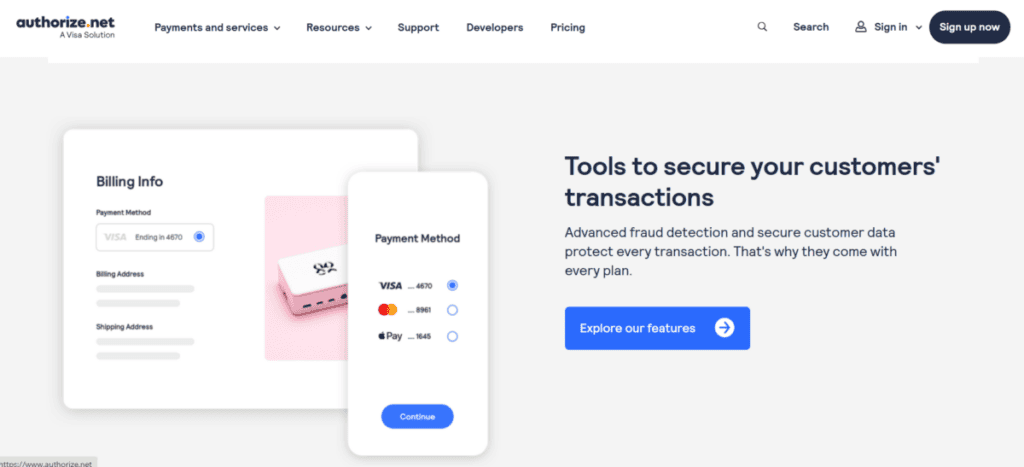
Some standout features include Advanced Fraud Detection Suite, recurring billing capabilities, customer information management, and hosted payment forms for easier PCI compliance. It also supports invoicing and email billing, which is especially useful for service-based businesses or freelancers.

Developers benefit from its API-driven architecture, which supports custom integrations and enables businesses to tailor the platform to specific workflows. Businesses can also access tools for managing subscriptions and analyzing transaction data through detailed reporting features.

Another key advantage is the support for third-party integrations; Authorize.Net works with over 140 different shopping carts, CRM systems, and accounting platforms. While it may lack some modern bells and whistles, the depth and reliability of its features make it a trusted solution for businesses with complex payment needs.

Authorize.Net Review

Ease of Use and User Interface

When it comes to ease of use, Authorize.Net is a mixed bag. The platform is functional and highly reliable, but it does have a learning curve; especially for users unfamiliar with payment processing or setting up merchant accounts. The interface isn’t the most modern, and compared to newer competitors, it may feel a bit dated.

Nevertheless, navigation becomes fairly simple once users get used to the system. Transaction information, customer profiles, reports, and account settings are all accessible through the merchant dashboard. Although everything is well-organized, some of the options might not be fully accessible without technical expertise.

Authorize.Net has worked to simplify the onboarding process. To assist new users in getting started, there is a setup wizard, thorough help documentation, and a committed support staff. However, compared to rivals like Square or Stripe, users seeking a plug-and-play, ultra-intuitive experience may find it more complex.

In terms of mobile accessibility, the platform does offer mobile SDKs and an app, though again, these aren’t as polished as newer mobile-first solutions. Ultimately, Authorize.Net prioritizes functionality over visual appeal, and for many businesses, that’s a worthwhile trade-off.

Integration and Compatibility

One of the biggest selling points of Authorize.Net is its impressive compatibility with a wide range of third-party services. Whether you’re using a custom-built eCommerce store or a popular platform like Shopify, WooCommerce, BigCommerce, or Magento, Authorize.Net has ready-to-use plugins or API support to make integration seamless.

The gateway supports integration with over 140 shopping carts, and it plays well with CRMs, accounting software, ERP systems, and various shipping and tax calculators. Businesses with existing tech stacks rarely encounter issues when adding Authorize.Net to their workflow.

Developers appreciate the extensive documentation and SDKs available in multiple languages, including Java, PHP, Ruby, and .NET. REST and SOAP APIs allow for custom functionality, which gives merchants complete control over checkout experiences, customer data handling, and backend workflows.

For physical retail, Authorize.Net integrates with multiple point-of-sale systems and card readers, offering a consistent experience across channels. Although some hardware integrations may require third-party solutions, the flexibility of the platform allows it to accommodate unique business needs without forcing you into proprietary ecosystems.

Payment Processing Options

Authorize.Net supports a variety of payment types, giving businesses a flexible range of options for collecting money. It handles credit and debit cards, eChecks (ACH payments), and digital wallets like Apple Pay, Google Pay, and PayPal.

The virtual terminal, which enables merchants to manually enter card information for phone or mail orders, is one of the most alluring offerings. Service providers and small businesses that deal with remote payments will find this especially helpful.

Additionally, it facilitates customer information management and subscription billing, allowing for the safe storage of payment information for loyal clients. This is perfect for gyms, SaaS companies, and any other business that provides recurring services.

As long as the company is headquartered in the United States, Canada, the United Kingdom, or Australia, international payments are accepted. To guarantee compatibility with foreign cards and currencies, merchants must consult their merchant account provider.

While not every niche or geographic market will find it perfect, Authorize.Net handles the essentials of payment processing quite well, especially for businesses looking for a comprehensive, stable solution with flexible payment types.

Security and Fraud Prevention Tools

Authorize.Net takes security seriously, offering multiple layers of protection to safeguard both merchants and customers. All transactions are encrypted and PCI DSS compliant, ensuring that sensitive payment information is never stored or transmitted in an unsecured format.

One of its most powerful features is the Advanced Fraud Detection Suite, which includes customizable filters to block suspicious transactions, flag unusual patterns, and limit potentially fraudulent activity. Filters can be adjusted based on geographic location, transaction velocity, amount thresholds, and more.

Tokenization and CVV validation are also supported to protect customer data during and after checkout. With tokenization, card numbers are replaced with unique identifiers, reducing the risk of data breaches.

In addition, Authorize.Net offers tools like IP address blocking, daily velocity checks, and email notifications for high-risk activity. These features are especially useful for online merchants with a high volume of transactions or those operating in industries prone to fraud.

While the setup of these tools may require some technical understanding, the protection they offer makes Authorize.Net a highly secure option in today’s digital payment landscape.

Authorize.Net Review

Pricing and Fee Structure

Although Authorize.Net’s pricing structure is fairly simple, depending on how you sign up, it may be a little confusing. The Payment Gateway Only plan, which costs $25/month plus $0.10 per transaction and $0.10 daily batch fee, is an option if you already have a merchant account.

Pricing for those seeking a gateway + merchant account all-in-one solution is 2.9% + $0.30 per transaction, with no setup costs. This model, which is similar to rivals like Square and Stripe, is perfect for companies looking for a more simple, integrated solution.

Depending on the volume and features utilized (such as fraud detection or recurring billing), additional services like eCheck processing may incur additional incidental fees. These fees are typically $0.75 per eCheck.

While not the cheapest option out there, Authorize.Net offers good value considering its feature set and reliability. Businesses should be aware of the fee structure and determine whether the flexibility of bringing your own merchant account is worth the slightly more complex pricing.

Customer Support and Service Quality

Customer support is an area where Authorize.Net performs relatively well. They offer 24/7 phone support, email assistance, and an extensive online knowledge base. There’s also a support portal with how-to articles, setup guides, and troubleshooting FAQs.

Businesses report generally positive experiences with support staff, especially when it comes to resolving technical or account-related issues. However, some users have noted long wait times during peak hours, and not every support rep has deep technical knowledge, especially for more complex API-related queries.

Authorize.Net also provides dedicated account managers for higher-volume merchants, which can make a big difference in terms of personalized support. For smaller merchants, the forums and documentation often suffice to resolve basic issues.

The online community and developer support pages are useful for those doing their own integrations. Although the user interface and terminology might feel dated, the support resources help bridge that gap.

Overall, Authorize.Net provides dependable support that meets the needs of most businesses, but users looking for instant live chat support or ultra-fast response times may find the experience more traditional than modern.

Recurring Billing and Subscription Management

One of the main advantages of Authorize.Net is recurring billing. Businesses can set up recurring payments for subscription-based services using the Automated Recurring Billing tool. ARB simplifies billing cycles for subscription box companies, gym owners, and SaaS providers.

Frequency, billing amounts, start dates, and trial periods are all customizable by merchants. By charging clients automatically on time, the system eliminates the need for manual billing. When used in combination with the Customer Information Manager, you can safely store payment information and give repeat customers a smooth checkout process.

Reporting tools allow you to track active subscriptions, failed transactions, and cancellations. There’s also flexibility in pausing or editing existing subscriptions, which is a feature not always offered by competitors.

However, the interface for managing subscriptions isn’t the most intuitive and may require a bit of exploration. While it’s effective and reliable, it lacks the slick UX of newer platforms like Stripe Billing.

Nonetheless, for businesses that need powerful and secure recurring billing tools, Authorize.Net delivers a dependable solution.

Mobile and In-Person Payment Capabilities

Authorize.Net isn’t just for online businesses. It offers tools for accepting payments in person, including a VPOS and mobile app. The mobile SDKs allow developers to build custom mobile payment experiences, while the VPOS system enables brick-and-mortar stores to accept card payments using a compatible card reader.

The solution works well for businesses that need a unified backend for both online and in-person payments. It’s particularly useful for service providers who visit customers on-site, like contractors or consultants.

However, the mobile app and in-person features aren’t as polished or user-friendly as those offered by Square or Shopify POS. There’s more setup involved, and you may need to source hardware from third-party providers.

Still, Authorize.Net’s flexibility and ability to sync all payment activity into a single dashboard make it a practical choice for multi-channel businesses that want centralized control.

Reporting and Analytics Tools

A variety of analytics and reporting tools are offered by Authorize.Net to assist merchants in monitoring and evaluating their transactions. The platform provides insights that assist businesses in making data-driven decisions, ranging from daily transaction summaries to in-depth analysis of payment trends.

Chargebacks, failed payments, settlement batches, sales volume, and recurring billing can all produce reports. Users can alter the date range, payment methods, and client segments using filters.

You can arrange for regular reports to be sent to you via email, and all reports can be exported in CSV format. These tools are accurate and useful, but they lack the visual appeal of more recent platforms.

For businesses that need more robust analytics, Authorize.Net’s API allows the integration of external BI tools or dashboards. This flexibility is appreciated by developers and enterprises who want more than just basic reports.

Overall, the reporting is comprehensive enough for most businesses, even if the interface isn’t as modern as some may prefer.

Reliability and Uptime

Authorize.Net is known for its rock-solid reliability. It boasts an impressive uptime track record, which is critical for businesses that can’t afford interruptions in payment processing. The platform’s infrastructure is built for scalability, so whether you’re handling a few dozen transactions or thousands per day, performance remains stable.

The gateway uses multiple data centers and redundant systems to ensure continuous operation. Any scheduled maintenance is communicated in advance, and outages are extremely rare.

Merchants who have used the platform for years consistently report positive experiences when it comes to uptime and overall dependability. Even under heavy transaction loads, the system performs efficiently without slowdowns or lags.

In an industry where downtime can translate to lost sales, Authorize.Net provides peace of mind with a system that simply works when it needs to.

Who Should Use Authorize.Net?

Established small to medium-sized enterprises, expanding e-commerce websites, service providers, and subscription-based businesses are the ideal candidates for Authorize.Net. Businesses that don’t mind a slightly higher learning curve and seek a dependable, adaptable, and secure payment infrastructure will find it useful.

Businesses that use custom-built websites or have unique workflows and need a highly configurable gateway will find it especially useful. The modular design of the platform is also advantageous to businesses that wish to use their own merchant account.

For solopreneurs or microbusinesses seeking a fast, cutting-edge setup with little configuration, it might not be the ideal choice. Plug-and-play systems like Square or PayPal might be simpler to implement in those situations.

Authorize.Net Review

Pros and Cons Summary

Pros:

Long-standing reputation for reliability and security

Supports multiple payment types and channels

Excellent fraud detection tools

Works with third-party merchant accounts

Highly customizable via API

Cons:

User interface feels outdated

Not ideal for beginners without technical help

Monthly fee adds cost for low-volume merchants

Limited support for multi-currency without add-ons

Authorize.Net may not be trendy or beginner-friendly, but it’s a powerhouse for businesses that want control, security, and stability from their payment provider.

FAQs

Q1: Is Authorize.Net suitable for small businesses or startups?
Yes, but only if the business expects moderate to high transaction volume or needs advanced features like fraud detection or recurring billing. The monthly fee may not be cost-effective for very small startups.

Q2: Does Authorize.Net support international transactions?
Authorize.Net supports international card payments but requires the business to be based in select countries (like the U.S., Canada, U.K., or Australia). Multi-currency support depends on your merchant account provider.

Q3: Can Authorize.Net be used with a third-party merchant account?
Yes. One of Authorize.Net’s key advantages is the ability to integrate with an existing merchant account. Alternatively, users can opt for an all-in-one solution offered directly by Authorize.Net.