
Tag Archives: Payment processing solutions

Electronic Merchant Systems Review

Electronic Merchant Systems Review

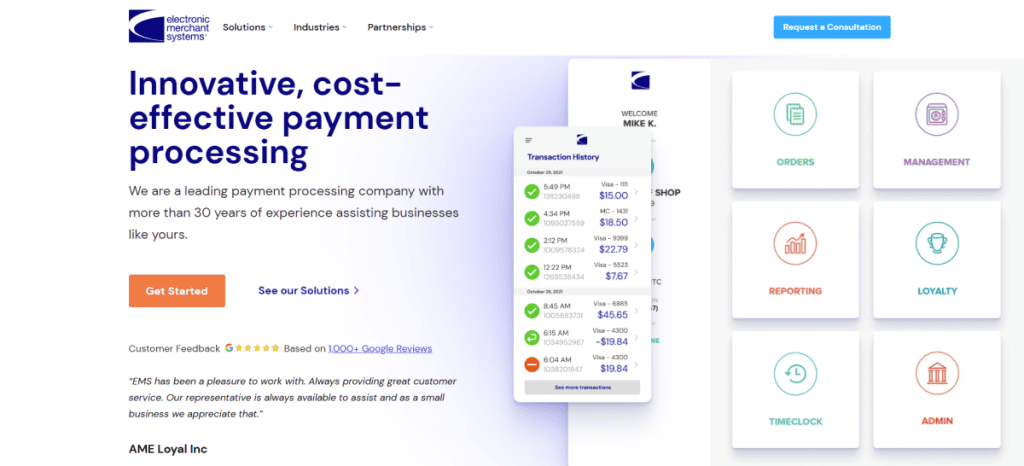
EMS is a prominent provider of payment processing solutions catering to businesses of all sizes. Established over three decades ago, EMS has built a strong reputation in the financial technology sector, offering a comprehensive suite of services, including credit card processing, POS systems, mobile payment solutions, eCommerce payment gateways, and merchant funding options. The company’s focus on innovation, security, and customer support has positioned it as a competitive player in the payment processing industry. Lets read more about Electronic Merchant Systems Review.

EMS serves a wide range of industries, including retail, hospitality, healthcare, and eCommerce. The company prides itself on providing customizable payment solutions that integrate seamlessly with various business models. With a customer-first approach, EMS emphasizes reliability, efficiency, and affordability, ensuring that merchants can process transactions securely and efficiently.

EMS’s in-house customer support is one of its best features; it is available around-the-clock to help businesses with technical problems, payment disputes, and system troubleshooting. Furthermore, EMS places a high priority on security by implementing cutting-edge fraud prevention tools and complying with Payment Card Industry Data Security Standards to shield companies from possible threats.

Merchants have given EMS mixed reviews despite its advantages; some have praised its customer service and ease of use, while others have voiced concerns about contract terms and pricing transparency. In order to assist businesses in making an informed decision, this review attempts to present an objective and thorough analysis of EMS, encompassing its services, pricing, reputation, customer support, and general dependability.

Company Background: History, Headquarters, Ownership, and Mission | Electronic Merchant Systems Review

Electronic Merchant Systems is a well-established payment processing company that has been serving businesses since its founding in 1988. With over three decades of experience in the financial technology sector, Electronic Merchant Systems has grown into a reliable provider of payment solutions, helping merchants streamline transactions across multiple industries, including retail, hospitality, healthcare, and eCommerce.

Headquartered in Cleveland, Ohio, EMS operates nationwide, with a strong presence in various cities across the United States. The company supports businesses of all sizes by offering tailored payment processing solutions that integrate with different operational models. Over the years, Electronic Merchant Systems has expanded its reach through regional offices and a network of sales representatives, ensuring its services are accessible to businesses in diverse locations.

Electronic Merchant Systems operates as a privately held company under the ownership of its parent organization, Francis David Corporation. This corporate structure allows EMS to maintain control over its service offerings, technological advancements, and customer relationships without external shareholder influence. The company’s leadership focuses on continuous improvement and innovation to remain competitive in the rapidly evolving payment processing industry.

EMS’s goal is to give companies safe, effective, and user-friendly payment solutions that improve customer satisfaction and operational effectiveness. The company envisions a time when companies of all sizes can use cutting-edge payment technologies to expand and prosper. By putting security, innovation, and exceptional customer service first, EMS hopes to establish enduring relationships with retailers and give them access to dependable and reasonably priced payment processing solutions.
Electronic Merchant Systems Review

Services and Solutions Offered by Electronic Merchant Systems

Electronic Merchant Systems provides a comprehensive suite of payment processing solutions designed to meet the needs of businesses across various industries. Their services cater to retail, hospitality, healthcare, and eCommerce businesses, ensuring seamless transaction processing and enhanced customer experiences.

Payment Processing Services

Electronic Merchant Systems enables merchants to accept major credit and debit cards efficiently. Their payment processing services support EMV (Europay, MasterCard, and Visa) chip card transactions, offering increased security against fraud. Additionally, EMS provides NFC payment solutions, allowing businesses to accept contactless payments from digital wallets like Apple Pay and Google Pay, ensuring faster and more secure transactions.

Point of Sale Systems

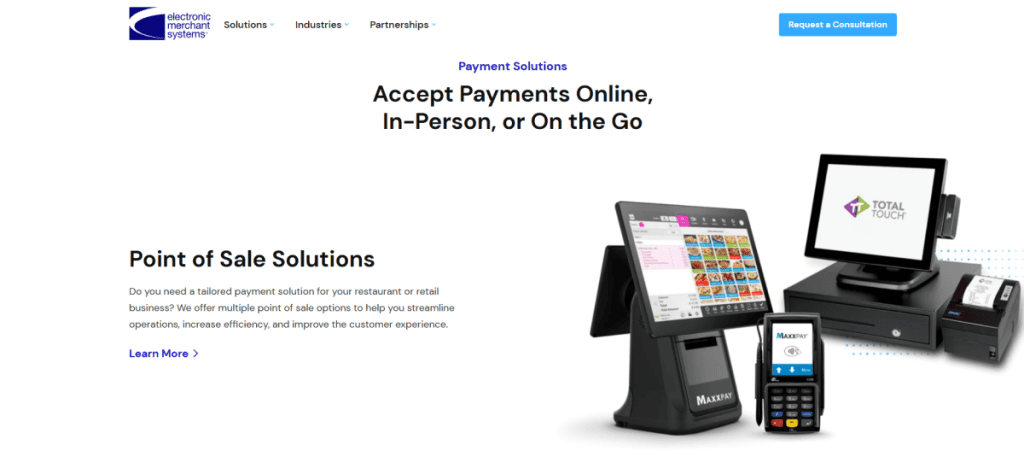
Electronic Merchant Systems offers MaxxPay POS solutions, an all-in-one system designed to streamline operations for small and medium-sized businesses. They also provide Total Touch POS systems, a specialized solution tailored for the restaurant industry, offering features such as table management, order tracking, and seamless payment integration.

Mobile Payment Solutions

Electronic Merchant Systems provides mobile processing apps for businesses that are always on the go, enabling retailers to take payments from smartphones and tablets. By integrating with mobile devices, these solutions give businesses that need to process transactions outside of traditional storefronts flexibility.

eCommerce Solutions

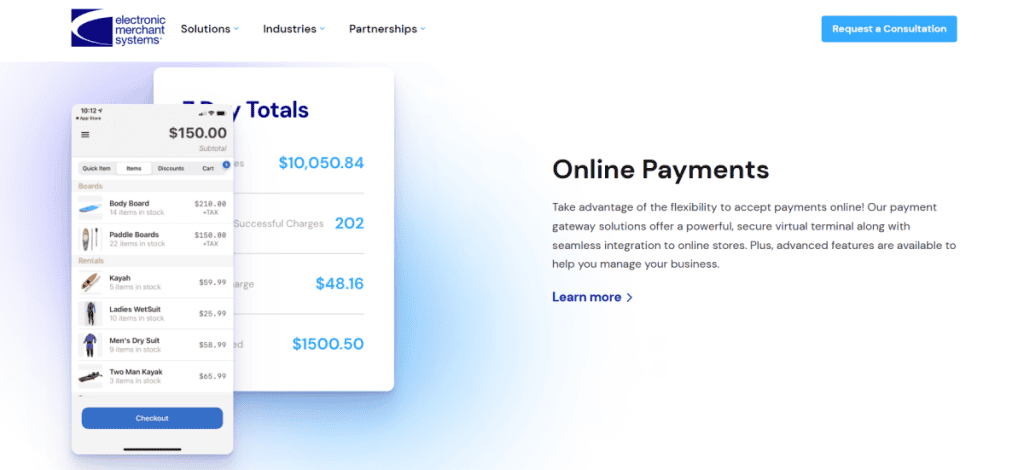
Electronic Merchant Systems supports online businesses with secure payment gateways that enable seamless transaction processing. They also provide shopping cart integrations, allowing businesses to connect their eCommerce platforms with EMS’s payment processing system.

Additional Services

Electronic Merchant Systems extends its offerings with gift and loyalty card programs, helping businesses attract and retain customers. They also offer merchant funding options, providing financial support for business expansion. Additionally, EMS prioritizes payment security and fraud prevention, ensuring compliance with PCI DSS standards to safeguard merchant transactions.

Technology and Infrastructure of Electronic Merchant Systems

Electronic Merchant Systems utilizes a robust technological infrastructure to deliver secure and efficient payment processing solutions. The company continuously invests in its platforms to ensure businesses can process transactions seamlessly across multiple channels, including in-store, mobile, and online environments.

Overview of EMS’s Technological Platforms

Credit and debit card transactions, EMV chip payments, NFC-enabled contactless payments, and eCommerce gateways are all supported by EMS’s integrated payment ecosystem. With the help of their proprietary MaxxPay POS system’s intuitive user interface, businesses can effectively manage transactions, inventory, and customer interactions. Furthermore, EMS’s mobile payment solutions give merchants flexibility by ensuring safe processing via smartphones and tablets.

Security Protocols and Compliance Standards

Security is a top priority for EMS. The company adheres to PCI DSS compliance, ensuring merchants’ payment data is encrypted and safeguarded against cyber threats. EMS employs end-to-end encryption and tokenization to enhance security and prevent unauthorized access to sensitive payment information. Advanced fraud prevention tools further protect merchants from chargebacks and fraudulent transactions.

Reliability and Uptime Statistics

Electronic Merchant Systems aims to provide high system reliability, minimizing downtime for merchants. While specific uptime statistics are not publicly disclosed, EMS claims to offer consistent payment processing with minimal service interruptions. Their cloud-based infrastructure helps maintain transaction continuity, even during peak business hours.

Integration Capabilities with Other Business Systems

Electronic Merchant Systems supports integration with accounting software, customer relationship management platforms, and eCommerce systems. Popular integrations include compatibility with QuickBooks, Shopify, WooCommerce, and other business applications, ensuring merchants can streamline operations without switching between multiple platforms. This flexibility enhances overall business efficiency while maintaining a seamless payment experience.

Customer Support and Service at Electronic Merchant Systems (EMS)

One of the main focuses of EMS service offerings is customer support. To help merchants fix technical problems, handle transactions seamlessly, and maximize the effectiveness of their payment systems for business purposes, the company offers a variety of support options.

Availability of Customer Support

EMS offers 24/7 customer support, ensuring that merchants can receive assistance whenever needed. This around-the-clock availability is particularly beneficial for businesses operating beyond standard business hours, including restaurants, retail stores, and eCommerce merchants.

Support Channels Offered

EMS provides multiple support channels, including phone, email, and live chat. Phone support allows merchants to quickly speak with a representative for urgent concerns, while email support is available for less time-sensitive inquiries. Live chat enables real-time assistance directly through the EMS website, offering a convenient option for quick troubleshooting.

Merchant Onboarding and Training Programs

To help businesses integrate EMS’s payment processing solutions, the company offers merchant onboarding and training programs. These programs guide new customers through the setup process, covering topics such as POS system usage, payment security measures, and transaction best practices. EMS also provides educational materials, including manuals and video tutorials, to ensure merchants fully understand their systems.

Account Management Services

Dedicated account managers are assigned by EMS to help merchants with their ongoing business requirements. By assisting with chargeback resolution, transaction monitoring, and system optimization, these managers make sure that companies process payments as efficiently as possible. EMS sets itself apart from rivals who might only use generic customer service models thanks to this individualized service.
Electronic Merchant Systems Review

Pricing and Contract Terms of Electronic Merchant Systems

EMS offers a range of pricing models and contract structures tailored to different business needs. However, like many payment processors, their pricing details are not fully transparent on their website, and merchants often need to request a custom quote to understand their specific costs.

Overview of Pricing Models

EMS reportedly offers flat-rate pricing and interchange-plus pricing, though the exact rates vary based on business type, transaction volume, and industry. Flat-rate pricing provides merchants with a consistent percentage fee for each transaction, making costs predictable. Interchange-plus pricing, on the other hand, separates the interchange fees charged by card networks from EMS’s processing markup, which can sometimes lead to more competitive rates for high-volume businesses.

Contract Length and Termination Policies

EMS typically requires merchants to sign a long-term contract, often spanning three to five years. Some agreements include an early termination fee if a merchant decides to cancel before the contract ends. Reports suggest that ETF charges vary, and merchants should carefully review the terms before signing.

Fees Associated with Services

Setup fees, monthly service fees, and per-transaction fees are all possible charges from EMS. Chargeback fees, gateway fees for online transactions, and PCI compliance fees are examples of additional expenses. However, merchants should ask for a complete breakdown before committing, as these fees are not made public.

Equipment Leasing or Purchasing Options

EMS provides POS systems and card readers, which merchants can either lease or purchase outright. Leasing may involve long-term commitments with additional costs, while purchasing equipment outright can be a more cost-effective option for businesses planning to use EMS’s services long-term.

Reputation and Reviews of Electronic Merchant Systems (EMS)

EMS has built a reputation as a longstanding payment processor serving businesses across various industries. However, customer and employee reviews reflect a mix of experiences, highlighting both strengths and areas of concern.

Customer Reviews

Summary of Positive Feedback

Many merchants appreciate EMS’s user-friendly payment solutions, 24/7 customer support, and secure transaction processing. Businesses often highlight the reliability of EMS’s POS systems, mobile payment solutions, and eCommerce integrations. Some customers also commend EMS for providing customized solutions tailored to specific business needs.

Summary of Negative Feedback

Some merchants have voiced concerns regarding pricing transparency, long-term contracts, and early termination fees, despite the positive aspects. A prevalent grievance pertains to concealed charges that might not be explicitly revealed during the onboarding process. Some users also complain about having trouble terminating services, pointing to complicated contracts or expensive termination fees. Customer service response times are generally good, but some reviews claim that they have also been erratic.

Employee Reviews

Work Environment and Culture

EMS receives mixed employee reviews. Some employees praise the company for providing growth opportunities, a collaborative work environment, and competitive benefits. However, others mention high-pressure sales tactics, job instability, and challenging sales quotas as potential downsides.

Employee Satisfaction and Retention

While some employees appreciate the structured training programs and team-oriented culture, turnover appears to be relatively high in sales roles, possibly due to performance-based compensation models.

Industry Recognition

Electronic Merchant Systems has earned various awards and certifications, reinforcing its credibility in the payment processing industry. It maintains PCI DSS compliance and has partnerships with major card networks, contributing to its reputation as a secure and reliable merchant service provider.

Competitor Comparison of Electronic Merchant Systems (EMS)

Alongside a number of other reputable companies, Electronic Merchant Systems competes in the payment processing market. Verifone, Ingenico, and TSYS are important rivals, each providing unique solutions to meet different business requirements.

Overview of Key Competitors

Verifone specializes in payment terminals and POS solutions, widely used by retailers and hospitality businesses. Their focus is on hardware innovation, offering secure payment devices.

Ingenico is a global leader in POS systems and contactless payment solutions, serving businesses in over 170 countries. Known for its secure payment technology, Ingenico is a preferred choice for enterprises.

TSYS (Total System Services) provides merchant services, card processing, and payment gateway solutions, catering to banks, large retailers, and small businesses alike. TSYS emphasizes customizable pricing and enterprise-level payment solutions.

Comparison of Services and Pricing

Electronic Merchant Systems competes by offering a comprehensive suite of payment solutions, including credit card processing, mobile payments, POS systems, and eCommerce gateways. Unlike Ingenico and Verifone, which focus on hardware, EMS provides end-to-end merchant services, including 24/7 customer support and business funding options. Compared to TSYS, EMS primarily targets small and mid-sized businesses, whereas TSYS serves a broader range, including financial institutions. Pricing transparency remains a concern for EMS, as many competitors disclose standard rates upfront.

Market Positioning and Differentiators

Electronic Merchant Systems differentiates itself with customized payment solutions, security features, and merchant support. Its PCI DSS compliance, fraud prevention tools, and integration capabilities help it stand out. However, concerns over contract terms and hidden fees may impact its competitive positioning against providers offering more transparent pricing models.

Pros and Cons of Electronic Merchant Systems (EMS)

A variety of payment processing options are available from EMS to assist companies in effectively handling transactions. Potential clients should weigh the company’s disadvantages before using its services, despite the fact that it offers a number of benefits.

Advantages of EMS

Comprehensive Service Offerings
Electronic Merchant Systems provides a full suite of payment solutions, including credit and debit card processing, mobile payments, eCommerce gateways, POS systems, and business funding options. This allows businesses to manage transactions across multiple channels seamlessly.

Technological Capabilities
EMS utilizes secure, PCI-compliant payment platforms with features like EMV chip card processing, NFC payments, and fraud prevention tools. Its POS systems (MaxxPay and Total Touch) offer flexibility and scalability, catering to both retail and restaurant businesses.

Customer Support Quality
EMS offers 24/7 customer support through phone, email, and live chat, which is a significant advantage over some competitors that provide only limited support hours. Additionally, EMS provides merchant training and onboarding assistance, helping businesses get started with their payment solutions.

Disadvantages of EMS

Potential Contract and Fee Concerns
One of the biggest criticisms of Electronic Merchant Systems is lack of pricing transparency. Merchants often need to request a custom quote, and some have reported hidden fees, long-term contracts (3-5 years), and high early termination fees.

Customer Complaints and Resolutions
Some customers have raised concerns about billing disputes, contract cancellation difficulties, and unexpected charges. While EMS does address complaints, the resolution process may take time, leading to frustration among some users.
Electronic Merchant Systems Review

Conclusion

Electronic Merchant Systems provides a wide range of payment options, robust technology, and round-the-clock customer service. Potential customers should, however, thoroughly go over the terms and costs of the contract before committing. EMS is ideal for companies looking for a full-service payment processor, but it should be approached with an eye toward price transparency.

FAQs

What industries does Electronic Merchant Systems serve?

EMS caters to a wide range of industries, including retail, hospitality, healthcare, eCommerce, and service-based businesses. Their payment solutions are designed to accommodate businesses of all sizes, from small shops to large enterprises, offering tailored transaction processing and POS systems.

How does EMS ensure the security of transactions?

EMS prioritizes payment security by adhering to PCI DSS compliance. It employs end-to-end encryption, tokenization, and fraud detection tools to protect sensitive cardholder data and prevent unauthorized transactions.

Can EMS’s payment solutions integrate with existing business systems?

Yes, EMS supports integration with accounting software, CRM platforms, and eCommerce solutions. Businesses using QuickBooks, Shopify, WooCommerce, and other applications can seamlessly connect EMS’s payment processing services for streamlined operations.

Flow Payment Credit Card Review

Flow Payment Credit Card Review

Businesses need dependable, safe, and affordable payment processing solutions in an increasingly digital environment. Offering customized credit card processing solutions, Flow Payments is a specialized merchant service provider that mostly serves high-risk businesses. Regardless of whether a company works in retail, e-commerce, or a high-risk, regulated industry, Flow Payments promises to offer tailored processing options with affordable prices and a focus on security and compliance. Lets read more about Flow Payment Credit Card Review.

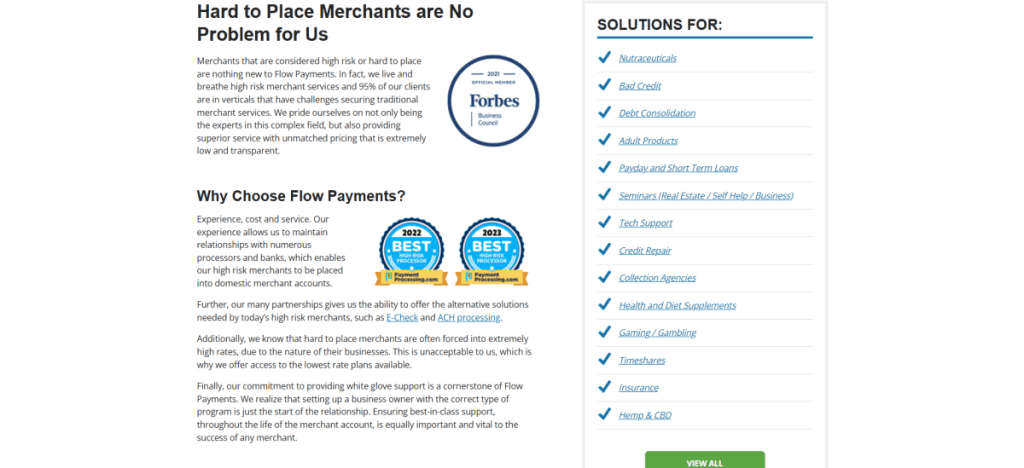
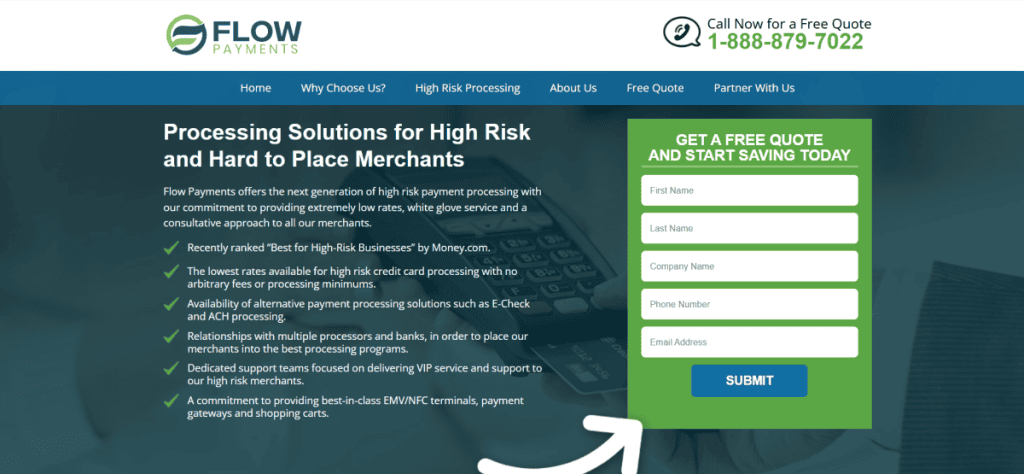
Flow Payments is known for its expertise in serving high-risk merchants—businesses that often struggle to find reliable payment processing solutions due to regulatory scrutiny or high chargeback rates. The company provides a range of services, including credit and debit card processing, cashless ATM solutions, e-check and ACH processing, and secure payment gateway integrations. By partnering with multiple acquiring banks and processors, Flow Payments aims to offer flexible and scalable solutions tailored to the specific needs of different industries.

The payment processing sector is very competitive, featuring many providers delivering different tiers of service. What distinguishes Flow Payments is its emphasis on high-risk merchants, a group that frequently lacks adequate support from conventional processors. Numerous popular payment providers enforce strict limitations or completely decline to partner with companies in sectors such as CBD, adult entertainment, or online gaming. Flow Payments addresses this need by providing tailored underwriting, chargeback management, and fraud prevention solutions, allowing businesses in these industries to function effectively. This specialization establishes the company as an important participant in the wider payment processing arena. 

Company Background | Flow Payment Credit Card Review

Flow Payments was established to address the growing need for specialized payment processing solutions, particularly for high-risk businesses. Unlike mainstream merchant service providers that often decline high-risk merchants due to regulatory complexities and higher chargeback rates, Flow Payments was designed to offer tailored solutions to businesses that struggle to obtain traditional payment processing. While exact details about its founding date and headquarters location are not widely publicized, the company has positioned itself as a reliable partner for industries such as CBD, adult entertainment, and online gaming, which face stringent banking restrictions.

Mission and Core Values

Flow Payments aims to deliver secure, adaptable, and affordable payment solutions for businesses frequently neglected by conventional financial institutions. The company values transparency, providing merchants with straightforward pricing models free of hidden charges or limiting agreements. A service that prioritizes customers, prevents fraud, and adheres to industry regulations lies at the heart of its operational strategy. Flow Payments also highlights technological advancement, guaranteeing that businesses benefit from cutting-edge payment gateways, enhanced security features, and smooth integrations with e-commerce platforms. 

Leadership and Management Team

While Flow Payments does not widely publicize its leadership team, the company is known for working closely with industry professionals who have extensive experience in merchant services, banking, and financial technology. The team’s expertise in high-risk payment processing enables them to navigate complex regulatory landscapes and offer customized solutions for businesses facing compliance challenges. Their hands-on approach to customer support further differentiates Flow Payments from larger, more impersonal processors in the industry.

Services Offered

Flow Payments offers an extensive range of payment processing services tailored to cater to the requirements of both conventional and high-risk enterprises. The company’s services are designed for enterprises that need adaptable, safe, and compliant payment solutions, facilitating smooth transactions on various platforms. 

Credit and Debit Card Processing

Flow Payments supports businesses by enabling them to accept all major credit and debit cards, including Visa, Mastercard, American Express, and Discover. Whether processing transactions in-store, online, or via mobile payment solutions, the company ensures fast and secure processing. Businesses operating in high-risk sectors benefit from specialized underwriting and chargeback management tools, reducing the risk of sudden account closures or withheld funds.

Cashless ATM Solutions

Flow Payments provides cashless ATM solutions for businesses in sectors with strict banking regulations, like cannabis dispensaries. This system enables customers to execute card transactions resembling ATM withdrawals, offering a lawful and compliant way for non-cash payments and minimizing cash-handling risks for merchants. 

E-Check and ACH Processing

Flow Payments enables businesses to accept e-checks and ACH transfers. This service is particularly beneficial for high-ticket transactions, recurring billing, and industries where credit card acceptance may be limited. ACH processing reduces processing fees compared to traditional card transactions, making it a cost-effective option.

Point-of-Sale (POS) Systems

The company provides sophisticated POS solutions, such as countertop terminals and mobile payment devices, enabling businesses to process payments in-store or while traveling. These systems are intended for efficiency, facilitating contactless payments, EMV chip transactions, and also QR code-based payments. 

E-Commerce Integrations

For online merchants, Flow Payments provides secure payment gateways that integrate seamlessly with major e-commerce platforms like Shopify, WooCommerce, and Magento. These integrations ensure smooth online transactions while incorporating essential fraud prevention measures, such as tokenization and encryption, to protect sensitive customer data.

By offering a diverse range of services, Flow Payments ensures businesses in various industries have access to reliable and secure payment processing solutions tailored to their specific needs.

Specialization in High-Risk Merchants

In the payment processing sector, companies are frequently categorized as high-risk because of elements like regulatory oversight, elevated chargeback rates, or the type of their offerings. Industries generally viewed as high-risk encompass CBD and cannabis, adult entertainment, online gaming, travel agencies, firearms sales, and subscription services. Businesses in these sectors often encounter challenges securing payment processing services from conventional banks and mainstream providers because of possible legal issues, fraud threats, or irregular income sources. 

Flow Payments’ Approach to High-Risk Processing

Flow Payments specializes in providing tailored payment solutions for high-risk businesses by partnering with multiple acquiring banks and payment networks. Unlike standard processors that often impose restrictive policies or outright deny service to high-risk businesses, Flow Payments offers customized underwriting, allowing merchants to find processing solutions suited to their industry-specific risks. The company also provides chargeback mitigation tools, fraud prevention mechanisms, and compliance support to help businesses navigate complex regulations. Additionally, Flow Payments offers stable payment processing with minimal disruptions, ensuring business continuity for merchants who may otherwise struggle with sudden account terminations from traditional providers.

Success Rate and Industry Reputation

Flow Payments has established a solid reputation in the high-risk merchant sector by providing dependable and clear processing solutions. Although exact success rates are not disclosed, customer testimonials indicate that numerous high-risk enterprises experiencing regular rejections elsewhere have successfully secured merchant accounts via Flow Payments. Its position in the industry is strengthened by favorable feedback regarding its responsive customer support, reasonable pricing models, and proactive risk management approaches. The emphasis on high-risk merchants positions Flow Payments as an important choice for companies seeking a reliable and compliant payment processing service. 

Pricing and Fee Structure

Understanding the costs associated with payment processing is crucial for businesses, especially those in high-risk industries. Flow Payments aims to provide transparent and competitive pricing while ensuring businesses are not burdened with unnecessary fees or restrictive contracts.

Transparency in Pricing

One of the key concerns for businesses when choosing a payment processor is understanding the pricing structure. Flow Payments emphasizes transparency by providing customized pricing based on business type, risk level, and transaction volume. Unlike some processors that offer flat-rate pricing, Flow Payments typically structures its fees using interchange-plus or tiered pricing models. This means merchants receive a breakdown of actual interchange costs along with the processor’s markup, allowing for better cost analysis. However, since Flow Payments primarily caters to high-risk merchants, pricing can vary significantly depending on the business category and associated risks.

Comparison with Industry Standards

Flow Payments offers competitive pricing in the high-risk payment processing market. Although prominent services like Square and Stripe provide reduced rates for typical businesses, they frequently decline high-risk merchants or impose considerably higher fees if they choose to accept them. Flow Payments offers more consistent and dependable solutions for high-risk businesses, eliminating the threat of abrupt account closures. In comparison to other high-risk processors, its rates typically align with industry standards, but exact pricing is not available publicly, necessitating businesses to seek a tailored quote. 

Absence of Hidden Fees and Processing Minimums

High-risk merchants often face unexpected charges, making cost management difficult. Flow Payments differentiates itself by eliminating hidden fees and processing minimums, ensuring businesses pay only for the services they use. Many competitors impose monthly minimum processing requirements, early termination fees, or non-compliance charges, increasing overall costs. Flow Payments claims to operate with full transparency, but businesses should carefully review their contracts to confirm all associated costs.

Application and Onboarding Process

Setting up a merchant account with a payment processor can often be a complex and time-consuming process, especially for high-risk businesses. Flow Payments aims to streamline the application and onboarding experience by offering a structured and transparent process. While approval timelines may vary based on business risk levels, the company provides dedicated support to guide merchants through each step.

Steps to Apply for Services

The Flow Payments application process starts with an online request, in which businesses submit fundamental information about their industry, transaction volume, and processing requirements. After the inquiry is submitted, a representative usually reaches out to talk about particular needs and possible pricing options. Following the initial consultation, the merchant must submit a formal application that encompasses business and financial information. The application is subsequently evaluated by underwriting teams to determine risk and compliance prior to obtaining final approval. 

Required Documentation

As a high-risk payment processor, Flow Payments requires detailed documentation to verify the legitimacy of a business and assess potential risks. Merchants typically need to provide:

A valid business license or incorporation documents

A government-issued ID of the business owner(s)

Recent bank statements (usually 3–6 months)

Processing history (if applicable)

A detailed business plan (for some high-risk industries)

A refund and chargeback policy

Timeline for Approval and Setup

The approval timeline depends on factors such as the business type, financial history, and industry risk classification. Standard approvals may take anywhere from a few days to a week, while high-risk businesses may face longer underwriting times. Once approved, integration with payment gateways or POS systems is typically completed within a few days, allowing merchants to begin processing transactions without significant delays.

Technology and Integrations

A reliable payment processing system must offer seamless integration with various platforms while ensuring security and compliance. Flow Payments provides merchants with a range of payment gateway options, e-commerce compatibility, and industry-standard security measures to facilitate smooth transactions while safeguarding sensitive data.

Payment Gateway Options

Flow Payments offers various payment gateway solutions, enabling businesses to select the option that aligns best with their operational requirements. These gateways enable online transactions, recurring payments, and mobile payments while guaranteeing compatibility with high-risk sectors. The company collaborates with multiple third-party payment gateways while providing its own unique solutions, allowing merchants the flexibility to integrate their chosen payment processing system. Capabilities like real-time transaction reporting, automated billing, and fraud detection tools improve business productivity. 

Compatibility with E-Commerce Platforms

For online businesses, Flow Payments provides seamless integration with popular e-commerce platforms, including Shopify, WooCommerce, Magento, and BigCommerce. This ensures that merchants can accept credit card payments without significant modifications to their existing website infrastructure. Additionally, the company offers API-based solutions for custom website integrations, allowing businesses to tailor the payment experience according to their specific requirements.

Security Measures and PCI Compliance

Security is a top priority in payment processing, particularly for high-risk merchants who may face increased fraud threats. Flow Payments ensures that all transactions are protected through encryption, tokenization, and advanced fraud detection tools. The company maintains full PCI DSS compliance, ensuring that businesses adhere to strict security protocols to protect customer payment data. These measures help minimize chargebacks, reduce fraud risks, and ensure a secure payment environment.

Customer Support and Service

Dependable customer support is an essential element when selecting a payment processor, particularly for high-risk merchants who frequently need tailored help. Flow Payments prioritizes delivering attentive and informed assistance to guarantee that businesses encounter minimal interruptions in their payment processing operations. 

Availability and Responsiveness

Flow Payments offers customer support during standard business hours, with some reports suggesting extended availability for urgent issues. While the company does not explicitly advertise 24/7 support, it claims to provide timely responses to merchant inquiries. Response times generally depend on the complexity of the issue, with technical and underwriting-related concerns taking longer to resolve. Many high-risk merchants rely on quick issue resolution to prevent account holds or processing interruptions, making responsiveness a key factor in service quality.

Dedicated Account Management

One of the standout features of Flow Payments’ customer service is its dedicated account management for merchants. Unlike larger payment processors that rely on automated responses and generic support teams, Flow Payments assigns account managers to businesses, particularly those in high-risk industries. This personalized approach helps merchants navigate underwriting processes, compliance requirements, and chargeback mitigation strategies. Having a direct point of contact can significantly improve the overall experience, especially for businesses that require customized payment solutions.

Support Channels Offered

Flow Payments offers various options for customer support, such as phone, email, and an online inquiry platform. Although live chat support doesn’t seem to be a main feature, the company guarantees that merchants can reach representatives via conventional communication channels. Moreover, educational resources like FAQs and knowledge base articles might be available to assist businesses in resolving typical payment processing problems on their own. 

Pros and Cons

Like any payment processor, Flow Payments has its strengths and weaknesses. While it offers specialized solutions for high-risk merchants, certain limitations may impact businesses depending on their specific needs. Evaluating both the advantages and potential drawbacks can help merchants make an informed decision.

Advantages of Choosing Flow Payments

High-Risk Merchant Specialization – Flow Payments stands out for its ability to serve industries that are often rejected by mainstream payment processors. Businesses in sectors like CBD, adult entertainment, and online gaming benefit from customized underwriting and stable processing solutions.

Multiple Payment Solutions – The company provides a wide range of payment processing services, including credit and debit card acceptance, e-check and ACH processing, cashless ATM solutions, and POS system integrations.

Flexible Pricing and No Hidden Fees – Unlike some competitors, Flow Payments claims to offer transparent pricing without hidden fees or long-term contractual obligations. This allows businesses to understand their costs upfront.

Strong Security and Compliance – The company ensures PCI DSS compliance and implements encryption, tokenization, and fraud detection tools to protect merchant and customer data.

Dedicated Account Management – Merchants receive personalized service through dedicated account managers, helping them navigate onboarding, compliance, and chargeback prevention.

Potential Drawbacks or Limitations

Limited Public Pricing Information – Flow Payments does not provide standardized pricing on its website, requiring businesses to request a custom quote. This can make cost comparisons challenging.

Approval Process Can Be Lengthy – High-risk merchants often face extended underwriting times, and while Flow Payments aims to expedite approvals, processing times may still be longer than those of mainstream providers.

No Clear 24/7 Support – While Flow Payments offers multiple support channels, the absence of explicitly advertised 24/7 support may be a drawback for businesses requiring round-the-clock assistance.

While Flow Payments is a strong contender for high-risk businesses, companies in lower-risk categories may find more cost-effective and faster alternatives with mainstream payment processors.

Conclusion

Flow Payments offers a dependable option for high-risk merchants in need of consistent payment processing. Featuring customized underwriting, various payment methods, and robust security protocols, it distinguishes itself in its sector. Nonetheless, companies need to evaluate pricing transparency and the availability of support prior to making a commitment. It’s a reliable option for individuals requiring specialized high-risk processing services. 

FAQs

What industries does Flow Payments consider high-risk?

Flow Payments serves businesses in industries often classified as high-risk, including CBD and cannabis, adult entertainment, online gaming, firearms sales, travel services, and subscription-based businesses. These industries face higher chargeback rates or regulatory scrutiny, making it difficult to secure traditional payment processing.

Are there any long-term contracts or cancellation fees?

Flow Payments claims to offer flexible contracts without long-term commitments or hidden cancellation fees. However, specific terms may vary based on the merchant’s risk profile, so businesses should carefully review their agreements before signing.

How does Flow Payments ensure the security of transactions?

Flow Payments maintains PCI DSS compliance and implements security measures such as encryption, tokenization, and fraud detection tools. These protections help safeguard sensitive payment data, reducing the risk of fraud and chargebacks for merchants.

SunTrust Merchant Services Review

SunTrust Merchant Services Review

SunTrust Merchant Services, a division of SunTrust Banks, provided businesses with payment processing solutions, including credit and debit card transactions, POS systems, and e-commerce integration. These services were designed to facilitate seamless payment experiences for both merchants and customers. Lets read more about SunTrust Merchant Services Review.

SunTrust Banks and BB&T Corporation combined in December 2019 to create Truist Financial Corporation, with its headquarters situated in Charlotte, North Carolina. This combination formed the United States’ sixth-largest bank, combining vast financial knowledge and resources. After the merger, SunTrust Merchant Services joined Truist’s full range of financial services.

Presently operating under the Truist name, the company still offers merchant services, supplying a range of payment processing options to fulfill the requirements of various businesses. These services consist of sophisticated POS systems, mobile payment choices, and secure e-commerce platforms, all aimed at boosting operational effectiveness and enhancing customer contentment.

The integration of SunTrust Merchant Services into Truist’s operations reflects the company’s dedication to delivering innovative financial solutions. Leveraging the combined strengths and resources of both legacy institutions, Truist aims to offer robust and reliable merchant services that empower businesses to grow and adapt in an ever-changing market landscape.

Key Features and Offerings of SunTrust Merchant Services | SunTrust Merchant Services Review

SunTrust Merchant Services, now operating under the Truist brand, offers a comprehensive suite of payment processing solutions tailored to meet the diverse needs of businesses.

Payment Processing Options: Merchants can accept a variety of payment methods, including major credit and debit cards, ensuring flexibility for customers. The service also supports mobile payment options like Apple Pay and Google Pay, catering to the growing preference for contactless transactions.

POS Solutions: Truist provides advanced POS systems designed to enhance transaction efficiency. These systems are customizable to suit various industries, offering features such as inventory management, sales tracking, and customer relationship management. The integration of these functionalities aims to streamline business operations and improve the overall customer experience.

E-commerce Integration: Truist provides strong e-commerce solutions for online businesses to make secure and efficient online transactions. These services consist of payment gateways that work with different shopping cart platforms, allowing smooth integration with current websites. Furthermore, Truist also enables businesses to coordinate in-store and online sales through an integrated system, supporting omnichannel sales strategies.

Mobile Payments: Recognizing the importance of mobility in modern business, Truist provides mobile payment processing options. Merchants can process payments using smartphones or tablets equipped with compatible card readers, making it convenient to accept payments on the go. This flexibility is particularly beneficial for businesses that operate outside traditional retail environments, such as food trucks, market vendors, or service providers.

SunTrust Merchant Services Review

Security Measures and Compliance of SunTrust Merchant Services

SunTrust Merchant Services, now operating under the Truist brand, places a strong emphasis on security and compliance to protect both merchants and their customers.

Data Security: To safeguard transaction and customer data, Truist employs advanced encryption technologies that secure sensitive information during transmission and storage. This approach ensures that cardholder data remains confidential and protected from unauthorized access. Additionally, Truist implements robust firewalls and intrusion detection systems to monitor and defend against potential security threats.

PCI Compliance: Truist follows the Payment Card Industry Data Security Standard (PCI DSS), which is a list of security rules created to safeguard cardholder information. These criteria cover multiple factors, such as ensuring secure networks, safeguarding cardholder information, and enforcing powerful access control measures. Truist shows its dedication to ensuring a secure payment environment for clients by adhering to PCI DSS.

Fraud Prevention: To minimize the risk of fraudulent activities, Truist offers a suite of fraud prevention tools and features. These include real-time transaction monitoring, which analyzes transactions for unusual patterns or behaviors that may indicate fraud. Additionally, Truist provides merchants with access to fraud detection services that utilize machine learning algorithms to identify and prevent suspicious activities. By integrating these tools into their payment processing solutions, Truist helps merchants proactively manage and mitigate fraud risks.

Pricing Structure and Fees of SunTrust Merchant Services

Understanding the pricing structure and associated fees of SunTrust Merchant Services, now operating under the Truist brand, is essential for businesses considering their payment processing solutions.

Contract Terms: SunTrust Merchant Services typically offers multi-year contracts, often spanning three years. These agreements may include early termination fees, which can be as high as $495, should a business decide to cancel the service before the contract’s end date. It’s crucial for merchants to thoroughly review contract terms to understand the implications of early termination and any associated penalties.

Monthly Fees: Merchants may encounter various monthly fees, including account maintenance charges, which can range from $5 to $21. Additionally, there may be fees for services such as PCI compliance, which could be around $19.95 per month. Other potential monthly charges might include fees for statement processing and access to specific features or tools.

Transaction Fees: The pricing model for transaction fees is frequently structured in tiers. For companies with up to $50,000 in monthly transactions, swiped purchases may result in a fee of about 2.69% and $0.19 per transaction, while keyed-in purchases could be approximately 3.69% and $0.19 per transaction. If you process more than $50,000 per month, the swiped rates could go down to around 2.29% plus $0.19, while keyed-in rates could be 3.29% plus $0.19. The rates may differ depending on the business’s type and processing volume.

Hidden Costs: Merchants should be vigilant for potential hidden fees, which might include charges for batch processing, annual fees, or fees for non-compliance with PCI standards. Some users have reported unexpected fees appearing on their statements, underscoring the importance of carefully reviewing all terms and conditions.

Hardware and Software Support of SunTrust Merchant Services

SunTrust Merchant Services, now operating under the Truist brand, offers a range of hardware and software solutions to meet diverse business needs.

Equipment Options: Truist provides various point-of-sale hardware options, including traditional countertop terminals, mobile card readers, and integrated POS systems. These devices are designed to handle multiple payment methods, such as credit and debit cards, contactless payments, and mobile wallets. The selection aims to cater to different business environments, from retail stores to service-based industries.

Software Compatibility: Truist’s software solutions are designed to blend well with their hardware, offering features such as sales tracking, inventory management, and customer relationship management. Moreover, these software programs work well with different third-party apps, enabling companies to tailor their processes to meet specific needs. This means that merchants can keep their current processes while still improving their features.

Integration Flexibility: Truist emphasizes the ease of integrating their systems with existing business infrastructures. Whether a business operates a physical storefront, an online platform, or both, Truist’s solutions are designed to unify payment processing across channels. This flexibility simplifies operations, reduces the need for multiple systems, and provides a cohesive experience for both merchants and customers.

SunTrust Merchant Services Review

Customer Support and Service of SunTrust Merchant Services

SunTrust Merchant Services, now operating under the Truist brand, offers customer support through various channels to assist businesses with their payment processing needs.

Availability: Truist provides customer support via phone and email. For general inquiries, clients can contact 844-4TRUIST (844-487-8478) during business hours: Monday through Friday, 8 a.m. to 8 p.m. ET, and Saturday, 8 a.m. to 5 p.m. ET. For merchant services-specific support, the client support line is 877-672-4228. These channels aim to offer timely assistance to address various concerns.

Response Time and Quality: Although Truist aims to deliver fast and efficient customer service, certain users have experienced difficulties such as extended waiting periods and problems in resolving their issues. These instances show differences in how quickly responses are given and the quality of service provided, showing possible areas for enhancing customer support.

Support for Dispute Resolution: Truist offers assistance with chargebacks and transaction disputes, providing guidance on the necessary steps to address such issues. However, some merchants have reported dissatisfaction with the support received during dispute resolution processes, highlighting the importance of clear communication and effective assistance in these situations.

Ease of Use and Setup of SunTrust Merchant Services

SunTrust Merchant Services, now operating under the Truist brand, emphasizes a streamlined and user-friendly experience for businesses adopting their payment processing solutions.

Onboarding Process: The initial account setup with Truist is designed to be straightforward. Businesses begin by submitting an application detailing their operations and processing needs. Upon approval, Truist provides the necessary hardware and software, assisting with installation and configuration to ensure seamless integration with existing systems. This approach aims to minimize downtime and facilitate a smooth transition to their services.

User-Friendliness: Truist’s payment processing systems are created with a focus on user-friendly design. The interfaces are neat and well-structured, enabling users to easily move through different functions like transaction processing, reporting, and account management. The systems can be used on different devices like desktops, tablets, and smartphones, giving businesses the flexibility to oversee operations from different places.

Employee Training: Recognizing the importance of effective utilization, Truist offers comprehensive training resources for business staff. These resources include detailed user manuals, online tutorials, and access to customer support for real-time assistance. Additionally, Truist provides guidance on best practices for payment processing and security protocols, ensuring that employees are well-equipped to handle transactions efficiently and securely.

Truist aims to equip businesses with the tools and support needed for effective management of their payment processing needs through a streamlined onboarding process, user-friendly systems, and comprehensive training resources. Truist’s dedication to improving its clients’ operational efficiency is emphasized by its commitment to providing user-friendly features and extensive support.

Pros and Cons of SunTrust Merchant Services

SunTrust Merchant Services, now operating under the Truist brand, offers a range of payment processing solutions for businesses. Evaluating its advantages and potential drawbacks can help businesses make informed decisions.

Pros:

Comprehensive Payment Solutions: Truist provides a variety of payment processing options, including credit and debit card acceptance, mobile payments, and e-commerce integration, catering to diverse business needs.

Advanced Security Measures: The service emphasizes data security, employing encryption and adhering to PCI DSS to protect sensitive information.

Integration Flexibility: Truist’s systems are created to smoothly connect with current business structures, backing up both physical and online sales outlets.

Customer Support Availability: Multiple support channels, including phone and email, are available to assist businesses with their payment processing needs.

Cons:

Complex Fee Structure: Some users have reported that the fee structure can be intricate, with various charges such as monthly fees, transaction fees, and potential hidden costs, making it challenging to predict overall expenses.

Contractual Obligations: Frequently, the service entails multi-year agreements with potential early termination fees, possibly restricting flexibility for businesses exploring other choices.

Customer Service Variability: Feedback indicates inconsistencies in customer service quality, with some users experiencing delays or difficulties in resolving issues.

Limited Online Account Management: Certain account management features may not be fully accessible online, necessitating direct contact with customer service for specific tasks.

Comparison to Competitors of SunTrust Merchant Services

SunTrust Merchant Services, now operating under the Truist brand, offers a range of payment processing solutions. When compared to major competitors in the merchant services industry, several unique selling points and potential drawbacks emerge.

Square: Square is renowned for its user-friendly interface and transparent, flat-rate pricing, making it particularly appealing to small businesses and startups. Unlike Truist, which often requires multi-year contracts, Square offers month-to-month agreements with no long-term commitments. However, Square’s flat-rate fees may be higher for businesses with larger transaction volumes, whereas Truist’s tiered pricing could offer more cost-effective solutions for such enterprises.

PayPal: PayPal stands out in the realm of online payment handling, offering smooth integration with e-commerce websites and a reputable name that can boost consumer trust. While Truist provides e-commerce options, it does not have the same online visibility and worldwide reach as PayPal. In contrast, Truist offers a wider range of face-to-face payment options, such as advanced POS systems, which could benefit traditional businesses.

Helcim: Helcim is recognized for its transparent interchange-plus pricing and absence of long-term contracts, appealing to businesses seeking flexibility and clear cost structures. Truist’s pricing model, which may include various fees and potential hidden costs, could be less predictable. However, Truist offers a broader range of banking services, which might be beneficial for businesses looking for an all-in-one financial solution.

Stax by Fattmerchant: Stax offers subscription-based pricing with direct cost pass-through, which can be cost-effective for businesses with high transaction volumes. In contrast, Truist’s tiered pricing model may not provide the same level of savings for high-volume merchants. However, Truist’s extensive banking infrastructure and additional financial services could offer added value that Stax does not provide.

SunTrust Merchant Services Review

Final Verdict

SunTrust Merchant Services, now known as Truist, provides robust payment processing functions, extensive banking assistance, and secure options. Nevertheless, not all businesses may find its multi-year contracts and complicated fee structure suitable. Small enterprises could gain from its dependable assistance, while bigger enterprises may see worth in its strong, adaptable offerings.

FAQs

What are the contract terms for SunTrust Merchant Services?

SunTrust Merchant Services, now operating under the Truist brand, usually provides contracts that last multiple years, typically spanning three years. These contracts might contain cancellation fees that reach up to $495 if a company chooses to end the service before the contract’s expiration. Merchants must carefully examine contract terms to grasp the consequences of ending early and any related penalties.

Does SunTrust provide support for mobile payments?

Yes, Truist supports mobile payment processing, allowing businesses to accept payments via smartphones or tablets equipped with compatible card readers. This flexibility is particularly beneficial for businesses that operate outside traditional retail environments, such as food trucks, market vendors, or service providers.

How secure is SunTrust Merchant Services for transaction processing?

Truist employs advanced encryption technologies to secure sensitive information during transmission and storage. Additionally, Truist adheres to the PCI DSS, a set of security requirements designed to protect cardholder data. These standards encompass various aspects, including maintaining secure networks, protecting cardholder information, and implementing strong access control measures. By complying with PCI DSS, Truist demonstrates its commitment to maintaining a secure payment environment for its clients.

Payliance Review

Payliance Review

Payliance is a well-known fintech firm that focuses on providing payment processing solutions designed for different sectors like lending, collections, e-commerce, and gaming. Founded in 2007, Payliance has earned a strong reputation for providing complete payment solutions tailored to the unique requirements of its customers. The company handles more than 4.5 million transactions every month, showcasing its expertise and dependability in the payment processing sector. Payliance offers ACH processing, credit and debit card processing, eCheck processing, and real-time payments to aid businesses in optimizing payment procedures, reducing expenses, and managing fraud threats.

Payliance Review

Company Background

John Cullen and Steve Valachovic established Payliance in 2007. The company was founded to meet the increasing need for tailored payment processing solutions in heavily regulated sectors. Over time, Payliance has grown its range of services and customer portfolio, becoming a reliable ally for companies in need of effective and safe payment processing options.

Payliance is headquartered in Columbus, Ohio. The central location allows the company to effectively serve clients across the United States, providing robust support and timely services. Based on the most recent information available, Payliance has around 71 staff members, representing a medium-sized business equipped to provide customized services while upholding efficiency in operations. The company employs a variety of professionals, such as compliance experts, payment processing specialists, and customer service representatives.

Payliance functions in the financial software sector, offering various payment processing solutions aimed at improving transaction efficiency and security. The company’s strong skills in ACH processing, real-time payments, and verification services make it a significant player in fintech, especially for businesses in lending and e-commerce industries.

Payliance Review

Services Offered by Payliance

Payliance provides a wide range of payment processing services designed to meet the diverse needs of its clients. Here is a detailed look at their key services:

ACH Processing

ACH (Automated Clearing House) payments are a cornerstone of Payliance’s offerings, allowing businesses to transfer funds directly between bank accounts efficiently and cost-effectively. The benefits include lower processing fees compared to credit card transactions and faster processing times, with options for same-day or next-day settlements. Payliance supports batch transfers and offers API integrations, making it easy for businesses to automate and streamline their payment processes. Additionally, Payliance facilitates transactions on weekends and holidays, ensuring uninterrupted service for clients.

Debit and Credit Card Processing

Efficient processing of debit and credit cards is essential in a society that is becoming more reliant on electronic payments. Payliance provides strong solutions, including instant authorization, to minimize the chance of fraudulent transactions. Their online merchant portal offers live transaction reports, helping businesses manage their finances efficiently. The automated card account updater prevents disruptions in recurring payments, enhancing customer satisfaction and decreasing churn.

Real-Time Processing and Funding

Payliance’s real-time processing capabilities are particularly beneficial for the lending industry. They enable instant fund transfers and loan repayments via debit cards, enhancing customer experience by providing immediate access to funds. This feature helps lenders build trust with their clients and streamline their operations.

RCC and Check Conversion

Payliance simplifies the check handling process with RCC (Remotely Created Checks) and check conversion services. eCheck processing eliminates the need for physical checks, reducing handling time and costs. This service converts paper checks into electronic transactions, making the process faster and more secure.

High-Risk Processing

Targeting industries with elevated levels of risk, such as online gambling, Payliance provides specialized processing services that come equipped with advanced security features and fraud detection methods. These actions reduce the dangers linked to high-risk transactions and guarantee adherence to industry regulations.

Virtual Terminal

Payliance transforms any device into a virtual payment terminal, allowing merchants to process payments securely from any location. This flexibility is ideal for businesses operating in various environments, from retail stores to outdoor markets, ensuring they can accept payments wherever their customers are.

Security Features of Payliance

Payliance places a strong emphasis on security to protect its clients’ sensitive information and ensure safe transactions. Here’s an overview of their key security features:

SSL Certification and Cybersecurity Measures: Payliance uses SSL (Secure Socket Layer) certification to secure the transmission of data between their servers and clients. This encryption protocol ensures that all data exchanged remains confidential and protected from interception by malicious entities. Their cybersecurity measures extend beyond SSL, employing advanced cloud-based solutions to safeguard their networks from online threats. This comprehensive approach to cybersecurity helps maintain the integrity and confidentiality of customer data.

Tokenization of Sensitive Information: Payliance uses tokenization to increase security for sensitive cardholder data. This procedure entails substituting confidential information with a distinct identifier or token that is incapable of accessing the original data without a particular key. This implies that if the data is captured, it is impossible to utilize it for deceitful intentions. Tokenization plays a crucial role in minimizing the likelihood of data breaches and supporting businesses in meeting industry standards like PCI-DSS (Payment Card Industry Data Security Standard).

Secure Virtual Terminal and Gateway: Payliance provides a secure virtual terminal and gateway, ensuring that all transactions processed through their platform are protected. The virtual terminal allows merchants to process payments securely from any location, while the gateway facilitates safe online transactions. Both the terminal and gateway incorporate encryption and tokenization technologies, providing an additional layer of security. These features ensure that sensitive information is protected during transmission and storage, minimizing the risk of fraud.

Contract Terms and Pricing of Payliance

When it comes to contract terms and pricing, Payliance is not very forthcoming with detailed information on their website or other publicly available resources. This lack of transparency means that potential clients must contact Payliance directly to receive specific quotes tailored to their business needs. This approach allows Payliance to provide customized pricing based on the unique requirements and transaction volumes of each merchant, but it also raises several concerns.

Lack of Publicly Available Information on Fees and Contracts: One of the primary challenges that potential customers encounter is the lack of comprehensive details regarding fees and contract terms available on Payliance’s website. It becomes challenging for businesses to evaluate Payliance’s services against those of other payment processors without engaging in direct communication. Businesses seeking clear pricing information may find a significant disadvantage in the lack of transparency.

Need for Merchants to Contact Payliance Directly for Quotes: To understand the cost structure and contract specifics, merchants must engage with Payliance’s sales team. While this allows for personalized service and potentially more accurate pricing, it can also be time-consuming and may deter businesses that prefer easily accessible information. The requirement to contact the company directly can also make it challenging to anticipate total costs and budget accordingly.

Potential Concerns About Hidden Fees and Contract Length: Given the lack of upfront information, there are potential concerns about hidden fees and the length of contracts. Some reviews and customer feedback suggest that merchants have encountered unexpected charges and long-term commitments that were not initially apparent. This can create apprehension among potential clients who are wary of undisclosed costs that could impact their financial planning.

Payliance Review

Customer Support and Complaints of Payliance

Payliance provides several customer service channels, including phone support and email, to assist its clients. The company’s contact options aim to offer prompt and comprehensive support, ensuring that merchants can resolve issues swiftly. Despite these channels, customer feedback suggests that the quality of support may vary.

Overview of Customer Service Channels: Payliance provides customer assistance through several different channels. Customers are able to contact us by phone or email for help with their payment processing requirements. These channels are intended to offer immediate assistance and resolve any issues merchants may have about their accounts or transactions.

Common Complaints from Customers: Several common complaints have been raised by Payliance users. These include claims of harassment by the company’s debt collection services and erroneous charges that customers insist they did not authorize. Such issues have led to frustration among users, with many expressing dissatisfaction over their experiences. Some merchants have reported difficulties in reaching support representatives or getting timely resolutions to their problems.

BBB Rating and Customer Reviews: Payliance holds an A+ rating from the Better Business Bureau (BBB), indicating a generally positive standing in terms of business practices. However, customer reviews on the BBB website tell a different story, with an average rating of one star based on 14 reviews. These reviews often cite poor customer service, unexpected fees, and unresolved billing issues as significant concerns. Despite the high BBB rating, the disparity between the rating and customer satisfaction highlights areas needing improvement.

Company’s Response to Complaints: Upon receiving feedback, Payliance has taken steps to attend to and solve problems. Usually, the company addresses BBB complaints by clarifying their actions and providing resolutions to the impacted customers. The efficacy of these solutions varies, with some customers feeling that their problems are still not fixed. Taking a proactive stance towards addressing complaints is a good indicator, however, the key to improving customer satisfaction lies in the consistency and quality of resolving issues.

In summary, while Payliance provides multiple customer support channels and holds a strong BBB rating, common complaints and customer reviews indicate areas where the company could improve its support and service quality.

User Experience and Interface of Payliance

Payliance is designed with user experience and merchant ease of use in mind, providing a seamless interface for managing payment processes.

Ease of Use for Merchants: Merchants find Payliance’s system intuitive and straightforward, which simplifies the complexities of payment processing. The user-friendly design allows businesses to quickly navigate through various features without needing extensive technical knowledge. This ease of use is particularly beneficial for small and medium-sized enterprises that may lack dedicated IT support.

Features of the Web-Based Merchant Portal: The web-based merchant portal is a standout feature of Payliance, offering comprehensive tools for transaction management. Merchants can access a dashboard that displays real-time transaction data, enabling them to monitor and manage their financial activities efficiently. The portal is designed to be accessible from any device, providing flexibility for business owners who need to manage transactions on the go.

Real-Time Reporting and Transaction Management Tools: Real-time reporting is an essential function that enables merchants to continuously monitor their financial status. Payliance’s tools for managing transactions offer in-depth reports on transaction history, assisting businesses in monitoring sales, refunds, and chargebacks. This feature assists not just with financial reconciliation, but also with quickly identifying and resolving problems. Furthermore, the website provides features for establishing regular payments and handling customer details, ultimately improving the user interface.

Market Position and Competitors of Payliance

Payliance operates in a competitive market, offering payment processing solutions alongside well-known industry players like Hyperwallet Systems, Wibmo, ProPay, TrustCommerce, and PPRO. Each of these companies brings unique strengths to the table, and understanding these can help in assessing where Payliance stands.

Comparison with Competitors

Hyperwallet Systems specializes in payout platforms for marketplace and e-commerce businesses, offering integrated payee verification and cross-border payments. Hyperwallet’s comprehensive payout solutions make it a strong competitor in the global payments market.

Wibmo focuses on payment security, risk management, and digital payment solutions for banks and merchants. Known for its robust fraud prevention and authentication services, Wibmo is a key player in secure digital transactions.

ProPay offers versatile credit card processing services, particularly for small businesses and direct sellers. Their mobile payment solutions and integration capabilities provide flexibility and convenience for various business models.

TrustCommerce emphasizes secure and reliable payment processing solutions with a strong focus on compliance and fraud prevention. Their services cater to a wide range of industries, ensuring safe and efficient transactions.

PPRO provides digital payment solutions, including credit card processing, alternative payments, and e-wallets. PPRO’s extensive reach and integration options make it a preferred choice for businesses looking to scale their local payment services globally.

Unique Selling Points of Payliance

Payliance stands out with its customized payment processing solutions specifically created for industries with high levels of risk, including online gambling and lending. Businesses in need of secure and dependable payment methods can benefit greatly from the strong ACH processing features, instant payment choices, and thorough eCheck and check conversion services provided by them.

Areas Where Payliance Stands Out or Falls Short

Payliance stands out with its ability to handle high-risk transactions and provide specialized solutions for lending and collections. Their security features, including SSL certification and tokenization, ensure data protection and compliance with industry standards. However, Payliance’s lack of transparency regarding contract terms and pricing can be a drawback for potential clients who prefer upfront information. Additionally, mixed customer reviews, particularly regarding customer support and hidden fees, highlight areas where Payliance could improve.

In summary, Payliance competes well with other major players in the payment processing industry by offering tailored solutions and robust security features, though there are areas for improvement in transparency and customer satisfaction.

Pros and Cons of Payliance

Payliance offers several advantages and some drawbacks for businesses considering their payment processing services. Here is a balanced view of their pros and cons:

Pros

Comprehensive Range of Payment Solutions: Payliance provides a diverse array of payment solutions, including ACH processing, debit and credit card processing, eCheck, and check conversion services. This variety ensures that businesses can find the right solution to meet their specific payment processing needs, whether it’s for everyday transactions or more complex financial operations.

Real-Time Processing and High-Risk Merchant Services: The standout feature of Payliance is its real-time processing capabilities, which are particularly beneficial for the lending sector. Improving customer satisfaction and efficiency is accomplished by making immediate fund transfers and loan payments with debit cards. Additionally, Payliance separates itself from competing companies by its willingness to partner with high-risk merchants, including online gambling businesses that other companies might steer clear of.

Strong Security Measures: Payliance prioritizes security, employing robust measures like SSL certification, tokenization of sensitive information, and secure virtual terminals and gateways. These features help protect merchants and their customers from data breaches and fraud, ensuring transactions are safe and compliant with industry standards.

Cons

Lack of Transparency in Pricing and Contract Terms: A significant downside of Payliance is the lack of publicly available information regarding their pricing and contract terms. Prospective clients must contact the company directly to obtain quotes, which can be time-consuming and make it difficult to compare Payliance with other service providers easily.

Mixed Customer Reviews and Complaints About Service Quality: Customer opinions on Payliance are varied, with numerous grievances regarding the quality of service, such as problems with customer assistance and unanticipated fees. Even though the company has an A+ rating from the Better Business Bureau, the average customer rating is significantly lower, suggesting that some users are not satisfied..

Limited Publicly Available Information: There is limited publicly available information on Payliance’s full range of services, contract specifics, and pricing. This lack of transparency can be a deterrent for potential clients who prefer to have detailed information upfront before making a decision.

FAQs

What types of businesses does Payliance serve?

Payliance serves a wide range of businesses, including retail, lending, and high-risk industries such as online gambling.

How secure is Payliance’s payment processing?

Payliance uses strong security measures such as SSL certification, tokenization of sensitive data, and secure virtual terminals to prevent fraud and data breaches.

How can I get a quote for Payliance’s services?

To get a quote, businesses need to contact Payliance directly through their website or customer service. Quotes are personalized based on the specific needs and services required by the business.

Conclusion

To conclude, Payliance provides a wide variety of secure payment options, such as instant processing and services for merchants with higher risk levels. Nonetheless, it has inconsistent customer reviews and a lack of transparency in pricing. All in all, it is a dependable choice for companies in need of strong payment processing, but interested individuals should contact them directly for specific terms.

Redstone Payment Solutions Review

Redstone Payment Solutions Review

Redstone Payment Solutions offers a variety of merchant electronic payment services to businesses of all sizes, providing comprehensive solutions. Redstone strives to improve payment processes for its clients by utilizing advanced technology to boost efficiency and customer satisfaction. The company offers an assortment of payment processing choices, such as credit and debit card transactions, ACH and e-check processing, and mobile payments, to meet the diverse requirements of contemporary businesses. Lets read more about Redstone Payment Solutions Review.

Redstone Payment Solutions Review

Company Background

Redstone Payment Solutions was established with the goal of streamlining payment processing and aiding businesses in boosting profitability. Since beginning, the company has expanded greatly, handling more than $2 billion in merchant volume every year. The company has a long history of focusing on innovation and customer service, making it a dependable choice for businesses in need of effective payment options.

The Petru family, highly experienced in credit card processing, leads Redstone Payment Solutions. Larry Petru, together with Gary and Tim Petru, has played a key role in driving the company’s expansion and upholding its commitment to customer-oriented services. Their leadership and industry expertise have been pivotal in establishing Redstone as a trusted name in the payment processing sector.

Redstone Payment Solutions is built on the core values of honesty, integrity, and customer service. The company’s mission is to educate merchants on innovative payment processing solutions while helping them avoid unnecessary fees and increase profitability. This mission is reflected in the company’s commitment to providing transparent and efficient services to its clients.

Redstone Payment Solutions’ headquarters is located at 10406 Lake Rd., Suite 200 in Houston, Texas. The company serves a wide variety of businesses throughout the United States from this central hub. By having a strong operational infrastructure and using cutting-edge technology, Redstone makes sure it can cater to the payment processing requirements of a wide range of clients, from small businesses to large companies.

Redstone Payment Solutions Review

Products and Services

Redstone Payment Solutions offers a wide range of products and services designed to meet the diverse needs of businesses. With advanced technology and a comprehensive suite of payment processing options, Redstone aims to streamline operations and enhance the customer experience.

Redstone provides robust payment processing services, including credit and debit card processing. This allows businesses to accept a variety of card types from their customers, ensuring a smooth and efficient transaction process. Additionally, Redstone offers ACH (Automated Clearing House) and e-check transactions, enabling secure electronic payments directly from customers’ bank accounts.

Online, Mobile, and In-Person Payments

Redstone supports multiple payment methods to cater to the needs of different business models. Whether a business operates online, in-person, or on-the-go, Redstone’s payment solutions ensure that transactions are seamless and secure. The company facilitates online payments through e-commerce integration, mobile payments via smartphone apps, and in-person payments with advanced POS systems.

Point of Sale (POS) Solutions

Redstone provides cutting-edge Point of Sale solutions in collaboration with Clover. The Clover POS systems are created to meet different business requirements, offering versatility and effectiveness. The selection consists of portable devices such as Clover Flex, smartphone-compatible Clover Go, NFC and EMV-enabled Clover Mini, and the all-inclusive Clover Station with a touch screen for in-person transactions.

Features and Benefits

The Clover POS systems come with numerous features, such as inventory management, employee tracking, sales reporting, and secure transaction processing. These features help businesses manage their operations effectively and provide a superior customer experience.

Additional Services

Redstone Payment Solutions also offers a variety of additional services to support business growth and efficiency. Virtual terminals allow businesses to process payments from any internet-enabled device, while mobile card readers enable on-the-go transactions. Gift cards and loyalty programs help businesses attract and retain customers by offering personalized discounts and rewards.

EBT Fleet Cards

For businesses involved in transportation and delivery services, Redstone provides EBT fleet cards. These cards manage vehicle-related expenses and are accepted at numerous fuel stations, making it easier for companies to track and control their fleet expenses.

Merchant Cash Advances

Redstone also provides merchant cash advances, giving fast funding to businesses with no requirement for personal collateral. This service aids companies in handling their cash flow and investing in growth opportunities, offering adaptable repayment plans determined by revenue.

Redstone Payment Solutions offers a wide range of products and services that can help businesses improve their payment processing capabilities and reach operational excellence.

Technology and Security

Redstone Payment Solutions places a strong emphasis on technology and security to ensure that businesses can process payments safely and efficiently. By implementing advanced fraud prevention tools, PCI compliance assistance, and robust data security measures, Redstone aims to protect both merchants and their customers from potential threats.

Fraud Prevention Tools

Redstone Payment Solutions employs a variety of fraud prevention tools to safeguard transactions and minimize the risk of fraudulent activities. These tools include real-time transaction monitoring, which helps detect and prevent suspicious activities as they occur. Additionally, the company uses advanced encryption technologies to secure sensitive payment data during transmission, ensuring that it cannot be intercepted or misused by malicious actors. Fraud detection algorithms and machine learning models are also utilized to identify patterns and anomalies that could indicate fraudulent behavior, providing an extra layer of protection for merchants.

PCI Compliance Assistance

Achieving and maintaining PCI (Payment Card Industry) compliance is crucial for any business that handles credit card transactions. Redstone Payment Solutions offers comprehensive assistance to help businesses navigate the complex requirements of PCI compliance. This includes guidance on meeting the necessary standards for data security and protection, as well as access to an Approved Scanning Vendor (ASV) who can conduct regular security scans to identify vulnerabilities. By providing these resources, Redstone ensures that its clients can achieve and maintain compliance with PCI DSS (Data Security Standard), thereby reducing the risk of data breaches and enhancing overall security.

Data Security Measures and Breach Protection

Data security is a top priority for Redstone Payment Solutions. The company employs multiple layers of security measures to protect sensitive information from unauthorized access and breaches. These methods involve end-to-end data encryption, protecting information from the starting point to the end destination, and tokenization, which substitutes critical card details with special identifiers usable only within the transaction setting. Furthermore, Redstone enforces strict access controls and conducts regular security audits to guarantee only authorized individuals can access sensitive information. In the event of a security breach, the company has established protocols to quickly identify and mitigate the impact, minimizing potential damage and ensuring a swift recovery.

By leveraging advanced technology and implementing stringent security measures, Redstone Payment Solutions provides a secure payment processing environment that businesses can trust. This commitment to technology and security helps protect merchants and their customers, fostering confidence and reliability in the payment process.

Redstone Payment Solutions Review

Rates and Fees

Understanding the rates and fees associated with Redstone Payment Solutions is crucial for businesses to manage their expenses effectively. The company’s pricing structure includes several components that merchants should be aware of to avoid unexpected costs.

Overview of Pricing Structure

Redstone Payment Solutions employs a tiered pricing structure, which varies based on the volume of transactions processed by the merchant. This pricing model is designed to provide flexibility and accommodate businesses of different sizes and transaction volumes. However, the details of this structure can significantly impact a merchant’s overall costs.

Monthly Minimum Fees

One of the key aspects of Redstone’s pricing is the monthly minimum fee, set at $40. This fee is charged to ensure that businesses meet a minimum threshold of transaction processing each month. If a business does not reach this minimum, they are still required to pay the $40 fee, which can be a consideration for smaller businesses or those with variable transaction volumes.

Transaction Rates

Redstone offers competitive transaction rates that fluctuate based on the type and volume of transactions. Merchants who handle monthly transactions of up to $50,000 usually face rates of about 2.69% plus $0.19 for swiped transactions and 3.69% plus $0.19 for keyed-in transactions. Businesses that handle over $50,000 per month will enjoy reduced rates of 2.29% plus $0.19 for card-present transactions and 3.29% plus $0.19 for card-not-present transactions. Businesses need to comprehend these rates in order to determine their costs for each transaction.

Early Termination Fees

Redstone Payment Solutions includes early termination fees in their contracts. These fees can be substantial, often around $495 or more, depending on the remaining time left on the contract. This fee is charged if a merchant decides to cancel the service before the contract term ends.

Contract Terms and Conditions

The standard contract term with Redstone is typically three years, with an automatic renewal clause for one to three years. It’s important for merchants to be aware of these terms and the conditions under which they can cancel or renew their contracts to avoid unexpected fees.

Equipment Lease Terms

Merchants using Redstone’s equipment, such as Clover POS systems, are often subject to a non-cancellable 48-month equipment lease term. These leases can cost $4000 or more, which is a significant commitment. Understanding the lease terms and conditions is essential to avoid long-term financial obligations.

Renewal Policies

Redstone’s agreements typically include automatic renewal provisions, typically prolonging the agreement for an additional one to three years unless the merchant submits written notice of termination within a designated timeframe before the agreement’s expiration date. This strategy may result in prolonged financial obligations if not handled with caution.

Businesses can better control their payment processing expenses by comprehending the rates and fees associated with Redstone Payment Solutions.

Customer Support and Service

Redstone Payment Solutions emphasizes robust customer support and service to ensure that businesses have the assistance they need to manage their payment processing effectively. The company provides multiple channels for customer support, including phone support, online forms, and a comprehensive FAQ and knowledge base.

Customer Service Channels

Redstone provides a range of customer service options to accommodate various preferences and requirements. Businesses can contact them directly for immediate assistance via various domestic phone lines and a toll-free number included in their phone support options. Moreover, there is an option to use an online customer service form to submit questions and issues, making it easier for individuals who like to communicate digitally.

Phone Support

Phone support is a critical aspect of Redstone’s customer service strategy. The company provides dedicated support lines during business hours, ensuring that merchants can get timely help for any issues they encounter. This direct line of communication helps resolve problems quickly and efficiently, enhancing the overall customer experience.

Online Forms

For businesses that prefer online communication, Redstone offers an online form for customer support inquiries. This form allows merchants to describe their issues in detail and receive a response from the support team, which is particularly useful for non-urgent matters or when phone lines are busy.

FAQ and Knowledge Base

Redstone has a thorough FAQ section and knowledge base available on their website. This source provides responses to frequently asked questions and comprehensive instructions on utilizing their services and gear. The knowledge base allows merchants to solve problems on their own, decreasing the need for support and speeding up the resolution of typical issues.

Sales Practices and Team

Use of Independent Sales Agents

Redstone Payment Solutions employs independent sales agents to market their services. While this approach allows for a broader reach, it has also led to some issues. Independent agents are sometimes associated with varying levels of experience and training, which can result in inconsistent service and support for merchants.

Telemarketing Practices

Telemarketing is utilized by Redstone as a component of its sales approach. Despite its ability to reach potential clients, telemarketing has also generated numerous complaints. Certain business owners have complained about continual sales calls and forceful strategies, which might be discouraging and affect the image of the company.

Common Complaints and Issues

Despite its strong support structure, Redstone has received some complaints, primarily related to sales practices and contract terms. Merchants have reported issues with undisclosed fees and contract terms, often stemming from the actions of independent sales agents. These complaints highlight the importance of thoroughly reviewing contract details and asking for clarification when necessary.

Overall, Redstone Payment Solutions offers a solid customer support framework, but potential clients should be aware of the issues related to sales practices and ensure they fully understand the terms and conditions before committing.

Customer Reviews and Feedback

Customer reviews for Redstone Payment Solutions present a mixed picture, reflecting both positive experiences and notable concerns.

Overview of Positive Reviews

Numerous favorable reviews praise Redstone Payment Solutions for its cutting-edge technology and wide variety of services offered. Customers often commend the company for its efficient payment processing solutions and the user-friendly design of its Clover POS systems. Small business owners frequently praise the adaptability and usefulness of Redstone’s services, specifically highlighting features such as mobile payments and virtual terminals. Furthermore, the customer support team is praised for being both prompt and supportive.

Common Praises from Customers

Common praises from customers include the ease of integration with existing business systems, the reliability of payment processing, and the extensive support resources available. Users appreciate the fraud prevention tools and the assistance provided in achieving PCI compliance. The overall satisfaction with the technology and security measures implemented by Redstone is a recurrent theme in positive feedback.

Overview of Negative Reviews

Conversely, critical reviews frequently center around the sales methods and contract terms of the business. Certain clients have expressed concerns about undisclosed charges and the intricacy of ending contracts, especially regarding the steep penalties for cancelling early. There are also concerns regarding the pushiness of freelance sales representatives and constant telemarketing phone calls.

Common Complaints and Criticisms

The most common complaints revolve around undisclosed fees, the difficulty in understanding contract terms, and the perceived lack of transparency. Issues with the independent sales agents’ practices, such as not fully disclosing contract details, are frequently mentioned.

Analysis of Review Trends

In general, Redstone Payment Solutions is praised for its strong technological features and helpful customer service, but prospective clients should be wary of the contract terms and sales tactics. It is recommended to carefully examine and comprehend the contract before committing in order to prevent any unexpected situations. The varied feedback highlights how crucial clear communication and transparency are in upholding customer trust and satisfaction.

Pros and Cons

Evaluating the pros and cons of Redstone Payment Solutions helps potential clients understand the benefits and drawbacks of the service, enabling them to make informed decisions.

Pros

Advanced POS Solutions Redstone Payment Solutions offers a variety of advanced Point of Sale (POS) systems, particularly through its partnership with Clover. These systems are designed to cater to different business needs, providing features like inventory management, employee tracking, and detailed sales reporting. The flexibility of choosing between portable devices, smartphone-compatible options, and comprehensive countertop systems allows businesses to select the most suitable solution for their operations.

Comprehensive Range of Services The company offers a wide range of payment processing services, such as credit and debit card processing, ACH and e-check transactions, and mobile payments. Moreover, Redstone also provides support for virtual terminals, mobile card readers, and numerous other instruments that aid in the efficient management of payments for businesses. This complete range of services ensures that businesses, no matter their size, can access all the solutions they require from one provider.

Strong Fraud Prevention Tools Redstone is committed to security, employing robust fraud prevention tools to protect transactions. These include real-time transaction monitoring, advanced encryption technologies, and fraud detection algorithms. The company’s focus on security helps reduce the risk of fraudulent activities, providing peace of mind to merchants.

Cons

High Early Termination Fees One of the significant drawbacks of Redstone Payment Solutions is the high early termination fees associated with their contracts. These fees can be substantial, often around $495 or more, depending on the remaining contract term. This can be a financial burden for businesses that need to cancel their services before the contract ends.

Issues with Independent Sales Agents The use of independent sales agents has led to inconsistent experiences for some customers. Complaints have been raised about aggressive sales tactics, lack of transparency, and insufficient disclosure of contract details by some agents. This can result in misunderstandings and dissatisfaction among clients.

Moderate-to-High Complaint Rate Even though Redstone Payment Solutions has its strong points, it also has a relatively high level of complaints. Typical problems consist of hidden charges, confusing agreement terms, and challenges in terminating services. These grievances underscore the importance of prospective clients carefully examining and comprehending the terms prior to agreeing to the service.

By evaluating the advantages and disadvantages, companies can more effectively determine if Redstone Payment Solutions is suitable for their requirements and matches their expectations.

Competitive Analysis

Redstone Payment Solutions operates in a highly competitive market, contending with top players like Square, PayPal, and Stripe. Each of these competitors offers distinct advantages and drawbacks compared to Redstone.

Comparison with Top Competitors

Square is well-known for its user-friendly interface and fixed pricing, which is why it is a popular choice among small businesses. PayPal provides a strong platform with comprehensive e-commerce integration and worldwide presence. Tech-savvy businesses prefer Stripe due to its advanced API and customization features. Contrary to this, Redstone Payment Solutions differentiates itself by offering a wide range of services designed for different types of businesses, especially with its state-of-the-art Clover POS systems.

Strengths and Weaknesses Relative to Competitors

Strengths: Redstone’s primary strengths lie in its advanced POS solutions and extensive range of services. The flexibility and functionality of the Clover POS systems provide significant advantages for businesses needing robust, customizable payment solutions. Additionally, Redstone’s strong focus on fraud prevention and PCI compliance assistance offers a secure environment for merchants, enhancing trust and reliability.

Weaknesses: However, Redstone’s high early termination fees and the issues associated with its independent sales agents can be significant drawbacks. These aspects can lead to customer dissatisfaction and higher overall costs, making it less appealing compared to competitors with more transparent pricing and sales practices. Additionally, the moderate-to-high complaint rate indicates potential reliability issues that competitors like Square and Stripe manage more effectively with streamlined, user-friendly services and transparent policies.

In conclusion, although Redstone Payment Solutions provides extensive, advanced services, prospective customers should thoroughly consider these benefits in relation to the disadvantages, especially when comparing to rival companies with simpler pricing and sales strategies.

FAQs

What types of businesses does Redstone Payment Solutions serve? Redstone Payment Solutions caters to a wide range of businesses, including retail stores, restaurants, healthcare providers, e-commerce businesses, and service industries. They offer tailored solutions to meet the specific needs of both small and large enterprises.

What are the main features of the Clover POS systems offered by Redstone? The Clover POS systems provided by Redstone include features such as inventory management, employee tracking, sales reporting, secure transaction processing, and mobile compatibility. These systems offer flexibility and advanced functionality to help businesses streamline their operations.

How can I contact Redstone Payment Solutions customer support? Customers can contact Redstone Payment Solutions customer support through multiple channels, including phone support, online customer service forms, and a comprehensive FAQ section on their website. The company provides dedicated support lines to ensure timely assistance.

Conclusion

Redstone Payment Solutions provides thorough payment processing services with state-of-the-art technology and strong security measures. Nevertheless, prospective users need to take note of steep early cancellation penalties and concerns related to independent sales representatives. In general, Redstone is a good choice for companies looking for adaptable and safe payment options, but they should thoroughly examine the terms of the contract.

Mainstream Merchant Services Review

Mainstream Merchant Services Review

Mainstream Merchant Services is a well-respected company in the payment processing industry, providing a range of solutions for businesses seeking to simplify their payment processes. Established in 2007, the company has expanded greatly and is based in Alpharetta, Georgia. Mainstream Merchant Services offers a complete range of payment processing options, such as credit card terminals, POS systems, and online payment gateways. The company’s goal is to provide affordable and safe services that assist businesses in improving their cash flow and expanding their customer base.

Mainstream Merchant Services Review

Company Overview

Mainstream Merchant Services has established a strong reputation in the industry since it was founded. Jerome Vignale, the current CEO, established the company. Under his direction, the company has increased its range of services and improved its position in the market. Mainstream Merchant Services was founded in Alpharetta, Georgia in the year 2007. The company was established to meet the increasing demand for trustworthy and effective payment processing options for businesses of any scale. Over time, its range of offerings has grown to encompass sophisticated POS systems, mobile payment solutions, and comprehensive fraud protection measures.

The mission of Mainstream Merchant Services is to provide businesses with secure, reliable, and cost-effective payment processing solutions. The company values integrity, customer satisfaction, and technological innovation, striving to deliver the best possible service to its clients. By focusing on these core values, Mainstream Merchant Services aims to build long-lasting relationships with its customers and help them achieve their business goals.

Mainstream Merchant Services Review

Services Offered by Mainstream Merchant Services

Mainstream Merchant Services provides a comprehensive suite of payment processing solutions tailored to meet the needs of various businesses. The company focuses on delivering high-speed, secure, and efficient services across different platforms.

Credit Card Processing

Mainstream Merchant Services supports the use of Visa, MasterCard, American Express, and Discover for credit and debit card payments. The company provides a variety of credit card terminals tailored for different types of businesses. The terminals range from high-speed choices like the Ingenico iCT220DC and VeriFone VX520DC to wireless options like the Dejavoo Z8 and Ingenico iWL255. These gadgets guarantee quick and safe transactions, improving the customer’s experience.

POS Solutions

The company offers a variety of POS systems to suit different business models. Some of the popular options include Mynt POS, Vital POS, and Poynt POS. Each system comes with unique features designed to streamline operations. For example, Linga POS offers online ordering, inventory management, a kitchen display system, and table-side ordering capabilities, making it ideal for restaurants. Vital POS and Poynt POS provide comprehensive back-office facilities, including mobile wallet integration, EMV chip card readers, cash drawers, and contactless payment options. These systems help businesses manage transactions efficiently and keep track of sales and inventory.

Mobile Payments

Mainstream Merchant Services provides robust mobile payment solutions, allowing businesses to accept payments on the go. The company offers devices like SwipeSimple and PAX handheld units, which can connect to smartphones via Bluetooth. These mobile solutions support both mega-stripe and chip card payments, enabling businesses to manage transactions from anywhere. The integration with smartphones and other devices ensures flexibility and convenience, particularly for businesses that operate in mobile environments.

Online Payment Processing

The company also demonstrates great proficiency in online payment processing with its virtual terminal, TSYS Web Pass. This platform enables merchants to accept payments from any internet-enabled device without the need for extra equipment. The main features consist of the ability to make recurring payments, multiple user functions, and comprehensive reporting dashboards. Merchants have the option to personalize invoices by adding their logo and design, access invoice history, and send payment reminders and links to customers. This system connects with different payment gateways like Authorize.net, eProcessingNetwork, and PayTrace, offering a smooth online shopping experience.

Mainstream Merchant Services aims to provide comprehensive and versatile payment solutions that cater to the needs of modern businesses, enhancing their ability to process transactions securely and efficiently.

Pricing and Fees for Mainstream Merchant Services

Understanding the pricing and fees associated with Mainstream Merchant Services is crucial for businesses considering their services. The company employs an interchange-plus pricing model, which is a transparent and fair approach widely used in the industry. This model involves a base rate (interchange fee) plus a small markup, providing merchants with predictable and often lower costs compared to other pricing models.

Pricing Model

The interchange-plus pricing model used by Mainstream Merchant Services includes various fees. For instance, merchants can expect a monthly payment gateway fee of $10 and a monthly virtual terminal fee of another $10. Additionally, there’s a regulatory fee of $3.95 per month and a PCI compliance fee of $6.95 per month. These fees cover essential services and compliance measures, ensuring businesses operate smoothly and securely.

Contract Terms

Usually, Mainstream Merchant Services demands a three-year agreement that will extend for another two years unless terminated. In the event that a merchant chooses to end the agreement prematurely, a $250 fee for early termination will apply. Nevertheless, the fee can be circumvented by submitting a written cancellation request a minimum of 30 days prior to the contract renewal date. These terms underscore the significance of comprehending the extended obligations and possible expenses linked to it.

Transparency and Hidden Fees

While Mainstream Merchant Services offers competitive rates, there are some concerns about transparency. The company does not publicly disclose all its pricing details, such as batch fees, gateway setup fees, and statement fees, which can be crucial for businesses to understand their total cost of ownership. Some reviews have noted instances of hidden fees, which can be a significant drawback for merchants who prefer clear and upfront pricing information.

Despite these concerns, Mainstream Merchant Services has received positive feedback for its overall reliability and customer support. Merchants are encouraged to conduct thorough research and compare Mainstream’s pricing and terms with other providers to ensure they select the best fit for their needs.

Mainstream Merchant Services Review

Customer Support and Service

Mainstream Merchant Services provides robust customer support through multiple channels to ensure that merchants receive timely and effective assistance. Their customer service framework is designed to handle a variety of issues and queries that merchants might face.

Support Channels

Mainstream Merchant Services provides various support alternatives for their customers. Merchants have the option to contact the support team through the live chat feature on their website for immediate help with problems. Moreover, merchants can opt for toll-free phone assistance or email support, ensuring they have access to the most convenient form of help. Having these support channels available aids in quickly and efficiently addressing time-sensitive issues.

The company also maintains an online knowledge base, which includes user manuals, guides, and FAQs. This resource is particularly useful for merchants who prefer self-service options or need to troubleshoot common problems outside of regular business hours.

Customer Service Quality

Customer service reviews for Mainstream Merchant Services are generally positive, highlighting the company’s commitment to resolving issues and providing support. According to various reviews, the customer support team is known for its professionalism and responsiveness. For example, some users have praised the support team for helping them navigate chargeback disputes effectively and providing clear guidance on compliance issues.

However, like any service provider, Mainstream Merchant Services has received some negative feedback. Common complaints include issues related to fund withholding and hidden fees. In one instance, a merchant reported difficulties in accessing funds due to a security block placed on their account. The support team worked to resolve the issue by clarifying the necessary steps to lift the block and release the funds.

Another common issue involves the early termination fees and contract terms. Some merchants have expressed frustration over automatic contract renewals and associated fees. The customer service team typically addresses these concerns by providing detailed explanations and, in some cases, negotiating the fees based on the merchant’s circumstances.

Overall, Mainstream Merchant Services appears to prioritize customer satisfaction and provides multiple channels to ensure merchants receive the support they need. While there are areas for improvement, the company’s proactive approach to customer service helps maintain a positive relationship with its clients.

Security and Compliance

Mainstream Merchant Services prioritizes security and compliance to ensure that merchants and their customers are protected from potential threats and breaches.

PCI Compliance

Mainstream Merchant Services provides strong resources and assistance to aid businesses in attaining PCI compliance. The PCI DSS is a collection of security standards created to safeguard card details before and after a financial transaction. Mainstream Merchant Services supports merchants in meeting these requirements by offering assistance and resources during the compliance process. This involves assisting with filling out the required Self-Assessment Questionnaires (SAQs) and providing continuous assistance to ensure compliance with evolving standards, like the shift to PCI DSS 4.0.

Additionally, Mainstream Merchant Services offers breach protection insurance, which provides significant benefits. This insurance helps cover the costs associated with a data breach, including forensic audits, notification expenses, and credit monitoring for affected customers. By mitigating these financial risks, merchants can focus on maintaining their business operations even in the event of a security incident.

Fraud Protection

To protect against fraud and data breaches, Mainstream Merchant Services implements several measures. The company partners with Aperia Solutions, a business intelligence provider, to enhance its fraud prevention capabilities. This partnership helps in monitoring transactions, identifying suspicious activities, and ensuring compliance with security protocols. The collaboration with Aperia Solutions enables Mainstream to offer comprehensive fraud protection tools, reducing the likelihood of data breaches and unauthorized transactions.

User Experience

Mainstream Merchant Services places a strong emphasis on user experience, ensuring their payment processing systems are intuitive and efficient for businesses of all sizes.

Ease of Use

The user interface of Mainstream Merchant Services’ POS systems and online platforms is designed to be user-friendly, making it easy for businesses to manage transactions efficiently. The POS systems, including options like Mynt POS, Vital POS, and Poynt POS, are equipped with straightforward interfaces that simplify daily operations. These systems allow for quick setup and training, enabling staff to use the system with minimal downtime.

Customer feedback on the usability of Mainstream Merchant Services’ platforms is generally positive. Users appreciate the simplicity and functionality of the interfaces, which help streamline the checkout process and improve overall operational efficiency.

Integration Capabilities

Mainstream Merchant Services provides strong integration features with different software and platforms, increasing the adaptability of their solutions. Their systems have the ability to smoothly connect with e-commerce websites, accounting programs, and other tools for managing businesses. This integration makes it easy for businesses to coordinate sales data, handle inventory, and monitor financials on various platforms seamlessly.

The ability to integrate with popular e-commerce platforms and accounting software like QuickBooks and Xero ensures that businesses can maintain a cohesive and streamlined workflow. This flexibility is particularly beneficial for businesses looking to expand their operations online or simplify their accounting processes.

Pros and Cons

Mainstream Merchant Services offers a range of advantages and some drawbacks that potential users should be aware of.

Pros

Comprehensive Service Offerings: Mainstream Merchant Services provides a wide array of payment processing solutions, including credit card terminals, POS systems, mobile payments, and online payment gateways. This ensures that businesses of all types and sizes can find solutions tailored to their specific needs.

Strong Customer Support: The company is recognized for its efficient and skilled customer service team. This support is accessible through different methods like live chat, toll-free phone support, and email, aiding businesses in promptly solving any problems to ensure seamless operations.

Security and Compliance Measures: Mainstream Merchant Services prioritizes security and compliance. They offer robust tools to help businesses achieve PCI compliance and provide breach protection insurance. Additionally, the company partners with business intelligence providers like Aperia Solutions to enhance fraud prevention capabilities.

Cons

Lack of Pricing Transparency on the Website: One of the main drawbacks of Mainstream Merchant Services is the lack of detailed pricing information available on their website. Potential customers may find it challenging to compare costs without direct consultation with the company.

Early Termination Fees and Contract Length: The standard contract length is usually three years and will renew automatically unless terminated. Some businesses may find this long-term commitment to be a drawback. Furthermore, early termination fees of approximately $250 could discourage businesses from canceling early due to dissatisfaction with the service.

Overall, while Mainstream Merchant Services offers a robust set of features and excellent customer support, potential customers should carefully consider the contract terms and seek detailed pricing information before committing.

Market Reputation

Mainstream Merchant Services holds a solid position in the payment processing industry. The company has received an A rating from the Better Business Bureau (BBB), indicating a positive standing in terms of reliability and trustworthiness. While the company is not BBB accredited, it has managed to maintain a good reputation with relatively few complaints recorded. This reflects well on their commitment to addressing customer issues promptly and effectively.

Mainstream Merchant Services is frequently recognized in industry evaluations for its extensive range of services and strong customer assistance. The company is known by its competitors for offering secure and efficient payment solutions to various businesses. The lack of significant controversies or legal problems continues to strengthen its image as a dependable service provider.

Customer reviews of Mainstream Merchant Services are mixed, but they generally lean towards the positive side. Positive reviews often highlight the company’s excellent customer support and the variety of services offered. Customers appreciate the responsive support channels, including live chat and phone support, which help in resolving issues quickly. Additionally, many users find the POS systems and payment processing solutions to be user-friendly and efficient, contributing to a smooth operational experience.

Some customers are worried about the absence of clear pricing and the inclusion of fees for ending the service early. Complaints frequently refer to unanticipated fees and the challenge of comprehending the entire fee schedule. Furthermore, some users have reported problems with fund withholding and contract terms, highlighting areas where the company could enhance its communication and policies.

Common themes in customer feedback include the high level of support provided and the effectiveness of the payment processing solutions, balanced by concerns about hidden fees and contract terms. Overall, while Mainstream Merchant Services has a generally positive reputation, potential customers are advised to thoroughly review the contract terms and seek detailed pricing information to avoid any surprises.

FAQs

What types of businesses can use Mainstream Merchant Services?

Mainstream Merchant Services caters to a wide range of businesses including B2B, non-profits, retail, online, MLM, MOTO, and wholesale businesses. They serve multiple industries such as healthcare, SAAS, movers, convenience stores, education, legal, electronics, and gas stations.

What are the contract terms for Mainstream Merchant Services?

Mainstream Merchant Services usually provides a three-year agreement with a $250 fee for canceling early. The monthly charges consist of a $10 payment gateway fee, a $6.95 PCI compliance fee, a $20 chargeback fee, a $20 monthly minimum fee, and a $3.95 regulatory fee.

How does Mainstream Merchant Services ensure PCI compliance?

Mainstream Merchant Services partners with Aperia Solutions to provide merchants with PCI compliance tools and support. They offer breach protection insurance to safeguard businesses from potential data breaches and cover expenses up to $100,000 for conducting forensic audits in case of a data breach suspicion.

Conclusion

Mainstream Merchant Services provides extensive payment solutions and robust customer assistance, despite its lack of transparent pricing and lengthy contract terms. In general, it is a trustworthy option for businesses looking for a variety of payment processing choices. Before making a commitment, potential users should thoroughly examine contract specifics and inquire about pricing details.