
Tag Archives: payment processing

PayJunction Review

PayJunction Review

PayJunction is a payment processing company that provides businesses with a range of solutions to accept and manage transactions efficiently. Known for its emphasis on transparency, security, and innovation, PayJunction has positioned itself as a reliable alternative to traditional merchant service providers. The company caters to businesses of all sizes, offering a combination of payment terminals, virtual processing solutions, and automation tools to streamline financial transactions. Lets read more about PayJunction Review.

Founded in 2000, PayJunction has built a strong presence in the payment processing industry over the past two decades. Headquartered in California, the company has grown by focusing on ethical business practices, cutting-edge technology, and customer-centric services. Unlike many processors that lock merchants into long-term contracts with hidden fees, PayJunction follows an interchange-plus pricing model, ensuring cost transparency.

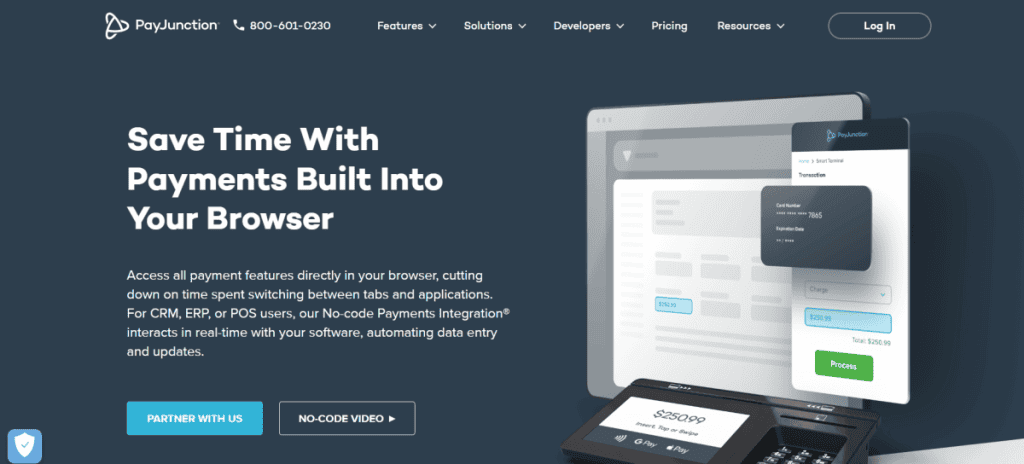
One of PayJunction’s most notable features is its ZeroTouch Terminal, a contactless payment system that improves security and does away with paper receipts. Businesses can easily integrate payment processing without requiring a lot of technical know-how thanks to the company’s No-Code Payments Integration®. PayJunction is renowned for its PCI Level 1 security compliance, which guarantees that companies can process payments while upholding the strictest data security guidelines.

With a reputation for reliable service, transparent pricing, and a commitment to sustainable, paperless transactions, PayJunction has gained traction among merchants seeking a modern and ethical payment processor. This review will take an in-depth look at its offerings, pricing, security, customer support, and overall value to businesses.

Product and Service Offerings | PayJunction Review

PayJunction provides a comprehensive suite of payment processing solutions tailored to businesses of all sizes. The company supports a variety of payment methods, including credit and debit card transactions, as well as ACH payments. By offering both in-person and remote payment solutions, PayJunction enables businesses to process transactions securely and efficiently. Its interchange-plus pricing model ensures transparency, making it a competitive choice for merchants looking for a straightforward cost structure.

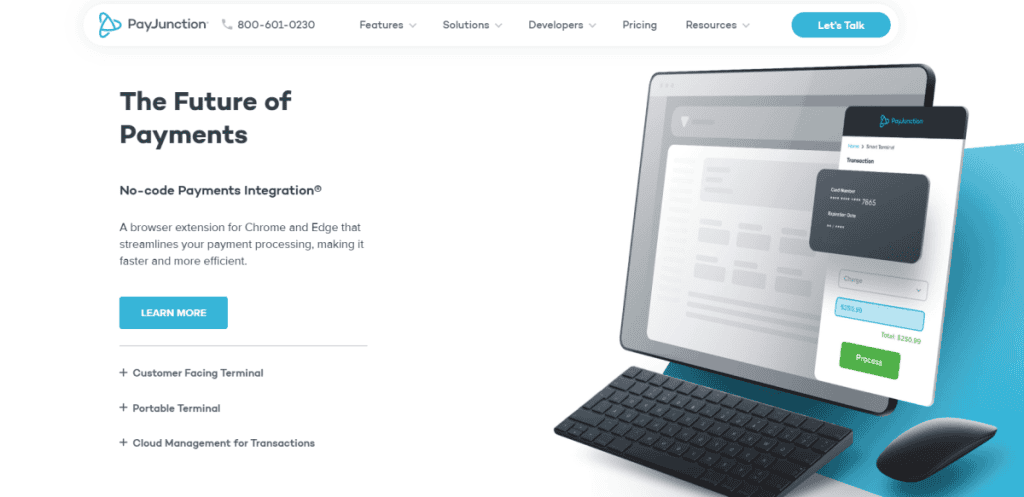
One of the standout aspects of PayJunction’s offering is its hardware solutions. The ZeroTouch Terminal is designed to facilitate contactless payments, reducing the need for paper receipts and enhancing transaction security. This terminal allows businesses to store digital signatures, further streamlining payment acceptance while reducing environmental impact. In addition to the ZeroTouch Terminal, PayJunction also offers a Portable Terminal, which provides mobility for businesses that require on-the-go payment processing, such as service providers and delivery businesses.

PayJunction offers a Virtual Terminal, which enables transactions to be processed via a web-based interface without the need for physical hardware, for companies that prefer virtual payment solutions. Additionally, companies that wish to incorporate payments into their current systems without requiring a lot of development work can do so more easily with its No-Code Payments Integration®. Additionally, PayJunction helps e-commerce companies by providing hosted checkout options and safe online payment processing solutions.
PayJunction Review

Pricing Structure

The interchange-plus pricing model, which PayJunction uses, is regarded as one of the most open pricing schemes in the payment processing sector. Interchange-plus pricing gives merchants a clear breakdown of processing fees, in contrast to flat-rate pricing, which can result in higher costs for companies with higher transaction volumes. In addition to a small, predefined markup, this model guarantees that businesses are charged the actual interchange rate established by card networks. Businesses are able to know exactly how much they are spending on each transaction thanks to this degree of transparency.

For credit and debit card processing, PayJunction’s transaction fees vary based on the type of card used and the nature of the transaction (card-present or card-not-present). ACH transactions are also supported, and they come with their own fee structure, typically lower than credit card processing rates. Businesses can choose to process ACH payments as a cost-effective alternative, especially for recurring billing or high-ticket transactions.

One aspect that businesses should consider is the monthly fee for low-volume merchants. PayJunction charges a $35 monthly fee for businesses that process less than $10,000 per month in transactions. While this fee may be a drawback for smaller businesses, it is offset by the absence of additional charges that many competitors impose.

PayJunction maintains a transparent pricing policy with no hidden fees. Unlike many processors, it does not charge PCI compliance fees, gateway fees, or early termination fees. This straightforward approach makes PayJunction an appealing choice for businesses seeking a fair and predictable cost structure.

Customer Support and Satisfaction

PayJunction offers multiple support channels to assist merchants with their payment processing needs. The company provides phone support, ensuring that businesses can speak directly with a representative for immediate assistance. In addition, a ticketing system allows merchants to submit inquiries online and receive responses in an organized manner. PayJunction also maintains a comprehensive knowledge base, which includes detailed articles, guides, and FAQs that help users troubleshoot common issues and understand the platform’s features. This self-service resource is beneficial for businesses that prefer finding quick answers without waiting for direct assistance.

The majority of merchants’ reviews of PayJunction’s support service are positive, with many praising the team’s professionalism and promptness. The experienced agents who help with onboarding, integration, and troubleshooting have received high marks from users. The company’s hands-on approach, where support agents assist businesses with setup procedures and effectively resolve technical issues, reflects its dedication to customer service.

One of the standout aspects of PayJunction’s support is its lack of outsourced customer service, which means businesses receive assistance directly from knowledgeable, in-house professionals. This is a key differentiator from many competitors that rely on third-party call centers.

While most reviews indicate a high level of satisfaction, some users have reported occasional delays in response times during peak hours. However, the general sentiment is that PayJunction offers reliable, high-quality customer support. The combination of phone, online, and self-service support options ensures that businesses can get the help they need in a timely manner.

Security and Compliance

PayJunction places a strong emphasis on security and compliance, ensuring that businesses can process payments while protecting sensitive customer data. The company is PCI Level 1 compliant, which is the highest standard of security in the payment processing industry. This compliance means that PayJunction adheres to strict regulations set by the PCI DSS, ensuring that businesses using its services are operating within a secure environment. Maintaining PCI Level 1 compliance helps protect businesses from potential data breaches and fraud-related liabilities.

To further enhance security, PayJunction employs encryption and tokenization to safeguard payment information. Encryption ensures that payment data is securely transmitted, preventing unauthorized access during transactions. Tokenization replaces sensitive cardholder information with a randomly generated token, meaning that actual card details are never stored on a merchant’s system. This reduces the risk of data exposure in the event of a security breach.

The likelihood of fraud and unauthorized transactions is greatly reduced by these advanced security measures. Because PayJunction manages compliance and risk mitigation on their behalf, businesses can take advantage of these protections without having to handle security protocols themselves. By facilitating contactless transactions and digital signatures, the company’s ZeroTouch Terminal further improves security by eliminating the need to handle actual cards and receipts.

By implementing robust security measures and adhering to PCI Level 1 compliance, PayJunction provides businesses with a reliable and secure payment processing solution. These protections ensure both merchants and customers can conduct transactions with confidence, minimizing security risks in the payment process.
PayJunction Review

Integration and Compatibility

PayJunction offers a range of integration options that allow businesses to seamlessly incorporate its payment processing solutions into their existing systems. One of its key strengths is its full-stack API, which provides developers with the flexibility to create custom payment solutions. This API enables businesses to integrate PayJunction’s services directly into their software, POS systems, and customer management platforms. With well-documented API resources, businesses can efficiently build and deploy payment functionalities without unnecessary complexity.

For businesses that require payment processing without extensive coding, PayJunction’s No-Code Payments Integration® offers an alternative solution. This feature allows companies to integrate payments into their systems without the need for advanced technical expertise, making it a convenient option for merchants who want a straightforward setup.

Additionally, PayJunction is made to work with third-party software, so companies can integrate it with accounting programs, CRM tools, and e-commerce platforms. By keeping financial management, sales tracking, and payment processing all in one cohesive system, this degree of compatibility helps businesses streamline operations.

The ease of implementation is another notable advantage. Unlike some processors that require complex onboarding processes, PayJunction’s integration options are designed to be user-friendly. Businesses can connect their systems without facing unnecessary delays, ensuring that payment processing is up and running quickly.

By providing robust API access, no-code integration, and broad software compatibility, PayJunction ensures that businesses can implement payment solutions that fit their specific needs while maintaining operational efficiency.

User Experience and Interface

PayJunction offers a well-designed and intuitive interface that enhances the overall user experience for businesses. Its dashboard provides merchants with a centralized platform to manage transactions, track sales, and access key payment data. The clean and organized layout ensures that users can quickly navigate through various functions without facing a steep learning curve. From processing payments to issuing refunds and managing customer records, all essential tools are easily accessible from the dashboard.

One of the standout features of PayJunction’s platform is its reporting tools and real-time monitoring capabilities. Businesses can generate detailed reports that provide insights into transaction history, sales trends, and payment performance. These reports can be customized to suit different business needs, helping merchants analyze financial data and make informed decisions. Real-time monitoring ensures that businesses can keep track of transactions as they happen, reducing the risk of errors and fraudulent activities.

PayJunction prioritizes mobile accessibility in addition to its web-based dashboard, enabling businesses to handle transactions from any location. The platform is designed to work well on a variety of devices, such as smartphones, tablets, and PCs. Merchants have complete control over their payment processing operations, whether they are handling payments while on the go or remotely reviewing sales data. A consistent and intuitive experience is guaranteed by the smooth device integration.

With its intuitive interface, powerful reporting tools, and mobile-friendly design, PayJunction provides a smooth and efficient payment management experience, making it easy for businesses to stay on top of their financial operations.

Pros and Cons

PayJunction offers several advantages that make it a strong option for businesses seeking a reliable payment processor.

Transparent Pricing – PayJunction follows an interchange-plus pricing model, ensuring businesses have clear visibility into transaction costs. There are no hidden fees, no PCI compliance fees, no gateway fees, and no early termination fees, making it a cost-effective choice for merchants who prioritize straightforward pricing.

No Long-Term Contracts – Unlike many competitors that require multi-year agreements, PayJunction offers month-to-month service, allowing businesses to cancel or switch providers without facing penalties. This flexibility is particularly beneficial for businesses that do not want to be locked into restrictive terms.

Strong Security Measures – PayJunction is PCI Level 1 compliant and employs encryption and tokenization to protect sensitive payment data. These security features help reduce the risk of fraud and unauthorized access, ensuring that transactions remain safe for both businesses and customers.

Quality Customer Support – Businesses have access to phone support, a ticketing system, and a comprehensive knowledge base. Unlike some competitors that outsource support, PayJunction provides in-house customer service, ensuring knowledgeable and responsive assistance.

However, PayJunction does have some potential drawbacks.

Monthly Fees for Low-Volume Businesses – Merchants processing less than $10,000 per month are subject to a $35 monthly fee, which may be a drawback for small businesses or seasonal operations.

Limited Hardware Options – While PayJunction provides high-quality ZeroTouch and Portable Terminals, its range of hardware solutions is not as extensive as some competitors, particularly those offering full-scale POS systems.

Despite these limitations, It remains a strong choice for businesses that value transparent pricing, security, and reliable customer support.
PayJunction Review

Competitor Comparison

PayJunction competes with several major payment processors, including Square and Clover, both of which offer comprehensive payment solutions for businesses. While all three companies provide essential payment processing services, they differ significantly in pricing structures, contract terms, hardware options, and security features.

Pricing and Contracts – PayJunction follows an interchange-plus pricing model, which provides more transparency than Square’s flat-rate pricing. Square charges a fixed percentage per transaction, which can be convenient but may lead to higher costs for businesses with large transaction volumes. Clover offers tiered pricing, which can vary based on the service provider. Unlike Clover, which often requires long-term contracts through resellers, It operates on a month-to-month basis, providing greater flexibility.

Hardware Options – In addition to touchscreen registers and handheld terminals, Square and Clover offer a wider range of POS hardware tailored to the restaurant and retail industries. The ZeroTouch and Portable Terminals from PayJunction, on the other hand, emphasize contactless transactions and digital receipts. Businesses seeking a simplified, environmentally friendly payment solution might favor PayJunction, while those needing advanced POS features might find Square or Clover a better fit.

Security Features – PayJunction is PCI Level 1 compliant and emphasizes security through tokenization and encryption. While Square and Clover also adhere to security standards, PayJunction’s ZeroTouch Terminal provides an extra layer of protection by eliminating the need for physical receipts, reducing the risk of fraud.

Businesses that prioritize transparent pricing, flexible contracts, and strong security features may find PayJunction a better choice. However, companies needing a broader range of POS hardware and built-in industry-specific tools may benefit from Square or Clover.

Conclusion

PayJunction is a great option for companies looking for a dependable payment processor because it provides flexible contracts, robust security, and transparent pricing. It is perfect for companies that prioritize cost transparency, security, and digital-first payment solutions because of its ZeroTouch Terminal, interchange-plus pricing, and PCI Level 1 compliance, even though it lacks a wide range of hardware options.

Frequently Asked Questions 

Does PayJunction require long-term contracts?

No, PayJunction operates on a month-to-month basis, meaning businesses are not locked into long-term contracts. Merchants can cancel the service anytime without facing early termination fees, providing greater flexibility compared to competitors that require multi-year commitments.

Are there any monthly fees for low-volume businesses?

Yes, businesses processing less than $10,000 per month are subject to a $35 monthly fee. While this may be a drawback for small businesses, PayJunction offsets it by eliminating other common charges such as PCI compliance and gateway fees.

What customer support options are available?

PayJunction offers phone support, a ticketing system, and a knowledge base. Unlike many competitors that outsource support, PayJunction provides in-house customer service, ensuring knowledgeable and efficient assistance.

Tidal Commerce Merchant Review

Tidal Commerce Merchant Review

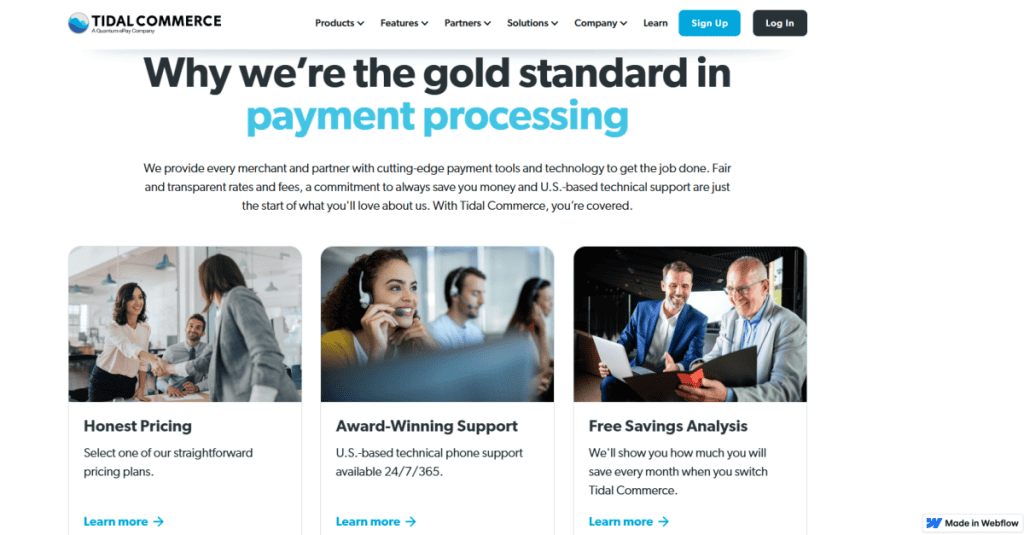
Tidal Commerce is a payment processing company that aims to provide secure and efficient merchant services for businesses of all sizes. The company positions itself as a transparent and customer-focused payment processor, offering a range of solutions, including credit card processing, point-of-sale systems, and e-commerce integrations. Lets read more about Tidal Commerce Merchant Review.

Tidal Commerce was founded with the goal of simplifying payment processing while maintaining high security and transparency. Although the exact founding year is not widely publicized, the company has established itself as a reputable player in the merchant services industry. Over the years, it has evolved by expanding its service offerings, integrating advanced technology, and prioritizing customer service.

The goal of Tidal Commerce is to offer simple, affordable payment options while guaranteeing that merchants are fully informed about costs and terms of contracts. The company wants to help businesses increase their profitability by getting rid of hidden costs and needless markups. Providing safe, dependable, and creative payment processing solutions that can grow with businesses is at the heart of its mission.

Tidal Commerce is committed to maintaining industry compliance and security standards. It follows PCI DSS guidelines to ensure safe transactions. Additionally, it holds accreditation from the Better Business Bureau and has received ratings that reflect its credibility and service quality. The company also meets industry-specific certifications related to secure payment processing, ensuring businesses remain compliant with evolving regulatory requirements.

Services Offered by Tidal Commerce Merchant Services | Tidal Commerce Merchant Review

Tidal Commerce provides a variety of payment solutions designed to cater to businesses of all sizes. The company focuses on secure, efficient, and transparent payment processing while offering flexible integration options.

Payment Processing Solutions

It supports credit and debit card processing, enabling businesses to accept payments from all major card networks, including Visa, Mastercard, American Express, and Discover. The company offers both in-store and online processing, making it suitable for brick-and-mortar businesses, e-commerce stores, and service-based merchants.

Online and mobile payment solutions are offered by Tidal Commerce to companies that need flexible or remote payment options. Merchants can use digital invoicing, virtual terminals, and mobile card readers to process payments. Businesses can use secure online portals or mobile devices to accept payments thanks to these features.

Point-of-Sale Systems

Tidal Commerce provides POS systems that are intended to increase business efficiency and streamline transactions. These systems have a number of features and capabilities, including CRM, sales reporting, and inventory management. Additionally, the POS systems are compatible with a wide range of business types, such as retail establishments, restaurants, and service providers, guaranteeing flexibility based on business requirements.

E-commerce Integration

For online businesses, Tidal Commerce provides shopping cart compatibility, allowing seamless integration with platforms like Shopify, WooCommerce, and Magento. Additionally, the company offers API offerings for businesses that require customized payment gateway solutions. This flexibility enables businesses to build tailored payment experiences while ensuring security and compliance.

Tidal Commerce Merchant Review

Pricing and Fees of Tidal Commerce Merchant Services

Tidal Commerce markets itself as a provider of transparent pricing with no hidden fees or complex contracts. However, like most payment processors, the total cost for merchants depends on factors such as transaction volume, business type, and specific services required.

Transparent Pricing Structure

It follows an interchange-plus pricing model, which means merchants pay the actual interchange fee set by card networks (Visa, Mastercard, etc.) plus a markup determined by Tidal Commerce. This pricing structure is generally preferred over flat-rate pricing, as it can be more cost-effective for businesses with high transaction volumes.

The company charges monthly and annual fees, but the exact amounts depend on the type of plan a merchant chooses. Some businesses may need to pay for additional features such as advanced reporting, PCI compliance, or chargeback protection.

Hidden Charges

Tidal Commerce emphasizes its lack of hidden fees, claiming that all costs are disclosed upfront. While most reviews suggest that the company maintains a transparent fee structure, merchants should carefully review their agreements to identify any undisclosed charges, such as fees for chargebacks, non-compliance, or additional services.

Contract Terms

Tidal Commerce’s flexible contract terms are one of its benefits. It provides month-to-month contracts without any obligatory long-term commitments, in contrast to certain processors that demand such commitments. Businesses can terminate their service without incurring penalties because there are no ETFs. Because of this, Tidal Commerce is a viable choice for companies seeking contract flexibility.

Customer Support of Tidal Commerce Merchant Services

Tidal Commerce emphasizes customer service as one of its key differentiators, aiming to provide responsive and knowledgeable support to businesses using its payment processing solutions. The company’s approach to customer service includes multiple communication channels and a focus on transparency.

Availability and Accessibility

It offers 24/7 customer support, ensuring that merchants can receive assistance at any time, including weekends and holidays. This around-the-clock availability is particularly beneficial for businesses that operate outside of standard business hours, such as restaurants, e-commerce stores, and service-based industries.

In terms of response times, Tidal Commerce generally receives positive feedback, with many customers reporting quick resolutions to issues. However, as with any service provider, experiences may vary depending on the complexity of the problem and peak hours of support requests.

Support Channels

It provides multiple ways for merchants to reach out for help, including phone, email, and live chat support. Phone support is ideal for urgent issues, while email and chat options offer convenience for less time-sensitive inquiries. The availability of live chat is an advantage, as it allows businesses to receive real-time assistance without waiting on hold.

Customer Feedback

In general, users have given Tidal Commerce’s support services positive reviews, and many merchants have expressed gratitude for the helpful and kind support staff. Some users have, however, complained about sporadic delays or trouble getting through to a representative during busy times. Overall, the business seems dedicated to offering dependable and easily reachable customer service.

Security and Compliance of Tidal Commerce Merchant Services

Security is a critical factor in payment processing, and Tidal Commerce prioritizes compliance with industry standards to ensure secure transactions. The company implements various measures to protect businesses and customers from fraud and data breaches.

PCI Compliance

Tidal Commerce is PCI DSS compliant, meaning it follows strict guidelines to protect cardholder data. This compliance ensures that merchants using Tidal Commerce meet the necessary security requirements, reducing the risk of data breaches and potential penalties for non-compliance.

Fraud Prevention Measures

It offers a number of fraud prevention tools and procedures to protect transactions. These include CVV checks, AVS, and real-time transaction monitoring to identify suspicious activity. Additionally, companies can minimize industry-specific risks by implementing customizable fraud filters.

The company also offers chargeback management tools, helping merchants dispute illegitimate chargebacks effectively. By providing insights into chargeback trends, Tidal Commerce allows businesses to take proactive measures to prevent disputes before they escalate.

Data Encryption

Tidal Commerce employs end-to-end encryption and tokenization to protect sensitive payment information. With encryption, card details are securely transmitted and stored, reducing the likelihood of unauthorized access. Tokenization replaces actual card numbers with unique tokens, ensuring that even if data is compromised, it remains useless to cybercriminals.

Overall, It integrates industry-leading security measures to protect transactions, making it a reliable choice for businesses that prioritize data security and compliance. However, merchants should still implement additional security best practices to enhance their protection.

Tidal Commerce Merchant Review

Technology and Integrations of Tidal Commerce Merchant Services

Tidal Commerce offers a range of technological solutions that cater to businesses looking for seamless payment processing integration. The company’s focus on software compatibility, developer tools, and hardware flexibility makes it a viable option for businesses that require tailored payment solutions.

Software Compatibility

Tidal Commerce integrates with various accounting and CRM systems, allowing businesses to streamline their financial and customer data. The compatibility with platforms like QuickBooks, Salesforce, and other business management tools helps merchants manage their sales, reporting, and customer insights more efficiently. This level of integration reduces manual work, minimizes errors, and improves overall business operations.

Developer Resources

Tidal Commerce offers API access and documentation for companies in need of specialized payment solutions. Through the company’s API, developers can incorporate payment processing into unique digital platforms such as mobile apps and websites. The availability of resources that are clear and well-documented guarantees that companies can apply payment solutions in accordance with their particular needs without facing significant technical difficulties.

Hardware Offerings

Tidal Commerce supports both proprietary and third-party hardware solutions, providing flexibility for businesses that already have existing payment terminals. Merchants can choose from a variety of POS systems, mobile card readers, and countertop terminals, ensuring that their payment setup aligns with their specific needs. This compatibility allows businesses to scale without being locked into expensive proprietary hardware.

Overall, Tidal Commerce offers a robust suite of integrations and technology-driven solutions that enhance payment processing efficiency. However, businesses should verify compatibility with their existing systems before implementation.

Reputation and Reviews of Tidal Commerce Merchant Services

Tidal Commerce has established a notable presence in the payment processing industry, earning recognition for its customer service and transparent practices.​

Customer Testimonials

Customers have said that Tidal Commerce’s services are satisfactory. One Yelp reviewer wrote, for example, “I would highly recommend Tidal Commerce! My employer recently switched to Tidal for our processing, and we are really happy about it. Positive experiences are also highlighted in testimonials on the official Tidal Commerce website. According to Pivot 10 Results President and CEO Gina Trimarco, “They saved us a lot of money for both our companies and their customer service rocks.” The Chicagoland Chamber of Commerce’s Senior Director of Accounting, Jill Synoga, also praised their customer service for being helpful and attentive.​

While these testimonials appear genuine, it’s important to approach them with a discerning eye, as businesses often showcase favorable reviews. Prospective clients should seek out additional feedback from various sources to form a well-rounded perspective.​

Third-Party Reviews

Tidal Commerce holds an A+ rating from the BBB, reflecting its commitment to resolving customer complaints and maintaining trustworthiness. However, some platforms, like Serchen, indicate a lack of user reviews, suggesting limited feedback on certain review sites.​

Overall, Tidal Commerce maintains a positive reputation, particularly regarding customer service and transparent pricing. Prospective clients are encouraged to consult multiple sources and consider their specific business needs when evaluating Tidal Commerce’s services.

Partnerships and Affiliations of Tidal Commerce Merchant Services

Tidal Commerce has strategically developed partnerships and affiliations to enhance its service offerings and strengthen its position in the payment processing industry.

Industry Partnerships

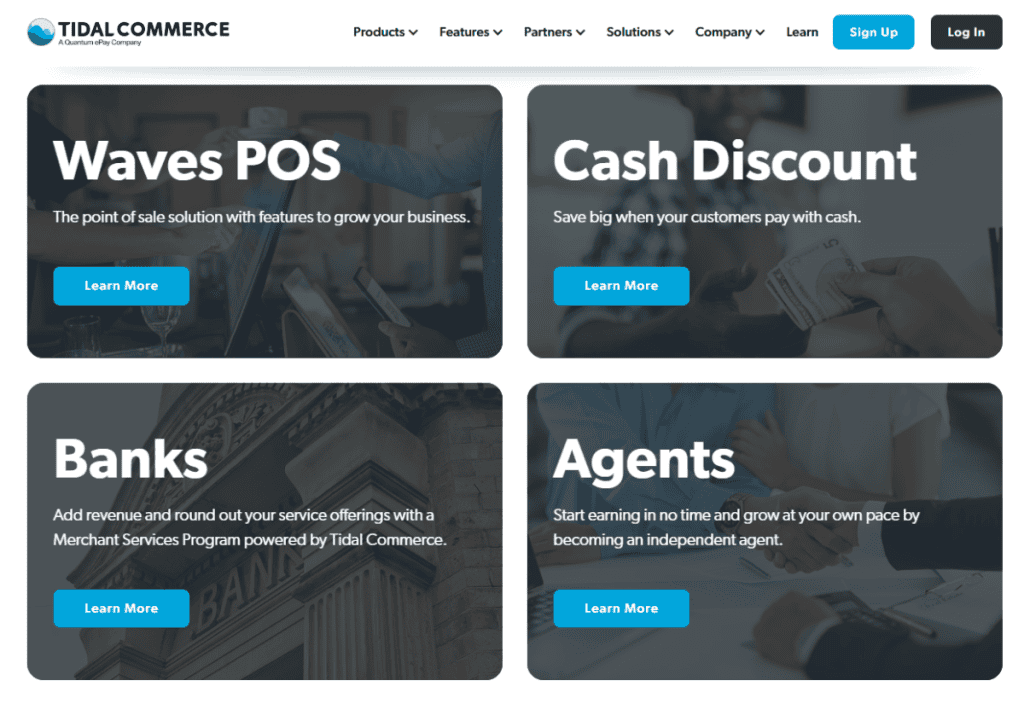
Tidal Commerce collaborates with various service providers to deliver comprehensive payment solutions. Notably, the company has established partnerships with banks, credit unions, associations, ISOs, referral partners, and ISVs. These collaborations enable Tidal Commerce to offer tailored merchant services, integrating seamlessly with existing financial and technological infrastructures.

Additionally, It is recognized as a Shopify Plus Partner, reflecting its expertise in headless and composable commerce technologies. This partnership allows the company to provide advanced e-commerce solutions to businesses seeking scalable and customizable platforms.

Memberships

Tidal Commerce actively engages with industry groups and associations to stay abreast of industry trends and best practices. The company collaborates with associations to offer exclusive discounted processing rates and other benefits to their members, thereby enhancing the value proposition for both the associations and their constituents.

Clientele

Retail, restaurants, hotels and hospitality, and nonprofits are just a few of the industries that Tidal Commerce serves. Merchants looking for mobile and tablet-based terminals, point-of-sale systems, and customized payment processing solutions are served by the company’s modular payment platform. Notable customers include companies like Framar and October’s Very Own, demonstrating Tidal Commerce’s ability to manage complex e-commerce requirements.

Pros and Cons of Tidal Commerce Merchant Services

Like any payment processor, It has strengths and weaknesses that businesses should consider before signing up. While the company offers competitive pricing and a wide range of services, some areas may require improvement based on customer feedback.

Advantages

One of Tidal Commerce’s biggest advantages is its competitive pricing. The company uses an interchange-plus pricing model, which is often more transparent and cost-effective than flat-rate pricing. Additionally, merchants benefit from no early termination fees, making it a flexible option for businesses that want to avoid long-term commitments.

Its comprehensive service offerings are an additional significant advantage. It facilitates e-commerce integrations, point-of-sale systems, mobile payments, and credit and debit card processing. Businesses that require specialized payment solutions can also access the company’s APIs, PCI compliance assistance, and fraud prevention tools. It is a flexible payment processor that can be used by clients of all sizes.

Disadvantages

While Tidal Commerce offers many advantages, there are some potential areas of improvement. Some customers have reported occasional delays in customer service response times, particularly during peak hours. Although the company offers 24/7 support, not all users have experienced quick resolutions to their issues.

Another concern among some users is the lack of detailed pricing information upfront. While the company emphasizes transparency, merchants may need to request a quote to get precise pricing, which can be inconvenient for those comparing providers.

Tidal Commerce Merchant Review

Conclusion

Strong security features, a variety of payment options, and competitive pricing are all provided by Tidal Commerce. However, some users complain about limited upfront pricing information and sporadic delays in customer service. It works best for companies looking for flexible, transparent payment processing. Before committing to the service, merchants should assess their unique requirements.

Frequently Asked Questions

  1. What industries does Tidal Commerce serve?

Tidal Commerce caters to a variety of industries, including retail, hospitality, healthcare, professional services, and e-commerce. Its payment solutions are designed for businesses of all sizes, from small startups to large enterprises.

  1. How does Tidal Commerce handle chargebacks and disputes?

Tidal Commerce provides merchants with chargeback management tools, real-time transaction monitoring, and fraud prevention measures. Businesses receive guidance on responding to disputes and can track chargebacks through the merchant portal.

  1. Are there any long-term contracts or cancellation fees?

Tidal Commerce offers month-to-month contracts with no early termination fees, providing flexibility for businesses that want to avoid long-term commitments.

KeyBank Merchant Services Review

KeyBank Merchant Services Review

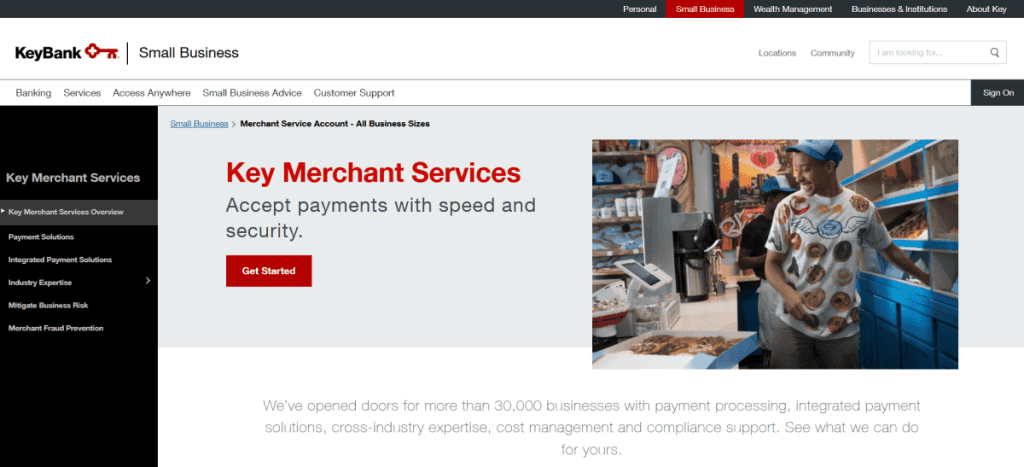
KeyBank Merchant Services is a payment processing service provided by KeyBank, which is among the largest financial entities in the United States. The service aims to assist businesses in accepting different payment methods, such as credit and debit cards, mobile payments, and ACH transactions. In collaboration with Fiserv, a prominent payment technology provider, KeyBank intends to provide a smooth and secure payment processing experience for enterprises in various sectors. Their offerings include POS systems and online payment processing, equipped with features designed for both small businesses and larger companies. Lets read more about KeyBank Merchant Services Review.

In today’s competitive marketplace, efficient payment processing is critical for business success. Customers expect fast, secure, and convenient payment options, whether they are shopping in-store or online. A reliable merchant services provider ensures smooth transactions, reduces fraud risk, and enhances customer satisfaction. Additionally, businesses require flexible payment solutions that integrate with their existing operations, whether through POS systems, mobile payment terminals, or e-commerce platforms.

KeyBank Merchant Services positions itself as a comprehensive payment processing partner by offering a mix of traditional and modern solutions. However, as with any merchant services provider, it is essential to assess factors such as pricing, contract terms, customer support, and security features before making a decision. This review will explore KeyBank Merchant Services in detail, providing an unbiased assessment of its features, costs, benefits, and potential drawbacks to help businesses determine whether it is the right fit for their payment processing needs.

Overview of Services | KeyBank Merchant Services Review

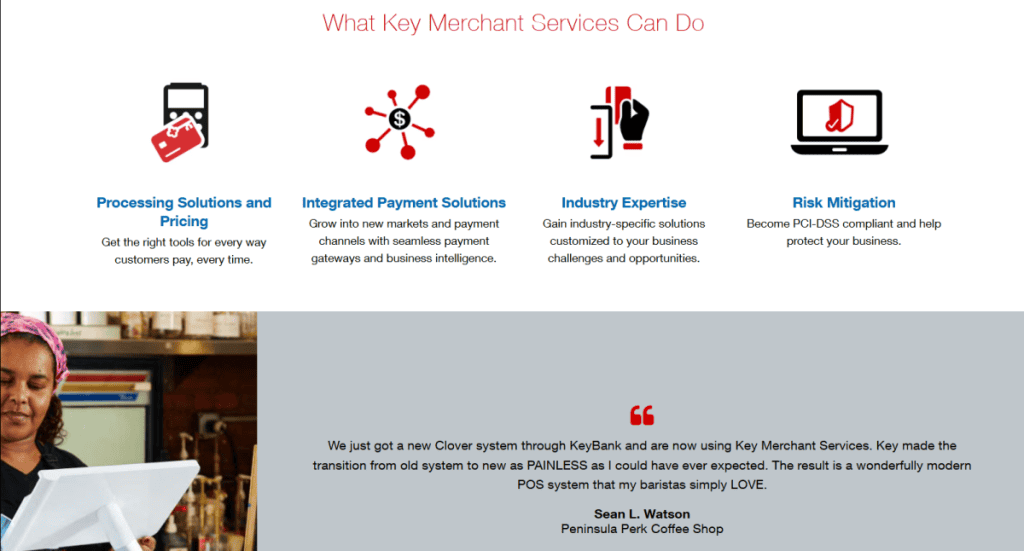
KMS provides various payment processing solutions aimed at assisting businesses in managing transactions effectively and securely. Their offerings serve multiple sectors, delivering resources that facilitate in-person, online, and mobile transactions. In collaboration with Fiserv, KMS incorporates cutting-edge payment technology to address the changing demands of contemporary businesses. 

Payment Processing Solutions

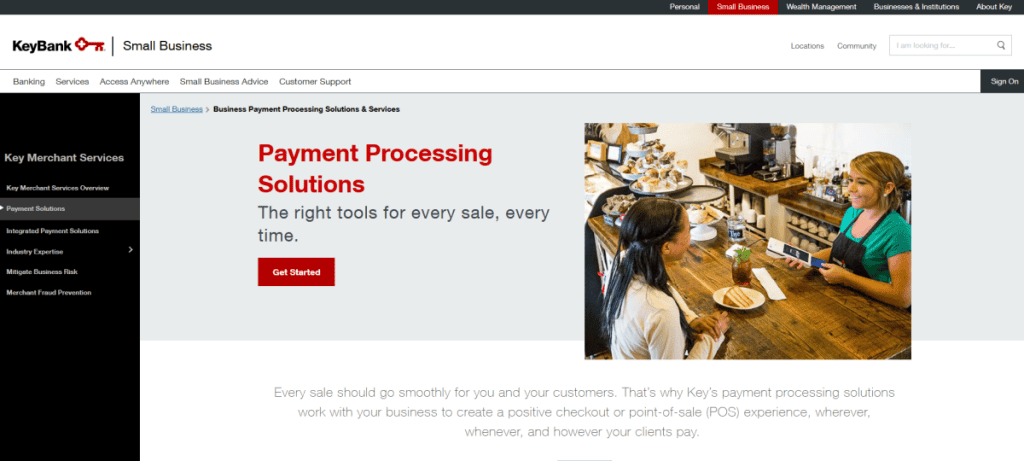
KMS enables businesses to accept a variety of payment methods, including credit and debit cards, contactless payments, and ACH transactions. Their payment processing solutions are designed to work with different types of businesses, from brick-and-mortar retail stores to e-commerce platforms. The service supports EMV chip transactions, mobile wallets like Apple Pay and Google Pay, and traditional magnetic stripe card payments.

Integrated Payment Solutions

To improve operational efficiency, KMS offers integrated payment solutions that connect with existing business software and systems. These integrations allow businesses to streamline payment acceptance, automate invoicing, and manage sales data seamlessly. Whether through POS terminals, online checkout solutions, or mobile payment options, KeyBank provides businesses with tools to simplify transaction management.

Industry-Specific Solutions

KMS tailors its payment processing services for different industries, including retail, healthcare, professional services, and restaurants. Their industry-specific solutions provide customized features, such as online appointment payments for healthcare providers or digital invoicing for service-based businesses.

Risk Mitigation and Compliance Support

Security is a critical concern in payment processing, and KMS helps businesses maintain PCI-DSS compliance to protect sensitive customer data. The service also offers fraud prevention tools, chargeback management support, and encryption technologies to minimize the risk of payment fraud and data breaches.

KeyBank Merchant Services Review

Pricing Structure

Understanding the pricing structure of KMS is crucial for businesses looking to optimize their payment processing costs. Like most merchant service providers, KMS charges transaction fees, monthly service fees, and additional costs for equipment, security, and chargebacks.

Transaction Fees

KMS applies transaction fees depending on the payment method used. For card-present transactions (swiped, dipped, or tapped), businesses generally face lower rates compared to card-not-present transactions (like online or manually entered payments). The standard fees comprise a percentage of the transaction sum along with a set fee for each transaction. Nonetheless, these rates may fluctuate based on the type of business, the level of industry risk, and the volume of processing. 

Monthly Fees

Most businesses using KMS are subject to a monthly service fee, which covers access to its payment processing platform and basic account maintenance. This fee may include PCI compliance support and account reporting tools. While the exact cost depends on the specific plan and services chosen, businesses should verify whether additional features like premium customer support or advanced fraud protection incur extra charges.

Additional Costs

Beyond standard processing and monthly fees, businesses may face additional costs for equipment rentals or purchases, chargeback fees, and security features. KMS provides POS systems, including Clover® terminals, which may require upfront investment or ongoing leasing costs. Chargeback fees apply when a customer disputes a transaction, and businesses may also need to pay for enhanced fraud prevention tools or PCI compliance services. Understanding these costs is essential for making an informed decision about using KeyBank Merchant Services.

Point-of-Sale Solutions

KMS provides various Clover® POS solutions designed for businesses across multiple sizes and sectors. These systems offer adaptability, safe payment processing, and extra business management functionalities. Regardless of whether a business runs a retail shop, eatery, or service-oriented firm, KMS offers a Clover®-powered solution aimed at simplifying transactions. 

Clover® Go (Portable Payments)

Clover® Go is a lightweight, mobile payment solution ideal for businesses that need to accept payments on the go. It connects via Bluetooth to smartphones or tablets and supports chip, swipe, and contactless transactions, including Apple Pay and Google Pay. This option is well-suited for businesses that frequently attend events, pop-up shops, or provide mobile services.

Clover® Flex (Versatile Mobile POS)

Clover® Flex is a handheld POS device that allows businesses to accept payments anywhere within their store or at off-site locations. It features a built-in receipt printer, barcode scanner, and touchscreen display, making it a great all-in-one solution for businesses that require mobility without compromising on full POS functionality.

Clover® Mini (Compact Countertop POS)

Clover® Mini is a small but powerful countertop POS system designed for businesses with limited space but high transaction needs. It offers tap, swipe, and chip payments, supports loyalty programs and inventory tracking, and integrates with back-office tools to streamline operations.

Clover® Station Solo & Duo (Full-Featured POS for High-Volume Businesses)

Clover® Station Solo and Duo are advanced, high-performance POS systems designed for businesses with a high transaction volume. The Solo version is a single-screen setup, while the Duo includes a customer-facing display for an enhanced checkout experience. Both options offer employee management, inventory control, and robust reporting tools to optimize business efficiency.

Industry-Specific Solutions

KMS provides industry-specific payment solutions tailored to meet the unique needs of businesses across various sectors. These customized solutions ensure seamless transactions, improve customer experience, and enhance operational efficiency.

Retail Payment Solutions

KMS provides extensive payment processing services for retail businesses, enabling them to accept credit cards, debit cards, mobile payments, and contactless transactions. Using integrated POS systems such as Clover®, retailers can oversee inventory, monitor sales, and simplify checkout procedures. Moreover, aspects like loyalty schemes and gift card alternatives assist companies in maintaining customers and promoting repeat purchases. 

Healthcare Payment Integration

For medical practices, KMS provides secure payment solutions that integrate with electronic medical records and practice management systems. This allows healthcare providers to accept co-pays, process insurance payments, and set up recurring billing for patient accounts. The system ensures HIPAA-compliant transactions and offers online payment portals for convenient patient payments, reducing administrative burdens for medical offices.

Professional Services Billing

Businesses in the legal, accounting, and consulting fields can benefit from KMS’s digital invoicing and recurring billing options. These solutions enable professionals to send secure online invoices, accept electronic payments, and automate billing cycles. With features like automated reminders and detailed reporting, businesses can efficiently manage cash flow while providing clients with convenient payment options.

Restaurant Payment Systems

KMS’s restaurant-focused payment solutions support tableside ordering, online reservations, and mobile payment acceptance. Clover® POS systems integrate with menu management tools, delivery platforms, and tip processing, allowing restaurants to streamline operations. Features such as split payments, tab management, and digital receipts enhance customer satisfaction while improving efficiency in fast-paced dining environments.

Customer Support & Service

Reliable customer support is a critical aspect of any merchant services provider, as businesses require prompt assistance to resolve transaction issues, technical problems, and account-related concerns. KMS offers multiple support channels, including phone, email, and online chat, to assist businesses with their payment processing needs.

Availability and Support Channels

KMS offers round-the-clock customer support, guaranteeing that businesses can get help whenever they face a problem. Their committed support staff can be reached through toll-free phone lines, email communication, and online chat options. Furthermore, companies can find self-assistance tools such as FAQs and troubleshooting manuals on KeyBank’s website. Merchant account representatives are accessible for businesses that need more tailored assistance with account setup, resolving disputes, or integrating systems. 

Customer Feedback on Support Quality

Customer experiences with KeyBank Merchant Services’ support vary. Some businesses praise the accessibility of 24/7 assistance, stating that issues are resolved efficiently and that representatives are knowledgeable about payment processing and technical support. However, negative feedback highlights occasional delays in response times and inconsistent service quality, particularly when dealing with complex issues such as chargeback disputes or POS system malfunctions. Some users have also reported difficulties navigating automated phone support before reaching a live representative.

While KMS offers a comprehensive range of support options, businesses considering this service should evaluate customer feedback on responsiveness and issue resolution. As with any merchant services provider, the quality of customer support can significantly impact a business’s payment processing experience.

KeyBank Merchant Services Review

User Feedback & Reviews

User feedback for KMS is mixed, with businesses highlighting both positive and negative aspects of their experience. As with most payment processors, opinions vary depending on factors such as customer service interactions, pricing, and ease of use.

Positive Experiences

Numerous companies value the simplicity and dependability of KMS’s payment processing solution. The Clover® POS systems are praised for their user-friendly interfaces, fast transaction processing, and capacity to connect with different business applications. Users also appreciate the variety of industry-specific functions, especially for retail, healthcare, and restaurant sectors. 

Several customers have remarked on the attentive customer support, particularly for general questions and account creation. The constant availability of support is advantageous for companies needing prompt solutions for transaction problems. Furthermore, the security protocols and compliance assistance offered by KMS are positively regarded, as they aid companies in upholding PCI-DSS compliance and safeguarding against fraud. 

Common Complaints

Despite its strengths, KMS has received criticism regarding pricing and contract terms. Some users report higher-than-expected processing fees, particularly for card-not-present transactions and additional service charges. Monthly fees and early termination fees have also been points of concern for businesses that were unaware of contract requirements.

Another common complaint involves service issues and response times. While some users report good experiences with support, others mention delays in resolving technical issues, difficulty disputing chargebacks, and challenges with contract cancellations. These concerns make it essential for businesses to carefully review pricing, contract terms, and customer service policies before committing to KMS.

Risk Mitigation & Compliance

Security and compliance are critical considerations for any business handling electronic payments. KMS provides a range of risk mitigation tools and compliance support to help businesses protect sensitive customer data and minimize financial risks. By offering PCI-DSS compliance assistance and fraud prevention solutions, KMS aims to enhance security and reduce the likelihood of data breaches or fraudulent transactions.

PCI-DSS Compliance Assistance

PCI-DSS comprises a series of security protocols aimed at safeguarding cardholder data. Companies that handle, store, or transmit credit card information must follow PCI standards to guarantee safe transactions. KMS assists merchants in attaining and sustaining PCI-DSS compliance by offering advice, self-evaluation resources, and security assistance. Adhering to regulations minimizes the chances of data breaches and possible fines for failing to comply. Nonetheless, certain businesses might face PCI non-compliance charges if they do not adhere to the necessary security standards, highlighting the importance for merchants to remain informed about compliance obligations. 

Fraud Prevention Tools and Security Measures

To help businesses prevent fraudulent transactions, KMS offers security features such as encryption, tokenization, and EMV chip technology. These tools safeguard payment data from unauthorized access and reduce exposure to fraud-related chargebacks. Additionally, real-time fraud monitoring and risk assessment solutions enable businesses to detect suspicious transactions before they lead to financial losses. While these security measures enhance protection, businesses should evaluate whether additional fraud prevention tools—such as AI-driven fraud detection or two-factor authentication—are necessary for their specific needs.

Conclusion

KeyBank Merchant Services provides various payment processing options, comprising POS systems, fraud deterrence tools, and tailored services for specific industries. Though it offers security and integration solutions, companies must thoroughly evaluate costs, contract conditions, and the dependability of customer support prior to making a commitment. Assessing requirements and weighing options is crucial for making an informed decision. 

KeyBank Merchant Services Review

FAQs

What types of payments can I process with KeyBank Merchant Services?

Credit and debit card payments, ACH transfers, e-commerce payments, and mobile wallet transactions (Apple Pay, Google Pay, and Samsung Pay) are all supported by KeyBank Merchant Services. Clover® POS systems allow businesses to accept contactless payments, EMV chip cards, and conventional swipe transactions.

Are there additional fees beyond transaction and monthly fees?

Yes, companies may have to pay for equipment, chargebacks, early termination fees, and PCI compliance expenses. Reviewing the contract specifics is crucial since enhanced security features, payment gateway services, and software integrations may incur additional costs.

How does KeyBank assist with PCI-DSS compliance?

KeyBank offers security monitoring, self-assessment tools, and guidance to help with PCI-DSS compliance. Merchants are given support in adhering to security guidelines to safeguard cardholder information, but failure to do so may incur further costs.

Payrix Payfac Review

Payrix Payfac Review

Digital payments are evolving and companies are progressively seeking seamless, scalable, and efficient solutions for payment processing. Payrix, a division of FIS (Fidelity National Information Services), is a significant participant in the payment facilitation sector, providing embedded payment solutions designed for software platforms and independent software vendors. By allowing companies to embed payment processing directly into their systems, Payrix offers a complete range of services that simplify merchant onboarding, compliance oversight, and transaction handling. Lets read more about Payrix Payfac Review.

Payrix distinguishes itself through its flexible PayFac-as-a-Service model and a full PayFac® solution, allowing software companies to choose between a simplified, managed approach or a fully integrated, self-managed payment facilitation experience. The platform supports various payment methods, including credit and debit cards, ACH transactions, and digital wallets, making it a versatile solution for businesses operating across multiple industries.

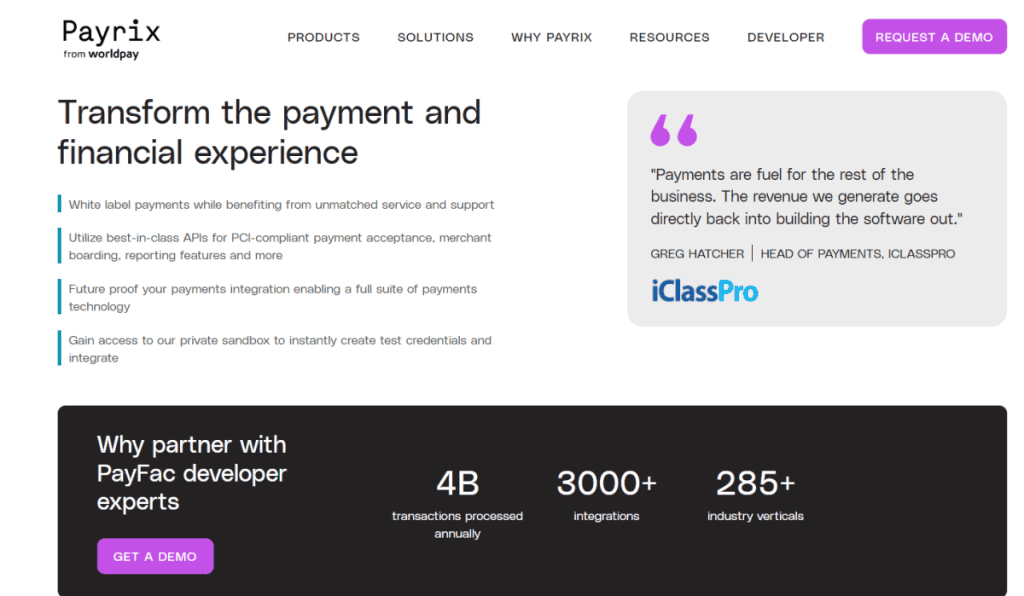
As a contemporary PayFac provider, Payrix focuses on automation, risk management, and scalability. It primarily serves SaaS platforms and tech-oriented businesses aiming to monetize payments while preserving oversight of the user experience. Featuring a developer-friendly API and white-label options, Payrix allows businesses to integrate payments seamlessly, avoiding the complications tied to conventional merchant accounts. 

In this review, we will explore Payrix’s offerings in detail, evaluating its features, pricing, compliance measures, and overall value proposition. By examining both its strengths and potential limitations, this unbiased analysis will help businesses determine whether Payrix is the right payment facilitation solution for their needs.

Company Background | Payrix Payfac Review

Payrix was established with the goal of making payment facilitation easier for businesses and software platforms aiming to integrate payments smoothly into their services. Acknowledging the increasing demand for integrated financial solutions, Payrix created an all-encompassing payment system that allows software providers to act as payment facilitators without the challenges of handling compliance, underwriting, and risk independently. 

In 2021, Payrix was acquired by FIS, a global leader in financial technology solutions. This acquisition further strengthened Payrix’s capabilities by providing access to FIS’s extensive network, resources, and expertise in payment processing and financial services. As a result, Payrix has been able to scale its offerings, enhance security features, and expand its global reach.

Mission and Vision

Payrix aims to enable software platforms with effortless and scalable payment solutions, enabling businesses to incorporate payments as a fundamental aspect of their services. The organization imagines a future in which embedded payments are seamless, safe, and highly adaptable, allowing software vendors to improve user experiences while creating new revenue streams. 

Key Milestones and Achievements

Founding and Early Growth: Developed as a specialized payment facilitator designed for SaaS platforms.

Acquisition by FIS (2021): Marked a significant expansion in resources and capabilities.

Expansion of PayFac Models: Launched both PayFac-as-a-Service and full PayFac® solutions to cater to different business needs.

Strengthened Compliance & Security: Enhanced fraud prevention and risk management tools.

Global Expansion: Extended payment services to new markets, broadening accessibility for international software providers.

With these milestones, Payrix has positioned itself as a strong contender in the embedded payments industry, offering businesses a robust and flexible PayFac solution.

Payrix Payfac Review

Payrix PayFac Solutions

Payrix offers two primary solutions for businesses looking to integrate payment facilitation: PayFac-as-a-Service and the full PayFac® model. Both are designed to provide software platforms and ISVs with the ability to process payments seamlessly, but they differ in terms of control, complexity, and responsibility.

PayFac-as-a-Service

PayFac-as-a-Service is a comprehensive, managed payment facilitation option that enables companies to integrate payments into their platforms without assuming the entire regulatory and compliance responsibility. Using this model, Payrix manages underwriting, compliance, risk assessment, and merchant onboarding, allowing software firms to profit from payments without significant operational burdens. It serves as a perfect option for platforms aiming to offer integrated payments swiftly without dealing with the challenges of registering as a PayFac. 

Full PayFac® Model

The full PayFac® model is designed for businesses that want to take full ownership and control of their payment processing. This solution provides companies with the infrastructure to become a registered payment facilitator, giving them direct control over onboarding, merchant relationships, risk management, and pricing structures. However, this approach requires significant investment in compliance, fraud prevention, and operational resources.

Comparison of Both Models

Ease of Implementation: PayFac-as-a-Service is faster and simpler, while full PayFac® requires a more involved setup.

Control & Customization: Full PayFac® offers complete control, whereas PayFac-as-a-Service outsources key processes to Payrix.

Risk & Compliance: Full PayFac® demands in-depth regulatory compliance, while PayFac-as-a-Service minimizes liability.

Target Audience

PayFac-as-a-Service: Ideal for SaaS platforms, startups, and businesses that want embedded payments without regulatory burdens.

Full PayFac® Model: Best suited for larger, established businesses looking to own the entire payment experience and maximize revenue.

By offering these two solutions, Payrix provides flexibility to businesses at different stages of growth, allowing them to choose the level of control and responsibility that aligns with their strategy.

Features and Functionality

Payrix provides an extensive array of features aimed at streamlining payment processing for software platforms. With adaptable payment acceptance and strong risk management features, its capabilities are customized to fulfill the requirements of companies looking for integrated payment solutions. 

Payment Acceptance

Payrix supports a variety of payment methods, including credit and debit cards, ACH transfers, and digital wallets like Apple Pay and Google Pay. Its omnichannel capabilities enable businesses to process transactions across multiple touchpoints, whether online, in-person, or through mobile applications. Additionally, Payrix provides developer-friendly APIs that allow for seamless integration into existing software platforms, ensuring a smooth payment experience for end users.

Merchant Onboarding

A notable feature of Payrix is its automated underwriting and risk evaluation, which speeds up merchant approval while ensuring compliance. Companies can develop personalized onboarding processes designed to meet their specific operational requirements. The duration for activating a merchant differs according to risk evaluation, yet Payrix strives for fast, seamless onboarding. 

Risk and Compliance Management

Security and compliance are critical in payment processing, and Payrix offers fraud detection and prevention tools to minimize transaction risks. The platform is PCI-compliant, ensuring adherence to industry security standards. Tokenization and encryption further protect sensitive payment data from breaches.

Reporting and Analytics

Payrix provides real-time transaction monitoring, allowing businesses to track payments and detect anomalies instantly. Its customizable reporting dashboards offer in-depth insights into payment trends and customer behavior, helping businesses optimize their financial strategies.

White-Labeling and Customization

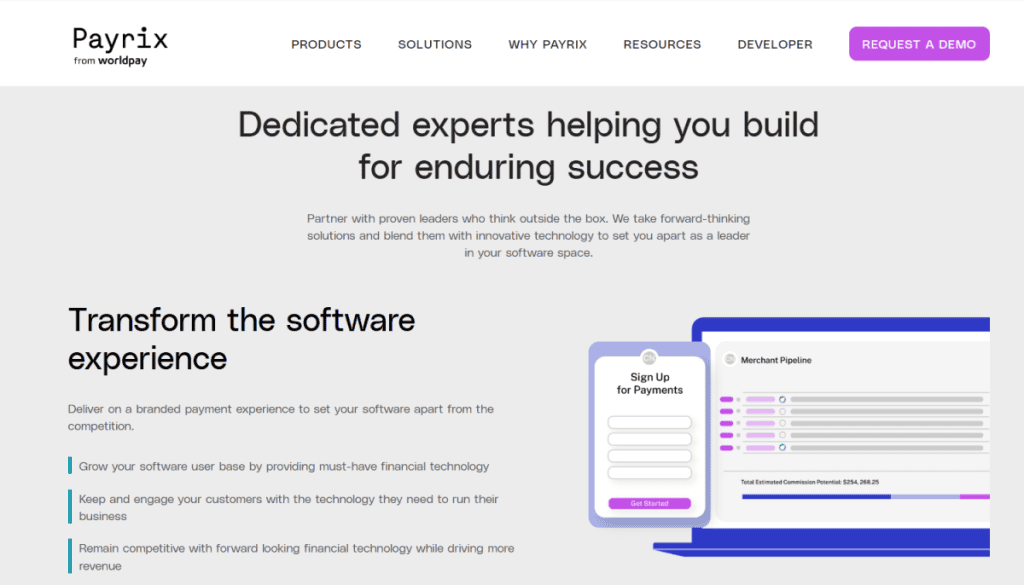
Payrix provides white-label payment solutions, allowing businesses to preserve their brand image while delivering integrated payment services. Users have the ability to tailor the interface and user experience to match their brand. Furthermore, the platform provides adaptable fee structures and pricing models, allowing businesses to manage their revenue sources. 

With its robust feature set, Payrix provides businesses with the tools needed to manage payments efficiently while maintaining security, compliance, and brand consistency.

Implementation Process

Incorporating Payrix into a current system requires a methodical approach aimed at facilitating seamless implementation and reducing interruptions to business activities. Regardless of employing PayFac-as-a-Service or the complete PayFac® model, companies must adhere to a series of essential steps to effectively execute Payrix’s payment solutions. 

Steps Involved in Integration

Initial Assessment & Account Setup – Businesses must first determine which Payrix model suits their needs. After registration, Payrix provides credentials for access to its API and platform.

API Integration & Customization – Payrix offers developer-friendly APIs that allow seamless integration with existing software. Businesses can customize payment flows, UI components, and merchant onboarding workflows.

Merchant Onboarding & Testing – The next phase includes setting up merchant accounts, configuring risk settings, and conducting sandbox testing to ensure transactions are processed correctly.

Compliance & Security Setup – Businesses must ensure PCI compliance, enable fraud prevention mechanisms, and implement tokenization to safeguard payment data.

Go-Live & Optimization – Once testing is complete, the system goes live. Continuous monitoring and optimization are necessary to improve transaction performance and user experience.

Typical Timelines and Phases of Deployment

Basic Integration (1-2 weeks): Suitable for businesses using PayFac-as-a-Service with minimal customization.

Moderate Customization (4-6 weeks): Requires API integrations, UI adjustments, and branding.

Full PayFac® Deployment (3-6 months): Businesses opting for full payment facilitation need extensive compliance, underwriting, and risk management setup.

Resources and Support During Implementation

Payrix provides extensive developer documentation, API references, and SDKs to facilitate integration. Businesses can access dedicated support teams, training materials, and compliance guidance to ensure a successful launch. For complex implementations, Payrix offers technical consultations and troubleshooting support, ensuring businesses have the necessary assistance throughout the deployment process.

Payrix Payfac Review

Pricing and Revenue Models

Payrix provides a customizable pricing model designed to meet various business requirements, regardless of whether a company chooses PayFac-as-a-Service or the complete PayFac® solution. Costs fluctuate depending on elements like transaction volume, risk degree, and necessary features. Nonetheless, Payrix does not openly provide a set pricing structure, which means companies must reach out to their sales team for a tailored estimate. 

Overview of Pricing Structures

PayFac-as-a-Service: Businesses using this model typically pay a per-transaction fee, which may include interchange fees, processing costs, and a markup. Since Payrix handles compliance, underwriting, and merchant onboarding, there may also be monthly platform fees or additional costs for advanced risk management tools.

Full PayFac® Model: Companies opting for full payment facilitation bear the costs of regulatory compliance, underwriting, and fraud prevention. They may pay licensing fees, compliance costs, and operational expenses, but they gain full control over pricing and revenue distribution.

Revenue-Sharing Opportunities for Partners

Payrix allows software platforms, ISVs, and SaaS providers to earn income via payment processing markups. Companies have the ability to establish their own pricing structures, either by implementing a fixed charge for each transaction or opting for a commission based on a percentage. Payrix’s white-label offering enables businesses to market and provide payment services under their own brand while profiting from every transaction. 

Cost-Benefit Analysis for Potential Clients

Pros: Low upfront costs for PayFac-as-a-Service, seamless merchant onboarding, and minimal compliance burden.

Cons: Full PayFac® requires significant investment in compliance and risk management.

Who Benefits? Startups and SaaS companies benefit from PayFac-as-a-Service, while established enterprises with high transaction volumes may find Full PayFac® more profitable in the long run.

Customer Support and Resources

Effective customer support is a crucial factor when evaluating a payment facilitation provider, and Payrix offers multiple support channels to assist businesses during onboarding, integration, and ongoing operations. While the company provides essential support resources, the overall responsiveness and availability may vary based on the service model and the level of customization required by businesses.

Availability and Responsiveness of Customer Support

Payrix offers regular support via email, telephone, and an online ticketing platform. For firms utilizing PayFac-as-a-Service, customer support is more proactive, as Payrix oversees merchant onboarding, compliance, and risk management. Nonetheless, for companies choosing the complete PayFac® model, a higher degree of self-administration is necessary, indicating they might have to depend more on documentation and developer tools instead of direct assistance. 
Some users report delays in response times, especially for complex issues, while others find the service satisfactory for routine inquiries. Higher-tier clients may have access to dedicated account managers, which can improve response times and service quality.

Training Programs and Educational Materials

To support its users, Payrix provides training materials, webinars, and guides to help businesses understand payment facilitation, compliance, and risk management. These resources are particularly useful for software platforms that want to educate their teams on payment infrastructure.

Access to Developer Resources and Documentation

Payrix offers comprehensive API documentation, SDKs, and sandbox environments for developers to test integrations before going live. The documentation is well-structured, making it easier for software teams to implement Payrix’s solutions.

Pros and Cons

As a payment processing provider, Payrix delivers various functionalities aimed at assisting software platforms in seamlessly integrating payments. Nonetheless, like any option, it presents both benefits and disadvantages that companies ought to weigh before selecting the platform. 

Advantages

Comprehensive Suite of Features – Payrix provides an extensive set of tools, including payment acceptance, risk management, reporting, and white-labeling options. These features make it a strong choice for businesses looking for an all-in-one payment facilitation solution.

Flexibility in Service Models – With both PayFac-as-a-Service and the full PayFac® model, businesses can choose a solution that aligns with their needs. Startups and SaaS platforms can benefit from the managed approach, while larger enterprises can take full control with the full PayFac® model.

Strong Security and Compliance Measures – Payrix ensures PCI compliance, fraud prevention, tokenization, and data encryption, making it a secure choice for handling sensitive payment information. Automated risk assessment further helps businesses mitigate fraudulent transactions.

Disadvantages

Potential Challenges for Smaller Businesses – While Payrix offers a managed PayFac solution, smaller businesses with low transaction volumes may find the service too complex or costly compared to standard merchant accounts or traditional payment processors.

Complexity in Full PayFac® Implementation – Businesses that opt for the full PayFac® model must navigate regulatory requirements, merchant underwriting, and risk management, which can be overwhelming for those without experience in the payments industry.

Pricing Considerations for Startups – Payrix does not publicly disclose pricing, and the cost structure may not be ideal for startups with tight budgets. Additional fees for compliance, fraud prevention, and customization may increase overall expenses.

Competitor Comparison

Payrix functions within a competitive environment together with prominent payment facilitation companies such as Stripe, Stax Connect, Adyen, and WePay. All of these platforms provide integrated payment solutions designed for software platforms and SaaS providers. Although Payrix offers a strong range of features, it possesses both benefits and aspects where rivals might excel. 

Comparison with Other Payment Facilitation Providers

Stripe Connect: Known for its developer-friendly APIs and global reach, Stripe Connect is often a preferred choice for businesses looking for a highly scalable, customizable solution. It offers fast onboarding, extensive documentation, and seamless international payment support, making it ideal for global SaaS platforms.

Stax Connect: Unlike Payrix, which offers PayFac-as-a-Service and full PayFac®, Stax Connect follows a subscription-based pricing model, which can be cost-effective for businesses with high transaction volumes.

Adyen: Adyen provides an end-to-end acquiring solution, eliminating the need for third-party processors. Its strength lies in global compliance and omnichannel capabilities, making it a strong competitor to Payrix for enterprise-level businesses.

WePay (Chase): WePay offers seamless banking integrations with Chase, making it attractive for businesses that prefer direct banking partnerships. However, its customization options are more limited compared to Payrix.

Unique Selling Points of Payrix

Flexible PayFac Models – Businesses can choose between PayFac-as-a-Service (managed solution) or full PayFac® (complete ownership), providing different levels of control.

White-Label Customization – Payrix allows businesses to brand and monetize payment services, unlike some competitors that retain branding control.

Strong Compliance & Risk Management – Automated underwriting, PCI compliance, and fraud prevention tools make it a secure choice for embedded payments.

Areas Where Competitors May Have an Edge

Ease of Integration – Stripe Connect and Adyen offer more streamlined onboarding and API documentation, making integration faster for developers.

Global Reach – Payrix primarily focuses on the U.S. market, while Stripe and Adyen have better international payment support.

Transparent Pricing – Competitors like Stax Connect and Stripe offer more straightforward pricing structures, while Payrix requires businesses to contact sales for a customized quote.

Payrix Payfac Review

Conclusion

Payrix provides a strong payment facilitation service featuring adaptable models, robust security, and customizable white-label options. Though it shines in compliance and integrated payments, its complexity and pricing model may not be ideal for every business. Firms aiming for scalability and oversight should look into Payrix, while new businesses might investigate easier options. 

Frequently Asked Questions

What types of businesses benefit most from Payrix’s PayFac solutions?

Payrix is ideal for SaaS platforms, ISVs, and marketplaces looking to integrate embedded payments. Businesses seeking white-label payment solutions or revenue-sharing models can benefit from its flexible PayFac offerings.

How does Payrix ensure compliance with payment industry regulations?

Payrix maintains PCI DSS compliance, offers fraud detection and risk management tools, and adheres to KYC and AML regulations to ensure secure transactions.

What support does Payrix offer during the integration process?

Payrix provides API documentation, developer resources, sandbox environments, and customer support to assist businesses with smooth integration.

Evolv Merchant Services Review

Evolv Merchant Services Review

Evolv Merchant Services is a payment processing provider that offers a comprehensive suite of solutions tailored to businesses of all sizes. Originally known as Approval Payment Solutions, the company rebranded as Evolv in 2021 to reflect its commitment to innovation and growth in the financial technology sector. With a strong focus on security, efficiency, and customer support, Evolv provides a range of services, including credit and debit card processing, ACH payments, point-of-sale systems, and e-commerce payment solutions. Lets read more about Evolv Merchant Services Review.

A major strength of Evolv is its flexibility across different sectors, including retail, hospitality, healthcare, and e-commerce. The firm collaborates with prominent financial institutions, such as United Bankers Bank, Community First Bank, and Republic Bank, to improve its service offerings and ensure secure, dependable transactions for merchants. 

Beyond payment processing, Evolv offers value-added services such as gift card programs, QuickBooks integration, and digital marketing solutions to help businesses streamline operations and drive customer engagement. Its pricing model is designed to accommodate businesses at different growth stages, though the transparency of fees and contract terms is an important factor potential customers should evaluate.

Although Evolv establishes itself as a strong contender in the merchant services sector, customer experiences differ. Some commend its quick customer support and smooth integrations, while others have raised issues regarding contract conditions and concealed charges. In this review, we will assess Evolv Merchant Services from various perspectives, delivering an unbiased evaluation of its advantages, drawbacks, and overall worth for merchants in search of a dependable payment processing partner. 

Company Background: History and Evolution of Evolv | Evolv Merchant Services Review

Evolv Merchant Services has its roots in Approval Payment Solutions, a payment processing company that served businesses across various industries. Established to provide secure and efficient transaction solutions, APS gradually expanded its services, adapting to the evolving needs of merchants in an increasingly digital economy.

In 2021, the organization experienced a major change, renaming itself to Evolv Merchant Services. This transformation involved more than merely a new name—it symbolized a strategic move toward updating its services and establishing itself as an innovative payment solutions provider. The rebranding sought to showcase Evolv’s dedication to innovation, smooth payment experiences, and customer-focused solutions. 

Evolv aims to enable companies with dependable, transparent, and scalable payment processing options. The company aims to streamline payment acceptance while maintaining security, efficiency, and adherence to industry standards. Through collaborations with recognized financial organizations such as United Bankers Bank, Community First Bank, and Republic Bank, Evolv seeks to provide strong transaction functionalities customized for the specific requirements of merchants. 

At its core, Evolv values integrity, innovation, and customer success. The company emphasizes transparency in pricing, strong security measures, and dedicated customer support to build long-term relationships with merchants. However, like many payment processors, customer feedback on contract terms and fees varies, making it essential for businesses to carefully assess whether Evolv aligns with their specific needs.

As the payments landscape continues to evolve, Evolv Merchant Services seeks to stay ahead of industry trends, offering merchants flexible and future-proof payment solutions to navigate the ever-changing business environment.

Evolv Merchant Services Review

Service Offerings: What Evolv Merchant Services Provides

Evolv Merchant Services offers a comprehensive range of payment processing solutions designed to cater to businesses of all sizes and industries. One of its core services is credit and debit card processing, enabling merchants to accept payments securely through traditional card readers, mobile payment systems, and online transactions. Additionally, Evolv supports ACH and check processing, allowing businesses to process electronic bank transfers for recurring payments or large transactions. The company also extends its services to high-risk merchants, offering tailored solutions for businesses that may struggle to secure payment processing due to industry regulations or high chargeback rates.

For in-person transactions, Evolv provides POS systems with a variety of options, including in-store payment terminals, mobile and wireless solutions, and integration capabilities with existing business software. This flexibility ensures that businesses can choose a system that aligns with their operational needs, whether they require a simple countertop terminal or a more advanced mobile payment solution.

E-commerce businesses can benefit from Evolv’s online payment solutions, which include secure payment gateways, online invoicing, and seamless integration with major e-commerce platforms. These features help merchants streamline digital transactions while ensuring security and compliance with industry standards.

In addition to payment processing, Evolv offers value-added services like gift and loyalty card programs, integration with QuickBooks, and digital marketing solutions. These extra services assist businesses in not just overseeing transactions but also improving customer interaction and financial monitoring. 

Although Evolv provides a variety of services, companies ought to assess pricing models and contract conditions to confirm they meet their unique requirements prior to making a commitment. 

Partnerships and Collaborations: Strengthening Merchant Services

Evolv Merchant Services has established strategic partnerships with financial institutions and industry associations to enhance its service offerings and provide merchants with secure, efficient, and scalable payment solutions. These alliances help Evolv stay competitive in the fast-evolving payments industry while ensuring that its clients have access to reliable transaction processing, financial security, and compliance with banking regulations.

A significant partnership for Evolv is with United Bankers Bank, Community First Bank, and Republic Bank. These financial organizations are essential in enhancing Evolv’s payment processing framework, enabling companies to enjoy quicker transactions, enhanced fraud protection, and superior financial management. Through partnerships with established banks, Evolv can provide merchants a degree of trust and dependability that independent payment processors might find difficult to achieve. 

In addition to banking partnerships, Evolv collaborates with multiple industry organizations to broaden its presence and improve its merchant support services. These partnerships allow Evolv to provide customized financial solutions, lower processing fees, and access to unique banking tools that assist businesses in enhancing their payment operations. 

For merchants, these partnerships translate into greater financial stability, enhanced customer service, and a broader range of payment acceptance options. Businesses can take advantage of more secure transactions, improved reporting tools, and better integration with banking systems. However, like any financial service provider, it is essential for businesses to assess how these partnerships directly impact fees, service quality, and overall value before committing to Evolv Merchant Services.

Customer Support and Resources: Evaluating Evolv’s Merchant Assistance

Customer support is a crucial factor when choosing a payment processor, and Evolv Merchant Services offers 24/7 customer service to ensure businesses receive assistance whenever needed. This around-the-clock availability is particularly beneficial for merchants who operate outside regular business hours, as payment processing issues can lead to lost sales and frustrated customers. However, while Evolv advertises continuous support, some user reviews suggest response times and issue resolution efficiency can vary, making it important for businesses to evaluate real customer feedback before committing.

To assist clients in optimizing the utilization of its services, Evolv offers training programs aimed at educating merchants about its payment systems, POS solutions, and online processing tools. These training sessions can be especially beneficial for new companies or those moving from a different provider, facilitating a seamless transition and reducing interruptions to everyday activities. Nonetheless, the reach and availability of these programs vary based on the merchant’s individual plan and service contract. 

Furthermore, Evolv provides a variety of online resources and documentation, such as user manuals, FAQs, and troubleshooting guides. These resources assist merchants in swiftly addressing small problems without requiring direct assistance. Although having self-help tools is beneficial, certain companies might still opt for more tailored onboarding and account management assistance, which may not always be easily available. 
Overall, Evolv provides a solid foundation for customer assistance, but as with any service provider, the actual experience may vary based on specific needs and expectations. Businesses should assess how well Evolv’s support aligns with their operational requirements before making a decision.

Pricing and Contract Terms: Understanding the Cost of Evolv Merchant Services

Pricing is a key consideration when choosing a merchant services provider, and Evolv Merchant Services offers a range of pricing models designed to accommodate businesses of different sizes and industries. While the company does not publicly disclose standardized pricing on its website, it typically provides customized pricing plans based on a business’s transaction volume, industry, and specific processing needs. This flexibility can be beneficial for merchants looking for tailored solutions, but it also means potential clients need to request a quote to get a clear idea of costs.

A significant aspect to take into account is the duration of the contract and policies for termination. Certain merchant service providers necessitate long-term contracts with early termination fees, which may pose a disadvantage for companies seeking greater flexibility. Although Evolv’s contract conditions may not be completely transparent at the outset, companies must thoroughly examine their contract to be aware of any cancellation charges, auto-renewal terms, or required minimum monthly payments. 

Transparency in pricing is another critical aspect. Many payment processors include hidden fees such as statement fees, batch processing fees, PCI compliance charges, or non-qualified transaction fees. Evolv’s fee structure may include similar costs, so businesses should ensure they receive a detailed breakdown of all potential charges before signing a contract.

Evolv Merchant Services Review

Customer Feedback and Reviews: What Merchants Say About Evolv Merchant Services

Customer feedback plays a crucial role in evaluating any merchant services provider, and Evolv Merchant Services receives a mix of positive and negative reviews. Many businesses appreciate the company’s range of payment solutions, flexible integration options, and 24/7 customer support. Merchants who have had positive experiences often highlight Evolv’s ability to provide tailored payment processing solutions, seamless setup, and helpful customer service representatives. Some users also praise the company’s partnerships with reputable financial institutions, which add a layer of trust and security to its services.

Nonetheless, some merchants also express shared grievances and worries. A frequent problem pertains to concealed fees and contract conditions that might not always be completely transparent. Certain companies report unforeseen expenses, including early termination fees, monthly minimum charges, or compliance-related costs that were not explicitly stated initially. Negative reviews have also highlighted billing disputes and challenges in canceling accounts. Furthermore, although Evolv provides round-the-clock customer support, certain users report that response times can inconsistent, and complicated problems might require more time to fix. 

When it comes to company responsiveness to customer concerns, Evolv appears to address complaints but may not always provide quick resolutions, particularly in cases involving billing disputes or contract disagreements. While some businesses find their support team helpful, others feel that communication could be improved.

Pros and Cons: Evaluating Evolv Merchant Services

Similar to any payment processor, Evolv Merchant Services has its strengths as well as aspects that could be enhanced. Although it provides multiple solutions customized for various business requirements, there are also certain issues that prospective clients should think about prior to making a commitment. 

Strengths of Evolv Merchant Services

Comprehensive Payment Solutions – Evolv provides a wide range of services, including credit and debit card processing, ACH payments, high-risk merchant solutions, and e-commerce payment gateways. This versatility makes it suitable for various industries.

Flexible POS and Online Payment Options – The company offers in-store payment terminals, mobile and wireless solutions, and e-commerce integrations, giving businesses multiple ways to accept payments.

Strong Banking Partnerships – Evolv collaborates with United Bankers Bank, Community First Bank, and Republic Bank, ensuring secure transactions and access to additional financial services.

24/7 Customer Support – Around-the-clock customer service is a major plus, especially for businesses that operate outside standard business hours.

Value-Added Services – Features like QuickBooks integration, digital marketing support, and gift/loyalty card programs enhance business operations beyond payment processing.

Potential Areas for Improvement

Lack of Transparent Pricing – Evolv does not publicly list its pricing, requiring businesses to request a quote. Some users report hidden fees or unexpected costs.

Contract Terms and Fees – There have been complaints about early termination fees and unclear cancellation policies. Businesses should carefully review their contract before signing.

Inconsistent Customer Support Experience – While 24/7 support is available, some merchants report slow response times and unresolved billing disputes.

Billing and Compliance Issues – Some users have raised concerns over unexpected charges, PCI compliance fees, and monthly minimums.

Comparative Analysis: How Evolv Stacks Up Against Competitors

When evaluating Evolv Merchant Services against other merchant service providers, it holds its own in terms of comprehensive payment solutions and financial institution partnerships. Evolv offers standard features like credit/debit card processing, POS systems, e-commerce payment gateways, and ACH payments, which are comparable to those provided by major players such as Square, Stripe, Clover, and PayPal. However, Evolv differentiates itself with a more personalized approach tailored to businesses of different sizes and industries.

A distinctive feature of Evolv is its collaborations with financial entities such as United Bankers Bank, Community First Bank, and Republic Bank. These partnerships strengthen its security, dependability, and financial stability, which are areas where some rivals fall short. Moreover, Evolv provides high-risk merchant services, a capability that is not consistently offered by mainstream providers such as Stripe or PayPal, which often impose tighter regulations on high-risk enterprises. 

Nonetheless, Evolv falls short in pricing transparency when compared to rivals such as Square and PayPal, which provide straightforward, flat-rate pricing. With Evolv, companies need to seek a personalized quote, complicating the process of comparing prices initially. Furthermore, contract conditions, undisclosed charges, and early cancellation policies may place it at a disadvantage relative to suppliers that provide month-to-month agreements without cancellation fees. 

In terms of market positioning, Evolv is best suited for businesses seeking customized payment solutions and strong banking partnerships. However, companies prioritizing pricing clarity and contract flexibility may find alternatives like Square or Stripe more appealing.

Evolv Merchant Services Review

Conclusion

Evolv Merchant Services provides an extensive array of payment options, robust banking collaborations, and round-the-clock assistance. Nonetheless, pricing transparency and contract conditions continue to be issues. Companies looking for tailored payment processing might gain advantages, but those focusing on transparent pricing and flexible contracts should evaluate options before making a decision. A thorough review is advised. 

FAQs

What industries does Evolv Merchant Services cater to?

Evolv serves a wide range of industries, including retail, hospitality, healthcare, e-commerce, and high-risk businesses. Its solutions are designed to accommodate both brick-and-mortar and online merchants.

Are there any hidden fees associated with Evolv’s services?

Some customers report unexpected charges such as early termination fees, PCI compliance fees, and monthly minimums. It’s essential for businesses to carefully review their contract and request full pricing details before signing.

How does Evolv ensure the security of transactions?

Evolv uses encryption, fraud prevention tools, and PCI compliance measures to protect merchant and customer data. Its banking partnerships also enhance transaction security.

Deft Payment Systems Review

Deft Payment Systems Review

Deft Payment Systems is a merchant services provider offering payment processing solutions for businesses across various industries. The company provides a range of services, including credit and debit card processing, e-check and ACH payments, mobile transactions, and integrated payment gateways. By catering to both traditional and high-risk merchants, Deft Payment Systems positions itself as a versatile payment processing partner for businesses with unique needs. Lets read more about Deft Payment Systems Review.

A key characteristic of Deft Payment Systems is its focus on customized solutions. In contrast to standard payment processors, Deft provides specialized payment solutions tailored to specific industries, featuring exclusive kiosks, payroll services, and gift card offerings. This makes it a compelling choice for companies seeking more than merely conventional credit card processing. 

The company also prioritizes security and compliance. Deft Payment Systems guarantees secure transaction processing for merchants and their customers through strong encryption standards, PCI compliance, and fraud detection methods. The company’s method for managing risk is especially helpful for high-risk vendors, who frequently have difficulty locating trustworthy and cost-effective payment processing options. 

In addition to its technical capabilities, Deft Payment Systems provides customer support via multiple channels, offering assistance with setup, integration, and troubleshooting. While the company presents a compelling suite of features, it’s essential to analyze its pricing, contract terms, user experience, and customer reviews to determine whether it truly delivers on its promises. This review will provide a comprehensive, unbiased assessment of Deft Payment Systems to help businesses make an informed decision.

Company Background | Deft Payment Systems Review

Founding and History

Deft Payment Systems was established with the goal of providing businesses with reliable and secure payment processing solutions. While specific details about its founding, such as the exact year and key founders, are not widely available, the company has positioned itself as a provider of both traditional and high-risk merchant services. Over the years, Deft Payment Systems has expanded its offerings to cater to businesses across various industries, from retail and e-commerce to more complex sectors like CBD, tech support, and debt consolidation.

A crucial strategy for the company has been adjusting to the changing payment environment. As e-commerce and digital transactions have grown, Deft Payment Systems has integrated online payment gateways, mobile processing, and ACH payments to enable businesses to receive payments in various formats. The company has created tailored solutions for various industries, including gift and loyalty card programs, to improve customer engagement for merchants. 

Mission and Core Values

Deft Payment Systems operates with a mission to provide secure, flexible, and cost-effective payment processing solutions to businesses of all sizes. The company emphasizes customer-centric services, security, and innovation as its core values.

Customer Focus – Providing tailored payment solutions to meet the unique needs of different industries.

Security and Compliance – Ensuring transactions are protected through PCI compliance and encryption technologies.

Innovation – Staying ahead of market trends by offering new and advanced payment solutions.

Leadership and Management Team

Details regarding the leadership team of Deft Payment Systems are not extensively found in public documents. Nonetheless, it is thought that the organization is guided by experts skilled in fintech, payment solutions, and risk assessment. Their proficiency in managing high-risk merchants indicates a team knowledgeable about intricate financial regulations and compliance obligations. The management’s approach focuses on providing competitive pricing models, strategies for risk reduction, and committed customer support. 

Deft Payment Systems Review

Services Offered

Deft Payment Systems provides a range of payment processing solutions tailored to meet the needs of businesses across various industries. From traditional credit card processing to specialized services for high-risk merchants, the company aims to deliver flexible and secure payment options.

Payment Processing Solutions

Credit and Debit Card Processing – Deft Payment Systems enables businesses to accept major credit and debit cards, including Visa, MasterCard, American Express, and Discover. The company provides both swiped and keyed-in transaction processing for in-store, online, and mobile payments.

E-check and ACH Transactions – To accommodate businesses that require direct bank-to-bank transfers, Deft Payment Systems supports e-check and ACH payments. These options are particularly useful for recurring billing, high-ticket transactions, and subscription-based businesses.

Mobile and Online Payment Gateways – Businesses can integrate Deft’s online payment gateway to accept payments through e-commerce platforms. Mobile payment solutions allow merchants to process transactions using smartphones or tablets, enhancing payment flexibility for businesses operating in remote or mobile environments.

Value-Added Services

Gift and Loyalty Card Programs – Deft Payment Systems provides customizable gift and loyalty card programs to help businesses enhance customer engagement and retention.

Payroll Services – The company offers payroll processing solutions, making it easier for businesses to manage employee payments efficiently.

Lead Generation Assistance – Some merchants, particularly those in high-risk industries, can benefit from Deft’s lead generation support, designed to help them find and retain customers.

Proprietary Kiosks for Specialized Payments – Deft Payment Systems provides self-service kiosks tailored for industries that require automated payment solutions, such as bill payments or ticketing.

Product Fulfillment Support – Businesses that require assistance with inventory management and order fulfillment can leverage Deft’s integrated solutions, streamlining operations alongside payment processing.

By offering both core payment solutions and additional business support services, Deft Payment Systems positions itself as a comprehensive provider for merchants seeking more than just transaction processing.

Target Markets

Deft Payment Systems caters to a wide variety of businesses, accommodating both standard-risk and high-risk merchants. Its capability to offer payment processing solutions for sectors that frequently have difficulty locating dependable service providers makes it a versatile option in the payments sector. 

Standard-Risk Merchants

E-commerce Businesses – Online merchants require seamless payment processing with secure gateways, fraud protection, and multi-currency support. Deft Payment Systems provides these features, allowing businesses to accept credit/debit card payments and ACH transactions.

Retail Establishments – Brick-and-mortar stores benefit from Deft’s POS solutions, mobile payment options, and integration with inventory management systems. The company supports businesses ranging from small boutiques to large retail chains.

High-Risk Merchants

Deft Payment Systems focuses on catering to high-risk sectors—companies that encounter greater scrutiny from conventional banks and payment processors because of regulatory hurdles, chargeback threats, or financial instability. 

CBD and Hemp Product Vendors – Many payment processors avoid working with CBD businesses due to evolving regulations. Deft Payment Systems provides solutions tailored to this industry, ensuring compliance while enabling smooth transactions.

Credit Repair Agencies – Given the potential for chargebacks, credit repair businesses often struggle to find processors. Deft supports these businesses with secure payment options.

Tech Support Services – Online tech support companies face fraud concerns, making them high-risk. Deft Payment Systems offers chargeback mitigation tools to help these businesses.

Adult Entertainment Industry – Businesses in this space require discreet, secure processing. Deft Payment Systems provides specialized merchant accounts that cater to their needs.

Debt Consolidation Firms & Payday Loan Providers – These businesses deal with financial services that often carry a high chargeback rate. Deft offers secure payment solutions designed to mitigate fraud and disputes.

Travel Agencies – The travel industry is prone to cancellations and disputes, increasing financial risk. Deft provides secure payment gateways and fraud prevention measures.

Dietary Supplement Companies – Supplements are often classified as high-risk due to potential regulatory issues. Deft Payment Systems accommodates these businesses with customized payment solutions.

Real Estate Seminar Organizers & Insurance-Related Programs – These industries often involve high-ticket transactions and recurring payments, making them susceptible to chargebacks. Deft Payment Systems offers tailored processing solutions to address these risks.

By serving both conventional and high-risk businesses, Deft Payment Systems appeals to a broad spectrum of merchants, offering industry-specific solutions to meet diverse payment processing needs.

Deft Payment Systems Review

Pricing and Contract Terms

Understanding the pricing and contract details of Deft Payment Systems is crucial for companies evaluating its services. The company’s pricing model changes depending on elements like the merchant’s sector, transaction volume, and risk assessment. Although Deft Payment Systems doesn’t reveal precise rates to the public, businesses can typically anticipate the following based on industry norms. 

Transaction Rates

Swiped Rates – Merchants accepting in-person payments through a POS system or card reader typically receive lower transaction rates. Swiped transactions are considered lower risk due to the physical card being present. While exact percentages are not disclosed, swiped rates usually range between 2.3% and 2.9% per transaction, depending on card type and merchant category.

Keyed-In Rates – Transactions where card details are manually entered tend to have higher rates due to the increased risk of fraud and chargebacks. Keyed-in transactions typically range between 3.1% and 3.5% per transaction, though specific pricing depends on business type and volume.

Fees

Early Termination Fees – Deft Payment Systems may charge an early termination fee if a merchant cancels their contract before the agreed-upon term ends. These fees can vary depending on the contract terms but may range from $250 to $500 or be based on liquidated damages.

PCI Compliance Fees – Ensuring compliance with PCI DSS is mandatory, and Deft Payment Systems likely charges an annual PCI compliance fee, typically ranging from $99 to $150 per year.

Equipment Lease Terms – Merchants who require physical terminals or POS systems may need to lease equipment from Deft Payment Systems. Equipment leases often involve long-term commitments, sometimes three to four years, with non-cancelable terms. Monthly lease fees vary but can range between $20 and $60 per device.

Contract Length and Terms

Deft Payment Systems’ contracts are often customized based on a merchant’s industry and risk profile. While some standard-risk businesses may receive month-to-month agreements, high-risk merchants might be required to sign multi-year contracts (typically 3 to 5 years) with automatic renewal clauses.

Understanding these pricing components is essential prior to enrollment, since certain expenses—particularly early termination fees and equipment leasing contracts—can accumulate considerably over time. Companies need to carefully examine their contract terms and negotiate whenever possible to guarantee they are receiving the best offer. 

Application and Onboarding Process

Deft Payment Systems follows a structured application and onboarding process designed to accommodate both standard-risk and high-risk merchants. While the approval process varies depending on the nature of the business, the company aims to provide a seamless experience from application to activation.

Application Procedures

The application process begins with businesses submitting key information, including company details, processing history, estimated transaction volumes, and industry classification. Merchants may need to provide additional documentation such as business licenses, bank account details, tax identification numbers, and past processing statements (if applicable).

For high-risk companies, the application procedure might necessitate additional documentation, such as compliance records and evidence of risk mitigation strategies to fulfill regulatory requirements. 

Underwriting Process

Deft Payment Systems performs a thorough underwriting process to assess the merchant’s business model, financial stability, and chargeback risks. The underwriting team evaluates factors such as industry risk level, processing history, and compliance with payment regulations.

High-risk merchants might need additional scrutiny, which could involve assessing the company’s chargeback policies, refund practices, and methods for resolving customer disputes. Certain companies might be required to maintain a reserve fund or a rolling reserve to handle possible chargebacks. 

Expected Timelines for Approval

Approval times depend on the risk category of the merchant. Standard-risk businesses can expect approvals within 24 to 48 hours, while high-risk merchants may experience a longer process, ranging from three to seven business days, depending on the complexity of the application and additional requirements.

Support During Setup

After approval, Deft Payment Systems offers onboarding assistance to aid merchants in integrating payment solutions into their current infrastructure. This involves support for establishing POS systems, integrating payment gateways for online stores, and maintaining PCI compliance. Merchants usually have the option to reach customer support via phone, email, or an online portal for help and technical guidance. 

Customer Support and Service

Customer support is a crucial aspect of any payment processing provider, as merchants need timely assistance with transactions, technical issues, and account management. Deft Payment Systems offers multiple support options, but the quality of service can vary based on customer experiences.

Availability and Responsiveness

Deft Payment Systems provides customer support during standard business hours, and some merchants report access to 24/7 support for urgent issues. The responsiveness of the team appears to depend on the complexity of the inquiry, with basic troubleshooting and account-related queries being handled more quickly than dispute resolutions or chargeback-related issues.

Dedicated Account Management

For merchants handling larger transaction volumes or working in high-risk sectors, Deft Payment Systems might designate a dedicated account manager. This offers companies a centralized contact for questions regarding payment processing, contract conditions, and account modifications. Nonetheless, certain clients observe discrepancies in account management, experiencing delays in response times when addressing intricate issues. 

Support Channels (Phone, Email, Online Portal)

Merchants can access customer support via phone, email, and an online portal. Phone support is typically the fastest way to get immediate assistance, while email and the online portal allow businesses to submit tickets for non-urgent issues. However, some users have reported longer-than-expected wait times for email responses.

Client Feedback on Support Quality

Client feedback regarding Deft Payment Systems’ support services are varied. Certain merchants commend the company for its informative and attentive representatives, whereas others mention delays in addressing disputes and billing questions. Merchants categorized as high-risk, specifically, experience prolonged resolution times because of extra compliance inspections. 

Security and Compliance

Security and compliance are critical components of any payment processing service, and Deft Payment Systems implements various measures to ensure transactions remain secure and adhere to industry standards. The company follows best practices in data encryption, fraud prevention, and regulatory compliance to protect both merchants and their customers.

Data Encryption Standards

Deft Payment Systems uses end-to-end encryption and tokenization to secure payment transactions. These technologies help prevent unauthorized access to sensitive cardholder data by replacing real card information with encrypted tokens during processing. Additionally, the company likely employs 256-bit SSL encryption to secure online payment gateways, reducing the risk of data breaches and cyberattacks.

PCI Compliance

The PCI DSS is a compulsory security framework that payment processors are required to adhere to in order to safeguard cardholder data. Deft Payment Systems asserts it is PCI-compliant, guaranteeing that its systems adhere to the necessary security standards. Nevertheless, vendors are frequently accountable for upholding their own PCI compliance, which may involve additional fees and regular security updates. Companies utilizing Deft Payment Systems need to verify if assistance with PCI compliance is provided or if they are required to handle it on their own. 

Fraud Detection and Prevention Measures

Deft Payment Systems employs various fraud prevention tools to safeguard transactions. These may include:

Real-time transaction monitoring to detect suspicious activity.

Address Verification Service to match billing addresses with cardholder records.

Chargeback mitigation tools to help merchants dispute fraudulent claims.

Multi-factor authentication for secure account access.

While these measures enhance security, high-risk merchants may still face additional scrutiny, rolling reserves, or delayed settlements as part of the company’s risk management strategy.

User Experience and Interface

Deft Payment Systems aims to provide a streamlined and intuitive payment processing experience for businesses of all sizes. Its platform includes a merchant dashboard, integration capabilities, and customization options designed to improve operational efficiency. However, the overall user experience can vary based on the specific needs of the merchant and the complexity of their payment processing requirements.

Ease of Use of Payment Platforms

Deft Payment Systems provides a fairly intuitive interface for handling transactions, tracking sales, and viewing reports. The POS systems, virtual terminals, and online gateways are created to be user-friendly, even for individuals with little technical knowledge. Companies can swiftly handle transactions, set up automatic payments, and view customer payment history with just a few clicks. Nonetheless, several merchants have indicated that specific advanced functionalities require a learning curve, especially for high-risk businesses involved in chargeback management. 

Integration Capabilities with Existing Systems

A key advantage of Deft Payment Systems is its compatibility with multiple e-commerce platforms, accounting software, and CRM systems. The payment gateway facilitates integration with well-known platforms such as Shopify, WooCommerce, and QuickBooks, allowing merchants to optimize their operations. Nevertheless, high-risk enterprises might encounter extra integration demands or compatibility constraints, based on regulatory standards in the industry. 

Merchant Dashboard Features

The merchant dashboard provides essential insights, including real-time transaction monitoring, sales reports, and chargeback tracking. Merchants can also view settlement times and manage refunds through the dashboard. Some users appreciate the clarity of the reporting tools, while others note that the interface could be more modern and customizable.

Customization Options

Deft Payment Systems enables companies to tailor specific aspects of their payment processing, including branded checkout interfaces, recurring billing frameworks, and fraud protection features. Nonetheless, the degree of customization might vary based on the merchant’s sector and transaction volume. 

Pros and Cons

Similar to any payment processing service, Deft Payment Systems possesses both advantages and disadvantages. Although it provides a wide array of services and serves high-risk enterprises, merchants should weigh possible disadvantages before enrolling. 

Advantages of Using Deft Payment Systems

Support for High-Risk Merchants – One of Deft Payment Systems’ standout features is its willingness to work with high-risk industries, including CBD, credit repair, and adult entertainment, which many traditional processors avoid.

Diverse Payment Solutions – The company provides various payment processing options, including credit and debit card transactions, e-checks, ACH payments, mobile and online gateways, and proprietary kiosks.

Integration with E-commerce and Business Software – Deft Payment Systems supports integrations with platforms like Shopify, WooCommerce, and QuickBooks, making it convenient for businesses to sync payment data with their existing systems.

Fraud Protection and Security Features – The company offers encryption, PCI compliance, real-time transaction monitoring, and chargeback prevention tools to enhance payment security.

Value-Added Services – In addition to payment processing, Deft Payment Systems offers payroll services, gift and loyalty programs, and lead generation assistance, making it a comprehensive business solution.

Potential Drawbacks or Limitations

Lack of Transparent Pricing – The company does not publicly disclose its rates, making it difficult for businesses to compare costs upfront. High-risk merchants may face higher transaction fees and rolling reserves.

Potential for Long-Term Contracts – Some merchants report multi-year agreements with early termination fees, which can be costly if a business wants to switch providers.

Customer Support Inconsistencies – While some businesses receive responsive service, others report delays in resolving disputes, chargebacks, and technical issues.

Equipment Leasing Costs – Merchants needing POS terminals may have to enter long-term, non-cancelable lease agreements, which can be expensive.

Deft Payment Systems Review

Conclusion

Deft Payment Systems provides a variety of payment options, especially advantageous for high-risk merchants. Although it offers robust security features, integrations, and additional services, worries about pricing clarity, contract conditions, and customer support remain. Companies must thoroughly examine contract specifics prior to making a commitment to guarantee it meets their requirements. 

FAQs

What types of businesses does Deft Payment Systems serve?

Deft Payment Systems supports both standard-risk and high-risk businesses, including e-commerce, retail, CBD, credit repair, tech support, travel agencies, and dietary supplements. It specializes in industries often rejected by traditional processors.

Are there any setup or application fees?

Deft Payment Systems does not charge setup or application fees, making it an accessible option. However, merchants should review contract terms for potential monthly service fees, PCI compliance fees, and other costs.

How does Deft Payment Systems ensure the security of transactions?

The company uses 256-bit encryption, PCI compliance protocols, real-time fraud detection, and chargeback prevention tools to protect payment data and reduce financial risks.

2Checkout Review

2Checkout Review

2Checkout is a globally recognized payment processing platform that enables businesses to accept online payments from customers worldwide. Founded in 2006, it has grown into a robust solution catering to merchants in over 200 countries and territories. The platform is designed to support a variety of business models, including e-commerce, digital services, and subscription-based offerings, making it a versatile choice for businesses looking to expand internationally. Lets read more about 2Checkout Review.

One of 2Checkout’s standout features is its ability to process multiple currencies and payment methods, including credit and debit cards, PayPal, and alternative payment options. This flexibility allows businesses to offer localized checkout experiences, improving conversion rates and customer satisfaction. Additionally, its extensive global reach makes it particularly attractive for companies looking to sell digital goods, software, and SaaS products to an international audience.

In 2020, 2Checkout was acquired by Verifone, a well-known name in the payment solutions industry. This acquisition strengthened its capabilities by integrating with Verifone’s extensive payment infrastructure. The platform now operates under the Verifone umbrella, benefiting from its security, compliance, and innovation in payment technology.

In addition to payment processing, 2Checkout offers companies advanced tools like fraud prevention, tax and compliance oversight, and subscription billing. Its intuitive interface and automated features assist merchants in optimizing their operations while ensuring security and adherence to international regulations. 

Even with its extensive features, 2Checkout faces some difficulties. Certain users indicate elevated transaction fees and periodic account holds, which may pose issues for businesses functioning with narrow profit margins. Nonetheless, for businesses in need of a globally integrated, comprehensive payment solution, 2Checkout continues to be a powerful player in the competitive payment processing landscape. 

Company Background | 2Checkout Review

2Checkout was founded in 2006 as an online payment processing solution aimed at helping businesses accept digital payments globally. Over the years, it has evolved into a comprehensive e-commerce payment platform, supporting multiple currencies, payment methods, and business models. Initially gaining traction among small and mid-sized online merchants, 2Checkout expanded its services to accommodate SaaS providers, digital goods sellers, and global enterprises.

A significant milestone in 2Checkout’s history occurred in 2020 when it was acquired by Verifone, a leading provider of POS and payment solutions. This acquisition integrated 2Checkout’s digital commerce capabilities with Verifone’s extensive payment infrastructure, allowing businesses to access a more seamless, secure, and globally connected payment ecosystem. Under Verifone’s ownership, 2Checkout has continued to expand its offerings, focusing on global payment processing, fraud prevention, tax and compliance management, and subscription billing.

The acquisition brought both advantages and challenges. On the positive side, Verifone’s resources and industry expertise enhanced 2Checkout’s security and compliance capabilities, making it a more reliable solution for international merchants. However, some long-time users have reported changes in service structure, including revised pricing models and customer support challenges post-acquisition.

At present, 2Checkout maintains a strong standing in the payment processing industry, especially among companies that function on a global scale. It is commonly utilized by software firms, SaaS vendors, and digital content creators because of its robust international payment features. Nevertheless, it competes against major players such as PayPal, Stripe, and Adyen, which provide comparable features along with different pricing models and integration options. 

Although there are mixed opinions about its transaction fees and account approval process, 2Checkout continues to be a well-regarded entity in the payment sector, appreciated for its broad international reach, various payment methods, and compliance management resources. 

2Checkout Review

Key Features and Services

2Checkout offers a range of features designed to facilitate online payments, manage subscriptions, enhance security, and provide data-driven insights for businesses operating globally.

Payment Processing

2Checkout offers a variety of payment methods, such as credit and debit cards (Visa, Mastercard, American Express, Discover, JCB, etc.), PayPal, and several alternative payment solutions based on the region. Thanks to its worldwide presence, the platform allows companies to process payments in more than 200 countries and regions, accommodating over 100 currencies and various localized payment options to enhance conversion rates. 

Subscription Management

For businesses offering subscription-based services, 2Checkout provides recurring billing solutions that allow merchants to automate payments and manage customer subscriptions effortlessly. Users can customize billing cycles, trial periods, and pricing structures to fit different business models. The platform also includes dunning management tools, which help recover failed transactions and reduce involuntary churn.

Fraud Prevention

Security is a priority for 2Checkout, which includes PCI DSS Level 1 compliance to ensure secure payment processing. It also utilizes AI-driven fraud detection tools to monitor transactions in real time, minimizing chargebacks and fraudulent activities. Additionally, it offers 3D Secure authentication to enhance security for card transactions.

Integration and Compatibility

2Checkout works with more than 120 eCommerce platforms, such as Shopify, WooCommerce, Magento, and BigCommerce. It also offers a RESTful API, allowing developers to create tailored integrations and streamline workflows. The presence of plugins and SDKs guarantees seamless integration in various business settings. 

Reporting and Analytics

The platform offers detailed transaction reports, sales insights, and subscription analytics to help merchants track revenue and customer behavior. The dashboard provides a user-friendly interface for monitoring key performance metrics, making it easier for businesses to optimize their payment processes and improve financial decision-making.

Pricing Structure

2Checkout offers a tiered pricing model with three main plans: 2Sell, 2Subscribe, and 2Monetize, each catering to different business needs.

2Sell: Designed for businesses selling physical and digital products globally, this plan has a transaction fee of 3.5% + $0.35 per sale.

2Subscribe: Geared toward businesses with subscription-based models, this plan includes recurring billing and automated subscription management at 4.5% + $0.45 per sale.

2Monetize: A more advanced plan for digital goods, software, and SaaS businesses, featuring global tax and compliance management along with payment processing at 6.0% + $0.60 per sale.

Additional Costs

Beyond the base transaction fees, 2Checkout applies several additional charges:

Chargeback Fees: If a transaction is disputed by the customer, merchants face a $20 chargeback fee per incident, which aligns with many industry competitors.

Cross-Border Fees: Transactions processed in a different currency or country may incur a 2-3% additional fee, depending on the location.

Wire Transfer Fees: Merchants withdrawing funds via wire transfer may encounter extra processing fees, which vary by country and bank.

2Checkout Review

Comparison with Industry Standards

When compared to rivals such as Stripe (2.9% + $0.30 for every transaction) and PayPal (3.49% + a fixed fee for each transaction), 2Checkout’s starting rates are relatively higher, especially for businesses dealing with subscriptions and digital products. The absence of a flat-rate pricing structure and extra cross-border charges can render it less economical for companies with substantial transaction volumes. Nevertheless, for businesses requiring international tax compliance, multi-currency functionality, and comprehensive fraud protection, 2Checkout’s pricing could be warranted. 

While the pricing structure offers flexibility, potential users should evaluate their sales volume and international operations to determine whether 2Checkout is the most cost-efficient choice for their business.

User Experience

An effortless and user-friendly experience is crucial for every payment processing platform. 2Checkout strives to offer a simple onboarding experience, an easy-to-use dashboard, and attentive customer support, although user opinions differ. 

Onboarding Process

Creating an account with 2Checkout entails a multi-step registration procedure that necessitates businesses to provide key information, such as company information, payment options, and compliance papers. 

Approval is not instant—merchant accounts must undergo a verification process, which can take anywhere from a few hours to several days, depending on the business type and risk level.

Some users have reported delays or requests for additional documentation, particularly for high-risk industries or international merchants.

Dashboard and Interface

2Checkout provides a clean, structured dashboard that allows users to manage transactions, subscriptions, and reports easily.

The interface is designed to be user-friendly, with clear navigation menus and access to key business insights.

Merchants can track sales, refunds, chargebacks, and revenue trends directly from the dashboard.

Some users feel the dashboard lacks the modern UI/UX design seen in competitors like Stripe or Square.

Customer Support

Reliable customer support is crucial when dealing with payment processing issues, and 2Checkout offers multiple communication channels.

Support is available through phone, email, and live chat, though response times can vary.

Enterprise users often receive quicker assistance, while smaller businesses sometimes report delays or difficulty reaching support representatives.

The knowledge base and FAQs are available, but some users find the documentation insufficient for resolving complex issues.

Pros and Cons

Similar to any payment processing system, 2Checkout possesses both advantages and disadvantages. Although it performs well in global payment acceptance, subscription management, and security, it also entails increased transaction fees and possible account-related issues. 

Advantages

2Checkout provides several benefits that make it a strong choice for businesses operating internationally.

Global Payment Acceptance – Supports payments in over 200 countries and 100+ currencies, making it ideal for businesses looking to expand globally.

Comprehensive Subscription Management – Offers recurring billing, flexible subscription plans, and dunning management, making it well-suited for SaaS and subscription-based businesses.

Robust Security Features – Maintains PCI DSS Level 1 compliance, AI-driven fraud detection, and 3D Secure authentication, ensuring secure transactions and minimizing chargeback risks.

Multiple Payment Methods – Accepts credit/debit cards, PayPal, and various local alternative payment methods, improving customer conversion rates.

Tax and Compliance Management – Automatically handles global taxes, VAT, and regulatory compliance, reducing the burden on businesses selling internationally.

Disadvantages

Despite its benefits, 2Checkout has some drawbacks that businesses should consider.

Higher Transaction Fees Compared to Competitors – Charges between 3.5% to 6.0% + $0.35 to $0.60 per transaction, which is higher than Stripe (2.9% + $0.30) and PayPal (3.49% + fixed fee).

Reports of Held Funds and Account Terminations – Some users have experienced account holds, frozen funds, or sudden terminations, particularly for businesses flagged as high-risk.

Limited Support for High-Risk Industries – Businesses in high-risk sectors (e.g., adult content, gaming, financial services) may struggle to get approved or face stricter restrictions.

Customer Support Concerns – Some merchants report slow response times and difficulty resolving disputes, particularly for smaller businesses.

While 2Checkout is a powerful tool for global merchants, businesses should carefully evaluate its pricing and policies before committing.

Customer Feedback and Reviews

2Checkout has received a mix of positive and critical reviews from users across various platforms, reflecting both its strengths and challenges.

Summary of User Reviews

On platforms such as Gartner Peer Insights, TrustRadius, and GetApp, users value 2Checkout for its reliability, security attributes, and international presence. Numerous companies emphasize their capacity to manage international payments effectively, with some claiming that fraud prevention systems have safeguarded them from chargebacks and conflicts. The platform is also noted for its strong API and abundance of features, making it a favored option for SaaS and subscription-oriented companies. Nevertheless, typical issues involve account freezes, slow fund withdrawals, and difficulties with customer service. 

Common Praises

Many users commend 2Checkout’s global reach, allowing businesses to accept payments in multiple currencies and payment methods across over 200 countries. The feature-rich platform, including subscription management, automated billing, and tax compliance tools, is frequently highlighted as a key advantage. Additionally, fraud prevention and security measures such as AI-driven risk management and 3D Secure authentication receive positive feedback from merchants who have successfully avoided fraudulent transactions.

Common Complaints

Despite its benefits, users report issues with account management, such as sudden account terminations or withheld funds, which can be frustrating for businesses. Customer support responsiveness is another frequent complaint, with some users finding it difficult to get timely assistance for urgent issues. Additionally, 2Checkout’s fee structure is considered higher than competitors like Stripe and PayPal, making it less cost-effective for some merchants.

2Checkout’s Responsiveness to Feedback

2Checkout proactively interacts with user input, addressing issues regarding fund holds, account approvals, and delays in customer support. The company recognizes the necessity for more stringent verification procedures to avert fraud and maintain compliance, yet it has faced criticism for occasionally failing to offer comprehensive explanations for account restrictions. Although it strives to tackle issues, a portion of users believe that the replies could be more clear and compassionate. 

Competitor Comparison

2Checkout operates in a competitive payment processing market alongside industry leaders like PayPal, Stripe, and Shopify Payments. Each platform offers unique features and pricing models, making them suitable for different business types.

Comparison with PayPal, Stripe, and Shopify Payments

PayPal is one of the most widely used payment processors, offering ease of use, buyer protection, and broad customer trust. However, PayPal’s transaction fees (3.49% + fixed fee per sale) are similar to 2Checkout’s pricing but can be higher for international transactions. Unlike 2Checkout, PayPal is more commonly used for peer-to-peer payments and has a less customizable checkout experience.

Stripe is known for its developer-friendly API, lower fees (2.9% + $0.30 per transaction), and advanced integrations. It offers strong customization options, making it ideal for businesses with tech expertise. However, Stripe’s global reach is not as extensive as 2Checkout’s, and it does not provide built-in tax and compliance management for international merchants.

Shopify Payments is tailored for Shopify store owners, integrating seamlessly with the platform while avoiding third-party transaction fees. Unlike 2Checkout, Shopify Payments has no additional fees for Shopify merchants, but it lacks the global payment flexibility and subscription management features that 2Checkout offers.

Differentiating Features and Pricing

2Checkout distinguishes itself with its extensive global presence, accommodating over 100 currencies and localized payment options across more than 200 nations. Moreover, its subscription management features surpass those of PayPal and Shopify Payments, rendering it an appealing choice for SaaS and digital product enterprises. Nonetheless, 2Checkout’s costs (ranging from 3.5% to 6.0% per transaction) are typically more expensive than the standard rates of Stripe and PayPal, which may be a disadvantage for companies with large transaction volumes. 

Suitability for Various Business Types

Best for global merchants: 2Checkout’s multi-currency support and compliance tools make it ideal for international sellers.

Best for subscription-based businesses: With automated billing and dunning management, 2Checkout is a strong choice for SaaS and digital services.

Not ideal for high-risk industries: Unlike PayPal and some Stripe-supported processors, 2Checkout is more restrictive on high-risk businesses, leading to potential account holds.

2Checkout Review

Conclusion

2Checkout serves as a robust payment processor for international enterprises and subscription-oriented models, providing multi-currency capabilities, fraud prevention, and tax compliance resources. Nonetheless, elevated fees, worries about account holds, and varying customer support feedback could be disadvantages. Companies requiring global access and subscription oversight will gain advantages, but budget-conscious sellers ought to evaluate other options. 

FAQs

What types of businesses benefit most from using 2Checkout?

2Checkout is ideal for global eCommerce businesses, SaaS providers, and subscription-based services that require multi-currency support and automated recurring billing. It is especially useful for digital goods, software sales, and international merchants needing tax compliance and fraud protection tools.

How does 2Checkout handle international transactions and currencies?

2Checkout supports 100+ currencies and payments in over 200 countries, offering localized payment methods and automatic currency conversion. It also manages international taxes and compliance to simplify cross-border transactions.

What are the contract terms and cancellation policies?

2Checkout operates on a pay-as-you-go model, meaning no long-term contracts. Merchants can cancel at any time, but withdrawal of funds and account closure may require verification and compliance checks.

NCR Payments Review

NCR Payments Review

NCR Corporation, established in 1884 as the National Cash Register Company, boasts a rich history in financial technology and payment processing. Throughout the years, it has transformed from a maker of mechanical cash registers into a worldwide frontrunner in financial services, retail, and hospitality technology solutions. NCR has consistently emphasized innovation, broadening its product range to satisfy the increasing needs of contemporary businesses, establishing it as a prominent name in payment processing. Lets read more about NCR Payments Review.

NCR Payments is a dedicated division of NCR Corporation that provides end-to-end payment solutions for businesses across multiple industries, including retail, restaurants, and banking. Leveraging decades of expertise, NCR Payments delivers a robust suite of services, including point-of-sale systems, payment terminals, e-commerce gateways, and integrated payment processing. The division plays a crucial role in helping businesses streamline transactions, improve operational efficiency, and enhance customer experiences.

A significant advantage of NCR Payments lies in its capacity to integrate effortlessly with other NCR solutions, forming a cohesive ecosystem for businesses aiming to handle sales, inventory, and customer interaction from a unified platform. Focusing on security, compliance, and scalability, NCR Payments has established itself as a strong competitor in the market, serving both small businesses and large corporations. With the growth of digital transactions, NCR Payments’ dedication to innovation and dependability guarantees its ongoing significance in the changing financial technology environment. 

Product and Service Offerings | NCR Payments Review

NCR Payments provides a comprehensive suite of payment solutions tailored to businesses across various industries, including retail, hospitality, and financial services. At its core, the company offers point-of-sale systems that integrate payment processing with business management tools. These POS solutions range from traditional countertop terminals to mobile and cloud-based systems, enabling businesses to accept payments efficiently in-store, online, or on the go.

A crucial element of NCR Payments’ system is its payment gateway, which enables safe online transactions. Tailored for online retail, the gateway accommodates multiple payment options, such as credit and debit cards, digital wallets, and contactless transactions. This allows companies to provide smooth checkout experiences while maintaining adherence to industry security regulations. Moreover, NCR Payments offers e-commerce solutions that connect with leading shopping platforms, enabling merchants to handle online and physical sales through a single system. 

Beyond payment processing, NCR Payments offers value-added services that help businesses optimize operations. Its inventory management tools enable real-time tracking of stock levels, reducing the risk of overselling or stock shortages. The company also provides customer loyalty programs, which help businesses engage and retain customers by offering rewards, discounts, and personalized promotions. Furthermore, NCR Payments includes advanced analytics and reporting, giving businesses access to critical data insights on sales performance, customer behavior, and financial trends.

With a focus on integration and efficiency, NCR Payments’ product suite is designed to support businesses of all sizes, offering scalable solutions that adapt to evolving commerce and payment needs.

NCR Payments Review

Technology and Integration

NCR Payments is built on a technologically advanced infrastructure designed to provide businesses with secure, efficient, and scalable payment solutions. The company leverages cloud-based systems, AI-driven analytics, and end-to-end encryption to ensure seamless transaction processing across various platforms. Its payment technology is designed for high-speed transactions, reducing processing times and improving the overall customer experience. With built-in redundancy and real-time transaction monitoring, NCR Payments ensures reliability and security, minimizing downtime and protecting against fraud.

A major strength of NCR Payments is its integration capabilities. The system is designed to work seamlessly with NCR’s broader suite of business solutions, including point-of-sale systems, self-service kiosks, and banking software. This enables businesses to create a fully interconnected ecosystem where payments, inventory, customer management, and reporting function within a unified platform.

In addition to NCR’s exclusive ecosystem, the payment platform facilitates integration with external applications. Companies can integrate NCR Payments with well-known e-commerce platforms, accounting software, and customer relationship management systems, enhancing operational efficiency and data alignment. Integration with systems such as QuickBooks, Shopify, and Salesforce increases the platform’s adaptability, making it an attractive option for companies with varied operational requirements. 

NCR Payments also supports API-driven integration, allowing developers to customize payment functionalities to fit unique business workflows. Whether a company requires tailored payment solutions or seamless data exchange between systems, NCR’s technology infrastructure is designed to support adaptability and scalability. With a focus on interoperability, NCR Payments positions itself as a future-ready payment solution for businesses seeking efficient and integrated financial operations.

Pricing and Contractual Terms

NCR Payments follows a structured pricing model with different plans designed for businesses of varying transaction volumes. It includes monthly fees, transaction charges, and contractual obligations that merchants should carefully review before committing.

Plan Options and Fees: NCR Payments offers different pricing plans based on business needs. The Starter Plan has no monthly fee when paired with a hardware terminal subscription, with transaction fees set at 2.99% + $0.15 per transaction. Non-qualified transactions incur a higher fee of 3.5% + $0.15. The Premium Plan costs $165 per month, offering a lower transaction rate of 2.25% + $0.15 per transaction, though non-qualified transactions remain at 3.5% + $0.15.

Minimum Monthly Fee: Merchants must fulfill a minimum monthly processing requirement. For instance, if a company handles $500 in sales with a discount rate of 1.69%, the discount charges would total $8.45. If the lowest monthly fee is established at $10, the merchant needs to process a minimum of $600 to steer clear of extra fees. If the sales volume does not meet expectations, the company will incur the minimum charge. 

Contract Terms and Early Termination: NCR Payments typically requires a 36-month initial contract term. If a merchant terminates the contract early, they are obligated to pay the remaining fees for the rest of the contract period. This can result in significant costs, making it essential for businesses to evaluate the long-term financial commitment before signing.

Additional Fees and Considerations: While NCR Payments provides transparent pricing for standard transactions, businesses should review the agreement for any additional costs, such as chargeback fees, hardware costs, and potential rate increases. Understanding these charges in advance can help avoid unexpected expenses.

NCR Payments Review

User Experience and Interface

NCR Payments is designed to provide businesses with an intuitive and efficient payment processing experience. The platform features a user-friendly interface that is easy to navigate, making it accessible for both small business owners and large enterprises. NCR’s point-of-sale systems come with touchscreen interfaces, clear menu layouts, and straightforward payment options, ensuring a smooth transaction process for employees and customers alike. The system is optimized for quick order processing, minimizing checkout times and improving customer satisfaction.

A major advantage of NCR Payments is its ability to customize. Companies can customize the interface to align with their operational requirements, such as incorporating personalized buttons, modifying menu designs, and integrating particular payment options. The platform enables merchants to establish loyalty programs, monitor sales, and oversee inventory straight from the dashboard. These characteristics assist companies in optimizing everyday activities while keeping oversight of financial dealings. 

The learning curve for new users is relatively low, as NCR Payments offers training resources, user guides, and customer support to assist businesses in onboarding. While most users find the system intuitive, some advanced features—such as detailed analytics and multi-location management—may require additional time to master. However, once set up, the platform provides a seamless experience, reducing manual work and enhancing operational efficiency.

In summary, NCR Payments combines features and user-friendliness, establishing it as an excellent option for companies seeking a scalable and flexible payment processing system. Its focus on usability guarantees that companies can swiftly implement and use the system with little disruption. 

Customer Support and Service

NCR Payments provides a range of customer support options to assist businesses in managing their payment processing systems effectively. The company offers 24/7 customer service, ensuring that businesses can get help whenever issues arise. Support is available through multiple channels, including phone, email, and live chat, allowing merchants to choose the most convenient method based on their needs. Response times can vary, with phone support generally being the quickest way to resolve urgent matters, while email and chat support may take longer depending on the complexity of the issue.

In addition to direct customer support, NCR Payments provides comprehensive self-service resources to help users navigate the system independently. These include training materials, user manuals, and an online knowledge base, which cover common troubleshooting steps, system configurations, and best practices for maximizing platform efficiency. This can be particularly beneficial for businesses onboarding new employees or implementing advanced features.

NCR Payments provides specialized account management services for companies needing more personalized support, usually found in premium plans. This guarantees that larger companies or those with intricate requirements obtain customized assistance for integration, security, and operational issues. 

While NCR Payments generally receives positive feedback for its accessibility and support options, some users have reported inconsistencies in response times and resolution efficiency. Peak business hours may result in longer wait times for phone or chat assistance. Despite this, the availability of extensive resources and round-the-clock support ensures that most issues can be addressed effectively, making it a reliable option for businesses requiring ongoing assistance.


Security and Compliance

Security is a critical aspect of any payment processing system, and NCR Payments prioritizes data protection through multiple layers of security measures. The platform uses end-to-end encryption and tokenization to safeguard sensitive transaction data, ensuring that customer payment details remain secure from potential threats. These technologies prevent credit card information from being stored in a vulnerable format, reducing the risk of data breaches. Additionally, NCR Payments employs real-time fraud detection and monitoring, which helps identify suspicious transactions and mitigate fraud risks before they impact businesses.

Regarding regulatory compliance, NCR Payments follows the Payment Card Industry Data Security Standard guidelines, guaranteeing that every transaction meets the utmost security criteria. Achieving PCI DSS compliance indicates that NCR Payments adheres to strict protocols for data encryption, access management, and secure processing of payments. This is essential for companies aiming to safeguard customer data while preserving confidence in their payment processes. 

The platform also supports EMV chip card technology, which enhances transaction security by making it harder for fraudsters to replicate card data. Additionally, NCR Payments offers secure contactless payment options, including NFC-based payments like Apple Pay and Google Pay, reducing the need for physical card swipes and further improving security.

While NCR Payments implements robust security protocols, businesses are encouraged to regularly update software, enable multi-factor authentication where applicable, and educate employees on security best practices. By combining NCR Payments’ security measures with proactive merchant-side actions, businesses can ensure a safer payment environment for their customers.

Market Reputation and Reviews

NCR Payments has garnered a mixed reputation in the market, with customer feedback highlighting both strengths and areas for improvement. Many users appreciate the platform’s comprehensive features and integration capabilities, noting that it effectively supports various business operations. For instance, some users have praised its user-friendly interface and robust inventory management tools, which facilitate efficient business processes.

Nonetheless, there are significant criticisms regarding customer service and pricing models. Several customers have indicated issues with customer support, highlighting struggles in contacting representatives and delays in resolving their problems. Moreover, worries have been expressed regarding the intricacy and clarity of the pricing structure, as some users believe that the charges exceed their expectations. For instance, certain merchants have voiced their unhappiness regarding unforeseen fees and the perceived ineffectiveness of customer support in resolving billing issues. 

In comparison to competitors, NCR Payments holds a significant position in the payment processing industry but faces stiff competition from other providers. Alternatives such as Shopify POS, Square Point of Sale, and Retail Pro are often highlighted for their ease of use, transparent pricing, and responsive customer support. These competitors have been recognized for offering more straightforward solutions, particularly for small to medium-sized businesses seeking intuitive and cost-effective payment processing systems.

Overall, while NCR Payments offers a robust suite of features suitable for various business needs, potential users should carefully consider the platform’s customer service track record and pricing structure. Evaluating these factors in the context of specific business requirements and comparing them with alternative providers can help businesses make an informed decision.

Pros and Cons

Similar to any payment processing system, NCR Payments possesses both advantages and disadvantages. Although it provides a strong set of features, smooth integration, and secure transaction handling, certain elements of its pricing and customer support have faced criticism. The following is a fair assessment of the platform’s benefits and drawbacks considering its characteristics, costs, and user reviews. 

Pros:

Comprehensive Payment Solutions – NCR Payments supports in-store, online, and mobile transactions, making it a versatile choice for businesses of all sizes.

Seamless Integration – The platform integrates well with NCR’s point-of-sale systems, inventory management tools, and third-party applications like QuickBooks and Shopify.

Security and Compliance – With PCI DSS compliance, end-to-end encryption, tokenization, and real-time fraud monitoring, NCR Payments ensures secure transactions.

Advanced Business Tools – Offers features like customer loyalty programs, sales analytics, and automated reporting, helping businesses improve operations.

Multi-Industry Support – Used widely across retail, hospitality, and financial services, providing tailored solutions for different business needs.

Cons:

Complex Pricing Structure – Users have reported difficulty understanding the pricing model, with various fees that may not be immediately transparent.

Lengthy Contract Terms – Requires a 36-month initial contract, and early termination may result in significant penalties.

Inconsistent Customer Support – Some customers have experienced delays in response times and challenges in resolving issues efficiently.

Hardware Costs – Businesses using NCR POS systems may face additional expenses for hardware purchases and maintenance.

Competitor Edge – Alternatives like Square and Shopify POS offer more straightforward pricing and user-friendly experiences, making them appealing to small businesses.

In general, NCR Payments is an effective option for companies requiring unified payment processing and operational resources. Nonetheless, businesses must thoroughly assess their pricing, contractual commitments, and customer service dependability prior to making a decision. 

NCR Payments Review

Conclusion

NCR Payments provides a complete payment processing service featuring robust integration, security, and sophisticated business tools. Nonetheless, its complex pricing, extended contracts, and unreliable customer service could be disadvantages. Although perfect for companies looking for a scalable solution, smaller enterprises may discover that options such as Square or Shopify are more affordable and easier to use. 

Frequently Asked Questions

Q1: What types of businesses benefit most from NCR Payments’ solutions?

NCR Payments is best suited for businesses in retail, hospitality, and financial services that require integrated payment processing with advanced business management tools. Large enterprises and multi-location businesses benefit the most due to the platform’s scalability, inventory management, and customer engagement features. However, small businesses may find alternatives with more straightforward pricing and flexible contracts.

Q2: How does NCR Payments ensure the security of transactions?

NCR Payments employs multiple security measures, including end-to-end encryption, tokenization, PCI DSS compliance, and real-time fraud monitoring. These features help protect customer data from cyber threats and unauthorized access. Additionally, the platform supports EMV chip technology and contactless payments, reducing the risk of card fraud.

Q3: Are there any hidden fees or charges that users should be aware of?

NCR Payments has a complex pricing structure that includes transaction fees, hardware costs, and potential early termination fees. Businesses should carefully review their contracts to identify minimum monthly fees, additional processing charges, and any penalties for canceling services before the agreed term.