
Author Archives: Linda Mae

Central Payment Corporation Review

Central Payment Corporation Review

Central Payment Corporation (CPAY), a well-known company offering transaction processing services, was established in 2005 and is based in San Rafael, California. The company provides various payment processing options to small and medium-sized businesses nationwide, such as credit and debit card processing, POS systems, e-commerce solutions, and gift and loyalty programs. CPAY has a customer base of over 60,000 merchants and handles over $3.5 billion in annual credit card sales. Let’s delve deeper into the Central Payment Corporation Review.

History and Partnership with TSYS

In August 2012, Central Payment Corporation formed a strategic joint venture with Total System Services (TSYS), a global leader in payment technology and software solutions. This partnership allowed TSYS to acquire a 60% stake in Central Payment, integrating CPAY’s extensive network of over 700 independent sales agents (ISAs) into its own distribution model. The joint venture aimed to leverage TSYS’s technological infrastructure and reputation in the payment industry, while allowing CPAY to maintain operational independence under its existing brand name.

Prior to forming a partnership, Central Payment had already solidified its presence in the payments industry by concentrating on acquiring merchants using its agent-centered approach. Twin brothers Matthew and Zachary Hyman, who are the founders of the company, have made CPAY stand out in the payments industry by focusing on offering competitive pricing and excellent customer service. Through the collaboration, CPAY broadened its abilities by leveraging TSYS’s processing knowledge and technical assistance, allowing the company to expand its operations.

Position in the Market and Services Provided

Today, Central Payment Corporation continues to operate as an affiliate of TSYS, focusing on providing comprehensive payment solutions such as mobile payment processing, recurring billing, and EMV-compliant hardware for secure transactions. The company also offers tailored solutions like the Card Compromise Assistance Plan (C-CAP) and competitive pricing strategies to enhance its market position. CPAY’s affiliation with TSYS has not only boosted its service offerings but has also strengthened its presence in the highly competitive merchant services industry.

Central Payment Corporation Review

Company Background | Central Payment Corporation Review

Central Payment Corporation (CPAY) was established in 2005 with the vision of providing reliable payment processing solutions to small and medium-sized businesses. Headquartered in San Rafael, California, the company quickly grew its market presence by leveraging a network of independent sales agents and offering a variety of services, including credit card processing, point-of-sale (POS) systems, and e-commerce solutions. CPAY’s commitment to service excellence and competitive pricing has enabled it to secure a strong position in the payment processing industry.

In 2012, Central Payment formed a strategic partnership with Total System Services (TSYS), a leading company in the financial technology industry. By entering into this collaboration, TSYS purchased a majority ownership of 60% in Central Payment. The partnership allowed CPAY to utilize TSYS’s cutting-edge processing technology and infrastructure, which improved its service capabilities. While TSYS holds the largest share, Central Payment remains functioning autonomously with its own brand name and takes advantage of TSYS’s assistance and knowledge.

The partnership with TSYS also allowed Central Payment to leverage broader market opportunities and strengthen its competitive edge. CPAY is now able to offer a wider range of services, including advanced fraud prevention tools and faster payment processing, which has been instrumental in expanding its client base across diverse industry sectors.

The company was co-founded by twin brothers Matthew and Zachary Hyman, who serve as co-managing partners. Their leadership and entrepreneurial vision have been pivotal in establishing Central Payment as a reliable provider of merchant services. Under their guidance, CPAY has continued to grow its footprint, offering innovative solutions that cater to the evolving needs of modern businesses. With a focus on scalability and technological advancement, the company remains a significant player in the payments industry, serving thousands of merchants across the United States.

Products and Services Offered

Central Payment Corporation (CPAY) provides a comprehensive suite of payment processing services designed to meet the needs of small and medium-sized businesses. The company’s offerings cover both online and in-person payment solutions, with a focus on delivering secure and efficient services to its merchant clients.

Payment Processing Services

Central Payment Corporation enables businesses to accept a wide range of credit and debit cards, including Visa, MasterCard, Discover, and American Express. The company supports both online and in-person transactions, making it a versatile solution for various business types. Merchants can use CPAY’s credit card terminals, mobile devices, or its dedicated Point-of-Sale (POS) systems to process payments seamlessly.

POS Systems

Central Payment offers the RiO POS system, a robust solution for brick-and-mortar businesses that require comprehensive sales and inventory management. This system integrates well with Authorize.Net for e-commerce transactions, providing businesses with a unified platform for both online and offline sales.

Mobile Payment Solutions

Central Payment Corporation offers a mobile application and card reader that work with iOS and Android gadgets. The portable reader is designed to be connected through a headphone jack and is ideal for companies that require mobile payment processing. Nevertheless, the business does not have a specific chip reader, which may present a challenge for retailers accepting EMV chip cards.

Gift and Loyalty Programs

With its MyGiftCentral solution, Central Payment Corporation enables businesses to create customized gift and loyalty cards. Merchants can choose from pre-designed templates or design their own cards, offering flexibility to meet specific branding needs.

Recurring Billing and E-commerce Solutions

Central Payment Corporation also provides tools for setting up recurring billing, making it ideal for subscription-based services. For e-commerce businesses, it offers secure payment gateway integration with fraud prevention tools to safeguard transactions.

Additional Services

To support businesses further, Central Payment Corporation offers the Card Compromise Assistance Plan (C-CAP), a form of data breach insurance that helps cover costs related to potential data breaches. Customer support is available via phone and email, ensuring assistance when needed.

Rates and Fees

Central Payment Corporation (CPAY) does not publicly disclose its rates and fees, making it difficult for potential clients to obtain a clear understanding of the costs involved before signing up. This lack of transparency is common in the payment processing industry, where fees often vary based on factors like business size, transaction volume, and the type of services required. Instead of a fixed pricing structure, Central Payment Corporation offers customized pricing tailored to individual merchant needs. To get a quote, businesses are encouraged to contact the company directly and discuss their specific requirements.

CPAY’s pricing model stands out due to its price match guarantee. The company states that it can meet or exceed the rates provided by any rival, ensuring merchants that they are receiving competitive pricing. Even though it may be tempting, it is recommended that businesses closely examine the contract terms, as some clients have noticed differences in the rates they were originally given compared to what they actually paid.

Another highlight is CPAY’s no cancellation fee policy. Merchants can terminate their contract without incurring additional costs, which is relatively uncommon in the payment processing sector. However, this comes with certain conditions related to equipment. If a merchant received “free” equipment as part of their contract, they may be required to return it or purchase it upon early termination, adding a layer of complexity to the cancellation process.

Despite these attractive features, there have been numerous customer complaints regarding hidden fees. Some merchants have reported unexpected charges, such as monthly non-compliance fees, statement fees, or additional costs associated with PCI compliance. These fees can significantly increase the total cost of using CPAY’s services, leaving some customers dissatisfied. For businesses considering CPAY, it is crucial to review the fine print of the contract and inquire about potential hidden charges to avoid surprises.

Equipment and Technology

Central Payment Corporation (CPAY) provides a variety of equipment options to cater to the diverse needs of its merchants. One of the notable benefits offered by CPAY is its free equipment program, which includes countertop terminals, mobile card readers, and comprehensive Point-of-Sale (POS) systems. This offering is designed to help small and medium-sized businesses set up their payment processing infrastructure with minimal upfront costs. However, the free equipment comes with certain conditions—merchants are typically required to return the equipment or purchase it if they terminate the contract before a specified period.

For merchants who prefer not to commit to long-term contracts, Central Payment Corporation provides the option to purchase the equipment outright. This allows business owners to have complete ownership and avoid the complexities involved in returning equipment in the event of early termination. Alternatively, leasing options are also available, though CPAY advises against leasing due to the higher cumulative costs associated with equipment rentals over time. This stance is in line with industry best practices, as leasing can lead to significant expenses for businesses in the long run.

When it comes to technology, CPAY’s range of equipment works with top brands like Verifone for in-store terminals, guaranteeing safe and dependable face-to-face transactions. The mobile readers from the company are compatible with both iOS and Android devices, allowing businesses to easily accept payments while mobile. CPAY’s RiO POS systems are perfect for physical stores, providing a strong option for handling sales and keeping track of inventory.

Additionally, CPAY integrates with Authorize.Net for e-commerce transactions, providing a seamless online payment experience. Overall, CPAY’s equipment and technology offerings cater to various business needs, but it’s essential for merchants to carefully evaluate their options to avoid potential long-term costs associated with leasing or contract-bound equipment usage.

Central Payment Corporation Review

Customer Service and Support

Central Payment Corporation (CPAY) offers customer support through both phone and email channels, providing assistance to merchants experiencing issues with their payment processing services or equipment. While the company’s support options are fairly standard in the industry, customer reviews and feedback highlight significant gaps in the quality of service provided.

One of the most common complaints about CPAY’s customer service is the long wait times when trying to reach a support representative. Several customers have reported being placed on hold for extended periods or having difficulty connecting with the right department to resolve their issues. In many cases, these delays have led to unresolved concerns, causing frustration among business owners who rely on timely support for their payment processing needs.

Aside from extended waiting periods, there have been many concerns raised about the general level of responsiveness and quality of customer support. Certain clients have described situations in which they had to reach out multiple times through phone calls or emails in order to get a response. However, even after receiving a reply, the solution provided was frequently found to be insufficient or short-term. The failure to follow up has led to merchant dissatisfaction, especially in handling technical issues or billing disputes.

To address these complaints, CPAY has implemented strategies such as advising merchants to follow proper escalation procedures and providing more detailed cancellation instructions. The company often responds to negative reviews by requesting that customers contact them directly to discuss the issues further. However, these responses have not always translated into effective solutions, as reflected in the mixed reviews online. Positive feedback generally highlights helpful representatives and satisfactory service experiences, but these appear to be less frequent compared to the negative reports.

User Reviews and Reputation

Central Payment Corporation (CPAY) has garnered a mixed reputation based on user reviews from platforms like Google, the Better Business Bureau (BBB), and independent forums. While some merchants appreciate the company’s services, a significant number of users have expressed dissatisfaction, citing various issues that have impacted their experience with the payment processor.

Common Complaints

The most frequently reported complaints revolve around hidden fees, difficulties with contract cancellations, and poor customer service. Many users claim they were charged fees that were not initially disclosed, including PCI compliance fees, statement fees, and other miscellaneous charges. This lack of transparency has led to frustration and confusion among merchants, especially small business owners who operate on tight budgets. Contract cancellations have also been a major pain point, with multiple reviewers mentioning the challenges they faced when attempting to end their service agreements. Some users reported being billed even after following the stated cancellation procedures, resulting in a prolonged and stressful process.

Another recurring issue in user feedback is CPAY’s customer service. Merchants have shared experiences of long wait times, lack of follow-up, and difficulty reaching knowledgeable support staff. In some instances, users felt their issues were dismissed or inadequately addressed, further damaging CPAY’s reputation.

Positive Feedback

In spite of receiving criticism, some customers have commended CPAY for its competitive products. Good feedback frequently mentions the company’s complimentary equipment offering, quick funding process, and well-informed team. Traders who have experienced seamless transactions with CPAY praise the quick onboarding process and the availability of account managers. However, the frequency of positive reviews seems to be lower than that of negative reviews.

Comparison with Parent Company TSYS

Compared to its parent company, TSYS, Central Payment seems to have a higher volume of complaints. TSYS, a larger entity with a broader market presence, generally maintains a better reputation in the industry for customer support and transparency. The contrast in feedback suggests that CPAY’s operational practices may need alignment with TSYS’s standards to improve its overall customer satisfaction and reputation.

Strengths and Weaknesses

Central Payment Corporation (CPAY) offers several strengths that make it an attractive option for small and medium-sized businesses looking for a comprehensive payment processing solution. However, like any service provider, it also has its share of weaknesses that prospective clients should consider before making a decision.

Strengths

One of the key strengths of CPAY is its wide range of products and services. The company offers payment processing for all major credit and debit cards, mobile payment solutions, and POS systems, making it versatile for various business types. CPAY’s product lineup includes credit card terminals, mobile card readers, and integration with Authorize.Net for e-commerce solutions, providing merchants with multiple ways to accept payments.

An additional benefit worth mentioning is CPAY’s policy of not charging cancellation fees. Traders can switch providers more easily because they are not required to pay punitive cancellation fees. Also, CPAY’s price match guarantee is a compelling feature, promising to match or beat competitors’ rates to provide merchants with competitive pricing. Businesses can feel more secure about the cost-effectiveness of the service due to the flexibility in pricing.

Weaknesses

Despite these strengths, Central Payment Corporation faces several challenges that have impacted its reputation. The company has a high volume of negative reviews, primarily due to complaints about hidden fees and billing disputes. Many merchants have reported unexpected charges, such as PCI compliance fees or additional statement fees, which were not clearly communicated upfront. This lack of transparency has led to frustration among customers.

Another weakness is the inconsistency in customer service. Many users have reported long wait times, unresponsive support, and difficulties in resolving issues, which can hinder businesses relying on prompt assistance. The limited transparency on rates and fees further compounds these problems, as merchants are often unclear about the actual costs they may incur, making it harder for Central Payment Corporation to maintain long-term customer satisfaction.

Central Payment Corporation Review

Competitors and Alternatives

Central Payment Corporation (CPAY) operates in a highly competitive market alongside other established payment processors such as CPI Card Group, Geidea, and CMS Info Systems. These companies offer similar services, including credit card processing, Point-of-Sale (POS) solutions, and mobile payment systems, making it essential for Central Payment Corporation to differentiate itself in terms of pricing, service quality, and customer satisfaction.

Overview of Competitors

CPI Card Group: Primarily known for its card manufacturing and issuance services, CPI Card Group specializes in providing EMV, contactless, and dual-interface payment cards to financial institutions and businesses. While it doesn’t offer direct payment processing like Central Payment Corporation, it competes in the broader financial technology space by supplying high-quality card solutions.

Geidea: Geidea, a payment service provider based in Saudi Arabia, provides a complete range of payment processing options, such as POS systems, e-commerce solutions, and contactless payments. Its popularity has grown due to its focus on new ideas and its smooth compatibility with different digital platforms. Geidea is a strong rival to Central Payment Corporation in the Middle Eastern market due to its extensive assistance and fairly clear pricing.

CMS Info Systems: Headquartered in India, CMS Info Systems provides end-to-end payment solutions, including cash management and ATM services, making it more diverse than CPAY in terms of service offerings. CMS focuses on secure transaction solutions and serves a large network of clients, including banks and financial institutions.

How Central Payment Stacks Up

In terms of offerings, CPAY’s versatility with mobile payment solutions, POS systems, and robust e-commerce integration positions it well against competitors. However, the lack of transparency in its pricing and the high volume of customer complaints about hidden fees give its competitors an edge. While Central Payment Corporation does offer a no-cancellation fee policy and price match guarantees, which are appealing to small business owners, its inconsistent customer service can deter potential clients.

Geidea, for example, is known for its straightforward pricing and strong customer support, while CMS Info Systems offers a broader range of financial services beyond standard payment processing, making these alternatives more attractive depending on the specific needs of a business. In comparison, CPAY’s strengths lie in its comprehensive product offerings, but it needs to improve its customer experience and pricing clarity to remain competitive in this rapidly evolving market.

Conclusion

Central Payment Corporation provides a wide variety of payment processing services, making it a great option for small and medium-sized businesses looking for flexible solutions. Although businesses may be enticed by its no-cancellation fee policy and wide array of services, they should be wary of possible hidden fees and customer service challenges. It could be advantageous for companies to consider other options before making a final decision if they desire clear pricing and reliable support.

Frequently Asked Questions (FAQs)

What is the cost of using Central Payment Corporation?

Central Payment Corporation does not publicly disclose specific rates and fees. However, the company offers a price match guarantee and encourages businesses to request a customized quote. This allows merchants to compare CPAY’s pricing with other processors to find the best option.

Is there a cancellation fee with Central Payment Corporation?

CPAY claims that there is no cancellation fee. However, merchants who cancel early may be required to return or purchase any equipment provided, adding some complexity to the cancellation process.

What types of equipment does Central Payment Corporation offer?

CPAY offers Verifone countertop terminals, mobile readers for tablets and smartphones, and RiO POS systems. These solutions cater to both in-store and online payment processing needs, providing flexibility for different business types.

Wex Inc. Review

Wex Inc. Review

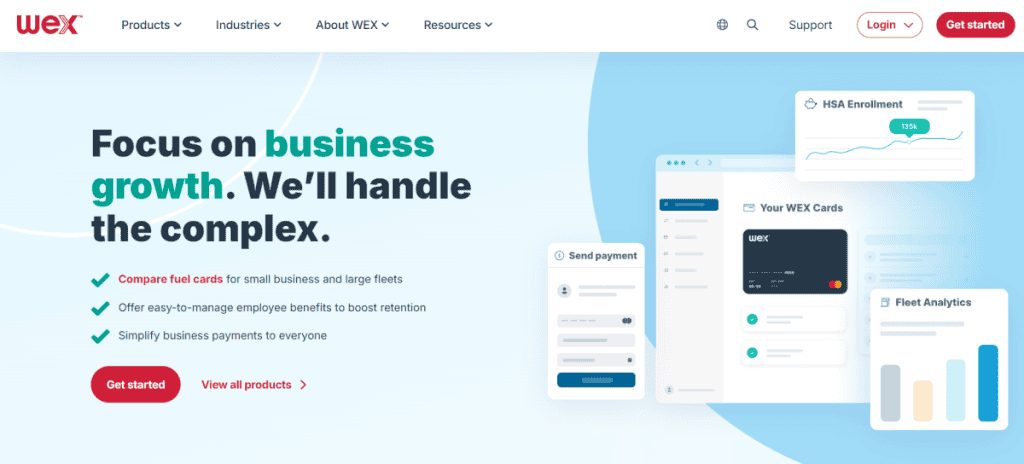
WEX Inc. is a top global commerce platform that streamlines business procedures in different sectors. Recognized as a major player in the financial and payment services industry, WEX Inc. provides a wide variety of solutions aimed at assisting fleet management, corporate payments, and benefits administration. The company has continuously developed throughout the years to meet the intricate requirements of its clients, offering customized solutions that are seamlessly integrated and empower businesses to enhance their operations and fuel expansion. Let’s delve deeper into the Wex Inc. Review.

Mainly, WEX Inc. is recognized for its strong services in the fleet management industry, offering fuel cards and telematics solutions. These services aid companies in managing fuel expenses, monitoring fleet operations, and producing detailed reports to improve decision-making. Furthermore, WEX provides support for corporate payment solutions such as virtual credit cards and accounts payable automation, which can greatly improve financial efficiency and security.

In the benefits administration domain, it delivers a wide array of products, such as Health Savings Accounts (HSAs), Flexible Spending Accounts (FSAs), and COBRA administration. These solutions are aimed at simplifying benefits management for HR teams while boosting employee satisfaction through easily accessible and transparent benefits plans.

The company specializes in mobility solutions, including travel payments and expense tracking, that leverage data analytics to assist businesses in cutting travel expenses and improving financial oversight. By emphasizing innovative technology and strong data capabilities, it is further solidifying its position as a top player in the financial services sector.

Company Background and Overview | Wex Inc. Review

WEX Inc., formerly known as Wright Express Corporation, has a rich history dating back to its founding in 1983. Initially focused on providing fuel card services, Wright Express grew steadily over the decades. In 2012, the company underwent a significant transformation, rebranding itself as WEX Inc. to better reflect its diversified offerings beyond fleet management. This rebranding marked the start of WEX’s evolution into a global commerce platform that serves a wide range of industries, including healthcare, travel, and corporate payments.

WEX’s international presence covers various important areas such as the United States, Latin America, Europe, and Asia. The company’s full range of offerings has solidified its strong presence in these fields, allowing it to assist businesses of any size with their financial and operational requirements. WEX’s capacity to adjust to diverse regional needs has positioned it as a favored ally for firms looking for expandable solutions across different regions.

When it comes to financial results, WEX has shown steady expansion. In the 2024’s second quarter, the company saw a revenue increase of 8% from the same period in 2023, reaching $673 million. This increase is credited to its impressive results in fleet and corporate payments sectors, as well as its skill in managing changes in fuel prices and currency exchange rates. It maintains financial stability and resilience through various revenue sources such as payment processing, account servicing, and finance fees.

Strategically, It focuses on expanding its product offerings and market presence to become a comprehensive platform for business payments, travel payments, and mobility solutions. The company continues to invest in technology, data analytics, and acquisitions to enhance its capabilities and better serve its global customer base, ensuring it remains at the forefront of innovation and growth in the financial services industry.

Wex Inc. Review

Core Services and Product Offerings

WEX Inc. offers a diverse range of services tailored to meet the needs of businesses across different sectors. These services are designed to simplify complex financial and operational processes, providing companies with greater control, efficiency, and transparency.

Corporate Payments: WEX Inc. supports corporate payment needs through solutions such as virtual credit cards, accounts payable (AP) automation, and corporate expense management. By leveraging these solutions, businesses can streamline their financial operations, automate invoice processing, and reduce manual errors. One of the core advantages of WEX’s corporate payments solution is its integration capabilities with existing financial platforms, allowing companies to maintain smooth workflows. Additionally, WEX Inc. ensures enhanced security through robust fraud detection mechanisms, which safeguard payment data and reduce the risk of unauthorized transactions.

Fleet Management: WEX Inc. is known for its extensive range of fleet management solutions, such as fuel cards, telematics, and expense tracking. The fleet fuel cards help companies effectively control fuel costs through providing up-to-date transaction information and reporting. These cards can be used at many gas stations, allowing drivers to fill up their tanks without having to bring cash. In addition, WEX’s telematics solutions offer live tracking to assist fleet managers in overseeing vehicle locations, planning routes more efficiently, and ensuring adherence to driving regulations. The outcome includes lower fuel expenses, improved use of assets, and in-depth understanding of fleet efficiency.

Benefits Administration: WEX’s benefits administration services encompass a variety of offerings such as Health Savings Accounts (HSAs), Flexible Spending Accounts (FSAs), and COBRA administration. These solutions are geared towards simplifying benefits management for HR teams while providing employees with easy access to their benefits. By using WEX’s benefits platform, companies can enhance employee engagement, reduce administrative burdens, and offer transparent, self-service options for benefits management.

Mobility Solutions: WEX’s mobility solutions cater to the travel and transportation needs of businesses. The company provides specialized services for managing travel payments, fuel management, and expense tracking. Leveraging data analytics, WEX Inc. helps businesses optimize travel costs, streamline expense reporting, and gain actionable insights into travel spending patterns. These solutions empower companies to maintain tighter control over travel-related expenditures while ensuring compliance and visibility.

Technology and Innovation

WEX Inc. uses advanced technology to offer customers efficient and creative solutions. The company’s dedication to digital transformation is clear in its incorporation of artificial intelligence (AI), data analytics, and automation in its products and services. These technologies enhance both user experience and operational efficiency while also improving data security, assisting businesses in simplifying financial processes and making decisions based on data.

Embracing Digital Transformation: WEX has adopted advanced digital tools to transform its service offerings. AI is used to automate routine tasks such as transaction monitoring, fraud detection, and expense categorization, allowing for faster and more accurate processes. The company also employs automation to handle large-scale payment operations, reducing manual intervention and increasing overall productivity. Through its data analytics capabilities, WEX Inc. provides customers with actionable insights into their financial activities, helping them optimize spending and identify cost-saving opportunities. Furthermore, WEX’s digital-first approach ensures that customers can access services seamlessly through a user-friendly interface, enhancing the overall customer experience.

Payment and Fleet Technology: WEX’s payment and fleet solutions are created to seamlessly integrate with corporate systems. The fuel cards have sophisticated tracking features that capture transaction information instantly, allowing fleet managers to have more control and visibility over fuel costs. Furthermore, WEX’s corporate payment solutions are supported by strong security measures like tokenization and encryption to safeguard sensitive financial information from unauthorized users. This smooth incorporation with current business platforms allows companies to simplify processes and attain greater efficiency.

Data Analytics Capabilities: WEX uses big data and sophisticated analytics tools to deliver insights that drive business success. By analyzing large volumes of transaction data, WEX helps customers understand spending patterns, manage cash flow, and forecast future financial needs. These data-driven insights support better decision-making, enabling businesses to optimize resource allocation and improve overall performance. The focus on data analytics allows WEX to continually refine its service offerings and deliver value to its diverse customer base.

Financial Performance and Stability

WEX Inc. has demonstrated robust financial performance and stability over recent quarters. In the second quarter of 2024, WEX reported total revenues of $673.5 million, reflecting an 8% increase compared to the same period in 2023. This growth was primarily driven by improved performance in its key business segments, including payment processing and account servicing revenues. The company’s ability to expand its offerings and maintain financial stability despite external challenges such as fuel price fluctuations and foreign exchange rate impacts speaks to its strong market position.

During the initial six months of 2024, WEX generated $1.33 billion in total revenues, showing a significant rise compared to the previous year. The company’s varied sources of income, such as payment processing, account maintenance, and finance fee revenue, have helped maintain its financial strength and stable cash flow. Furthermore, WEX efficiently controlled its operating expenses, as the total cost of services amounted to $530.9 million in the first half of 2024. This wise handling of costs, combined with an increase in revenue, contributed to the upkeep of strong profit margins.

Risk Factors and Market Challenges: Despite its strong financial performance, WEX faces several potential risks and challenges that could impact its stability. One major risk is the volatility of fuel prices, which can significantly influence profit margins, particularly within its fleet management segment. Additionally, changes in regulations affecting corporate payment services or fleet management could pose operational and compliance challenges. Economic fluctuations, such as declining demand for fuel or corporate payment services, can also adversely impact WEX’s overall performance.

Other challenges include competition from emerging fintech companies and increasing scrutiny regarding environmental, social, and governance (ESG) practices. These external pressures, combined with the need to stay at the forefront of technology and innovation, require WEX to continuously adapt and refine its strategic approach. Despite these challenges, WEX Inc. has consistently demonstrated strong financial results and an ability to navigate a complex and dynamic business environment.

Competitive Position and Market Strategy

WEX Inc. has solidified a robust competitive standing in the financial services and payments sector by providing a wide range of services, pioneering technology, and attracting a large customer base. The company excels in its wide range of services, including corporate payments, fleet management, and benefits administration. With a wide array of solutions, WEX Inc. can meet the specific requirements of different industries, serving as a comprehensive solution for numerous businesses. Moreover, WEX’s consistent emphasis on utilizing cutting-edge technology like AI and data analytics has allowed it to provide more effective and safe solutions. Its advantage over competitors lies in its seamless integration of these technologies, which improves user experience, operational efficiency, and decision-making abilities.

WEX differentiates itself from competitors by providing specialized solutions that are tailored to meet the specific demands of its clients. For example, its fleet management services include comprehensive telematics and fuel card solutions, allowing fleet managers to control fuel costs and optimize logistics. In the corporate payments sector, WEX’s virtual credit cards and accounts payable automation tools help businesses streamline financial operations while ensuring high levels of security. In benefits administration, WEX Inc. stands out with its Health Savings Accounts (HSAs) and other employee benefits offerings, which simplify benefits management for HR teams.

Challenges and Weaknesses: Despite its strengths, WEX faces several challenges in maintaining its market position. Competition from emerging fintech companies and large financial institutions is a constant pressure, requiring WEX to innovate continually. Moreover, adapting to changing regulations and addressing evolving customer expectations pose additional challenges. The company also needs to navigate economic fluctuations and manage the impact of fuel price volatility on its fleet management segment.

Growth Strategy and Future Plans: WEX aims to grow by acquiring strategic assets, forming partnerships, and investing in technology to expand its market reach. The organization seeks to improve its range of products and expand into new international markets. By utilizing its current strengths and committing to new technologies, WEX Inc. is in a strong position to continue expanding and taking advantage of new opportunities in the payments and financial services industries. Future plans involve increasing mobility solutions and improving data analytics to better assist clients.

Wex Inc. Review

Customer Experience and Support

WEX Inc. places a strong emphasis on providing excellent customer service and support to its clients. The company offers multiple channels for customer assistance, including phone, email, and live chat, ensuring that customers can reach out through their preferred method. WEX’s customer support teams are available to handle inquiries related to fleet management, corporate payments, and benefits administration, with dedicated representatives for each service category. This structured approach allows customers to receive specialized assistance tailored to their specific needs.

Customer Service: WEX offers continuous customer assistance for a variety of products and services. Clients can contact a specialized support team for assistance with fleet and fuel card management, including handling card problems and billing questions. Customers can receive help with virtual card questions and account management for corporate payments from support representatives. Furthermore, WEX Inc. provides assistance with benefits management, aiding both employees and employers in understanding Health Savings Accounts (HSAs), Flexible Spending Accounts (FSAs), and COBRA administration. Clients can access FAQs, tutorials, and self-service tools on the WEX website to address issues on their own.

Client Satisfaction and Retention: WEX places a strong focus on client satisfaction and retention through personalized service and loyalty programs. The company regularly gathers feedback to improve support quality and responsiveness. WEX’s commitment to personalized service is evident in its tailored support solutions, which are designed to meet the specific requirements of each client segment, whether in fleet management or employee benefits.

Tools and Resources: To further enhance the customer experience, WEX Inc. provides a range of tools and resources. Customers have access to an online knowledge base, benefit toolkits, and detailed documentation to help them maximize the value of WEX’s products. These resources not only assist in resolving common issues but also empower users to understand and utilize WEX’s solutions more effectively.

Environmental, Social, and Governance (ESG) Practices

WEX Inc. is committed to implementing robust Environmental, Social, and Governance (ESG) practices as part of its long-term strategy for sustainable growth and responsible business operations. The company’s efforts are structured around four key pillars: People and Culture, Environmental Innovation, Environmental Stewardship, and Social Impact. These pillars guide WEX’s initiatives to promote sustainability, support diversity and inclusion, and maintain strong governance practices.

Commitment to Sustainability: WEX Inc. is dedicated to minimizing its operational environmental footprint and advocating for sustainable business practices. The company has implemented various measures to incorporate sustainability into its business operations and the products it offers. For example, WEX aids in the shift towards electric vehicles (EVs) and offers options to assist clients in maximizing fuel efficiency. The company encourages environmental innovation by creating technologies that decrease energy usage and lower carbon emissions. Incorporating Environmental Stewardship into its operations, WEX actively monitors its environmental impact and collaborates with clients to meet sustainability targets, in line with worldwide climate aims.

Social Responsibility and Inclusion: WEX places a high value on diversity, equity, and inclusion (DEI). The company fosters a culture of respect and equality, ensuring that its workforce represents a diverse mix of voices and perspectives. WEX’s social responsibility extends to employee well-being programs, community engagement, and support for social causes. It regularly conducts employee surveys and engages in initiatives that promote health, safety, and professional growth for its staff. Additionally, the company partners with local communities to contribute to social development projects, demonstrating its commitment to positive social impact.

Governance and Compliance: WEX’s governance policies are designed to ensure ethical business practices and compliance with regulatory requirements. The company’s Board of Directors and executive leadership team provide dedicated oversight of ESG activities, promoting transparency and accountability across all operations. WEX Inc. follows rigorous compliance standards, implements data privacy protections, and upholds ethical selling practices to maintain stakeholder trust and business integrity.

Leadership and Corporate Culture

The strategic direction of WEX Inc. is guided by a skilled executive team, which also nurtures a successful corporate culture. Leading the way is Melissa Smith, who holds the positions of Chair, CEO, and President. Melissa has been a key player at WEX since 1997, taking on different positions, such as CFO during the company’s IPO in 2005. In 2014, she was appointed as CEO and in 2019 she was named Chair. Thanks to her guidance, WEX has evolved into an international B2B payments company, with a much broader presence and selection of products, moving beyond its origins as a fleet card provider in the U.S. While she was in office, the income of WEX has tripled, and the corporation currently functions in more than 16 nations with a workforce of around 7,000 employees across the globe.

The executive team includes other key leaders who bring diverse expertise from technology, finance, and corporate strategy, enabling WEX to stay ahead in the competitive fintech landscape. Their vision is to simplify complex business operations for customers through innovative technology, solidifying WEX’s position as a global leader in fleet management, corporate payments, and employee benefits administration.

Corporate Culture and Employee Engagement: WEX prides itself on a culture that values integrity, innovation, execution, relationships, and community. The company promotes a collaborative environment where employees are encouraged to share their ideas and challenge the status quo. This inclusive culture is built on the belief that diverse perspectives lead to better outcomes. Over half of WEX’s leadership team members come from different parts of the world, reflecting a commitment to diversity and global inclusiveness.

WEX Inc. also commits to fostering the growth and welfare of its employees. The company acknowledges and honors both individual and team successes, promoting a feeling of inclusion and direction within its employees. Therefore, WEX has been commended for its exceptional workplace and remains a top choice for individuals looking for a vibrant and supportive work atmosphere. WEX’s emphasis on fostering lasting connections with both employees and customers has led to impressive rates of employee retention and satisfaction, positioning the company as a top player in its industry and an employer of choice.

WEX’s corporate culture is characterized by a blend of professional growth opportunities, strong leadership, and a commitment to community impact, which collectively drive the company’s success and market reputation.

Wex Inc. Review

Pros and Cons of WEX Inc.

Pros

Diverse Service Offerings: WEX Inc. provides a broad range of solutions tailored for multiple industries, including fleet management, corporate payments, and employee benefits administration. This versatility allows it to cater to various client needs, making it a one-stop solution for businesses looking for integrated financial services.

Strong Technological Integration: WEX utilizes cutting-edge technology, such as AI, data analytics, and cloud-based platforms, to provide creative products and improve user experience. The company’s emphasis on technology helps it stay ahead of competitors and easily adjust to market shifts.

Global Reach: With operations across North America, Latin America, Europe, and Asia, WEX Inc. has a strong international presence, enabling it to serve customers worldwide and explore new markets for further growth.

Robust Financial Performance: The company has demonstrated consistent revenue growth and financial stability. For instance, in Q2 2024, WEX reported a revenue increase of 8% compared to the previous year, reflecting strong business performance across its key segments.

Commitment to ESG Practices: WEX places a strong focus on sustainability, social responsibility, and governance. Its efforts consist of advocating for fuel efficiency, shifting to electric cars, and nurturing a diverse and inclusive work environment, all of which improve its image as a responsible business entity.

Cons

High Dependence on Fuel Prices: A significant portion of WEX’s revenue is tied to fleet management and fuel cards, making it vulnerable to fluctuations in fuel prices. This dependency can impact profit margins, especially during periods of fuel price volatility.

Competitive Market: The financial services and payments sector faces intense competition as new fintech firms consistently join the market. WEX Inc. is dealing with difficulties in retaining its market share and must continuously come up with innovations to stay ahead of its competitors.

Complex Regulatory Environment: WEX operates in multiple countries, each with its own set of regulations and compliance requirements. Managing these complexities can be costly and may pose operational challenges.

Risk of Economic Fluctuations: Economic downturns or reduced demand for corporate services can negatively impact WEX’s business performance, particularly in its travel and payments segments.

Conclusion and Final Thoughts

WEX Inc. is distinguished for its wide range of services, robust integration of technology, and dedication to sustainability. Despite encountering obstacles like market competition and regulatory complexities, WEX remains a valuable option for businesses looking for creative financial solutions due to its strong market position and ongoing growth potential. Potential clients can take advantage of WEX’s knowledge and worldwide presence.

Frequently Asked Questions (FAQs)

What industries does WEX Inc. primarily serve?

WEX Inc. serves a diverse range of industries including fleet management, corporate payments, healthcare, travel, and benefits administration. Its solutions cater to businesses of all sizes, helping them streamline financial processes and manage operational complexities.

How does WEX ensure the security of its payment solutions?

WEX utilizes high-level security methods including encryption of data, tools for preventing fraud, and adherence to industry standards such as PCI DSS. These actions guarantee the security and reliability of payment transactions on all of its platforms.

What are the benefits of using WEX’s fleet management solutions?

WEX’s fleet management solutions offer reduced fuel costs, detailed reporting, real-time vehicle tracking, and enhanced operational efficiency, enabling businesses to optimize fleet performance and make data-driven decisions.

GoDaddy Merchant Services Review

GoDaddy Merchant Services Review

GoDaddy Merchant Services, also named GoDaddy Payments, is a payment processing solution created for small businesses and released in 2021. This service effortlessly incorporates with GoDaddy’s different web solutions, such as Websites + Marketing and Managed WordPress WooCommerce, enabling users to oversee transactions from one single dashboard. This integration streamlines the payment process for online and in-person sales, offering entrepreneurs a convenient platform to manage their business transactions. Let’s delve deeper into the GoDaddy Merchant Services Review.

GoDaddy Merchant Services is known for its wide availability to businesses of any size. It provides features like Pay Links, allowing companies to send payment requests through different channels like email and social networks. Furthermore, the Virtual Terminal function enables merchants to conveniently handle payments using their computer or mobile device, facilitating the acceptance of phone or in-person orders.

GoDaddy Merchant Services prioritizes user experience, focusing on quick setup and transparent pricing. Users can start processing payments almost immediately, with funds typically deposited into their bank accounts by the next business day. This solution is designed not only to facilitate transactions but also to empower small business owners with the tools necessary to thrive in an increasingly digital marketplace.

Overview of GoDaddy Merchant Services | GoDaddy Merchant Services Review

GoDaddy, founded by Bob Parsons in 1997, initially started as a domain registration service under the name “Jomax Technologies” before rebranding to GoDaddy in 1999. The company quickly grew to become the largest ICANN-accredited registrar globally, expanding its offerings beyond domain registration to include web hosting, website building, and digital marketing services. Over the years, GoDaddy has diversified into various aspects of the digital marketplace, focusing on enabling small businesses to establish and manage their online presence effectively.

GoDaddy started entering the ecommerce industry with tools such as its website builder, managed WordPress hosting, and digital marketing solutions. Acknowledging the increasing need for efficient payment options, GoDaddy launched GoDaddy Payments in 2021, signaling its venture into the financial services industry. This service enables small businesses to manage their transactions, whether online or in-person, on a single platform. This simplifies the process for business owners to handle payments, monitor transactions, and oversee their finances independently from third-party payment gateways.

The launch of GoDaddy Payments was fueled by its acquisition of Poynt, a company specializing in payment technologies, in late 2020. This acquisition provided GoDaddy with the necessary infrastructure and expertise to develop a comprehensive payment solution tailored to its user base. Today, GoDaddy Merchant Services integrates seamlessly with its existing ecommerce offerings, enabling users to manage transactions from a single dashboard, whether they’re running a small online store, taking phone orders, or accepting in-person payments.

GoDaddy’s journey from a domain registrar to a full-fledged digital solutions provider is a testament to its commitment to supporting entrepreneurs and small business owners at every stage of their business journey. The introduction of GoDaddy Merchant Services is yet another step in this direction, aiming to simplify payment processing and help businesses grow in an increasingly digital world.

Services Offered: Detailed List of Services Provided by GoDaddy Merchant Services

GoDaddy Merchant Services, also known as GoDaddy Payments, offers a wide range of tools designed to help businesses of all sizes process payments seamlessly. These services are specifically crafted to integrate with GoDaddy’s broader ecommerce solutions, such as their website builder, domain services, and hosting plans, providing a unified platform for managing online and offline transactions.

Payment Processing: GoDaddy Payments offers a built-in payment gateway, which can be used for processing payments directly on a website, through a mobile device, or at physical retail locations. It supports major credit and debit cards such as Visa, Mastercard, American Express, and Discover. The platform also enables users to accept contactless payments through Apple Pay and Google Pay, making it a versatile option for modern retail needs.

Virtual Terminal and Pay Links: FFor businesses without a dedicated website or physical store, GoDaddy offers a Virtual Terminal that transforms any browser into a payment processing platform. This tool is particularly beneficial for companies that receive orders via telephone. Additionally, Payment Links enable companies to generate payment requests that are shareable through email, social media, or SMS, simplifying the process of receiving payments from customers even without a website.

Point-of-Sale (POS) System: GoDaddy offers a POS system that includes hardware options like the GoDaddy Smart Terminal and GoDaddy Card Reader. These devices are designed for in-store transactions, providing features such as dual-screen displays, receipt printers, and payment processing for chip, swipe, and contactless payments. The POS system is ideal for businesses with physical locations, such as retail stores or pop-up shops.

Recurring Billing and Customer Management: GoDaddy Payments also supports recurring billing, which allows businesses to automate customer payments on a regular basis. This feature is particularly useful for subscription-based businesses or services that require consistent billing cycles. Additionally, GoDaddy provides built-in customer management tools, helping businesses keep track of customer details, transaction histories, and billing information.

Ecommerce Integrations: GoDaddy Payments smoothly connects with a variety of ecommerce platforms, including GoDaddy’s Managed WooCommerce stores. Customers have the ability to conveniently handle their e-commerce store, stock, and payment procedures all within one central control panel. GoDaddy also allows businesses to integrate with third-party services, giving them the option to use external payment processors such as Stripe or PayPal.

Comparison of Features: Payment Processing and Gateways: Compared to other payment processors like Square and Shopify, GoDaddy Merchant Services offers a streamlined solution that combines both payment processing and ecommerce management. While GoDaddy’s transaction fees are competitive, they are optimized for existing GoDaddy users looking for a cohesive solution that works across their website and POS systems. The built-in support for WooCommerce makes it ideal for businesses operating within the WordPress ecosystem.

GoDaddy Merchant Services Review

User Experience: Account Setup Process, User Interface, and Support Services

GoDaddy Merchant Services offers a straightforward and efficient account setup process, making it accessible for users of all experience levels. Setting up an account with GoDaddy Merchant Services involves just a few simple steps: entering your business information, connecting a bank account for payouts, and adjusting basic settings like close-of-day times and receipt customization. This easy setup ensures that businesses can start processing payments almost immediately, with minimal technical hurdles.

The user-friendly interface of GoDaddy Merchant Services is designed to be intuitive. Users can control their payments, check transaction history, process refunds, and create payment links all in one place through the dashboard. The interface is optimized and seamlessly integrates with other GoDaddy services, like Websites + Marketing and Managed WooCommerce stores. This concentration enables business proprietors to dedicate more time to their operations rather than having to manage various platforms or tools.

In terms of integration, GoDaddy Merchant Services supports a variety of devices and services. Users can integrate payment solutions like the GoDaddy Smart Terminal or Card Reader, which are ideal for physical store owners or businesses on the go. The system also integrates seamlessly with WooCommerce stores, making it an excellent choice for WordPress users. Additionally, GoDaddy Payments supports third-party integrations, which provides flexibility for businesses that want to use external payment processors or manage payments from different platforms.

Support and maintenance services provided by GoDaddy are available 24/7 through various channels, including phone, live chat, and email. GoDaddy Guides, their dedicated support team, are known for being responsive and knowledgeable, helping users resolve issues promptly. This consistent support ensures that merchants can get assistance whenever they need it, reducing downtime and improving the overall user experience.

Pricing and Fees: Explanation of Pricing Structures, Comparison with Industry Standards, and Hidden Fees

GoDaddy Merchant Services offers a simple pricing model that attracts small businesses and entrepreneurs looking for a clear and easy-to-comprehend fee structure. The main transaction fee for GoDaddy Payments is 2.9% + $0.30 for common online transactions, like payments made via Pay Links, Pay Buttons, and WooCommerce plugins. Manual transactions completed through the Virtual Terminal or a POS device will have a slightly increased fee of 3.5%, but there are no extra fixed expenses. This fee format is quite typical in the field and is similar to other leading payment services such as Stripe and PayPal.

For in-person transactions using GoDaddy’s POS system, the transaction fee is 2.3% with no additional fixed cost, making it competitive for small businesses that primarily operate in physical retail settings. Compared to industry standards, GoDaddy Payments offers a balanced pricing model with no monthly minimums, setup fees, or long-term contracts. This makes it particularly attractive to new businesses or those looking to avoid complex fee structures often associated with traditional merchant service providers.

In addition to standard transaction fees, GoDaddy Payments has a $15 chargeback fee for any customer disputes and a $10 monthly fee for using the Virtual Terminal. Refunds also incur a processing fee, which is worth noting for businesses with high refund volumes. While these charges are not necessarily hidden, they are important to consider when evaluating the total cost of using GoDaddy’s services.

GoDaddy Merchant Services Review

Security Measures: Overview of Security Protocols and Compliance, Data Privacy, and User Protection

GoDaddy Merchant Services places a high emphasis on security and data protection, implementing robust security protocols to safeguard both merchants and their customers. One of the core security measures utilized by GoDaddy is compliance with the Payment Card Industry Data Security Standards (PCI DSS). This set of standards ensures that any business processing, storing, or transmitting credit card information adheres to stringent security protocols. PCI DSS compliance includes the use of SSL certificates for secure data transmission, firewalls, encryption, and regular monitoring to detect and prevent unauthorized access.

Along with PCI DSS, GoDaddy utilizes various data privacy measures to safeguard users’ confidential information. GoDaddy’s privacy policies follow worldwide regulations, such as the GDPR, to maintain uniform data protection standards for all customers. GoDaddy offers tools for users to monitor, access, and manage their own personal information. This clear method of handling data builds trust and guarantees customers that their information will not be abused or traded.

GoDaddy also takes significant steps to protect customer transactions. The platform employs security protocols like two-factor authentication (2FA) and strong password requirements to reduce the risk of account breaches. GoDaddy recommends additional measures such as keeping server software up-to-date, reducing the use of third-party plugins, and limiting access to sensitive areas of the website. These practices help minimize vulnerabilities and ensure that both merchant and customer data are protected against potential cyber threats.

Customer Support: Overview of Options, Availability, and Quality of Service

GoDaddy Merchant Services provides a variety of customer support options to cater to business owners’ needs. Their primary support channels include phone, live chat, and email. GoDaddy offers 24/7 availability through these options, ensuring that help is always accessible for users who need assistance with technical issues, account management, or payment processing inquiries.

For phone support, GoDaddy has a global directory of phone numbers, making it easy for customers to get in touch based on their region. The live chat feature is particularly popular among users who require quick troubleshooting and guidance for specific issues. Additionally, users can contact GoDaddy through their support email, which is recommended for non-urgent queries or when more detailed assistance is required.

Based on user reviews, the quality of service shows a blend of opinions. A lot of users value the round-the-clock availability and quick replies from GoDaddy’s support team, also known as GoDaddy Guides. Customers praise the staff for their professionalism and expertise. Nevertheless, certain reviews express worries regarding the efficacy of assistance for more intricate issues. Frustrations commonly arise when trying to resolve issues such as account suspensions or payment delays, posing challenges for business owners who depend on prompt payment processing.

While GoDaddy’s support is highly accessible, the quality can vary depending on the complexity of the issue at hand. Minor issues such as account setup or product questions are usually handled efficiently, but more intricate matters may require longer waiting times or escalations. Overall, GoDaddy’s customer support is reliable for most basic needs but may face challenges when addressing more complicated scenarios.

Pros and Cons: Summarize Key Strengths and Potential Drawbacks

GoDaddy Merchant Services offers a range of benefits for small business owners and entrepreneurs looking for a streamlined payment processing solution integrated with their website and ecommerce platforms. However, like any service, it has its own set of drawbacks that may not be suitable for everyone.

Key Strengths:

User-Friendly Services: GoDaddy Merchant Services is known for its easy-to-use interface, making it accessible for users with little to no technical background. The setup process is straightforward, and the service integrates seamlessly with other GoDaddy products, such as its website builder and hosting services.

Comprehensive Support: GoDaddy offers around-the-clock assistance through various methods like phone calls, online chat, and emails. This high level of availability guarantees that assistance is available to users at all times, reducing downtime and improving the overall user experience.

Integrated Payment Options: GoDaddy Payments supports a wide variety of payment methods, including credit cards, debit cards, and contactless options like Apple Pay and Google Pay. This flexibility makes it convenient for both online and in-person transactions.

No Long-Term Contracts: Users of GoDaddy are not obligated to commit to lengthy contracts, allowing businesses to cancel the service without being charged termination fees at any point. This level of adaptability is particularly advantageous for new businesses and seasonal companies.

Potential Drawbacks:

Pricing Complexity: While GoDaddy offers competitive rates, the pricing structure can be somewhat complex. Additional fees, such as for chargebacks or using virtual terminals, can add up over time and become a burden for businesses with higher transaction volumes.

Limited Customization: GoDaddy’s payment services are optimized for use within its own system. Businesses that utilize third-party ecommerce platforms may discover that the customization choices are slightly restricted when compared to more specialized payment gateways..

Customer Support Variability: Although support is available around the clock, the quality of assistance can vary based on the complexity of the issue. Some users have reported delays in resolving account-related concerns or difficulty reaching satisfactory resolutions for more technical issues.

GoDaddy Merchant Services Review

Competitor Comparison: Brief Comparison with Similar Services like Shopify Payments and Square

When comparing GoDaddy Merchant Services with other leading payment platforms like Shopify Payments and Square, several key distinctions and unique selling propositions stand out. Each platform is designed to cater to different business needs, so the best choice often depends on the specific requirements of the business.

GoDaddy Merchant Services vs. Shopify Payments: Shopify is mainly a platform focused on e-commerce, providing a variety of features designed for online retail. Shopify Payments, the integrated payment gateway of Shopify, accepts various payment methods like credit cards, Google Pay, and Apple Pay, and is compatible with multiple currencies. Furthermore, Shopify offers a catalog of more than 6,000 apps in its app store that allow users to improve their store’s capabilities effortlessly. Shopify provides advanced functionalities such as extensive reporting, inventory management, and tools for selling internationally, which make it a great choice for businesses looking to expand globally. On the other hand, GoDaddy Merchant Services offers a more cost-effective choice with easier tools for individuals seeking simple payment solutions on their GoDaddy sites. This makes it a good option for small businesses and entrepreneurs who value simplicity and affordability more than advanced features and customization choices.

GoDaddy Merchant Services vs. Square: Square, on the other hand, is known for its flexibility and versatility in payment processing, both online and in-person. Square provides a variety of point-of-sale (POS) solutions and hardware options like card readers and terminals, making it an excellent choice for businesses with a physical presence. Square’s pricing is straightforward, and it offers a range of free and paid plans depending on the user’s needs. While GoDaddy focuses more on integration with its web services, Square excels in offering comprehensive POS systems that allow for seamless in-person transactions.

Unique Selling Propositions of GoDaddy Merchant Services: One of the key benefits of GoDaddy Merchant Services is its smooth incorporation with other GoDaddy offerings like the website creator and domain services. This integration enables users to streamline operations by overseeing all areas of their business from one platform. Moreover, GoDaddy Merchant Services provides no extended contracts, competitive transaction fees, and a straightforward setup procedure, making it a convenient option for small businesses already within GoDaddy’s ecosystem.

Conclusion

GoDaddy Merchant Services provides a convenient payment solution with competitive features designed specifically for small businesses. Although being integrated with GoDaddy’s ecosystem is a significant benefit, the drawbacks include pricing complexity and limited customization options. It is advised for users who want simplicity and easy integration with current GoDaddy products.

FAQs

What makes GoDaddy Merchant Services stand out from other payment processors?

GoDaddy Merchant Services is unique for its seamless integration with GoDaddy’s suite of products, such as website hosting and domain services, making it an ideal option for small businesses already using the GoDaddy platform. It also offers competitive transaction rates and a simplified setup process.

Are there any long-term contracts or cancellation fees with GoDaddy Merchant Services?

No, GoDaddy Merchant Services does not require long-term contracts, and there are no cancellation fees, allowing businesses to opt out at any time without additional costs.

How does GoDaddy Merchant Services support multi-channel sales (online, in-person, mobile)?

GoDaddy Merchant Services supports multi-channel sales through its built-in payment gateway, POS systems, and mobile payment options. This allows businesses to process transactions seamlessly across online stores, physical locations, and mobile devices.

Payline Data Review

Payline Data Review

Payline Data is a well-known payment processor that provides flexible solutions for businesses of varying sizes, ranging from small startups to high-risk enterprises. Established in 2011 and based in Chicago, the company was bought by Pineapple Payments in 2017, enhancing its position in the industry. What makes Payline Data stand out from a lot of its rivals is its focus on transparency, flexibility, and user-friendly features, making it the top pick for small to medium-sized businesses. Let’s delve deeper into the Payline Data Review.

A standout characteristic of Payline Data is its clear pricing model. The company provides transparent interchange-plus pricing, ensuring businesses can accurately anticipate their monthly costs without any hidden fees. Furthermore, there are no PCI compliance fees, annual fees, or early termination fees charged, which enhances its attractiveness. Payline Data offers adaptable, month-to-month agreements that enable companies to adjust their payment solutions without being locked into lengthy contracts.

Payline Data’s commitment to serving diverse industries is evident through its specialized offerings for high-risk businesses, nonprofits, and healthcare providers. The company is known for its ability to support high-risk merchants in industries like CBD, travel, and tobacco, which are often turned down by other processors. Additionally, its HIPAA-compliant solutions and customized rates for nonprofits make it a viable option for these niche markets.

The process of getting started is easy and supported by a specialized account manager who helps with setup and integration, guaranteeing a seamless experience for new users. With next-day funding, a variety of POS options, and compatibility with multiple payment gateways, Payline Data is a trustworthy and flexible payment processor.

What is Payline Data? | Payline Data Review

Payline Data is a comprehensive payment processing service established in 2011 and headquartered in Chicago, Illinois. It quickly rose to prominence due to its innovative approach to providing flexible, transparent payment solutions tailored to various business needs. In 2017, Payline Data was acquired by Pineapple Payments, a Pittsburgh-based omni-channel payment processing technology company. The acquisition allowed Payline Data to expand its reach and resources, adding nearly 10,000 merchants and over $2 billion in annual processing volume to its portfolio. This strategic move also strengthened Pineapple Payments’ offerings and enabled both companies to cater to a broader spectrum of businesses.

Payline Data caters to a variety of clients, including regular retail stores, online businesses, healthcare agencies, charitable organizations, and risky sectors like CBD and travel. The extensive range of services offered includes merchant accounts, virtual terminals, and different point-of-sale (POS) solutions. Payline also provides options for ACH payments and easy integration with eCommerce, making it a flexible option for companies requiring tailored solutions.

One of the company’s standout features is its specialized support for high-risk merchant accounts. Many payment processors turn down high-risk industries due to the increased potential for chargebacks and fraud. However, Payline Data embraces these businesses by providing custom solutions tailored to their unique needs. Additionally, Payline’s services for healthcare providers include HIPAA-compliant payment processing, making it an ideal choice for medical professionals who need to ensure privacy and security in their transactions.

Payline’s clear pricing, flexible contracts, and lack of hidden costs are attractive to small and medium-sized companies. Payline stands out as a provider that values customer needs and community support by offering reduced rates and supporting nonprofits.

Payline Data Review

Products and Services Offered

Payline Data provides a wide range of payment processing services tailored to meet the needs of various business types, from retail and eCommerce to high-risk industries like CBD, travel, and tobacco. The company’s comprehensive product suite includes solutions designed to streamline payments, ensure security, and provide flexibility for businesses of all sizes.

Merchant Accounts: Payline offers full-service merchant accounts that cater to a variety of business models, including retail, eCommerce, and omnichannel operations. For high-risk businesses, such as those in the CBD or travel industries, Payline provides custom solutions that address the unique challenges associated with these sectors. By offering specialized underwriting and risk management, Payline helps businesses that might otherwise struggle to find reliable payment processing options.

Payment Gateway: The Payline Gateway is a unique solution created to facilitate smooth payment processing. Businesses can also choose to connect with external gateways like Authorize.Net and NMI. Important characteristics consist of automatic billing, digital invoicing, and a customer data vault, ensuring secure storage for sensitive data to improve the safety and effectiveness of payment processes.

Virtual Terminal: Payline’s virtual terminal allows businesses to accept card-not-present payments from any internet-connected device, making it ideal for remote operations or businesses that require the flexibility to process payments over the phone or via email. The terminal supports ACH payments and offers recurring billing without additional gateway fees, providing a cost-effective solution for managing transactions.

Mobile Payments: Payline’s mobile payment options, such as Cardpointe and Clover Go, enable businesses to receive payments using iOS and Android devices. This service is especially advantageous for businesses looking for mobility and flexibility, allowing them to make transactions while on the move.

POS Systems: Payline offers a variety of POS hardware options, including Clover POS and NCR Silver systems. It also supports integration with third-party POS software, providing businesses with the flexibility to choose solutions that best suit their operational needs.

eCommerce Integration: Payline’s eCommerce services are compatible with over 175 shopping cart platforms, allowing online businesses to easily accept payments and streamline transactions. The company also integrates with accounting tools like QuickBooks, simplifying financial management and reporting.

Nonprofit and Educational Solutions: Payline provides nonprofit and educational organizations with discounted rates and hosted payment page choices, as well as donor management features that assist in secure and efficient fund collection.

Healthcare Solutions: Payline’s HIPAA-compliant solutions are designed specifically for healthcare providers. They include seamless integration with medical software and electronic health records (EHR), ensuring that sensitive patient data is handled securely and in compliance with industry regulations.

Pricing and Fees

Payline Data is known for its transparent and straightforward pricing structure, making it a popular choice among small and medium-sized businesses looking to understand their processing costs upfront. The company utilizes an interchange-plus pricing model, which means merchants pay a fixed percentage above the interchange rate set by credit card networks. This type of pricing is widely considered more transparent and fair than tiered pricing models used by some competitors.

Pricing Models: Payline provides two main pricing options: the Swipe Plan and the Keyed-in/Online Plan. The Swipe Plan is created for face-to-face transactions and has a charge of 0.20% + $0.10 for each transaction, along with a monthly fee of $10. The Online and Keyed-in Plan costs 0.30% + $0.10 per transaction and includes a $20 monthly charge, applicable for online and keyed-in transactions. The two-tiered system offers adaptability for companies with varying transaction requirements, positioning Payline as a suitable option for both physical and online stores.

Monthly Fees and Additional Charges: Payline’s pricing structure is relatively straightforward, with no long-term contracts, annual fees, or PCI compliance fees. The absence of these fees simplifies cost management and makes it easier for businesses to switch providers if needed. However, the company does enforce a $25 minimum monthly processing fee, which could be a disadvantage for low-volume merchants. In addition, Payline charges penalties for chargebacks and for failing to complete PCI compliance requirements within 90 days of signing up.

Special Pricing for High-Risk Merchants and Nonprofits: High-risk merchants, such as those in industries like CBD and travel, may be subject to higher fees due to the increased risks associated with these sectors. However, Payline provides custom solutions and tailored rates to accommodate these businesses. Nonprofit organizations and educational institutions can benefit from lower rates and are eligible for the first two months without any monthly fees, making it an attractive option for these sectors.

Hardware and Software Integrations

Payline Data offers versatile hardware and software integration options, making it a flexible solution for businesses with diverse payment processing needs. Its compatibility with various hardware devices and comprehensive software integration capabilities enables seamless integration into existing business systems, ensuring smooth and efficient operations.

Hardware Integrations: Payline Data is compatible with various types of point-of-sale (POS) hardware, catering to the needs of both small retail stores and big businesses. The business provides devices like the Ingenico Desk/3500 and Clover Flex for in-person purchases, known for their easy-to-use design and dependability. These devices are compatible with EMV chip cards, Apple Pay, Google Pay, and magstripe cards, allowing businesses to accommodate all customer preferences. Payline offers mobile card readers that can be connected to smartphones or tablets, transforming them into portable registers, in addition to countertop terminals. This makes it perfect for businesses that require to receive payments while on the move, like food trucks, pop-up stores, or field service providers.

Software Integrations: On the software side, Payline Data is compatible with numerous platforms, enhancing its versatility and utility for different business types. Merchants can easily integrate Payline with accounting software like QuickBooks, allowing them to streamline bookkeeping and financial reporting. The platform also integrates smoothly with eCommerce tools like Shopify, providing a unified system for managing both online and in-store transactions. For businesses that require a more comprehensive solution, Payline supports integrations with POS systems like Vend and NCR Silver, offering tools for inventory management, customer relationship management (CRM), and detailed reporting.

Flexibility and Customization: Payline offers a wide variety of hardware and software choices to help businesses design a personalized payment system that meets their operational requirements. Payline’s strong integration capabilities allow businesses to improve their payment processing and provide better customer experiences, whether they are accepting payments in person, on the go, or online.

Payline Data Review

Contract Terms and Early Termination

Payline Data offers flexible contract terms that are highly favorable for businesses, making it easy for merchants to start or stop using their services without facing any penalties. Unlike many other payment processors that require long-term contracts, Payline Data operates on a month-to-month basis, allowing businesses to opt in and out of their services as needed. This flexibility makes it particularly attractive for small and medium-sized enterprises that prefer to avoid long-term commitments.

No Long-Term Contract Requirements: Payline Data stands out due to its absence of extended contract obligations. Businesses are not obligated to long-term contracts, which is a major advantage, particularly for new ventures or those uncertain about their payment processing requirements in the long run. This allows merchants to test Payline’s services easily and determine if it is suitable for their business without concerns about getting tied up in contracts.

No Early Termination Fees: In addition to not requiring long-term contracts, Payline Data does not charge any early termination fees. This feature provides merchants with the freedom to switch providers whenever they wish, making it an appealing option for businesses that might be considering other processing solutions in the future. This level of flexibility is rare in the payment processing industry, where early termination fees can often be a barrier to switching providers.

Transparent Contract Terms for High-Risk Merchants: Payline Data’s clear contract terms also apply to high-risk merchants and special industries. Despite the fact that high-risk companies, like those in the CBD or travel sectors, may face increased processing fees and more strict compliance requirements, Payline is transparent about these terms. This level of transparency allows for trust to be established and ensures that high-risk merchants fully comprehend the contract terms before agreeing to use Payline’s services.

Customer Support and Technical Assistance

Payline Data offers customer support that is reliable and straightforward, focusing on providing a smooth experience for businesses during their initial setup and ongoing operations. The company aims to deliver high-quality support, though its service hours and methods may not be as comprehensive as some competitors.

Availability of Customer Support: Payline Data’s customer support is available during regular business hours, from 8 a.m. to 5 p.m. Central Time, Monday through Friday. This availability is suitable for most standard business inquiries and provides merchants with the opportunity to connect with representatives over the phone or via email. However, the absence of 24/7 support might be a drawback for businesses that operate outside of these hours or experience issues during weekends and holidays.

Support Channels and Options: Despite the absence of live chat or 24/7 availability, Payline makes up for it with email and phone support options. The support team of the company is recognized for their prompt and expert assistance, providing personalized help for resolving technical problems or addressing inquiries about payment processing. Merchants in need of additional help can fill out the online form on Payline’s website and can anticipate receiving a reply within one business day.

Dedicated Account Managers: One of the standout features of Payline’s customer support is its dedicated account manager service. When a new merchant signs up, they are assigned a dedicated account manager to guide them through the onboarding process. This support includes setting up customized payment solutions, integrating with existing systems, and providing ongoing assistance as needed. The account manager remains a point of contact throughout the merchant’s relationship with Payline, ensuring consistency and familiarity.

Security and Compliance

Payline Data places a strong emphasis on security and compliance, ensuring that businesses and their customers are protected during every transaction. By adhering to industry standards and implementing advanced security measures, Payline Data offers a robust framework for secure payment processing, minimizing the risks of fraud and data breaches.

PCI-Compliant Processing: Payline Data is fully compliant with the Payment Card Industry Data Security Standard (PCI DSS), which is a crucial requirement for businesses handling credit and debit card payments. This compliance ensures that sensitive cardholder data is handled securely and reduces the risk of data breaches. Payline helps merchants maintain PCI compliance by offering tools and resources, including a dedicated PCI compliance support team that can assist with any queries or concerns regarding the security requirements.

Fraud Protection Measures: In order to enhance the protection of companies against fraudulent activities, Payline Data integrates various security measures, including Verifi’s Cardholder Dispute Resolution Network (CDRN). The CDRN system offers merchants tools for managing disputes and provides regular updates in real-time, helping prevent chargeback disputes from escalating and minimizing potential financial losses. This proactive method assists merchants in dealing with problems more effectively and sustaining a decreased chargeback ratio.

Advanced Security Features: Payline Data utilizes a variety of advanced security features to enhance transaction safety. These include address verification services (AVS) and card verification value (CVV) checks, which authenticate cardholders and prevent unauthorized transactions. Additionally, Payline employs tokenization, a method that replaces sensitive card information with a unique identifier or token, making it difficult for unauthorized parties to access or use cardholder data. Tokenization not only protects against breaches but also simplifies compliance with PCI requirements.

With its variety of security and compliance tools, Payline Data offers businesses a safe space to handle payments, assisting them in reducing risks and establishing trust with customers. Payline’s transparent and proactive security features make it a dependable option for businesses focusing on transaction safety and compliance.

Payline Data Review

Pros and Cons

Payline Data has a range of benefits and some drawbacks, making it essential for businesses to evaluate whether its offerings align with their specific needs. While it stands out for its transparent pricing and industry support, there are a few limitations to consider.

Pros: An important benefit of Payline Data is its clear pricing structure. It functions based on an interchange-plus pricing model, which is generally seen as equitable and transparent. Without any undisclosed fees, businesses can more accurately forecast their monthly expenses, avoiding unexpected charges such as annual or PCI compliance fees. Another advantage is the month-to-month contract option provided by Payline, enabling businesses to easily switch in and out without being tied down by long-term agreements or extra fees for cancelling. This degree of flexibility is especially advantageous for companies trying out various payment processors or facing seasonal changes in volume.

Payline Data is also known for its support of high-risk industries such as CBD, travel, and tobacco, which are often declined by other payment processors. Additionally, nonprofits receive special discounted rates and unique programs, making Payline a viable option for organizations seeking cost-effective solutions.

Cons: While Payline Data offers many advantages, there are some drawbacks to consider. One limitation is the company’s customer support availability. Customer service is only accessible during standard business hours (8 a.m. to 5 p.m. Central Time), and there are no 24/7 support or live chat options. This might be a concern for businesses that operate outside these hours or need assistance during critical times.

Another downside is the comparatively higher interchange-plus rates, which may not be favorable for businesses focused on cost efficiency. Finally, Payline mandates a minimum monthly processing fee of $25. This may pose a challenge for small businesses with low sales, as they may not reach the minimum requirement and end up incurring extra expenses despite having few transactions.

In general, Payline Data is strong in adaptability, clarity, and industry assistance, but may not be ideal for all businesses, especially those in need of consistent customer support or lower fees for small processing amounts.

Conclusion

Ultimately, Payline Data is a versatile and trustworthy payment processor recognized for its clear pricing, flexible contract terms, and tailored support for high-risk industries and nonprofits. While providing helpful services and solutions, some businesses may find the limited customer support hours and increased fees challenging.

FAQs

What is Payline Data’s monthly fee structure?

Payline offers two main monthly plans: $10 for in-person transactions and $20 for online/keyed-in transactions. Additionally, there is a $25 minimum processing fee, which applies if the transaction volume falls below a certain threshold.

Does Payline offer specialized services for high-risk merchants?

Yes, Payline provides specialized services for high-risk merchants and has partnerships with over 20 bank providers to increase the chances of approval for high-risk accounts.

Are there any hidden fees with Payline Data?

No, Payline prides itself on transparent pricing without any hidden fees. There are no annual fees or PCI compliance charges, and the first month of service is often free for new customers.

Blackbaud Merchant Services Review

Blackbaud Merchant Services Review

Blackbaud Merchant Services is a full payment processing solution created specifically for non-profits, schools, and other mission-focused groups. It allows these groups to securely and effectively handle donations, oversee recurring gifts, and receive payments via methods such as credit cards, direct debit, and mobile wallets. The service effortlessly blends with other Blackbaud products, serving as a complete solution for organizations dependent on fundraising and donation management. Let’s delve deeper into the Blackbaud Merchant Services Review.

The platform is customized to address the specific requirements of the nonprofit industry, offering an efficient method for managing financial transactions with a focus on security and compliance. Blackbaud follows top standards for data protection as a Level 1 PCI-compliant service provider, making it a dependable option for organizations wishing to protect donor information.

Blackbaud Merchant Services is designed to help nonprofits maximize their revenue and enhance donor engagement by offering a range of features such as real-time reporting, fraud prevention, and easy-to-use interfaces. The platform’s integration with Blackbaud’s suite of products—such as Raiser’s Edge and eTapestry—provides a holistic view of the organization’s financial health and donor activities. This comprehensive view allows organizations to make data-driven decisions, optimize their fundraising strategies, and ultimately, increase their overall impact.

Blackbaud Merchant Services aids nonprofits in enhancing donation conversions and decreasing abandoned donations by offering features such as automated updates for recurring gifts and digital wallet choices. The platform also accommodates different payment methods, allowing donors to contribute with their preferred ways easily, which can lead to up to 20% more revenue from enhanced engagement and satisfaction.

Blackbaud Merchant Services is specifically designed for medium to large nonprofits, educational institutions, healthcare organizations, and other mission-driven entities that manage high volumes of donations and need robust, scalable solutions for payment processing. Its focus on fundraising and donor management makes it ideal for organizations that want to streamline their financial operations and enhance the overall donor experience.

Company Background and Overview | Blackbaud Merchant Services Review

Blackbaud is a leading provider of software solutions designed exclusively for the nonprofit sector, empowering organizations to maximize their social impact. Founded in 1981, Blackbaud started as a small venture developing a billing software system for private schools. Over the years, the company has expanded significantly, acquiring multiple platforms and enhancing its offerings to become a comprehensive service provider for nonprofits, educational institutions, and social enterprises.

The product lineup of the company consists of solutions for fundraising, grant management, financial management, donor management, and corporate social responsibility. A few of its top products are Raiser’s Edge NXT, a robust fundraising CRM for big nonprofits; Financial Edge NXT, a web-based accounting system; and eTapestry, a CRM for smaller nonprofits. Furthermore, Blackbaud provides JustGiving, a top peer-to-peer fundraising platform, as well as YourCause, which specializes in corporate giving and volunteering.

Blackbaud is well-known for its strong knowledge of the social good sector and dedication to advancing technology and data intelligence. Its system is created to blend effortlessly, enabling nonprofits to efficiently handle their operations while concentrating on their mission. Blackbaud’s dedication to social impact has established it as a reliable ally for almost 150,000 organizations around the globe, spanning from small local charities to big educational institutions and global nonprofits.

The company’s market position is reinforced by its dedication to providing robust, scalable solutions that meet the complex needs of its clients. Blackbaud’s reputation within the nonprofit sector is strong, largely due to its specialized offerings, commitment to data security, and ongoing support for organizations. Despite some challenges, such as past cybersecurity incidents, Blackbaud continues to be a preferred partner for organizations seeking to optimize their social impact and drive meaningful change.

Blackbaud Merchant Services Review

Key Features of Blackbaud Merchant Services

Blackbaud Merchant Services is a comprehensive payment processing solution that integrates seamlessly with the Blackbaud suite of products. It is designed to support nonprofits, educational institutions, and other mission-driven organizations in managing their donations and payments effectively. The service offers a range of features that cater specifically to the needs of these organizations, making payment processing simpler, more secure, and more efficient.

Integration with Blackbaud Software Solutions: One of the key advantages of Blackbaud Merchant Services is its seamless integration with other Blackbaud products such as Raiser’s Edge and eTapestry. This integration provides a unified ecosystem where organizations can track donations, manage donor data, and process payments all within a single platform. By centralizing payment transactions and financial reconciliation in one place, Blackbaud helps reduce administrative burden, streamline operations, and improve overall financial transparency.

Payment Processing Options: Blackbaud Merchant Services offers various payment options such as credit and debit card processing, ACH payments, and mobile payment methods. It allows for the use of major credit cards and digital wallets such as Apple Pay, PayPal, and Google Pay, offering donors convenience and flexibility. This extensive variety of payment methods assists charities in appealing to a larger demographic, increasing donation levels and improving the overall donor journey.

Security and Compliance: Security is a top priority for Blackbaud Merchant Services. The platform is PCI Level 1 certified, meeting the highest industry standards for data security. Blackbaud uses advanced fraud prevention measures such as tokenization and real-time transaction monitoring to protect donor data and minimize the risk of fraudulent activities. This ensures that organizations can handle sensitive payment information with confidence.

Reporting and Analytics: Blackbaud provides real-time reporting and detailed analytics that help organizations track their donations and analyze donor behavior. The platform offers pre-reconciled bank deposits and automated updates for recurring gifts, making financial management simpler. With access to comprehensive insights, nonprofits can make data-driven decisions to optimize their fundraising strategies and maximize impact.

Pricing and Fee Structure

Blackbaud Merchant Services has a straightforward pricing structure designed specifically for nonprofits and mission-driven organizations. The platform typically charges 2.99% + $0.30 per transaction for most credit card payments, such as Visa, Mastercard, Discover, and JCB. However, for American Express transactions, the rate is slightly higher at 3.5% + $0.30 per transaction. ACH or direct debit transactions incur a fee of 1% + $0.30, with a maximum cap of $5 per transaction, and there is a $5 fee for returned transactions. For PayPal payments, Blackbaud charges 2.9% + $0.30 per transaction.

Blackbaud’s pricing structure stands out due to its lack of monthly fees, setup fees, or hidden costs, which is a significant benefit. This level of transparency simplifies predicting payment processing costs for nonprofits without the concern of surprise fees. Furthermore, Blackbaud provides options such as Complete Cover, enabling nonprofits to cover processing fees and minimize costs, ultimately increasing fundraising profits.

In comparison with other payment processors, Blackbaud’s rates are competitive but may not be the lowest in the industry. Some payment processors like Stripe and PayPal may offer slightly lower transaction fees depending on the type of organization or volume of transactions. However, Blackbaud stands out due to its specialized services tailored for nonprofits, deep integration with Blackbaud’s ecosystem, and robust support for compliance and security.

Strengths and Benefits

Blackbaud Merchant Services offers several strengths and benefits that make it an ideal payment solution for nonprofits and mission-driven organizations. The platform is tailored specifically for organizations that rely heavily on fundraising and donation management, providing tools and features designed to optimize these processes.

Tailored for Nonprofits: Blackbaud Merchant Services is custom-built for fundraising and donation management, helping organizations streamline payment processes and boost donor engagement. The platform integrates seamlessly with other Blackbaud products like Raiser’s Edge, enabling nonprofits to have a unified system for managing donations, processing payments, and tracking donor data. This interconnected ecosystem saves time and simplifies financial management, allowing organizations to focus on their core mission rather than administrative complexities.

Reliable Customer Support: Blackbaud provides various options for assistance such as chat support, help guides, webinars, and training resources available from Blackbaud University. The company’s customer service is well-known for its responsiveness and expertise, receiving praise from users. Blackbaud’s customer support team helps with implementation, troubleshooting, and ongoing optimization to ensure organizations maximize their software solutions. Having training choices and a forum within the community enhances the level of support provided.

Ease of Use: Blackbaud Merchant Services is recognized for its user-friendly interface and simple setup process. The platform is easy to navigate, even for those without extensive technical expertise. It offers a range of features such as pre-reconciled bank deposits, detailed reporting, and automated updates of payment data for recurring gifts, which reduce the time and effort required for financial management. This makes it easier for nonprofits to manage disbursements and track transactions effectively, ensuring smooth operation of fundraising activities.

Blackbaud Merchant Services Review

Limitations and Drawbacks

While Blackbaud Merchant Services offers several benefits for nonprofits, it does come with certain limitations and drawbacks that potential users should consider.

Restriction on Integrations: One of the primary limitations of Blackbaud Merchant Services is its restriction on integrations. The platform is designed to work exclusively within the Blackbaud ecosystem, meaning it integrates seamlessly with other Blackbaud products like Raiser’s Edge and eTapestry but offers limited compatibility with third-party software solutions. This lack of flexibility can be a disadvantage for organizations that use a mix of software solutions or prefer to maintain a multi-vendor environment. As a result, nonprofits that require more diverse integration capabilities may find Blackbaud Merchant Services limiting in its connectivity options.

Higher Costs, Especially for Smaller Nonprofits: Blackbaud Merchant Services may have higher costs than some other competitors, especially for smaller nonprofit organizations processing fewer transactions. Organizations on a tight budget may quickly accumulate costs with standard transaction fees, like 2.99% + $0.30 per transaction for credit cards and 3.5% + $0.30 for American Express. In addition, despite the lack of setup or monthly fees being attractive, the total cost structure may not be the most economical choice for small businesses with limited resources. This makes Blackbaud a better option for medium to large nonprofits that can more easily handle these expenses.

Reports of Unexpected Fees and Charges: There have been some reports from users regarding unexpected fees and charges. While Blackbaud positions itself as transparent and straightforward with its pricing, a few organizations have encountered additional fees that were not initially anticipated. For instance, extra fees can be applied for specific services or support requirements, which may not be clearly outlined at the beginning of the service agreement. This lack of clarity can be a source of frustration for some users who prefer a more predictable pricing model.

Who Should Use Blackbaud Merchant Services?

Blackbaud Merchant Services is specifically designed to meet the needs of mid-sized to large nonprofits, educational institutions, and other mission-driven organizations. With its deep integration into the broader Blackbaud ecosystem, it is ideal for organizations that already use other Blackbaud solutions such as Raiser’s Edge NXT for fundraising, Financial Edge NXT for accounting, or Luminate Online for campaign management. By leveraging these integrations, nonprofits can streamline operations, manage donor data more effectively, and optimize their fundraising strategies.

Blackbaud Merchant Services is a strong choice for organizations that deal with a large number of transactions, require advanced donor management, or want a platform with comprehensive reporting and analytics features. The security options of the system, such as PCI compliance and tools for preventing fraud, establish it as a dependable option for protecting sensitive donor data. Moreover, its capability to accept regular donations and multiple payment options, such as mobile wallets and credit cards, makes it user-friendly for donors and enhances donation rates.

However, Blackbaud Merchant Services may not be the best fit for small nonprofits or organizations with limited budgets. The pricing structure can be relatively high compared to other payment processors, which might be a concern for those with lower transaction volumes. Additionally, the platform’s exclusivity within the Blackbaud ecosystem can be a limitation for those seeking broader integration capabilities with third-party solutions. For small nonprofits that do not require advanced features or are looking for a more budget-friendly solution, options like PayPal or Stripe may be more suitable alternatives.

Alternatives to Blackbaud Merchant Services

Blackbaud Merchant Services is a robust solution for nonprofits, but there are several alternatives that may be better suited for certain organizations depending on their specific needs. Competitors such as Donorbox, iATS Payments, and Fundraising Report Card offer distinct features and pricing models that make them appealing options for nonprofits looking for flexibility and affordability.

Donorbox is an excellent option for organizations seeking a versatile donation platform with recurring donation management. It offers features like customizable donation forms, donor management, and fundraising tools, making it ideal for nonprofits focused on driving conversions. Donorbox is more cost-effective with a 1.5% platform fee on top of standard transaction fees, making it a strong competitor for small to medium-sized organizations.

iATS Payments caters specifically to nonprofit organizations, offering secure payment processing with tools like fraud prevention and PCI compliance. It is ideal for organizations in need of strong security measures and who desire a payment solution that easily connects with different CRM platforms, such as Blackbaud’s Raiser’s Edge. Even though it lacks the advanced fundraising tools of Donorbox, this platform is dependable for handling payments and managing donor information.

Fundraising Report Card is dedicated to offering analytical resources to assist nonprofits in assessing their fundraising effectiveness. Despite not being a primary payment processor, it enhances existing systems by providing valuable information to improve fundraising approaches. This is beneficial for companies wanting to improve their data analysis and donor interaction approaches.

When choosing between these options, organizations should consider their budget, integration needs, and specific fundraising goals. Donorbox is best for comprehensive fundraising tools, iATS for secure payment processing, and Fundraising Report Card for performance analytics. Each platform offers unique advantages that can cater to different organizational requirements.

Blackbaud Merchant Services Review

Customer Reviews and Feedback

Blackbaud Merchant Services has garnered mixed feedback from its users, with both positive and negative reviews reflecting different experiences based on the organization’s size and specific needs.

Common Positive Themes: Many users appreciate the seamless integration of Blackbaud Merchant Services with other Blackbaud products, such as Raiser’s Edge and Financial Edge. This integration simplifies the donation management process and makes it easier for nonprofits to track financial data and donor information within a single system. Another frequently mentioned benefit is the platform’s ease of use, especially for organizations that are already familiar with Blackbaud’s suite of software. Users also value the security features, such as PCI compliance and fraud detection, which ensure that sensitive donor data is well-protected. Moreover, the availability of multiple payment options, including ACH, credit card, and mobile payments, makes it convenient for nonprofits to process donations in various formats.

Common Negative Themes: A frequent issue cited is the relatively steep price linked to Blackbaud Merchant Services. The cost may not be economical for smaller nonprofits with lower transaction volumes, as the pricing scheme consists of a standard rate of approximately 2.6% plus $0.26 per transaction. Some users have also voiced dissatisfaction with unanticipated fees, like extra costs for specific services or features that were not clearly stated in the original agreement. Additionally, a lot of users also discover that the platform’s ability to integrate with other Blackbaud products is limited, which hinders flexibility and creates difficulties for nonprofits trying to effectively manage their data and payments with third-party tools.

Conclusion

Blackbaud Merchant Services is a great choice for medium to large nonprofits looking for a unified payment solution in the Blackbaud ecosystem. While providing strong security and easy integration, it might not be economical for smaller companies. In general, it is perfect for well-established nonprofit organizations that value convenience and data management more than reduced expenses.

Frequently Asked Questions (FAQs)

What is the transaction fee for Blackbaud Merchant Services?

Blackbaud typically charges around 2.99% per transaction for U.S.-based customers. Additional fees may apply for specific services like ACH payments or PayPal integration.

Can Blackbaud Merchant Services be used without other Blackbaud software products?

No, Blackbaud Merchant Services is designed to integrate exclusively with other Blackbaud products, limiting its use for organizations that prefer third-party payment processors.

Does Blackbaud Merchant Services support mobile and recurring payments?

Yes, Blackbaud supports both mobile payments and recurring billing, making it suitable for managing regular donations or memberships.

Capital One Merchant Services Review

Capital One Merchant Services Review

Capital One Merchant Services was introduced as an expansion of Capital One Bank, targeting the provision of payment processing solutions for businesses, specifically small and medium-sized enterprises (SMEs). Capital One can provide a wide range of services, such as credit and debit card processing, mobile payment options, and e-commerce solutions, by teaming up with Worldpay, a reputable merchant services provider. Let’s delve deeper into the Capital One Merchant Services Review.

The main aim of Capital One Merchant Services is to make payment processing easier for businesses through providing trustworthy and secure solutions. This enables merchants to concentrate on their main activities without having to be concerned about managing transactions. Capital One’s goal is to serve a diverse range of businesses, including physical stores and online e-commerce sites, in order to help them efficiently handle payments across various platforms.

In today’s business environment, merchant services play a crucial role in driving sales and customer satisfaction. With the shift towards digital payments and the increasing need for security and convenience, businesses require robust solutions that can handle different types of payments, from contactless and mobile to traditional swipe methods. By providing these services, Capital One supports businesses in keeping up with evolving payment trends, reducing fraud risks, and maintaining smooth cash flow. This is particularly important as customer expectations rise, and businesses look to offer seamless payment experiences to stay competitive.

Overview of Products and Services | Capital One Merchant Services Review

Capital One Merchant Services offers a broad range of products designed to meet the needs of modern businesses. By partnering with Worldpay, the company delivers efficient payment processing capabilities that handle a wide array of payment methods, allowing businesses to serve their customers with flexibility and convenience. Whether for small businesses or larger enterprises, Capital One’s services are aimed at enhancing the transaction experience and simplifying payment management.

One of the main features is its payment processing functions, which encompass assistance for credit cards, debit cards, and digital wallets like Apple Pay, Google Pay, and PayPal. This range of options allows businesses to receive payments from almost any customer, regardless of whether they are buying online, in person, or on their mobile devices. The collaboration with Worldpay offers companies trustworthy and speedy payment processing, which includes next-day funding that is crucial for cash flow management.

Capital One provides a range of online and in-store payment options, as well as handling payment transactions. Some examples are mobile card readers, POS systems, and e-commerce payment gateways. These solutions are created to be simple to set up and blend with current systems, allowing businesses to quickly and efficiently begin accepting payments.

Capital One Merchant Services also provides value-added services such as invoicing and recurring payments, which are particularly useful for businesses that offer subscription-based services or need to manage multiple transactions over time. With these additional services, businesses can automate billing, reduce administrative tasks, and improve the customer experience by offering more payment options and flexibility.

Capital One Merchant Services Review

Payment Processing Solutions

Capital One Merchant Services provides comprehensive payment processing solutions that cater to businesses across various industries. By leveraging Worldpay’s technology, Capital One enables businesses to accept payments seamlessly across multiple channels, whether online, through mobile devices, or in-store. This flexibility ensures that businesses can provide their customers with a consistent, smooth payment experience, regardless of how or where they choose to make purchases.

Capital One provides various forms of support across multiple channels, such as eCommerce, mobile payments, and retail transactions. Businesses can incorporate Capital One’s solutions into their online stores for eCommerce by utilizing payment gateways that securely handle transactions and customer data. Businesses can accept payments on the go with the help of mobile card readers and apps that support mobile payments. Retail stores profit from in-person payment systems that allow various payment options like credit and debit cards, contactless payments, and digital wallets.

In terms of integration, Capital One Merchant Services is designed to work seamlessly with both existing POS systems and custom-built options. This compatibility makes it easier for businesses to upgrade their payment systems without overhauling their entire setup. Additionally, virtual terminals are available for businesses that need to process payments remotely, such as for phone orders or manual transactions.

Security is a top priority for Capital One Merchant Services. To protect sensitive customer data, their payment processing solutions include advanced features like tokenization, which replaces card details with unique tokens, and robust fraud detection tools that monitor transactions in real-time. Capital One is also fully compliant with PCI DSS (Payment Card Industry Data Security Standard), ensuring that businesses meet the highest standards of security to protect both themselves and their customers from data breaches and fraud.

Fees and Pricing Structure

Capital One Merchant Services, operating through its partner Worldpay, offers a pricing structure that can vary depending on the specific needs of the business. While there are no fixed pricing details openly available, certain fees and rates are consistent across most accounts. Businesses are typically charged setup fees, monthly service fees, transaction fees, and additional costs depending on their chosen service options.

The transaction fees for credit and debit card processing with Capital One are typically tiered. For example, swiped transactions are charged around 2.90% plus a $0.30 fee, while keyed-in (card-not-present) transactions may cost around 3.30% plus $0.30. Businesses also face monthly fees that can include PCI compliance fees, which range between $15 to $25 per month, and an annual reporting fee, which can be approximately $69.

Capital One’s fees generally match industry standards when compared to competitors, but they may not be the most competitively priced. Certain other providers offer wholesale rates or pricing based on membership, potentially decreasing transaction expenses for businesses handling more transactions. Nonetheless, Capital One provides flexibility in contractual discussions, especially for smaller to medium-sized enterprises, potentially leading to better terms for individual merchants depending on their transaction volumes and type of business.

Capital One Merchant Services provides personalized pricing plans depending on the size and volume of transactions for businesses with high transaction volumes. This allows companies to discuss prices and charges that more closely match their requirements for payment processing. These plans are advantageous for businesses with a high volume of transactions, as they typically offer more competitive pricing.

However, businesses should be aware of potential hidden costs, such as early termination fees, which can range from $95 to $495. Additionally, equipment leasing costs and automatic contract renewals may incur extra expenses if not carefully managed. Transparency in pricing is an area where businesses are encouraged to review their contracts thoroughly to avoid unexpected costs.

Integration and Compatibility

Capital One Merchant Services offers robust integration and compatibility options, designed to seamlessly fit into various business systems. Whether businesses operate through physical retail locations, eCommerce platforms, or mobile setups, Capital One’s services ensure smooth integration with a wide range of software and hardware solutions. This flexibility is crucial for businesses that need their payment processing system to function across multiple channels without disruption.

For retail environments, Capital One’s services integrate with a variety of Point of Sale (POS) systems. This allows businesses to accept payments through card readers, smart terminals, and mobile devices. The hardware is compatible with most major POS systems, ensuring that businesses don’t need to overhaul their existing infrastructure to utilize Capital One’s merchant services.

Businesses that utilize eCommerce platforms such as Shopify or WooCommerce can smoothly incorporate Capital One’s payment gateway into their online stores on the software end. This integration allows customers to have a seamless and safe checkout experience, whether they are shopping on a desktop or a mobile device. Capital One offers an API for developers to create personalized applications that meet specific business requirements. This API support is especially beneficial for companies needing custom payment solutions or extra features in their current systems.

Accounting software integration is another key feature of Capital One Merchant Services. The platform supports compatibility with popular accounting tools such as QuickBooks, making it easy for businesses to track transactions, manage payments, and reconcile accounts. This streamlining of payment data into financial management tools helps businesses save time and reduce manual errors.

One of the standout features is the simplicity of use and setup. Capital One makes sure that the integration process is easy, providing specialized assistance to help businesses start promptly. Capital One’s merchant services are a convenient option for various industries, offering flexible integration for both small businesses and larger enterprises.

Capital One Merchant Services Review

Customer Support and Service

Capital One Merchant Services offers a variety of customer support channels designed to meet the diverse needs of its clients. Businesses can reach out to Capital One for assistance via phone, email, or live chat, ensuring they have multiple ways to connect with support when needed. While the availability of 24/7 support may depend on specific plans or services, the company strives to provide responsive and efficient service to help resolve issues promptly.

Capital One’s customer support is typically seen as robust, but the level of service can differ depending on the specific situation. The support team is well-informed about the services they provide, such as payment processing, integration assistance, and security concerns. Businesses often get support from account managers who are specialized in assisting them, especially when they are onboarding. Nevertheless, a few clients have observed that response times may be quicker at times of high demand.

Capital One also provides a range of online resources for its merchant services clients. These resources include comprehensive guides, FAQs, and troubleshooting tips, all designed to help businesses resolve common issues independently. The availability of these self-help tools is particularly valuable for merchants who prefer to handle minor issues on their own or want to learn more about optimizing their payment solutions.

Another critical aspect of Capital One’s customer support is its merchant training and onboarding process. When businesses sign up for Capital One Merchant Services, they receive step-by-step guidance to ensure that the setup and integration process runs smoothly. The company offers tutorials, webinars, and personalized training sessions to help merchants get the most out of their payment processing systems. This emphasis on thorough onboarding and continued support ensures that businesses can maximize the effectiveness of the services they receive from Capital One.

Security and Compliance Features

Capital One Merchant Services places a strong emphasis on security and compliance to protect both businesses and their customers. With an increasing number of digital transactions and potential fraud risks, maintaining a high level of security is critical for any payment processor. Capital One ensures that its merchant services comply with the highest industry standards while offering advanced tools to safeguard sensitive financial data.

Capital One Merchant Services adheres to the Payment Card Industry Data Security Standard (PCI DSS), which is a crucial security protocol in place. All businesses processing credit card transactions are required to comply with PCI DSS regulations to guarantee merchants adhere to data protection best practices. This involves keeping cardholder data secure, encrypting sensitive information, and consistently monitoring for weaknesses.

Capital One provides advanced fraud detection tools that monitor transactions in real-time to identify and address suspicious activity before it becomes a security threat. These tools aid businesses in reducing chargebacks and minimizing losses from fraud. The system utilizes machine learning algorithms to identify abnormal transaction patterns, giving businesses more authority and supervision over their payment processing.

Encryption and tokenization are additional layers of security provided by Capital One. Encryption ensures that all sensitive data, such as credit card information, is scrambled during transmission, making it inaccessible to unauthorized parties. Tokenization further enhances security by replacing actual card details with unique, non-sensitive tokens, which can only be decoded by authorized systems. This minimizes the risk of data exposure, even in the event of a breach.

For businesses that require more extensive security measures, Capital One offers risk management services. These services provide businesses with insights into their transaction risks and help them implement strategies to mitigate potential threats. By combining compliance, encryption, and advanced fraud detection, Capital One Merchant Services ensures that businesses can operate securely in today’s digital payment environment.

Pros and Cons

Strengths of Capital One Merchant Services:

Ease of Integration: One of the biggest advantages of Capital One Merchant Services is its seamless integration with various platforms. It supports multiple channels, including in-store, eCommerce, and mobile payments, making it flexible for businesses of all sizes. The compatibility with popular POS systems and accounting software also simplifies the setup and payment management processes.

Security Features: Capital One prioritizes security. By adhering to PCI DSS compliance, utilizing tokenization, and employing encryption, businesses can have confidence in the security of their transactions. The advanced tools for detecting fraud improve security and lessen the chance of chargebacks and fraud, which is a major worry for lots of merchants.

Multi-Channel Support: Capital One offers a variety of payment processing options, from online and mobile transactions to traditional card payments in physical stores. This multi-channel support allows businesses to cater to different customer preferences and streamline their payment operations across all platforms.

Weaknesses or Areas for Improvement:

Complex Fee Structure: One major drawback is the complexity of Capital One’s fee structure. Businesses must navigate through various setup fees, monthly service charges, and transaction fees. Additionally, there are other costs, such as PCI compliance fees and equipment leasing charges, which can make it hard to understand the full cost upfront.

Customer Support: Some companies have experienced delays in receiving responses from Capital One’s customer support channels like phone, email, and live chat, especially during busy times. Improving customer service responsiveness and availability may enhance the overall user experience.

Who Would Benefit Most:

Capital One Merchant Services is best suited for small to medium-sized businesses that require flexible payment processing solutions and robust security. Its multi-channel support makes it ideal for businesses operating both online and in-store, while its security features make it appealing for businesses handling high volumes of transactions. However, businesses looking for simple pricing structures or those needing more responsive customer support may need to carefully consider these factors.

Capital One Merchant Services Review

Comparison with Competitors

When comparing Capital One Merchant Services to other major providers like Stripe, Square, and PayPal, there are both similarities and differences that businesses should consider. Each of these companies offers competitive payment processing solutions, but they cater to different types of businesses and needs.

Stripe is recognized for its platform that is friendly to developers, providing a wide range of APIs for personalized integrations, making it a favored option for technology-centric companies and online platforms. The pricing is clear, without any monthly charges and a consistent transaction fee, which is attractive for eCommerce companies seeking flexibility in constructing payment systems.

Square is known for offering user-friendly hardware for face-to-face transactions, like card readers and POS systems. Small businesses and startups prefer it because of its simple and transparent pricing, without any setup fees or monthly charges. Square offers more than just payment processing by including extra features such as inventory management and customer engagement tools for businesses.

PayPal offers the benefit of global recognition and trust, which can increase conversion rates for online retailers. It provides payment solutions for both online and in-person transactions, with the advantage of PayPal’s buyer protection, which can boost consumer confidence. However, PayPal’s fees are often higher than some of its competitors, especially for international transactions.

Capital One’s Unique Selling Points: Capital One Merchant Services, in partnership with Worldpay, focuses heavily on security and multi-channel support. Its ability to integrate with various POS systems and accounting platforms provides flexibility for businesses. Additionally, Capital One offers robust fraud detection tools and PCI DSS compliance, making it particularly suitable for businesses that handle large transaction volumes and need advanced security.

Where Capital One Stands in the Market: Although Capital One Merchant Services is not as well-known as Stripe or Square in the payment processing industry, its collaboration with Worldpay allows it to effectively compete, especially in regards to security and potential for business growth. Nevertheless, small businesses looking for simplicity may not be attracted to its intricate fee system and unclear pricing. For companies that value security and multi-channel support more than user-friendly features and clear pricing, this is the ideal choice.

Conclusion

Capital One Merchant Services offers strong security features, support across multiple channels, and smooth integration, making it a reliable choice for businesses focusing on security and growth. Nevertheless, the intricate fee system might prove difficult for smaller companies. Capital One’s products are well-suited for ensuring secure and flexible payment processing, especially for those dealing with high transaction volumes.

FAQs:

What types of businesses benefit most from Capital One Merchant Services?

Capital One Merchant Services is best suited for small to medium-sized businesses, especially those requiring multi-channel support for in-store, online, and mobile payments. It’s ideal for businesses that prioritize security and scalability.

Are there any hidden fees with Capital One Merchant Services?

While the pricing structure is transparent, businesses should be aware of additional costs such as setup fees, PCI compliance fees, and potential early termination fees.

How secure are payments processed through Capital One Merchant Services?

Payments are highly secure, featuring PCI DSS compliance, tokenization, encryption, and advanced fraud detection tools to safeguard sensitive customer information.

Cash App Review

Cash App Review

Originally introduced as Square Cash in 2013 by Block, Inc. (formerly Square), Cash App has transformed into a comprehensive financial resource that provides more than just person-to-person transactions. Originally created as a basic tool for sending and receiving money, Cash App soon broadened its offerings to include options such as banking, investing, and trading cryptocurrency. Let’s delve deeper into the Cash App Review.

At the heart of Cash App, it is still a peer-to-peer payment platform that enables users to easily send money by inputting a recipient’s $Cashtag, phone number, or email address. Customers have the option to connect their bank accounts or credit/debit cards in order to finance transactions. Although most transfers are free, there is a 3% fee for credit card transactions.

Cash App’s functionality has grown over the years. One of the most notable additions is the Cash Card, a customizable debit card linked to the user’s Cash App balance. This card can be used for in-store and online purchases, and users can also withdraw cash from ATMs. To enhance its appeal, Cash App introduced “Cash Boosts,” which offer discounts when using the Cash Card at selected merchants.

In 2019, it grew its services to include investments, enabling users to trade stocks and ETFs with zero commission fees. It also launched trading for digital currency, with emphasis on Bitcoin, enabling users to purchase, trade, or retain the cryptocurrency within the application. This characteristic attracts users who want to expand their financial portfolio without using a different platform.

Despite its wide array of features, Cash App is not a bank. It partners with FDIC-insured banks to provide its financial services, ensuring that users’ balances are protected. The app’s versatility, ease of use, and integrated banking and investing features have made it one of the most popular financial tools in the U.S. and the U.K.

Key Features of Cash App | Cash App Review

Cash App offers a range of key features that make it a versatile financial tool, from simple peer-to-peer payments to more advanced options like investing and cryptocurrency transactions. Below is an overview of its most significant features.

Sending and Receiving Payments

One of Cash App’s core functions is facilitating quick and easy money transfers between users. Sending and receiving payments is straightforward—users can transfer money instantly by entering the recipient’s $Cashtag, phone number, or email. This service is free for standard transfers, and it supports international payments between the U.S. and the U.K., offering a convenient way for users in these countries to exchange money.

Cash Card (Debit Card)

The Cash Card is a debit card connected to a user’s Cash App balance that can be customized for free. Users have the ability to buy items from any store that takes Visa, whether it be online or in person. Moreover, the card allows for cash withdrawals from ATMs, but incurs a $2.50 charge per transaction unless the account holder has established monthly direct deposits exceeding $300, in which case the fee is waived. Customers have the ability to customize their card with various designs, setting it apart from typical bank cards.

Cash App for Teens

For users aged 13 to 17, Cash App offers a special version of the Cash Card with parental supervision. Parents can monitor and manage their teen’s spending, while teens get access to a limited version of Cash App, allowing them to send and receive money and use their Cash Card at approved retailers. Safety measures include spending limits and category restrictions, ensuring the card is used responsibly.

Investment and Stock Trading

Thanks to the option to buy fractional shares, users of Cash App can invest in stocks and ETFs with just $1. The platform also enables users to set up automated investments for scheduling regular purchases of stocks. This feature is perfect for novice investors seeking a straightforward, cost-free method to begin investing.

Cryptocurrency Support

In addition to stock trading, it supports Bitcoin transactions. Users can buy, sell, or hold Bitcoin within the app. The platform also allows users to send Bitcoin directly to other wallets, making it a flexible option for cryptocurrency enthusiasts.

Cash Boost

Cash Boost is a rewards feature that offers discounts when using the Cash Card at partner retailers. Users can select one Boost at a time, which applies instant discounts to purchases at select merchants, such as restaurants or popular stores, further enhancing the appeal of using the Cash Card.

Cash App Review

Banking Features of Cash App

It provides various convenient banking services, expanding its functionality beyond just a payment app for individuals. By incorporating features like direct deposit and a savings account, it offers users an easily manageable way to handle their financial matters.

Direct Deposit

One of the standout banking features of Cash App is its direct deposit option, which allows users to receive their paychecks up to two days early. This feature can be especially useful for individuals who need faster access to their earnings. It provides users with routing and account numbers, which can be used to set up direct deposits with employers. Once set up, funds are deposited directly into the user’s Cash App account, which they can then spend using their Cash Card or transfer to a linked bank account.

Savings Account

It also provides a feature for high-yield savings accounts, giving users up to 4.50% APY (Annual Percentage Yield). This attractive interest rate enables users to increase their savings more efficiently compared to conventional bank accounts. The savings account is smoothly connected to the Cash Card, allowing users to conveniently use their savings for transactions or to withdraw money as necessary. This capability allows Cash App users, especially those seeking a more adaptable option to traditional banking, to save money conveniently and effortlessly.

These banking features, combined with the ease of use that Cash App is known for, provide users with a simple yet comprehensive financial management tool. Whether you’re looking for early access to your paycheck or a convenient way to grow your savings, Cash App’s banking options are designed to meet those needs efficiently.

How Cash App Stands Out

It distinguishes itself in the crowded world of mobile payment apps by offering a combination of no-fee services, simplicity, and flexibility in managing funds. This mix of features makes it particularly appealing to a broad range of users, from casual spenders to those looking for more advanced financial management options.

No Monthly Fees

One of Cash App’s most attractive features is its lack of monthly maintenance fees. Unlike traditional banking services, it users don’t have to worry about paying fees for maintaining an account, overdrafts, or meeting minimum balance requirements. This makes it a cost-effective option for those looking to avoid the various charges often associated with other financial institutions. The only fees Cash App charges are for specific actions, such as funding an account with a credit card (which incurs a 3% fee) or making instant transfers, which come with fees ranging from 0.5% to 1.75%, depending on the transaction.

Ease of Use

Cash App stands out because of its easy-to-use and user-friendly interface. Establishing payments, moving funds, or getting access to money is simple and easy. Users have the ability to swiftly send or ask for money by providing simple details such as a recipient’s $Cashtag or phone number. The app is made for users to easily navigate, including those who are not familiar with digital banking or payment platforms. Cash App’s simple design allows users to easily make transactions with just a few taps.

Flexibility with Cash Deposits and Withdrawals

Cash App provides flexibility when it comes to managing cash. Users can deposit physical cash into their Cash App account at participating retailers such as Walmart and Walgreens. In terms of withdrawals, Cash App allows users to withdraw funds from ATMs, though a fee of $2.50 applies for each transaction unless users have set up direct deposit, which waives this fee for up to three ATM withdrawals per month. These options provide added convenience, allowing users to manage both digital and physical money effortlessly.

Fees and Costs

It maintains its appeal by offering a range of free services, but it does charge fees for certain transactions, especially when users require faster transfers or more convenience. Understanding these fees can help users minimize costs and make the most of Cash App’s services.

Transaction Fees

Cash App enables users to freely send and receive money through their bank accounts or debit cards. Nevertheless, if you make payments using a credit card, you will be charged a 3% fee for the transaction. This cost is quite common on most payment platforms, although it can become significant for users who often use credit cards for transactions. It provides a quick option for users to transfer their funds instantly to a linked bank account or debit card when they require immediate access to their money. The fees for these immediate transfers range from 0.5% to 1.75% of the transferred amount, with a minimum fee of $0.25.

ATM Withdrawals

For users withdrawing cash with the Cash Card, It charges a $2.50 fee per ATM transaction. In addition to Cash App’s fee, users may also be subject to additional fees from the ATM provider. However, this fee can be waived if users have direct deposits of $300 or more into their Cash App account each month. In this case, it offers up to three free ATM withdrawals per 31-day period, making it a valuable option for users who need regular access to cash.

Cost-Saving Tips

To avoid unnecessary fees, users can opt for standard deposits instead of instant transfers. Standard transfers are free and typically take 1-3 business days to complete. Additionally, users should consider funding transactions with a debit card or bank account to avoid the 3% fee charged on credit card payments. By utilizing direct deposit, users can also take advantage of the fee waivers on ATM withdrawals, further reducing costs.

Cash App Review

Security and Privacy Features

It prioritizes security and privacy by implementing multiple measures to safeguard users’ accounts and data. These characteristics enhance the security of the platform when it comes to managing financial transactions, including peer-to-peer payments and investments in Bitcoin and stocks.

Account Security

Cash App ensures the security of user accounts by offering several layers of protection. One key feature is the ability to enable PIN or fingerprint authentication, adding an extra barrier before any transaction is processed. This provides peace of mind for users who want to ensure that unauthorized individuals cannot access their accounts or funds. Additionally, Cash App allows users to withdraw Bitcoin to external wallets, a feature that not only provides flexibility but also ensures that their cryptocurrency assets are stored in more secure locations if they prefer to use personal wallets rather than keeping funds on the platform.

Fraud Protection

Preventing fraud and scams is a main focus for Cash App. Sophisticated fraud detection technologies are used by Cash App to ensure the safety of users. The application tracks transactions and identifies any questionable behavior, automatically voiding transactions that appear potentially fraudulent. Although the platform is susceptible to scams, particularly those conducted outside the app like phishing, it actively seeks to reduce risks. Users are also urged to activate the optional Security Lock function, necessitating users to input their PIN for each transaction, providing an additional level of security.

Data Privacy

Cash App also prioritizes data privacy through encryption and secure communication protocols. All data sent through the app is encrypted, ensuring that both personal information and financial data are protected from unauthorized access. Cash App uses these protocols for both public and private connections, meaning user data remains secure whether they’re using a public Wi-Fi network or mobile data.

Pros and Cons of Cash App

Cash App has become a popular platform for peer-to-peer payments, offering a mix of banking, investing, and cryptocurrency features. While it’s packed with useful tools, it also has some limitations. Here’s a breakdown of the pros and cons.

Pros

Cash App’s ease of use for peer-to-peer transfers is one of its greatest benefits. Individuals have the ability to quickly send and receive money by simply tapping a few times, making it a perfect option for fast payments between loved ones. Standard transfers and basic features do not incur fees, saving money for users who do not require immediate access to funds. Moreover, Cash App differentiates itself by offering investment and cryptocurrency trading services on a single platform. Users have the ability to purchase portions of stocks or ETFs with only $1, and they can also trade Bitcoin without the need for a different app or account. The platform’s special characteristics, like Cash Boosts that offer discounts at specific stores with the Cash Card, and early direct deposit, enhance its benefits.

Cons

Despite these advantages, Cash App has some notable downsides. Its customer service options are limited, with no direct phone support, which can be frustrating for users who encounter issues. Instant transfers, while convenient, come with fees that range from 0.5% to 1.75%, which can add up for frequent users. Additionally, while Cash App supports Bitcoin, it is currently the only cryptocurrency available, limiting options for users interested in trading other digital currencies. Lastly, the $2.50 ATM withdrawal fee can accumulate unless users receive direct deposits of $300 or more each month, which qualifies them for fee-free withdrawals at select ATMs.

Comparison with Competitors

Cash App is a popular payment platform, but it’s not without competition. When compared to other major players like Venmo, PayPal, and Zelle, Cash App stands out in some areas while falling short in others. Here’s how it stacks up.

Cash App vs. Venmo

Both Cash App and Venmo are designed for easy peer-to-peer payments, providing a user-friendly experience. Nevertheless, there are slight variations in fees and limits. Venmo also levies a 3% fee on credit card transactions, just like Cash App, though it does not provide services for Bitcoin trading or stock investments as Cash App does. Cash App keeps transactions private while Venmo has a more socially integrated interface that enables users to share payments on a public feed. Cash App permits verified users to send a maximum of $7,500 per week, whereas Venmo has a weekly limit of $4,999. In general, Venmo may attract users seeking a social payment experience, while Cash App provides a wider range of financial services.

Cash App vs. PayPal

PayPal is a more established platform and offers a wider range of services, including international payments to over 200 countries, compared to Cash App’s limited U.S. and U.K. scope. PayPal also supports multiple currencies, making it a go-to platform for businesses and global users. Cash App, on the other hand, shines with its fee structure for domestic transactions, offering free transfers between users and a simple interface. PayPal charges higher fees, particularly for cross-border transactions and currency conversions. However, PayPal’s customer service options are more robust, including phone support, whereas Cash App’s customer service is mostly limited to email and chat.

Cash App vs. Zelle

Zelle is another strong competitor, particularly for users seeking fast, fee-free bank transfers. Zelle integrates directly with bank accounts, making transfers nearly instant and free, unlike Cash App, which charges fees for instant transfers. However, Zelle lacks the broader functionalities of Cash App, such as the ability to invest in stocks or trade Bitcoin. Zelle is best for users who want a simple, no-fee solution for transferring funds directly from one bank to another, while Cash App provides more comprehensive financial services.

Cash App Review

Who is Cash App Best Suited For?

Cash App provides a wide range of functions designed for diverse users, making it a flexible resource for a variety of financial requirements. Cash App offers specific advantages suited to your financial habits, whether you are a teenager, a casual investor, or a freelancer.

Teens and Young Adults

Cash App is particularly well-suited for teens and young adults due to its straightforward interface and features like the Cash Card. This free, customizable debit card allows users to make purchases online and in stores, withdraw money from ATMs, and even earn discounts through Cash Boosts. Cash Boosts offer instant savings when using the Cash Card at participating retailers, which can include popular restaurants and clothing stores. For teens, there are parental controls to monitor spending, making it a safe and flexible option for managing money.

Casual Investors

For those who are interested in starting to invest, Cash App offers a user-friendly platform for beginners. Casual investors can now begin investing with as little as $1 by purchasing fractional shares of stocks and ETFs. The straightforward layout of the app allows users to monitor their investments easily, with no trading fees, making it perfect for beginners. Furthermore, Cash App also facilitates Bitcoin transactions, enabling users to purchase, sell, or keep Bitcoin directly within the app without the requirement of a separate cryptocurrency platform, making it ideal for those intrigued by cryptocurrency but hesitant to engage in more complex trading platforms.

Freelancers and Small Business Owners

Freelancers and individuals with small business ventures can also take advantage of Cash App. The system enables users to effortlessly receive payments from clients or customers through Cash for Business. Business owners have the ability to generate a distinct $Cashtag to provide to customers for quick and easy transactions. It is especially beneficial for mobile or small businesses that require a convenient way to handle payments while on the move, eliminating the necessity of a traditional POS system.

Conclusion

To sum up, Cash App provides a user-friendly interface with benefits such as zero monthly fees, opportunities for investing in cryptocurrency, and convenient payment options like the Cash Card. Nevertheless, there are constraints like charges for immediate transfers and restricted customer support. This is perfect for those who use it casually, new investors, and small business proprietors.

FAQs

Can I use Cash App for international transfers?

Currently, it supports payments between users in the U.S. and U.K. only. International transfers beyond these two countries are not available.

How do I avoid fees with Cash App?

To avoid fees, opt for standard transfers instead of instant transfers and avoid using a credit card to fund your account, as this incurs a 3% fee.

Is Cash App safe to use for Bitcoin transactions?

Yes, Cash App is safe for Bitcoin transactions, but for added security, it’s recommended to withdraw Bitcoin to an external wallet.

My Business Venture Review

My Business Venture Review

MBV is a complete e-commerce solution that provides entrepreneurs with a simple and convenient option to start their online stores. MBV offers pre-built websites, hosting services, and a wide selection of over 14,000 products, suitable for those with little technical knowledge. Entrepreneurs can begin selling right away without having to deal with complicated website development or setting up payment gateways. Lets read more about My Business Venture Review.

My Business Venture stands out for its comprehensive approach, offering an online store, credit card processing services, SEO, and marketing support all in one package. The goal of the platform is to simplify the process of launching an internet-based company, enabling users to concentrate on choosing and selling products instead of dealing with the intricacies of website upkeep.

My Business Venture is accredited by the Better Business Bureau (BBB) and boasts an impressive A+ rating. This rating reflects the company’s commitment to resolving customer complaints and delivering reliable service. However, customer reviews have been mixed. While many users appreciate the convenience and comprehensive service MBV offers, some have raised concerns about the high startup costs, ongoing fees, and the heavy reliance on paid marketing strategies. For potential users, it’s important to weigh these factors carefully to determine if MBV is the right fit for their e-commerce ambitions.

Turnkey Online Store Solutions

My Business Venture (MBV) provides a comprehensive solution for entrepreneurs looking to establish an e-commerce business without requiring advanced technical skills. With its turnkey online store offerings, MBV enables users to launch a fully operational, customizable online store, making it a suitable option for those seeking to enter the digital retail space quickly.

One of the main benefits of MBV’s complete service is the ready-made, online shopping websites they offer. These websites are easy to change, so businesses can adjust the look and feel to match their style. The setup is straightforward, so even people with no web design experience can use it. Entrepreneurs can quickly create their online store and start selling products soon after signing up.

A big plus of MBV’s service is the huge selection of over 14,000 products they provide access to. These products cover popular categories like electronics, beauty items, and sports gear. With such a wide range, users can choose their own products and customize their online stores to fit specific markets, helping them succeed in the competitive online shopping world.

In addition to the inventory, MBV’s turnkey websites are equipped with essential e-commerce features like secure payment processing, shopping cart systems, and customer merchant accounts. The payment processing is compliant with industry standards, ensuring transactions are safe and reliable for both the business owner and the customer. This integrated system streamlines online transactions, enabling businesses to accept payments without needing additional third-party solutions.

My Business Venture Review

Comprehensive Service Package and Features | My Business Venture Review

My Business Venture (MBV) provides a range of service packages tailored to meet the needs of aspiring entrepreneurs entering the e-commerce space. These packages offer varying levels of support, resources, and tools to help businesses get up and running with minimal hassle. The main offerings include the Standard, Professional, and Enterprise packages, each with its own pricing and features to cater to different business sizes and goals.

Standard Package: Priced at $495 upfront, followed by $99.83 per month for 36 months, this package provides the essential tools for launching an online store. It includes access to MBV’s comprehensive product inventory, which consists of over 14,000 products across categories like electronics and beauty. A fully functional, customizable website is part of the deal, allowing entrepreneurs to start selling quickly without worrying about technical details. The monthly payment structure makes this an accessible entry point for those with a lower initial budget.

Professional Package: For a single payment of $2,795, the Professional package is designed for people who want more advanced features. Along with the same website and product list included in the Standard package, this option provides advanced marketing tools like the Diamond Marketing Package and automatic search engine submission for 24 months. These tools help increase a website’s visibility and bring in more visitors, which is crucial for growing the business.

Enterprise Package: For a one-time fee of $3,995, the Enterprise package builds on the Professional plan, adding valuable perks like a custom logo and comprehensive training through MBV University. My Business Venture University offers training in areas like website management, marketing strategies, and customer service best practices, providing business owners with the skills needed to succeed. This package also includes a larger product inventory and personalized support, making it ideal for entrepreneurs who want to maximize their business potential from the start.

Moreover, all MBV packages come with key features like personalized domain names, 24/7 secure web hosting, and tools for managing customer information and monitoring sales. These features make sure that business owners have all they need to run a successful online store without dealing with the technical details.

Payment Processing and Security

My Business Venture (MBV) provides comprehensive payment processing services that are seamlessly integrated into their turnkey online stores. This ensures that new business owners can handle transactions smoothly without needing additional third-party systems. My Business Venture supports payment gateways like Authorize.Net and Pay-Me-Now, both of which are widely recognized for their reliability and security in online transactions. These gateways allow businesses to accept a wide range of payment methods, ensuring flexibility for customers while maintaining secure processing.

One of the key advantages of MBV’s payment system is its PCI-compliance. This means My Business Venture follows the strictest security rules set by the Payment Card Industry Data Security Standard (PCI DSS), making sure that important card information is kept safe. This kind of security is very important for companies that handle online payments, where the chances of data theft and fraud are greater. Besides, MBV also helps businesses in high-risk industries by offering secure payment solutions, even when these businesses might have trouble finding reliable payment services elsewhere.

In terms of cost, My Business Venture applies a flat transaction rate of 2.19% plus $0.20 per transaction. This predictable pricing structure is beneficial for small business owners who need to plan and budget their operational expenses. The simplicity of this flat-rate system allows entrepreneurs to manage their transaction fees easily without worrying about fluctuating costs.

Overall, MBV’s integration of e-commerce and payment processing creates a user-friendly environment for new business owners. By offering secure, PCI-compliant payment gateways and a transparent fee structure, MBV helps entrepreneurs focus on growing their business without getting bogged down by complex financial processes. This all-in-one approach makes payment management more accessible for online store owners, enhancing the overall functionality and ease of use.

Marketing and Sales Tools

My Business Venture (MBV) offers a robust suite of marketing and sales tools designed to help entrepreneurs drive traffic to their online stores and boost sales. These tools are integrated into their service packages, providing a comprehensive solution for users who may not have extensive experience in digital marketing. The marketing tools focus on essential areas like search engine optimization (SEO), social media integration, email marketing, and paid advertising strategies, ensuring that store owners can effectively reach their target audience.

My Business Venture provides a crucial marketing tool called SEO. This feature improves a store’s visibility on big search engines like Google, helping businesses get more visitors from searches. By making product listings, store descriptions, and meta tags better, MBV’s SEO tools make it more likely that potential customers will find the online store. This is especially helpful for businesses aiming for long-term, steady traffic growth.

My Business Venture also offers social media integration, which allows store owners to connect their websites to popular platforms like Facebook, Instagram, and Twitter. This integration enables businesses to leverage social media marketing to drive traffic and engage with customers directly. For more targeted efforts, MBV supports paid advertising campaigns, including Facebook Ads, to reach a broader audience and generate immediate traffic boosts. These campaigns can be customized to suit different budget levels and audience segments, providing flexibility for store owners.

Email marketing is another valuable tool provided by MBV. Through email campaigns, entrepreneurs can send targeted messages to potential customers, encouraging repeat business and promoting special offers. This direct form of communication allows store owners to build relationships with their customer base while driving sales.

To cater to varying business needs, My Business Venture offers different marketing packages, such as the Diamond and Titanium tiers. These packages provide varying levels of marketing support and tools, allowing businesses to scale their efforts based on their service tier. Whether it’s improving search visibility through SEO or running paid ad campaigns, MBV provides an all-in-one marketing solution that empowers business owners to maximize their online presence and increase sales.

My Business Venture Review

Customer Support and Training

My Business Venture (MBV) provides extensive customer support and training resources to ensure that entrepreneurs can operate their online stores effectively. My Business Venture offers 24/7 U.S.-based customer support, accessible via phone, email, and live chat. This round-the-clock availability ensures that users receive timely technical assistance whenever they encounter issues, whether it’s during website setup, payment processing, or any business-related challenges.

One of MBV’s strengths is its focus on personalized support, catering to both new and experienced business owners. The support team is well-equipped to guide users through the process of setting up their online store, managing product listings, and resolving any operational problems that may arise. Whether you need help with troubleshooting or more in-depth assistance with specific e-commerce features, MBV’s support staff provides clear, prompt guidance.

Besides providing technical assistance, My Business Venture puts a lot of focus on training resources through MBV University, their educational platform. MBV University provides a range of resources such as training videos, tutorials, and guides to help business owners make the most of the platform. These resources cover topics from managing websites and e-commerce marketing strategies to best practices for customer service. The aim is to equip entrepreneurs with the knowledge they need to run successful online businesses, even if they don’t have much experience beforehand.

A standout feature of MBV’s training approach is its one-on-one training sessions. These personalized sessions provide business owners with tailored advice and assistance, ensuring that they receive the specific guidance they need to meet their business goals. The combination of comprehensive educational materials and direct, individual support makes My Business Venture a strong choice for entrepreneurs who value hands-on assistance and continuous learning.

Pricing Structure and Potential Costs

My Business Venture (MBV) offers several pricing tiers designed to cater to different business needs and budgets, but the costs can be significant, especially for the higher-end packages. The pricing structure starts with the Standard Package, which requires an upfront payment of $495, followed by a monthly fee of $99.83 for 36 months. This package includes access to MBV’s product inventory, a fully functional customizable website, and basic marketing tools. It is a more budget-friendly option, but the ongoing costs can add up over time.

For extra features, My Business Venture has the Professional Package for a one-time cost of $2,795. This package gives you more marketing tools, like the Diamond Marketing Package, and helps your website be seen more by submitting it to search engines for 24 months. But, you need to spend more at first and also plan for future marketing costs, like paid ads.

The best package, called Enterprise, costs $3,995 once. It has everything in the Professional Package plus more, like a custom logo and full training from MBV University. The training helps business owners

In addition to these packages, users must consider other ongoing expenses, such as monthly fees for website hosting and paid advertising, which can increase the total cost of using MBV. While the packages offer a comprehensive suite of tools, entrepreneurs who choose cheaper options may find it challenging to manage marketing independently, potentially leading to further investment in external services.

Strengths and Weaknesses of My Business Venture (MBV)

Strengths:

All-in-one e-commerce solution: MBV provides a complete package that includes website setup, product inventory, and payment processing. This integration simplifies the process for entrepreneurs, allowing them to focus on growing their business without worrying about technical details. It’s particularly useful for those with minimal e-commerce experience.

24/7 customer support and extensive training: MBV provides 24/7 customer support from the United States, available through phone, email, and live chat. Also, My Business Venture University offers various training resources, such as videos and personalized sessions, to assist users in using the platform effectively and improving their store’s performance.

User-friendly websites: MBV’s platform is designed to be simple to use, making it easy for individuals with little technical expertise to set up and manage an online store. The system handles all the backend work, enabling users to start selling quickly.

Wide product selection: MBV gives users access to over 14,000 products across various categories, allowing for a flexible approach to selecting and curating inventory. This variety helps business owners target different customer niches and adjust their store offerings as needed.

Weaknesses:

High startup costs: MBV’s initial investment, particularly for the more advanced packages such as Professional and Enterprise, can be a significant financial challenge for entrepreneurs with limited budgets. Although these packages provide additional features, the upfront cost might not be worth it for those who are uncertain about the potential return on their investment.

Profitability concerns: Some users have reported challenges in achieving profitability, often due to the additional costs involved, such as ongoing paid advertising and marketing expenses. These extra expenses can add up, making it harder for businesses to turn a profit in the early stages.

Focus on paid advertising: MBV’s marketing strategies mainly focus on paid advertising, like Facebook Ads. This method may not be ideal for all business owners, particularly those with smaller budgets or who prefer using organic marketing methods.

Limited customization options: Although MBV provides customizable websites, some users have reported that many stores look similar due to the limited design templates. This lack of differentiation can make it challenging for business owners to stand out in a crowded online marketplace.

My Business Venture Review

Reputation and Customer Feedback

My Business Venture (MBV) has built a solid reputation in the e-commerce industry, evidenced by its A+ rating with the Better Business Bureau (BBB). This rating highlights MBV’s commitment to addressing customer concerns and maintaining strong customer support. However, like any service provider, MBV’s reputation is marked by a mix of positive and negative reviews from its users.

On the bright side, many customers like how easy and simple My Business Venture makes setting up. Business owners, especially those who aren’t very tech-savvy, really appreciate the ready-made solutions MBV offers, like already-built websites, a big selection of products, and smooth payment options. For these people, MBV makes starting an online business much easier, so they can concentrate on running and selling their products instead of dealing with technical stuff. Customers also mention the great customer service and the helpful training materials, which help them solve problems and manage their online shops well.

Despite these strengths, there are several common criticisms. A frequent complaint involves the high upfront costs associated with some of MBV’s service packages, particularly the Professional and Enterprise tiers. While these packages come with advanced features, the initial investment can be prohibitive for entrepreneurs on a budget. Some users have also expressed dissatisfaction with the limited customization options for the websites, which often results in stores that look similar, reducing the ability to stand out in a crowded online market.

Another issue customers have mentioned is MBV’s use of upselling and extra charges, particularly for marketing services. People have found it difficult to handle SEO and paid advertising, which are important for bringing in more visitors but usually need extra money.

Conclusion

Overall, My Business Venture (MBV) is perfect for entrepreneurs looking for a complete, ready-to-use solution to start an online business. It provides pre-made stores, lots of help, and access to products. But, people should be ready to pay some initial costs and put in continuous marketing work to make money and grow their business.

FAQs

Is My Business Venture a legitimate platform?

Yes, My Business Venture (MBV) is a legitimate platform that provides turnkey e-commerce solutions. It holds an A+ rating from the Better Business Bureau (BBB) and offers comprehensive tools to help entrepreneurs build and manage online businesses.

What are the startup costs for using My Business Venture?

Startup costs vary, starting at $495 for the Standard package and going up to $3,995 for the Enterprise package. There are also extra costs like monthly fees and marketing expenses that you need to account for when planning your budget.

Can I customize my MBV website?

MBV offers some customization options, but users have reported that the templates and layout choices can be limited, resulting in many websites looking similar.

Omega Bank Card Services Review

Omega Bank Card Services Review

Omega Bank Card Services has been a key participant in the payment processing field since it started in 2002. As an independent sales group associated with Wells Fargo Bank, Omega collaborates with top financial technology firms like Fiserv (First Data) and Clearent to deliver sophisticated merchant services. The company specializes in assisting small and medium-sized businesses in various industries, providing customized solutions to fulfill their payment processing requirements. Lets read more about Omega Bank Card Services Review.

Key Offerings and Market Positioning | Omega Bank Card Services Review

Omega Bank Card Services offers a comprehensive range of payment solutions, designed to enable businesses to accept various forms of electronic payments efficiently. Their product portfolio includes traditional credit and debit card processing as well as more modern services like cryptocurrency payment solutions, mobile and wireless payment devices, and on-site ATMs. Additionally, Omega supports businesses with point-of-sale (POS) systems and payment gateways, ensuring seamless online transactions.

A key offering in their range is the PayLo Unlimited plan, which lets businesses handle an unlimited number of credit card payments for a fixed monthly cost of $35. This removes the per-transaction charges that can reduce profits, making it a great choice for companies with many transactions. Additionally, Omega provides cash advances and business loans, helping small businesses grow or manage their money better.

Omega Bank Card Services has built a solid reputation by providing flexible, affordable solutions that work for different types of businesses, like retail, hospitality, and online stores. Their adaptable services and clear pricing make them a strong competitor in the payment processing industry.

Omega Bank Card Services Review

Commitment to Customer Service and Innovation

One of Omega Bank Card Services’ key differentiators is its unwavering commitment to customer service. Each client is assigned a dedicated success manager, ensuring personalized and real-time support. This hands-on approach ensures that businesses have the assistance they need, whether it’s setting up equipment, troubleshooting issues, or optimizing their payment systems.

Omega is also recognized for its commitment to innovation. By keeping up with industry advancements, they have adopted modern solutions such as mobile and wireless payments, cryptocurrency acceptance, and advanced POS systems like Clover. Their capability to provide state-of-the-art technology while ensuring top-notch service has made them a dependable partner for businesses looking for reliable payment processing solutions.

Service Offerings of Omega Bank Card Services

Omega Bank Card Services offers a broad range of solutions to meet the payment needs of businesses across various industries. From traditional payment methods to advanced e-commerce and mobile technologies, the company ensures seamless and secure transactions for businesses of all sizes.

Payment Processing Services: At the core of Omega’s offerings is its comprehensive payment processing services, which include credit card, debit card, and Automated Clearing House (ACH) payments. This ensures that businesses can accept multiple forms of payment, catering to both in-person and online customers. By partnering with industry leaders like Fiserv, Omega ensures the reliability and security of these transactions, enabling businesses to process payments quickly and securely. With support for a variety of payment methods, businesses can provide flexibility to their customers, whether they prefer traditional cards or direct bank transfers.

E-commerce Solutions: Omega provides strong e-commerce tools that let businesses add payment systems directly to their websites. These systems allow for safe, instant handling of online payments, boosting customer trust and happiness. Omega’s tools, such as virtual terminals and secure payment systems, help online sellers manage payments well and expand their online reach. By working with platforms like Payeezy, Omega makes these tools available to businesses of all sizes, enabling them to offer secure and easy online payment choices.

Mobile Payment Solutions: Omega Bank Card Services also supports mobile payment options, allowing businesses to accept payments on the go. With mobile point-of-sale (POS) systems, merchants can process payments from smartphones or tablets, enhancing convenience for both customers and business owners. This is especially beneficial for mobile businesses, service providers, or any business that wants to offer a more flexible payment option.

Point-of-Sale (POS) Systems: Omega offers a range of point-of-sale systems designed to streamline business operations. Their POS solutions are customizable, catering to industries such as retail, hospitality, and restaurants. By offering cloud-based and traditional POS systems, Omega ensures businesses can manage their transactions, inventory, and customer data seamlessly, all from a single platform.

Pricing and Fee Structure of Omega Bank Card Services

Omega Bank Card Services takes pride in providing flexible pricing plans that cater to businesses of all sizes. Their pricing structure is built to be clear and straightforward, so merchants know exactly what they’re paying for without any unexpected charges. This approach helps Omega Bank Card Services stand out in an industry where hidden fees and complicated pricing are often the norm.

Transparency in Pricing: Omega emphasizes clear and upfront communication regarding its fees. The company aims to provide merchants with detailed information about the costs associated with payment processing, including transaction fees, monthly charges, and any additional setup costs. Omega Bank Card Services offers different pricing models, including flat-rate and interchange-plus pricing, giving businesses the flexibility to choose the option that best suits their needs.

Breakdown of Fees: The standard pricing plan includes transaction fees, which typically range from 1.89% to 2.90% plus a small per-transaction fee (often around $0.23 to $0.30). Additionally, Omega charges a flat monthly fee of $35 for certain plans, such as their PayLo Unlimited program, designed to cap processing costs. Other fees may include a $9.95 terminal fee, a PCI compliance fee of $7.50 per month, and a $10 account maintenance fee. For merchants opting for e-commerce services or advanced POS systems, there may be additional charges based on the equipment or software used.

Hidden Costs or Additional Charges: Omega Bank Card Services aims to provide clear pricing, but it’s crucial for merchants to thoroughly review their contracts. Omega does impose a $199 early termination fee for businesses that lease equipment and decide to cancel before the contract period is over. However, this fee can be avoided if the equipment is returned within 30 days of cancellation. Additionally, businesses should look out for any extra charges, like insufficient funds (NSF) fees or chargeback fees, which might be applicable in certain situations.

Comparison with Industry Standards: Compared to industry standards, Omega Bank Card Services offers competitive pricing, particularly for businesses looking for transparent and straightforward fees. While some competitors may offer lower transaction rates, Omega’s flat-rate options can simplify accounting and help businesses manage costs more effectively. Additionally, the lack of hidden fees in their basic plans provides peace of mind for businesses that prefer predictable monthly costs. Overall, Omega’s pricing is aligned with other leading merchant service providers, offering flexibility and transparency in a crowded marketplace.

Contract Terms and Flexibility of Omega Bank Card Services

Omega Bank Card Services offers businesses contract terms that aim to provide flexibility, though it’s essential to understand the specifics before signing up. The company’s contract lengths are typically long-term, but they do offer a range of options to accommodate different business needs. This structure allows merchants to decide between short-term and long-term agreements based on their requirements, but understanding the implications of each option is crucial for avoiding potential fees.

Length of the Contract (Short-term vs. Long-term Contracts): Omega Bank Card Services usually offers contracts that last for three years. This is typical in the payment processing field and helps businesses keep the same service rates for a longer time. But, Omega can also provide shorter contracts or month-to-month agreements based on the services or equipment the business chooses. Companies that want more flexibility should ask about shorter contract options to avoid being tied to a long-term deal.

Early Termination Fees: Like many merchant service providers, Omega Bank Card Services has early termination fees for businesses that decide to exit their contract before the agreed term. This fee typically amounts to $199 for merchants who have leased equipment from Omega, but the company allows businesses to avoid this charge by returning the equipment within 30 days of contract termination. Merchants that did not lease equipment may have more flexible cancellation terms. It’s advisable to carefully review the termination clause before signing to ensure clarity on potential penalties.

Flexibility in Upgrading or Changing Plans: One of Omega’s strengths is its flexibility when it comes to upgrading or modifying services. As businesses grow or shift their needs, Omega allows for seamless upgrades to higher-tier plans or additional services, such as moving from basic payment processing to more comprehensive solutions like mobile payments or advanced POS systems. The ability to customize services makes Omega a good option for businesses that anticipate changes in their operational needs, as they can adjust their plans without disruption.

Customer Support and Resources at Omega Bank Card Services

Omega Bank Card Services places a major focus on customer service, striving to make sure that merchants receive prompt and efficient help whenever it is required. This aspect is crucial to their service, and the company offers various communication options to handle any problems that may arise, ensuring their customer service is both convenient and prompt.

Availability of Customer Support (24/7, Live Chat, Email, Phone): Omega Bank Card Services offers its customers 24/7 support through various channels, including live chat, email, and phone support. This ensures that businesses can receive help regardless of the time or issue, which is particularly valuable for those operating outside regular business hours or dealing with emergencies. Each merchant is also assigned a dedicated customer success manager, providing a more personalized level of service. This designated point of contact is responsible for addressing ongoing questions or concerns, ensuring that customers have consistent support throughout their relationship with Omega.

Quality of Support Services (Response Time, Issue Resolution): Omega’s customer support services are typically commended for their speedy and efficient quality. Traders note fast reaction times, especially via live chat and phone support choices. The customer success manager model guarantees efficient resolution of issues by being knowledgeable about the specific requirements of each business. The support team at Omega is recognized for their expertise in technical and operational aspects of payment processing, leading to quick resolution of issues with minimal downtime for hardware, software, or account management.

Additional Resources (Knowledge Base, Tutorials, Webinars): In addition to direct support, Omega Bank Card Services provides a comprehensive set of resources to help businesses navigate their payment processing systems. Their website includes a knowledge base with FAQs, guides, and tutorials, enabling merchants to find solutions to common issues on their own. Omega also offers educational materials such as webinars and tutorials, aimed at helping businesses optimize their use of the services and stay informed about updates in the industry. This proactive approach to resource provision empowers businesses to troubleshoot and learn independently when needed.

Omega Bank Card Services Review

Security and Compliance at Omega Bank Card Services

Omega Bank Card Services prioritizes security, as demonstrated by their strong measures to safeguard both merchants and customers. The company highlights the significance of upholding secure transactions and following industry regulations to guarantee trust and safety in its payment processing services.

Overview of Security Measures (PCI Compliance, Encryption, Fraud Protection): Omega Bank Card Services is fully PCI compliant, which means they adhere to the Payment Card Industry Data Security Standard (PCI DSS). This standard is designed to safeguard sensitive cardholder information during transactions. PCI compliance is crucial for reducing the risk of data breaches, and Omega ensures that all systems handling payments meet these strict guidelines. Additionally, Omega uses strong encryption protocols to protect transaction data from unauthorized access, ensuring that sensitive information is kept secure at all stages of the payment process.

Omega also offers advanced fraud protection tools to help businesses mitigate risks related to fraudulent transactions. These tools include features such as real-time transaction monitoring and alerts, designed to detect and prevent fraudulent activities before they can affect the business. By incorporating fraud detection mechanisms, Omega aims to provide merchants with peace of mind when handling customer payments.

Commitment to Data Protection and Secure Transactions: Omega Bank Card Services is dedicated to protecting the data of both merchants and customers. Encryption technology is utilized to securely transmit and store sensitive payment information, such as card numbers and account details. This degree of protection reduces the chance of data being compromised. Omega regularly modifies its security measures to stay ahead of new threats, demonstrating its dedication to upholding top security standards.

Compliance with Industry Regulations: In addition to PCI DSS compliance, Omega adheres to other relevant industry regulations to ensure a fully secure and compliant payment environment. The company complies with data protection regulations such as GDPR where applicable, ensuring that businesses working with international customers are protected. Omega’s ongoing commitment to compliance ensures that all security measures are in line with the latest legal and regulatory requirements, helping businesses avoid costly fines or penalties.

Technology and Integration at Omega Bank Card Services

Omega Bank Card Services emphasizes user-friendly technology and seamless integration, ensuring that businesses can efficiently manage their payment processes without any technical hurdles. The company’s commitment to providing merchants with flexible and scalable solutions is reflected in the usability of their platform and the integration capabilities they offer.

Platform Usability and Ease of Setup: One of the key strengths of Omega Bank Card Services is the ease of setting up its payment platform. Whether a business is using a traditional point-of-sale (POS) system or an e-commerce solution, Omega ensures that its systems are intuitive and user-friendly. The installation process for both hardware and software is straightforward, with step-by-step guidance provided by Omega’s support team. This makes the onboarding process simple, even for businesses with limited technical expertise. Furthermore, Omega provides training and ongoing support to help merchants get the most out of their payment solutions.

Integration with Existing Software (Accounting Systems, ERP, CRM): Omega Bank Card Services is created to easily work with various current business software, such as accounting systems, Enterprise Resource Planning (ERP) tools, and Customer Relationship Management (CRM) platforms. For example, it is compatible with common accounting programs such as QuickBooks, allowing payment data to be automatically synced for simpler tracking and reporting of finances. ERP integration enables businesses to handle inventory and financials on one platform, while CRM integration assists in monitoring customer interactions and enhancing the overall customer experience. This high level of compatibility guarantees that Omega’s solutions seamlessly integrate with a company’s current workflow, reducing disruptions.

Available APIs and Customization Options: To further enhance flexibility, Omega provides robust Application Programming Interfaces (APIs) that allow businesses to customize their payment processes. These APIs enable developers to build tailored solutions, whether that involves creating custom reports, integrating with a unique software system, or automating specific business functions. The APIs are well-documented and designed to be accessible for developers, allowing for a high degree of customization based on the specific needs of the business. This adaptability makes Omega’s technology a good fit for both small businesses with basic needs and larger enterprises that require more complex integrations.

User Experience and Interface of Omega Bank Card Services

Omega Bank Card Services prioritizes a smooth and user-friendly experience for its merchants, offering intuitive dashboards and powerful reporting tools. Whether a business is just starting or has been processing payments for years, Omega’s platform is designed to be accessible and easy to navigate, making payment management as seamless as possible.

User-Friendly Dashboards and Reporting Tools: One of the standout features of Omega Bank Card Services is its user-friendly interface. The dashboard provides merchants with an at-a-glance view of their transactions, helping them stay on top of their daily sales, refunds, and chargebacks. The reporting tools are equally straightforward, allowing businesses to generate detailed transaction reports that help track performance over time. These reports are customizable, so users can filter data based on time periods, transaction types, or specific customer details. For busy business owners, this ease of access and clarity in reporting is invaluable, helping them make informed decisions quickly.

Customization Options: Not only does Omega’s platform focus on ease of use, but it also offers extensive customization features to meet various business requirements. Merchants have the ability to customize the dashboard and reports to display the most pertinent data for their business activities. Furthermore, Omega offers tailored payment solutions depending on the nature of the business, such as retail, e-commerce, or mobile services. This flexibility enables businesses to smoothly incorporate payment processing into their current operations, improving efficiency and management of transaction data.

User Feedback and Overall Satisfaction: Customer feedback on Omega Bank Card Services is generally positive, with many users highlighting the platform’s simplicity and effectiveness. The combination of easy setup, clear reporting tools, and responsive customer service has led to high satisfaction among merchants. Users appreciate the intuitive nature of the system, especially when compared to more complex payment processing platforms. However, as with any service, some users have noted occasional challenges with customization features or integration, though these issues are typically resolved quickly by Omega’s support team.

Omega Bank Card Services for Small and Large Businesses

Omega Bank Card Services offers payment processing solutions that cater to businesses of all sizes, from small startups to large enterprises. The company’s flexibility and ability to scale make it a valuable partner for businesses in various industries, providing tools that can grow and adapt as the needs of the business change.

Tailored Solutions for Small Businesses: Small businesses often need simple, affordable payment processing solutions that are easy to set up and manage. Omega Bank Card Services understands these requirements and provides a range of options designed to help small businesses operate smoothly without overwhelming them with unnecessary complexity. Their offerings, such as the PayLo Unlimited program, allow small businesses to accept credit card payments at a flat rate, helping them avoid unpredictable transaction fees. Additionally, Omega’s mobile payment solutions and easy-to-use POS systems enable small business owners to operate efficiently, even with limited staff or resources.

Omega also offers flexibility in terms of contract length and service plans, which is beneficial for small businesses that may not want to commit to long-term agreements. This flexibility allows smaller businesses to start with basic services and upgrade as their business grows.

Scalability for Large Enterprises: For larger enterprises, Omega Bank Card Services provides a scalable infrastructure capable of handling high transaction volumes across multiple locations. Their advanced point-of-sale (POS) systems, such as Clover, offer robust features for managing inventory, employee tracking, and customer data, all from a single platform. These systems are designed to integrate seamlessly with other business tools like accounting software and CRMs, making them ideal for large-scale operations.

Omega has developed secure and efficient processing systems designed to manage complex payment requirements, allowing large businesses to expand without being hindered by their payment infrastructure. The company has robust fraud protection and security protocols that can handle the needs of large enterprises dealing with a substantial volume of sensitive customer data.

How Omega Caters to Different Industries: Omega Bank Card Services provides solutions tailored to the specific needs of various industries. Whether it’s retail, hospitality, healthcare, or e-commerce, Omega offers industry-specific tools designed to optimize payment processing for each sector. For instance, they provide specialized online ordering systems for restaurants, cryptocurrency payment support for tech-forward companies, and mobile payment options for businesses that operate on the go. This adaptability makes Omega a versatile choice for businesses looking for a payment processor that understands the unique challenges of their industry.

Omega Bank Card Services Review

Pros and Cons of Omega Bank Card Services

Here’s a breakdown of the pros and cons of using Omega Bank Card Services, highlighting its key strengths and areas that could use improvement.

Key Strengths

Customer Service: One of Omega’s standout features is its customer service. Each merchant is assigned a dedicated customer success manager who provides personalized assistance. This hands-on support ensures quick responses and timely issue resolution, which is often praised by users.

Pricing: Omega provides attractive pricing, especially through its flat-rate PayLo Unlimited program. This plan makes the cost structure simpler for businesses by enabling them to pay a fixed monthly fee instead of fees for each transaction, which is advantageous for small and medium-sized businesses seeking to simplify costs.

Robust Feature Set: Omega’s wide range of services includes everything from basic credit and debit card processing to more advanced solutions like e-commerce payment gateways, mobile payments, and point-of-sale (POS) systems. The availability of features like fraud protection and PCI compliance adds significant value for businesses that prioritize security.

Areas of Improvement

Contract Length: Omega typically requires a three-year contract, which may not be ideal for businesses seeking more flexibility. While this is a standard practice in the payment processing industry, some merchants prefer month-to-month agreements to avoid long-term commitments.

Hidden Fees: While Omega stresses the importance of being transparent, a few merchants have mentioned experiencing unforeseen charges, particularly when it comes to ending contracts early or leasing equipment. Sometimes, the benefits of their competitive pricing can be reduced by these extra expenses.

Comparison with Competitors

Compared to its competitors, Omega stands out in terms of customer support and pricing transparency, especially for small businesses. However, competitors like Square or Stripe might offer more flexible contract options or lower entry-level pricing for startups.

Feature-wise, Omega is comparable to other leading providers, but its three-year contract and occasional hidden fees can make competitors with shorter contracts or more flexible pricing more appealing to certain businesses.

In summary, Omega Bank Card Services excels in customer service and feature variety but could improve in contract flexibility and fee transparency.

Conclusion

To sum up, Omega Bank Card Services provides a dependable payment processing solution that is packed with features, along with excellent customer service and competitive pricing choices. Although its comprehensive range of services caters well to businesses of any size, enhancing contract flexibility and fee transparency could further solidify its competitive position in the market.

FAQs

What is the contract length for Omega Bank Card Services?

Answer: Omega typically offers both short-term and long-term contracts. However, it’s essential to review the details regarding early termination fees before signing to avoid any unexpected charges.

Does Omega Bank Card Services provide support for e-commerce businesses?

Answer: Yes, Omega offers a comprehensive suite of e-commerce solutions, including secure payment gateways and fraud protection tools, catering to the needs of online merchants.

Is Omega Bank Card Services PCI compliant?

Answer: Yes, Omega Bank Card Services is fully PCI compliant and implements advanced encryption and fraud prevention measures to ensure secure transactions.

Humboldt Merchant Services Review

Humboldt Merchant Services Review

Humboldt Merchant Services (HMS) has been a key player in the merchant services industry for many years, providing various payment processing options for businesses. Founded in 1993, HMS has earned a reputation for being dependable, especially for businesses considered high-risk. Over time, it has specialized in helping industries that often struggle to get merchant services from other providers. Lets read more about Humboldt Merchant Services Review.

Starting in Eureka, California, HMS was bought by Moneris Solutions in 2008, which was a big step in its development. This purchase allowed HMS to improve its services and take advantage of Moneris’ extensive resources and knowledge in payment solutions. This partnership has helped HMS enhance its offerings, especially in terms of security and compliance, making it a reliable option for businesses seeking secure and flexible payment solutions.

In terms of market position, HMS has carved out a niche for itself in high-risk industries such as e-commerce, retail, and specialty sectors. Its ability to offer fast approvals, even for merchants with higher risk profiles, sets it apart from competitors. This focus on flexibility and specialization has earned HMS a solid reputation for providing tailored solutions that meet the unique needs of diverse businesses.

Despite its focus on high-risk markets, HMS is also known for delivering dependable service to more traditional business sectors. The company’s consistent growth and market adaptation over the decades have positioned it as a trusted and experienced partner for businesses seeking secure and efficient payment processing solutions.

Services Offered by Humboldt Merchant Services | Humboldt Merchant Services Review

Humboldt Merchant Services (HMS) provides a wide range of payment processing solutions tailored to meet the needs of various industries, especially high-risk businesses. The company’s core offerings are designed to help businesses handle their transactions seamlessly, whether through in-store or online channels.

Payment Processing: HMS offers credit card, debit card, and mobile payment processing, enabling businesses to accept payments from major card networks like Visa, MasterCard, American Express, and Discover. Additionally, they support mobile wallet payments such as Apple Pay, Samsung Pay, and Google Pay. This range of payment options allows businesses to accommodate a broad spectrum of customer preferences, ensuring flexibility and convenience for their customers.

Point-of-Sale (POS) Systems: HMS offers strong point-of-sale (POS) systems that can manage different kinds of transactions, whether they happen in a store or on the go. These systems can accept chip cards (EMV), contactless payments, and regular magnetic stripe cards, making sure they work with the newest payment options. Companies can trust these systems for safe, quick, and efficient transactions.

E-commerce Solutions: For businesses operating online, HMS offers comprehensive e-commerce payment gateways and virtual terminals. These tools allow businesses to process online payments with ease, offering multi-currency support for global transactions. With these e-commerce solutions, businesses can securely manage payments, maintain real-time transaction reporting, and integrate with other business systems.

Recurring Billing and Invoicing: HMS also supports businesses with recurring billing and invoicing features. These are particularly useful for subscription-based services or businesses that need to automate regular payments. With these features, companies can set up automatic billing, manage invoicing cycles, and simplify their cash flow management.

Additional Services: Besides its main services, HMS offers extra benefits like virtual terminals for making payments from a distance and advanced fraud protection using its own risk management system. Their special fraud prevention tool helps companies protect themselves from chargebacks and fraud, making sure that payments are handled safely and securely.

Humboldt Merchant Services Review

Industries Served by Humboldt Merchant Services

Humboldt Merchant Services (HMS) has positioned itself as a reliable provider of payment processing solutions across a broad range of industries. While HMS serves many traditional business sectors, its key strength lies in catering to high-risk industries—businesses that often face challenges when seeking merchant services due to their higher likelihood of chargebacks or fraud.

High-Risk Industries: HMS specializes in supporting high-risk industries such as e-commerce, adult entertainment, firearms, bail bonds, and businesses selling vape or tobacco products. These industries often struggle to find payment processors due to perceived risks associated with higher fraud rates or regulatory complexities. HMS addresses these concerns by offering customized payment solutions designed to handle the unique challenges faced by high-risk businesses. Their advanced risk management systems and tailored fraud protection tools help mitigate these risks, making it easier for businesses in these sectors to operate smoothly.

Customization for Different Business Sizes: HMS provides customized solutions for businesses of all sizes. Whether you have a small startup, a medium-sized company, or a large corporation, HMS offers adaptable services that meet the unique needs of each client. Small businesses enjoy fast approvals and easy integration, while medium-sized companies get access to advanced features like detailed reporting and comprehensive customer support. Larger businesses can benefit from HMS’s scalable solutions, which include multi-currency processing and strong security features.

Industry-Specific Solutions: What sets HMS apart is its ability to offer industry-specific customization. For instance, businesses in high-risk sectors can opt for specialized chargeback management, while e-commerce companies might benefit from HMS’s recurring billing features. This tailored approach ensures that each industry receives a service package that addresses its distinct operational and regulatory needs, making HMS a versatile and comprehensive payment solutions provider.

Security and Compliance at Humboldt Merchant Services

Humboldt Merchant Services (HMS) is very focused on keeping its payment systems secure and following the rules set by the industry. For companies, especially those in areas that are more likely to have problems, protecting data is very important. Humboldt Merchant Services has created advanced tools and technology to protect important payment information.

Data Security and Fraud Prevention: HMS employs a multi-layered approach to data security, combining advanced technologies such as encryption and tokenization to protect transaction data. Encryption ensures that sensitive information, like credit card numbers, is securely transmitted across networks without exposure to potential threats. Tokenization, on the other hand, replaces sensitive payment details with a unique identifier or token, making it nearly impossible for hackers to use the data even if they intercept it. This dual protection system significantly reduces the risk of data breaches and fraud.

Additionally, Humboldt Merchant Services provides robust fraud prevention measures tailored to the needs of high-risk industries. Their fraud detection tools include real-time transaction monitoring and risk management solutions that identify and mitigate fraudulent activities before they escalate. HMS’s proprietary chargeback management system also helps businesses reduce the financial risks associated with fraudulent transactions.

Compliance with PCI-DSS: HMS adheres completely to the Payment Card Industry Data Security Standard (PCI-DSS), which consists of security measures aimed at guaranteeing a secure environment for any company handling credit card information. Adhering to PCI-DSS requirements ensures that HMS follows strict guidelines to safeguard cardholder data, such as keeping networks secure, enforcing strong access controls, and routinely testing security systems. This adherence ensures companies feel at ease, as they recognize their payment processor meets top security standards.

Technology for Transaction Protection: In addition to encryption and tokenization, Humboldt Merchant Services leverages other technologies such as multi-factor authentication and secure APIs to protect both in-store and online transactions. These technologies work together to ensure that both businesses and their customers are protected from fraud, ensuring secure and reliable payment processing.

Pricing and Fees at Humboldt Merchant Services

Humboldt Merchant Services (HMS) offers a pricing structure designed to cater to various types of businesses, especially those in high-risk industries. However, like many merchant service providers, HMS does not display a detailed fee structure on its website, and costs can vary depending on the type of business, its risk profile, and the services required.

Overview of Pricing Structure and Transparency: HMS’s pricing is designed to meet the specific needs of each client. This means that businesses might receive personalized quotes depending on their industry and the number of transactions they handle. This approach allows Humboldt Merchant Services to work with a variety of businesses, but it also means that potential customers may need to have in-depth discussions with HMS to fully understand their costs. Although HMS is known for being clear in its contracts, the lack of straightforward, upfront pricing can make it difficult for businesses to compare costs before making a decision.

Breakdown of Fees: Typically, Humboldt Merchant Services charges a combination of fees, including setup fees, monthly account fees, and transaction fees. The monthly minimum fee is reported to be around $20, while transaction fees usually range from 1% to 4.99% depending on the nature of the transaction, such as whether it’s a swiped or keyed-in payment. Additional fees may include charges for using virtual terminals, batch processing fees, and payment gateway fees. There is also a PCI compliance fee that businesses must factor into their costs.

Comparison with Industry Standards: When compared to other merchant service providers, HMS’s fees are generally in line with industry standards, particularly for high-risk businesses. However, due to the custom nature of their pricing, businesses may face higher rates than standard providers, particularly if they fall into high-risk categories. HMS’s fee structure is often more flexible for low-risk businesses, but the total cost can add up for companies requiring more specialized services.

Contracts, Terms, and Conditions: HMS usually provides contracts that last for one year, and there is a fee of about $159 if you end the contract early. Companies should read the contract terms carefully, because ending the contract early or not following the rules could lead to extra charges. Overall, while HMS offers a wide range of services, businesses should check the contract terms to make sure the service fits their long-term needs and budget.

Humboldt Merchant Services Review

Customer Support at Humboldt Merchant Services

Humboldt Merchant Services (HMS) provides a range of customer support options designed to assist businesses of all sizes. Whether it’s resolving a technical issue, answering account-related questions, or providing onboarding support, HMS aims to ensure that its clients receive responsive and reliable assistance.

Availability and Responsiveness: HMS offers multiple channels for customer support, including phone, email, and sometimes live chat. Phone support is typically available during regular business hours, allowing clients to quickly resolve issues that require immediate attention. The company is known for its prompt response times, especially for high-risk businesses that may require urgent support due to the nature of their transactions. Email support is also offered, providing a convenient option for businesses that need more detailed or non-urgent assistance.

Support Resources: Knowledge Base and Online Resources: Besides direct customer service options, HMS provides a range of online tools to assist users in finding solutions to typical questions. Their website features a knowledge base, frequently asked questions (FAQs), and other self-help materials. These tools are particularly useful for companies that like to solve problems on their own or need help outside regular business hours. The FAQs address a broad spectrum of subjects, ranging from billing and account setup to more technical issues such as payment gateways and security.

Quality of Support for Different User Segments: HMS tailors its support services based on the size and complexity of the business. For new clients, particularly small businesses or those entering high-risk industries, Humboldt Merchant Services provides personalized onboarding support to help them set up their accounts and integrate payment solutions smoothly. For larger merchants, HMS offers more advanced support, such as dedicated account management and in-depth reporting tools, ensuring that these businesses can operate without disruptions. Overall, HMS has earned a reputation for providing reliable and helpful customer service across different user segments.

Integration and Compatibility of Humboldt Merchant Services

Humboldt Merchant Services (HMS) provides flexible integration solutions, making it a dependable option for companies that need to link their payment processing systems with different platforms. Whether you operate a physical store, an online business, or both, HMS guarantees smooth compatibility with a variety of point-of-sale (POS) systems, online platforms, and accounting software.

Integration with POS Systems, E-Commerce Platforms, and Accounting Software: HMS provides robust integration options with popular POS systems, making it easier for businesses to handle transactions across different retail environments. The systems support both EMV and NFC payments, ensuring compatibility with modern chip-enabled cards and contactless payment methods like Apple Pay and Google Pay. Additionally, for e-commerce businesses, HMS offers smooth integration with major platforms such as Shopify, WooCommerce, and Magento. This allows online retailers to handle secure transactions and maintain consistent payment processing across various digital touchpoints.

On the accounting side, HMS works well with platforms like QuickBooks, helping businesses manage their finances and reports more easily. By connecting payment data with accounting software, businesses can track sales, balance accounts, and create financial reports quickly.

Custom API Options for Advanced Users: For businesses with unique requirements or those seeking more control over their payment processes, HMS provides custom API solutions. These APIs allow advanced users to build custom integrations tailored to their specific business needs. Whether it’s developing a custom checkout process for an e-commerce site or integrating payments into specialized business applications, HMS’s API offers flexibility and control for developers and tech-savvy businesses.

Ease of Integration for Businesses of All Sizes: HMS caters to businesses of all sizes, from small startups to large enterprises. For smaller businesses, the integration process is straightforward, with easy-to-follow guides and support resources available. Bigger companies can take advantage of more sophisticated integration options, like custom APIs and special technical help. No matter the size, HMS makes it easy to start, letting businesses quickly set up their payment systems without causing any trouble.

Humboldt Merchant Services Review

Pros and Cons of Humboldt Merchant Services

Humboldt Merchant Services (HMS) offers a variety of features that appeal to businesses, particularly those in high-risk industries. However, like any service provider, there are both advantages and disadvantages to consider before choosing HMS as your payment processing solution.

Pros

Flexible Solutions for Various Industries: One of the main strengths of HMS is its ability to cater to a wide range of industries, including high-risk businesses that may struggle to find other payment processors. Whether your business operates in e-commerce, retail, or specialty industries like firearms and bail bonds, HMS provides flexible and tailored solutions. This flexibility makes it an attractive choice for businesses that need customized support to meet their specific payment processing needs.

Strong Security Measures and Compliance: HMS is dedicated to keeping strong security measures in place, which includes following the Payment Card Industry Data Security Standard (PCI-DSS). By using features such as encryption and tokenization, HMS makes sure that all transactions are safe, protecting both companies and their customers from fraud. This emphasis on security is particularly crucial for businesses in high-risk sectors, which are more susceptible to fraudulent activities.

Customizable Service Offerings for High-Risk Businesses: HMS specializes in offering tailored services to high-risk businesses that may face challenges securing merchant accounts elsewhere. With risk management tools, chargeback prevention systems, and flexible contract terms, HMS helps these businesses manage their payment processing in a way that reduces risk and maximizes efficiency.

Cons

Possible Higher Fees for Smaller Merchants: While HMS provides valuable services for high-risk and large-scale businesses, smaller merchants may find the fees slightly higher than average. Setup fees, monthly minimums, and transaction fees can add up, particularly for businesses that process lower transaction volumes. Small businesses should carefully evaluate the cost structure to ensure it’s within their budget.

Long-Term Contracts or Termination Fees: HMS usually needs long-term agreements, which might not work for every business. Also, there are fees to end the contract early, about $159, which could be a problem for businesses that want to change providers before their contract is over.

Limited Global Reach for International Businesses: Although HMS offers multi-currency processing and e-commerce solutions, its services are largely tailored to the U.S. market. Businesses with significant international operations may find HMS’s global reach somewhat limited compared to other merchant service providers, which could affect their ability to expand globally.

Conclusion

Overall, Humboldt Merchant Services stands out for offering adaptable solutions, particularly for high-risk businesses, with robust security and customizable options. But, smaller businesses might encounter higher costs, and their services are not widely available internationally. Humboldt Merchant Services is perfect for high-risk sectors and is a good choice for businesses requiring tailored payment processing.

FAQs

What types of businesses are best suited for Humboldt Merchant Services?

Humboldt Merchant Services is ideal for high-risk businesses such as e-commerce, firearms, adult entertainment, and vape shops. It also serves standard businesses requiring flexible payment solutions and tailored support.

Are there any setup fees or cancellation penalties with HMS?

Yes, HMS typically charges setup fees and imposes an early termination fee of approximately $159 if businesses cancel their contract before the agreed term ends.

How secure is Humboldt Merchant Services in terms of protecting customer data?

HMS ensures high levels of security with PCI-DSS compliance, encryption, tokenization, and fraud prevention measures to protect sensitive customer data during transactions.